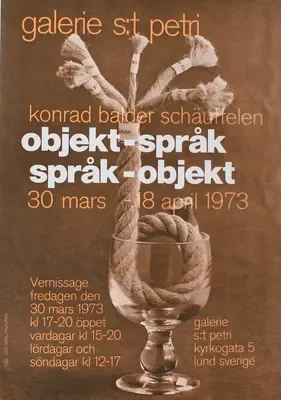
KONRAD BALDER SCHÄUFFELENOBJEKT SPRÅK SPRÅK-OBJEKT30.03 - 8.04.1973
Galerie S:t Petri S:t Petri Kyrkogata 5 Lund 046/14 78 00
Object-language – language-objects is what Konrad Balder Schäuffelen calls his exhibition, which will be shown at Galerie S:t Petri, Lund, from 30 March to 18 April 1973. This is the first time that this Munich-based artist is exhibiting at all in Sweden.
Schäuffelen studied medicine and philosophy in Germany and France. Between 1966 and 1970, he worked as a psychiatrist at the Max Planck Institute for Psychiatry in Munich. He is still a practicing psychiatrist.
Schäuffelen is interested in the dual functions of words. Beyond their semantic meaning, words also have an intrinsic value as symbols. Words are not only used to clarify and explain; they are also often used with the aim of confusing and obscuring, for example, by bureaucrats and other authorities.
The exhibited language-objects are poetic images, belonging to the field between literature and visual art.
[JEANSELLEM VIEWER] — KONRAD BALDER SCHÄUFFELEN OBJEKT SPRÅK SPRÅK-OBJEKT 30.03 - 8.04.1973 — Categories: docs, visual, press — Keywords: Galerie S:t Petri, Jean Sellem, archive — Category: docs — Konrad Balder SchäuffelenOBJECT LANGUAGE — LANGUAGE OBJECTSThe language objects, which can be understood as metaphors for a utopian object language, are poetic constructions situated in the realm between literature and visual art. In this respect, they exemplify the increasing blurring of boundaries between artistic disciplines. They correspond to a conception of poetry as an active force that can be found or realised everywhere. There is nothing in the world that would be unworthy of poetry.The objects can be understood as poems in a sculptural, tangible form. This form may be filled with reflection, emotion and sensory qualities such as irony, aggression, sensitivity to surfaces, and so forth. Since these “poems” dispense with discursive linguistic coherence, and since they are read in points, across surfaces or even three-dimensionally, they are closely related to concrete and visual poetry. Beyond its semantic statement, the individual word also possesses a “substantial” meaning—that is, a meaning that lies not only in what it carries as a vehicle of meaning, but also in its existence as a sign and a signal.Since the “signs” of a language can only be discussed through another, syntactic metalanguage, their “atactic”—that is, isolated and isolating—presentation contains a critical dimension. It raises the question of the extent to which the syntax and grammar of a language represent the ideology and system of power of the society that speaks the language concerned.This includes the phenomenon of interest to psycholinguistics whereby language can illuminate circumstances, but can just as easily obscure or even entirely conceal them.Linguistic irrationality also has a depth-psychological dimension. The oral-captative aspect in particular—the mouth as the organ of both food intake and acoustic speech production—plays a role: the objects are conceived as fetishes of fetishes. — — — Category: docs — — — Category: visual — — — Category: docs — — — Category: docs — Thank you very much for sending me the book and the two posters through Robert.I should have written to you long ago to tell you how highly both Marie and I thought of your exhibition here. It was truly a very important exhibition for the gallery and received exceptionally favourable reviews in the press. It was only regrettable that things turned out so poorly for you financially.There is one more thing I would like to ask you. There were various posters and prints featuring proverbs, Christmas trees and similar motifs, which the gallery sold for 5 kronor each. I would very much like to have one of each, if possible. They are intended for the gallery’s archive, which has now become quite extensive. Could you send me one of each item that is still available? Please let me know how much this would cost.I am sending you the DM 6 for the book right away. Many heartfelt thanks for everything.Yours, — — — Category: docs — INVENTORYA. Flat parcel3 × 3 screenprints, 41.5 × 59.5 — DM 40 each1 screenprint, Zahnschema (Dental Chart), 86 × 122* — DM 803 × 3 poster-poems — DM 6 each3 sheets of concrete poetry — DM 4 eachB. Small parcelLiber catenatus (Chained Book) — DM 700When repacking, please place paper or cardboard between the book and the chain, particularly over the lettering!C. Large parcel8 copies of raus mit der sprache (Out with It) — DM 6 each10 copies of München baut (Munich Builds) — DM 2 each2 copies of Eisernes Kreuz (Iron Cross) — DM 30 each1 geschütztes Messer (Protected Knife) — DM 60Preferably suspend it from the ceiling with nylon threads.3 copies of Zettelspieß (Note Skewer) — DM 60 each1 sprechendes Buch (Talking Book) — DM 580Preferably place it on a pedestal. Keep the book slightly open by inserting a pencil or something similar so that the sound can be heard more clearly. Should the Swedish word “bok” be recorded onto the tape loop? A leather case and microphone are supplied with the recorder.1 Lektroskop — DM 250By folding the lid backwards, the case can be used as a display base.1 Glas mit Tausende (Glass with Thousands) — DM 40For installation, see the poster!1 Schäuffelens Lyrik-Ausgaben (Schäuffelen’s Poetry Editions) — DM 1801 Alexander v. Humboldt mit Sprechblase (Alexander von Humboldt with Speech Bubble) — DM 800Please arrange the condom so that it hangs neatly towards the front!!1 Leseexemplar (Reading Copy) — DM 130* Please hang horizontally! — — — Category: docs — 17 March 1973Dear Jean,The audiovisual presentation is entitled LaufenderLauf [Running Run]. You must stretch the tape loop—one of the two versions is better!—by carefully running it over a stand in addition to the two reels of the tape recorder. It would be wonderful if the tape loop remained intact, as I do not have a copy and producing it is difficult.You must also connect the projector’s “Dia-Pilot” control—the socket!—to the “Dia-Pilot” output on the tape recorder. That is all! The control pulse is recorded on the third track of the tape. The order of the slides does not matter. The presentation only makes sense if the tape recorder and projector are connected through the pilot control. If you do not have suitable equipment, please do not carry out the action.Enclosed is my “little philosophy.” I hope you are satisfied with it. The Swedish translation of the description of each object should be supplied to the editorial offices. It would also be good if both documents were displayed in the exhibition, particularly the explanations of the objects—including those relating to the screenprints.Also enclosed is a list of addresses to which you should send the poster. Please let me know what additional postage costs you incur.Greetings to Marie and Robert.Salut!Balder* The addresses may also prove useful to you in other respects; they belong to so-called “important people.” Please do not send anything to those crossed out in pencil, as I will write to them myself. The telephone numbers are included merely for completeness. Unless otherwise indicated, these are addresses in the Federal Republic of Germany. — — — Category: docs — — — Category: docs — Konrad Balder SchäuffelenOBJECTSYou are invited to the openingon Friday, 30 March 1973, from 5 to 8 p.m.Galerie S:t PetriS:t Petri Kyrkogata 5, LundTel. 046 / 14 78 00Exhibition opening hours:Weekdays: 3–8 p.m.Saturdays and Sundays: noon–5 p.m.The exhibition runs from 30 March to 8 April 1973.Galerie S:t Petri — — — Category: press — <p><em style="color: rgb(17, 17, 17);">KUP 3.4.73</em></p> — He Creates Images with WordsGunnar Bråhammar at the openingIf I call the German Balder Schäuffelen, who is exhibiting at Galerie S:t Petri in Lund, a word artist, people may assume that he is a writer. He is one, too, since he writes books. At the same time, however, he uses words and letters to create images. Words and letters can be used as building blocks for compositions just as readily as circles and triangles, or apples and pears. Schäuffelen can therefore also be described as a word artist within the visual arts.Schäuffelen has entitled his collection of curious and amusing objects and printed sheets Object Language, Language Objects. Words appear in all of them, although they cannot always be deciphered. Schäuffelen, who studied both medicine and philosophy, enjoys playing with letters. He distrusts words, which can so easily appear objective, create confusion and conceal the truth.He also distrusts words when they are used in scientific and literary contexts. One example is the object Alexander von Humboldt with Speech Bubble. The artist took a small statuette of the famous German naturalist and provided it with a speech bubble: a condom pulled over poor Humboldt’s head. Into it, the scientist can vomit his entire torrent of words. The condom is bursting with tiny letters.He treats the words of famous authors in a similar way, for example in Schäuffelen’s Poetry Editions. Poems by six famous authors have been bottled in apothecary jars. The poems’ letters were made from dough and placed in separate jars. All the words are there, but they remain inaccessible without the right keys.“The idea is not new. I need only recall Carl Fredrik Reuterswärd, who, a few years ago, ground up the Swedish Academy’s word list and baked a loaf of bread from it. That loaf contained our language.” — — — Category: press — <p>ARB 5.4.73</p> — German Exhibitor at Galerie S:t PetriAn example of Konrad Schäuffelen’s “language objects”: Iron Cross.LUND: Object Language – Language Objects is the title Konrad Balder Schäuffelen has given to his exhibition currently on view at Galerie S:t Petri in Lund. This is the first time the Munich-based artist has ever exhibited in Sweden.Schäuffelen studied medicine and philosophy in Germany and France.Between 1966 and 1970, he worked as a psychiatrist at the Max Planck Institute of Psychiatry in Munich. He continues to practise as a psychiatrist.At Galerie S:t Petri, he is showing “language objects”—poetic images situated in the territory between literature and the visual arts.Schäuffelen is interested in the dual functions of words. — — — Category: press — <p><em style="color: rgb(17, 17, 17);">SDS 30.3.73</em></p> — “Paper Spear”“Paper Spear” is the name of this work by the German artist Konrad Balder Schäuffelen. In the programme accompanying his exhibition at Galerie S:t Petri in Lund, these 2,000 impaled sheets are described as follows:“Figurative poems, each in its own cut and stacked volume of poetry.”Opening today. — — — Category: docs — Galerie S:t Petri, Lund, SwedenOBJECT LANGUAGELANGUAGE OBJECTSbyKonrad Balder Schäuffelen30 March – 18 April 1973“Lettroskop”Kaleidoscope with alphabet. A revolving book for a presentation from A to Z. A spectacle turned from A to B. By examining words (concepts), one causes them, as they appear, to dissolve into boundless ornamentation. An instrument for seeing through things. An instrument of distortion and inversion.edition MAT, Cologne, collection 69“Iron Cross”Christmas pastry in a medal case.Ingredients:4 large eggs500 grams of sugar500 grams of No. 00 floura knife-tip of baker’s ammoniaThe model: for dismemberment in the trench; the decoration: to induce him to take part; the cross: for its emetic effect.In production since 1966.“Glass with a Piece of Rope”Wine glass with the strands of a rope end separated, like a German sentence split apart—hence the writing cuffs. The innermost nature of the rope is laid bare; is the same true of the sentence?In production since 1967.“Talking Book”Not a reader. A book that comes to meet you. A book that knows what it wants. An object that describes itself as tautological.Published by Rudolf Rieser, Cologne, 1970. Nine copies. — “Paper Spear”Figurative poems, each one in the eye: poetry sheets, cut out and stacked.Spear height: 19 cm, with approximately 2,000 sheets. 1969.“Schäuffelen’s Poetry Editions”Great poetry republished and literally bottled. Six bottles, each containing a famous poem in letters made of dough; letters, after all, are the smallest linguistic elements.edition MAT, Cologne, collection 70“Liber catenatus”Conradi Balderi Faliculae Liber catenatus, commonly known as the Chain Book.3 volumes, Munich, 1970.“Alexander von Humboldt with Speech Bubble”And inside it, the entire scientific-literary ejaculation!“Not for Home Loan”Chained book. What might possibly be written in it?Original work, 1967.“Knife in the Side”—the art of having a knife at hand—The concealed knife as an example of an action object. As long as it remains covered, it is “inscrutable”; if what conceals it is removed, it must literally be taken in hand. Its form is hidden behind the words—in this case, behind a collection of ideologically and emotionally charged word fragments taken from a supposedly objective magazine (Der Spiegel).The knife is a difficult responsibility to manage. It can be hung up, but even that carries risks. The knife, which slowly but surely emerges again, can nevertheless later be returned to the kitchen. — — — Category: visual — — — Category: visual