

PRESS RELEASE
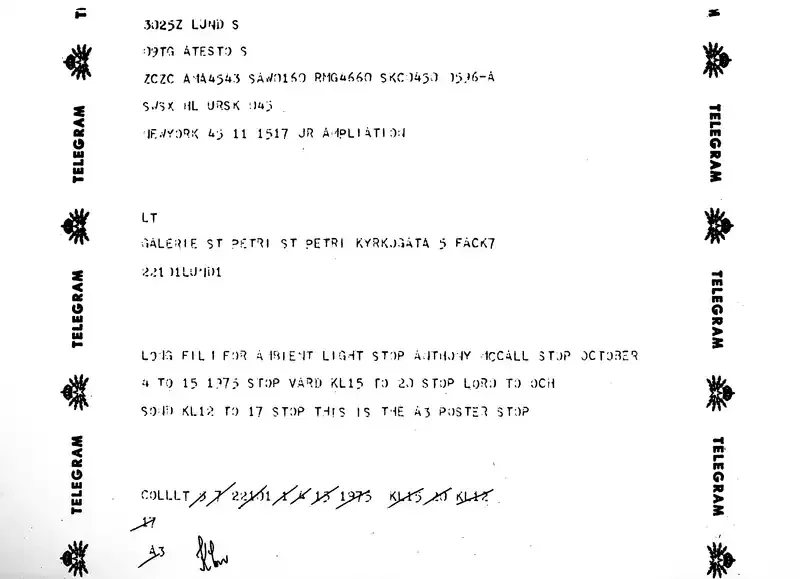
ANTHONY MACCALLLONG FILM FOR AMBIENT LIGHT04.10-15.10.1975
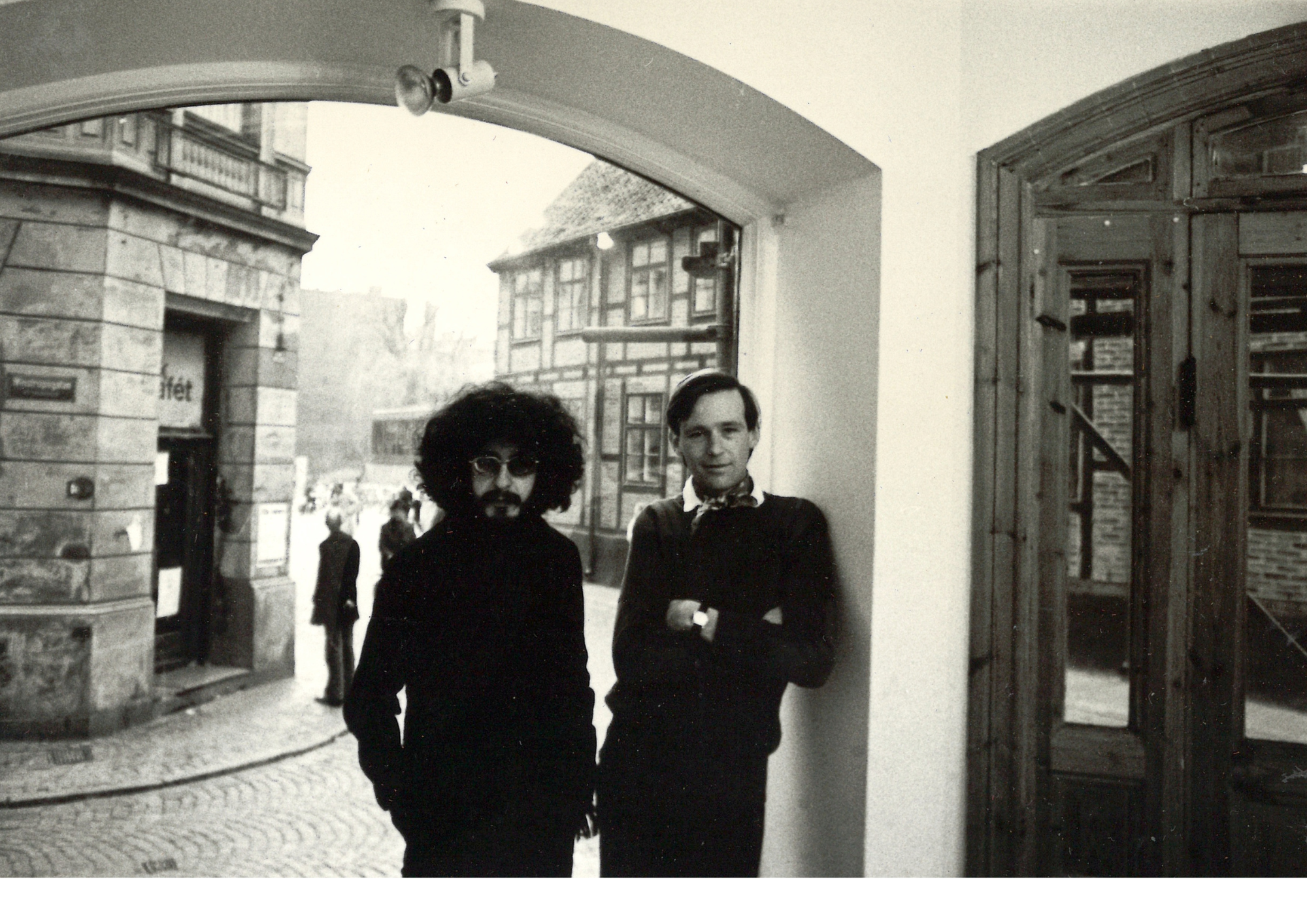
Jean Sellem and Anthony McCall, Lund, 1975. Courtesy Anthony McCall.
“Long Film for Ambient Light” by the Englishman Anthony McCall is not a film intended to be seen on a film screen. It is rather a demonstration and is perceived above all purely intellectually.
The film is shown at Galerie S:t Petri, Lund, from 4–15 October 1975. It consists of three parts: the artist’s statement, a time schedule, and an “unchangeable” room — the windows are covered with white paper and an incandescent bulb hangs down from the middle of the ceiling. The exhibition is open between 3 p.m. and 8 p.m. — from daylight, twilight, to darkness. It is then that the relation between the two light sources changes the most. The electric light is constantly switched on.
“Long Film for Ambient Light” is Anthony McCall’s ninth film. It recalls the earlier ones insofar as it points to experiences of changes in time. What distinguishes it from the others is that it does not use projector and celluloid.
Anthony McCall says, among other things: “Everything that happens, including the electrochemical thought processes, happens in time. A piece of paper on the wall is just as much duration as a film projector. The only difference lies in the latter’s immediate connection with our sensory perceptions.”
The earlier film presentations have taken place before a limited audience. “Long Film for Ambient Light” is McCall’s first attempt to get away from the “performance” aspect. He is more interested in investigating other basic principles such as temporality, light. For the first time he concentrates less on the physical process and more on the possibilities behind film as constative activity.
Anthony McCall is currently taking part in the Paris Biennale, where he is showing three films. This spring he exhibited in Malmö Konsthall’s invitational exhibition “New Media”. In England and the USA too, he has carried out various artistic activities.
ANTHONY MACCALLLONG FILM FOR AMBIENT LIGHT04.10-15.10.1975
Jean Sellem and Anthony McCall, Lund, 1975. Courtesy Anthony McCall.
« Long Film for Ambient Light » de l’Anglais Anthony McCall n’est pas un film destiné à être vu sur un écran de cinéma. C’est plutôt une démonstration et il est perçu avant tout de manière purement intellectuelle.
Le film est présenté à la Galerie S:t Petri, Lund, du 4 au 15 octobre 1975. Il se compose de trois parties : la déclaration de l’artiste, un horaire, et un espace « inchangeable » — les fenêtres sont couvertes de papier blanc et une ampoule à incandescence est suspendue au milieu du plafond. L’exposition est ouverte entre 15 heures et 20 heures — de la lumière du jour, du crépuscule, jusqu’à l’obscurité. C’est alors que la relation entre les deux sources lumineuses change le plus. La lumière électrique est constamment allumée.
« Long Film for Ambient Light » est le neuvième film d’Anthony McCall. Il rappelle les précédents dans la mesure où il renvoie à des expériences de changements dans le temps. Ce qui le distingue des autres est qu’il n’emploie ni projecteur ni celluloïd.
Anthony McCall dit entre autres : « Tout ce qui arrive, y compris les processus de pensée électrochimiques, arrive dans le temps. Un morceau de papier sur le mur est autant de la durée qu’un projecteur de film. La seule différence réside dans le lien immédiat de ce dernier avec nos perceptions sensorielles. »
Les précédentes présentations de films ont eu lieu devant un public limité. « Long Film for Ambient Light » est la première tentative de McCall de s’éloigner de l’aspect de « représentation ». Il est davantage intéressé par l’examen d’autres principes fondamentaux tels que la temporalité, la lumière. Pour la première fois, il se concentre moins sur le processus physique et davantage sur les possibilités derrière le film comme activité constative.
Anthony McCall participe actuellement à la Biennale de Paris, où il présente trois films. Ce printemps, il a exposé à l’exposition sur invitation « New Media » de la Malmö Konsthall. En Angleterre et aux USA également, il a mené diverses activités artistiques.
ANTHONY MACCALLLONG FILM FOR AMBIENT LIGHT04.10-15.10.1975
Jean Sellem and Anthony McCall, Lund, 1975. Courtesy Anthony McCall.
„Long Film for Ambient Light“ des Engländers Anthony McCall ist kein Film, der dafür bestimmt ist, auf einer Filmleinwand gesehen zu werden. Er ist eher eine Demonstration und wird vor allem rein intellektuell aufgefasst.
Der Film wird in der Galerie S:t Petri, Lund, vom 4. bis 15. Oktober 1975 gezeigt. Er besteht aus drei Teilen: der Aussage des Künstlers, einem Zeitplan und einem „unveränderlichen“ Raum — die Fenster sind mit weißem Papier bedeckt und eine Glühbirne hängt von der Mitte der Decke herab. Die Ausstellung ist zwischen 15 und 20 Uhr geöffnet — vom Tageslicht, über die Dämmerung, bis zur Dunkelheit. Dann verändert sich die Beziehung zwischen den beiden Lichtquellen am stärksten. Das elektrische Licht ist ständig eingeschaltet.
„Long Film for Ambient Light“ ist Anthony McCalls neunter Film. Er erinnert insofern an die früheren, als er auf Erfahrungen von Veränderungen in der Zeit verweist. Was ihn von den übrigen unterscheidet, ist, dass er keinen Projektor und kein Zelluloid verwendet.
Anthony McCall sagt unter anderem: „Alles, was geschieht, einschließlich der elektrochemischen Denkprozesse, geschieht in der Zeit. Ein Stück Papier an der Wand ist ebenso sehr Dauer wie ein Filmprojektor. Der einzige Unterschied liegt in der unmittelbaren Verbindung des letzteren mit unseren Sinneswahrnehmungen.“
Die früheren Filmpräsentationen haben vor einem begrenzten Publikum stattgefunden. „Long Film for Ambient Light“ ist McCalls erster Versuch, vom „Vorstellungs“-Aspekt wegzukommen. Er ist mehr daran interessiert, andere Grundprinzipien wie Zeitlichkeit, Licht zu untersuchen. Zum ersten Mal konzentriert er sich weniger auf den physischen Prozess und mehr auf die Möglichkeiten hinter dem Film als konstativer Tätigkeit.
Anthony McCall nimmt zurzeit an der Pariser Biennale teil, wo er drei Filme zeigt. Im Frühjahr stellte er in der Einladungsausstellung „New Media“ der Malmö Konsthall aus. Auch in England und den USA hat er verschiedene künstlerische Aktivitäten durchgeführt.
