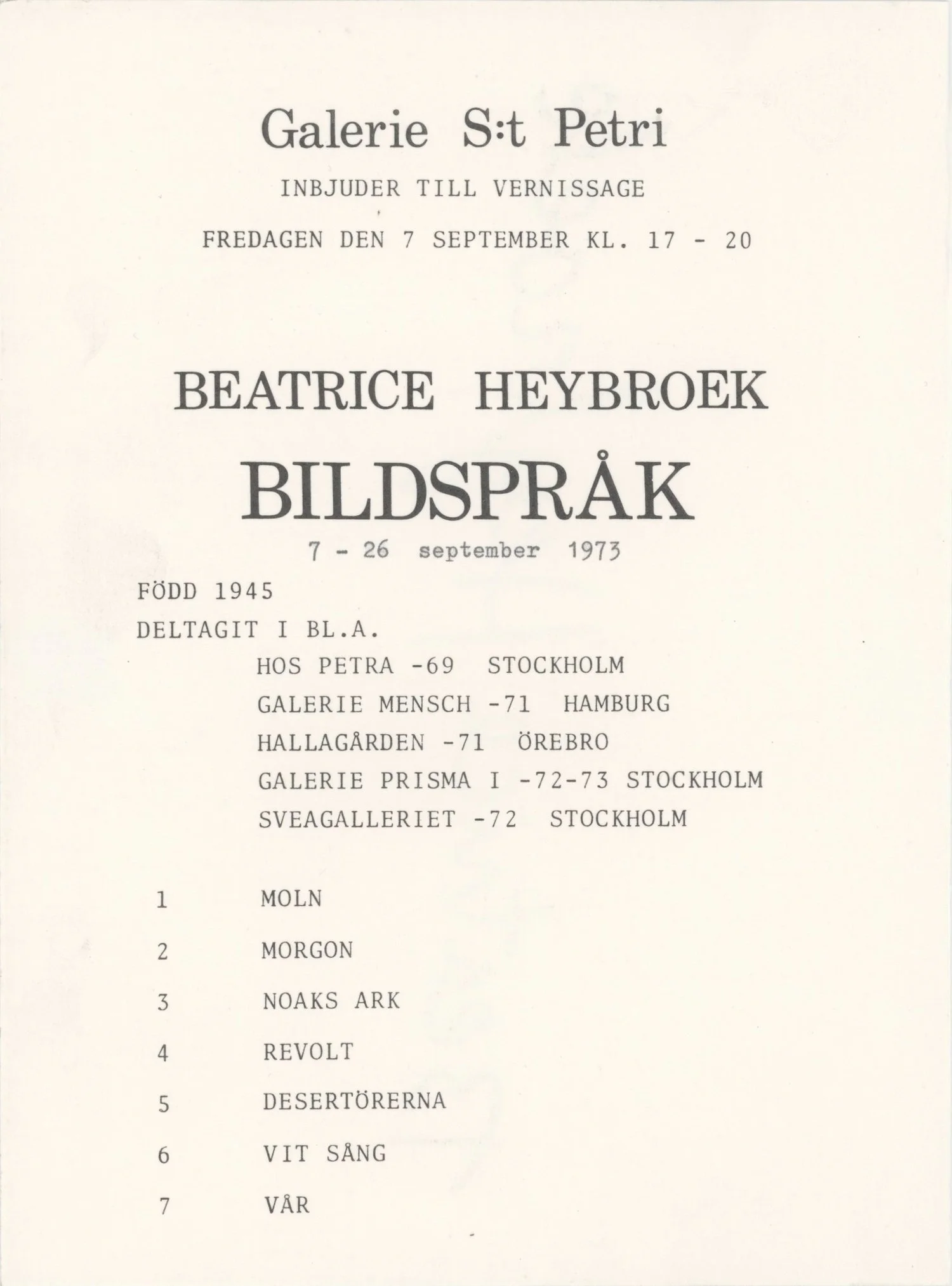
Beatrice Heybroek from Stockholm is exhibiting at Galerie S:t Petri from 7 to 26 September 1973.
She believes that there are two kinds of art: art that enriches people, giving them new perspectives and experiences, and art that deceives them. In her visual language, the world around us is reflected in both large and small things, together with the negative and positive experiences we encounter in life.
The positive is represented by the sky, clouds and sun, because everyone shares in these elements and no one can take them away from us. Negative human oppression is illustrated, for example, by a person locked in the grey corner of a room, shouting “Faen”.
Beatrice Heybroek says:
“To work with art is to work for peace and against oppression.”
Beatrice Heybroek, de Stockholm, expose à la Galerie S:t Petri du 7 au 26 septembre 1973.
Elle considère qu’il existe deux sortes d’art : un art qui enrichit l’être humain, lui apporte de nouvelles perspectives et de nouvelles expériences, et un art qui le trompe. Dans son langage visuel se reflète le monde qui nous entoure, dans ses grands comme dans ses petits aspects, ainsi que les expériences négatives et positives que nous rencontrons dans la vie.
Le positif est représenté par le ciel, les nuages et le soleil, car tous les êtres humains ont part à ces éléments et personne ne peut nous les enlever. L’oppression humaine, négative, est illustrée, par exemple, par une personne enfermée dans le coin gris d’une pièce et criant « Faen ».
Beatrice Heybroek déclare :
« Travailler avec l’art, c’est travailler pour la paix et contre l’oppression. »
Beatrice Heybroek aus Stockholm stellt vom 7. bis 26. September 1973 in der Galerie S:t Petri aus.
Sie ist der Ansicht, dass es zwei Arten von Kunst gibt: Kunst, die den Menschen bereichert, ihm neue Perspektiven und Erfahrungen eröffnet, und Kunst, die ihn täuscht. In ihrer Bildsprache spiegelt sich die Welt um uns herum im Großen wie im Kleinen wider, ebenso die negativen und positiven Erfahrungen, denen wir im Leben begegnen.
Das Positive wird durch Himmel, Wolken und Sonne dargestellt, denn an diesen Elementen haben alle Menschen teil, und niemand kann sie uns nehmen. Die negative menschliche Unterdrückung wird zum Beispiel durch einen Menschen veranschaulicht, der in der grauen Ecke eines Raumes eingeschlossen ist und „Faen“ schreit.
Beatrice Heybroek sagt:
„Mit Kunst zu arbeiten heißt, für den Frieden und gegen Unterdrückung zu arbeiten.“
[JEANSELLEM VIEWER] — BEATRICE HEYBROEK BILDSPRÅK 07 - 26.09.1973 — Categories: press, docs, visual — Keywords: Galerie S:t Petri, Jean Sellem, archive — Category: press — <p>SDS 7.9.73</p> — OpeningsMalmöGalerie Gustaf, Regementsgatan 94, 4–8 p.m.Gerhard F. Scholz.LundGalerie S:t Petri, S:t Petri Kyrkogata 5, 5–8 p.m.Visual Language. Beatrice Heybroek. — — — Category: press — <p><em style="color: rgb(17, 17, 17);">22.09.1973</em></p> — Beatrice Heybroek’s paintings possess a certain kind of awkwardness.GALERIE S:T PETRI, S:t Petri Kyrkogata 5, open Monday–Friday 3–8 p.m., Saturday and Sunday 12–5 p.m.There is a certain kind of awkwardness in Beatrice Heybroek’s paintings and objects which, of course, is anything but accidental or unintended. It seems simply to reflect and draw attention to an even greater awkwardness all around us.She possesses a very particular sensitivity which, as an artistic expression, is not especially easy to approach. Yet, curiously, this hardly seems to prevent an intuitive response to her work. Somehow, what she shows seems familiar, not at all unknown.Wednesday is the final day. — — — Category: press — <p><em style="color: rgb(17, 17, 17);">SDS 18.09.73</em></p> — Beatrice Heybroek, exhibiting at Galerie S:t Petri, makes naïve-looking, perhaps even genuinely naïve collages. Childhood is not idealised here in the usual banal way of adults.A lack of experience makes a child’s existence and perceptions different from those of an adult. Nevertheless, they are entirely natural in relation to the child’s own circumstances. Beatrice Heybroek depicts what is natural to the child in a natural way. Her images may be slightly too accomplished, but they are not contrived. — — — Category: press — <p>ARBETET 15.9.73</p> — Young Artist Exhibits in LundLUND: Beatrice Heybroek from Stockholm is currently exhibiting at Galerie S:t Petri in Lund. This is her first exhibition in Lund. She is showing around 25 works.Beatrice Heybroek was born in 1945. She has previously exhibited at Petri, Stockholm, in 1969; Galerie Mensch, Hamburg, in 1971; Hallagården, Örebro, in 1971; Galerie Prisma I, Stockholm, in 1972–73; and Sveagalleriet, Stockholm, in 1972.This is how Galerie S:t Petri presents Beatrice Heybroek and her work:— She believes that there are two kinds of art: art that enriches people, giving them new perspectives and experiences, and art that deceives them.— In her visual language, the world around us is reflected in both large and small things, in the negative and positive experiences we encounter in life.— The positive is represented by the sky, clouds and sun. Negative human oppression is illustrated, for example, by a person locked in the grey corner of a room, shouting “Faen”. — — — Category: press — <p><em style="color: rgb(17, 17, 17);">SKD 7.9.73</em></p> — Peace in a Peep Box“To work with art is to work for peace and against oppression,” says Beatrice Heybroek.Today, Friday, is the opening at Galerie S:t Petri in Lund. Beatrice Heybroek from Stockholm is exhibiting there until 26 September.She believes that there are two kinds of art: art that enriches people, giving them new perspectives and experiences, and art that deceives them. In her visual language, the world around us is reflected in both large and small things, together with the negative and positive experiences we encounter in life.The positive is represented by the sky, clouds and sun, because everyone shares in these elements and no one can take them away from us. Negative human oppression is illustrated, for example, by a person locked in the grey corner of a room, shouting “Faen”.Beatrice Heybroek says:“To work with art is to work for peace and against oppression.”This is what Bengt af Klintberg says about her:“In her pictures she places an extraordinary trust in you. It is like when you were a child and a friend took you by the hand and let you come along to discover a wonderful secret. There is a breathless feeling of peering into a little viewing box. I know few artists who possess such poetic sensitivity as Beatrice Heybroek.” — — — Category: press — <p>HELSINGBORGS DAGBLAD 21.9.73</p> — S:t PetriGalerie S:t Petri, next to the City Library in Lund, is always enjoyable to visit. This is above all thanks to Jean Sellem. With him, one encounters a constantly lively interest in young art. This interest is reflected both in his choice of exhibitors and in the information from Sweden and abroad that he makes available. Most recently, this concerned an artists’ group in Bergen and another in Iceland, both apparently fully abreast of the latest contemporary tendencies.The current exhibitor is Beatrice Heybroek from Stockholm. Under the title Bildspråk [Visual Language], she presents highly individual reliefs made of plaster, plastic and collage.These include a bedspread with a built-in music box, Moln [Cloud], a Huvudkudde [Pillow] in the form of a frog with a sound mechanism, and a Väska [Bag] with birds and soldiers.The little boy in the picture beside the article is actually placed in a recess in the wall of the house, which very effectively conveys his smallness and sense of being lost.The artist quite simply declares her willingness to exchange her art for objects of various kinds. There is something rather appealing about this. — — — Category: docs — BEATRICE HEYBROEKIn her paintings, she places an extraordinary trust in you. It is like when you were a child and a friend took you by the hand and led you to discover a wonderful secret. There is a breathless, peep-box-like feeling to it. I know few artists with such poetic sensitivity as Beatrice Heybroek. She has a quiet, persistent faith in poetry and in people’s ability to meet there, without artifice and without ulterior motives.In her work there is a kind of delight in dolls, miniature animals and old fabric patterns. Yet it soon becomes clear that she is not trying to evoke nostalgia or depict an idyll. The events of our time are constantly present; beneath the apparent idyll vibrates a powerful sense of threat. Without ever becoming loud or rhetorical, Beatrice Heybroek finds images for an insecurity that is not private but global.The broad protective frames or enclosing walls around the images already suggest that they are concerned with security and insecurity. There is a fruitful tension in the arrangement itself: at times the figures seem imprisoned, while at other times they appear to be protecting themselves from a threat coming from outside. Here, security means freedom from oppression, the grass’s freedom to grow. To me, Beatrice’s paintings are about the paradoxical power of softness and sensitivity to overcome oppression.I remember when I attended Norra Real and discovered cracks everywhere in the asphalt schoolyard. They were caused by small, round white mushrooms bursting through the black-grey asphalt with the force of their growth.Security and freedom come together in the images of nature, sky and birds. The green ground and rolling clouds are states of mind rather than an external reality; they form part of an immense cosmic pulse or breath. There is a secret understanding between animals and human beings. Lions and angels watch over sleeping people.And above all, poetry is indomitable: flowers caught in a rain of red threads just as they are about to flutter away. One of the pictures contains a music box that you can wind. In another, almost real wild-strawberry plants are growing. In a third, you see the ground rise and fall and hear it snore — yes, really! These are small surprises, placed there to make you happy.Bengt af Klintberg — — — Category: docs — — — Category: visual — — — Category: visual — — — Category: visual