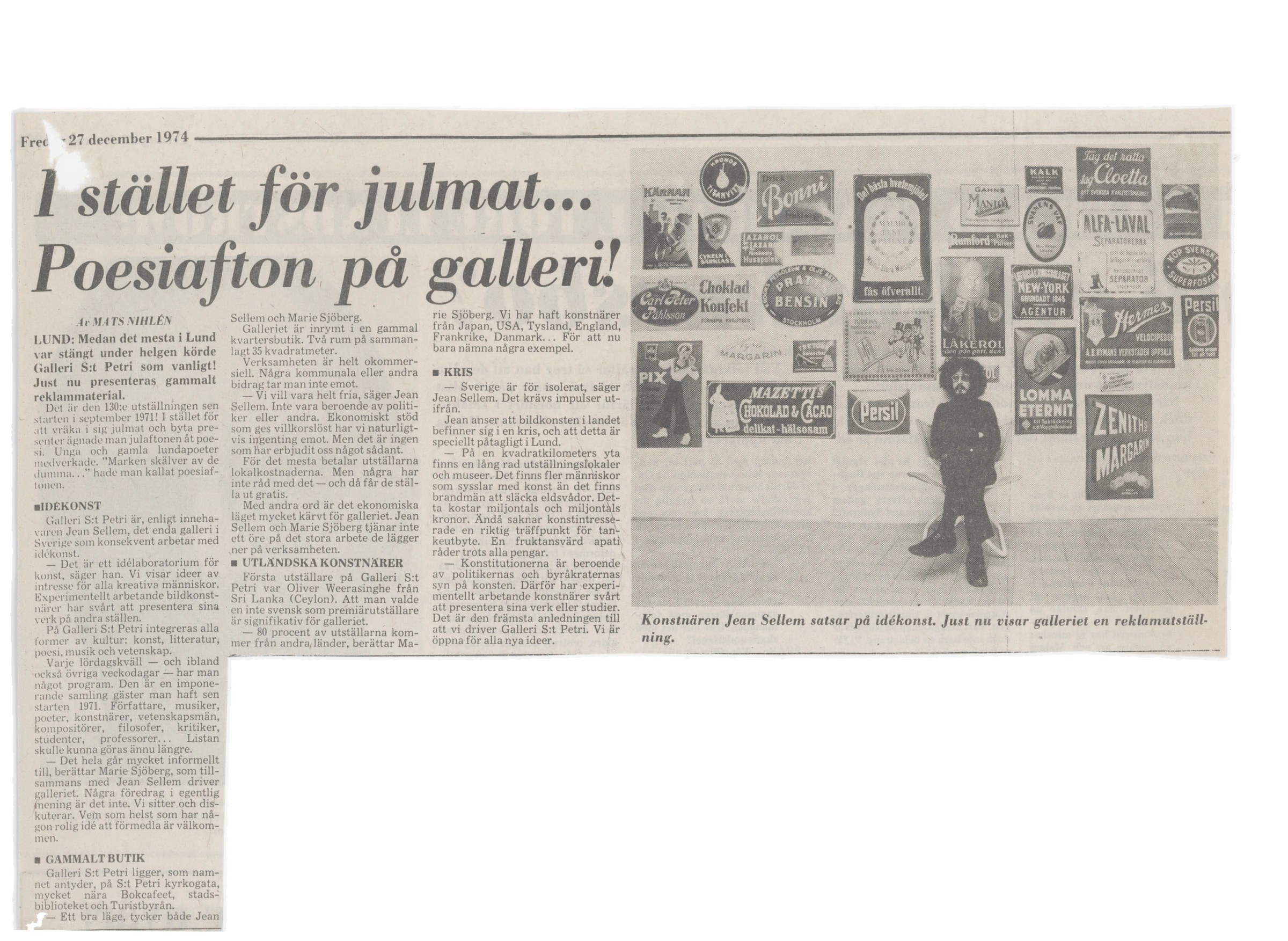
[JEANSELLEM VIEWER] — OLLE NESSLE GAMLA REKLAMGREJER 21.12.1974-08.01.1975 — Categories: docs, visual, press — Keywords: Galerie S:t Petri, Jean Sellem, archive — Category: docs — On 21 December at 12 noon, an exhibition opens at Galerie S:t Petri in Lund entitled “Epitaphs of Industrialism”, or more simply, “Old Advertising Stuff”. The exhibitor is Olle Nessle, formerly an advertising man and now working as an art teacher in Skurup.Since 1969 he has collected old advertising material, mainly enamel advertising signs, but also other signs, labels, packaging and quite a number of advertisements.One aim of the exhibition is to shed light on some of the concepts and methods of advertising from a historical perspective. Although more recent advertising is more sophisticated in its design and therefore more difficult to see through, its arguments and morality are essentially the same.Although the relatively limited material cannot provide a broad overview of different arguments and methods, the exhibition may nevertheless offer some insight into how advertising works. The fact that most of the material dates from before the 1960s makes the analyses simpler and the images clearer. The exhibition cannot claim to present a comprehensive “history of advertising”. There are too few works for that, and the lack of research and factual information is overwhelming. Olle Nessle is therefore very interested in getting in touch with anyone who has comments or material concerning the history of our most widely disseminated messages.On Saturday, 21 December, at 6 p.m., Olle Nessle will talk about his collection.The exhibition is open throughout the Christmas and New Year holidays until 8 January 1975, weekdays from 3–8 p.m., holidays from 12–5 p.m. — — — Category: docs — — — Category: docs — — — Category: visual — — — Category: visual — — — Category: press — — — Category: press — From the rubbish dump to the art galleryBy Ulf R JohanssonSKURUP (KvP) Finds — yes, he makes them in old country shops, at auctions or at rubbish dumps!Olle Nessle, a drawing teacher in Skurup, is passionate about collecting old advertising objects. Preferably they should be classic enamel signs featuring Pellerin’s margarine, the Pix boy in action, Lazarol and Lazarin slogans, the White Washing Bear, and so on.Today Nessle opens an exhibition in Lund with his advertising memorabilia — an exhibition that is not only about nostalgia...Olle Nessle does not collect old advertising signs made of enamel, cardboard, etc. merely for nostalgic reasons. He has a background of his own in the advertising business, but left it in order to retrain as a drawing teacher instead.His passion for collecting really took off in 1969, and now he is ready to exhibit:— One purpose of the exhibition is to look at advertising historically. Even if more recent advertising is more sophisticated and therefore harder to see through, the arguments — and the morality! — are basically the same, he says. But people were also more straightforward, more innocent, in the old days!— At first I collected these things more as a bit of fun. But then I discovered what an important role these images had played. They shaped visual ideals; often it was unsuccessful artists who supplied the pictures and the copywriting.Collecting old advertising slogans from country shops and the like is beginning to become fashionable. Olle is, for example, happy to exchange new finds with his friend Lasse Åberg (Ardy Strüwer’s colleague in the milk advertisements, you know!) and has also already donated a large part of the collection to the Nordic Museum:— But museums collect such things only to a limited extent, says Olle Nessle. Museums cannot even exchange objects with me, even if, for example, they have duplicates.It certainly is a remarkable collection that Olle Nessle has. Did you know, for example, that advertising once placed great emphasis on Swedishness? Here are a few examples:“Swedish winds are blowing. Wash clean in Swedish fashion.”“Buy Swedish — superphosphate!”“Kärnan — solid Swedish manufacture.”Today we consider ourselves too sophisticated simply to appeal to the blue-and-yellow national colours. We even allow ourselves to buy multinational products! At the same time, most racially coloured advertisements have completely disappeared.In the past, a supposedly scientific tone was also used quite frequently in advertisements.“It is the activation that makes Meditol the ideal lozenge,” one might read, for example. But that was not all.“Now, Daddy, you are as happy as before — and Mother was right when she said you should drink Biomin.”Today advertising makers are very cautious about using children in advertisements. In the old days, little Eva was even “bullied” in Radion advertisements because her nightdress was not as white as those of the other children![Footnote]Olle Nessle’s exhibition opens today at Galerie S:t Petri in Lund and remains open until 8 January next year.[Caption]In the past, advertising makers often emphasised buying Swedish — especially during the difficult years of crisis.[Caption]Olle Nessle has an unusual hobby: he collects old advertising signs. Tomorrow the first exhibition in Sweden of his objects opens in Lund. (Photo: Leif Å Andersson)[Caption]This is how small children could be “bullied” in the good old days of advertising — Eva’s nightdress is not as white as those of the other children! — — — Category: press — <p>[Caption]</p><p>Olle Nessle, the exhibitor, has been collecting advertising objects since 1969 and is himself a former advertising man.</p> — 22 December 1974Old AdvertisingSince 1969, Olle Nessle has collected advertising material, mainly enamel signs but also labels, packaging and advertisements. He is now exhibiting his objects at Galerie S:t Petri in Lund.The exhibition is entitled “Epitaphs of Industrialism”, but it is also called “Old Advertising Stuff”. The latter is simpler as a message. Olle Nessle, who is himself a former advertising man, is certainly aware of that. He now works as a drawing teacher in Skurup.One aim of the exhibition is to highlight some of the concepts and methods of advertising from a historical perspective. Although more recent advertising is more sophisticated in its design and therefore more difficult to see through, its arguments and morality are essentially the same, according to the exhibitor.The exhibition does not claim to present a fully developed “history of advertising”. There are too few exhibits for that, and the lack of research and factual information is too great. Olle Nessle would therefore like to get in touch with anyone who has opinions or material relating to the history of our most widely disseminated message.The exhibition is open throughout the Christmas and New Year holidays until 8 January. — — — Category: press — <p>[Caption]</p><p>The artist Jean Sellem is committed to idea art. At present the gallery is showing an exhibition of advertising material.</p> — 27.12.1974Instead of Christmas food... Poetry evening at the gallery!By MATS NIHLÉNLUND: While most of Lund was closed over the holiday, Galerie S:t Petri carried on as usual! At present, old advertising material is being shown.This is the 130th exhibition since the gallery opened in September 1971! Instead of stuffing themselves with Christmas food and exchanging presents, Christmas Eve was devoted to poetry. Young and old poets from Lund took part. “The ground trembles because of the stupid...” was the title given to the poetry evening.IDEA ARTAccording to its owner, Jean Sellem, Galerie S:t Petri is the only gallery in Sweden that consistently works with idea art.“It is a laboratory of ideas for art,” he says. “We present ideas that are of interest to all creative people. Visual artists working experimentally have difficulty presenting their work elsewhere.”At Galerie S:t Petri, all forms of culture are integrated: art, literature, poetry, music and science.Every Saturday evening — and sometimes on other weekdays as well — there is some kind of programme. The gallery has welcomed an impressive array of guests since it opened in 1971: writers, musicians, poets, artists, scientists, composers, philosophers, critics, students, professors... The list could be made even longer.“Everything is very informal,” says Marie Sjöberg, who runs the gallery together with Jean Sellem. “They are not really lectures in the usual sense. We sit and discuss. Anyone who has an interesting idea to communicate is welcome.”AN OLD SHOPGalerie S:t Petri is located, as its name suggests, on S:t Petri Kyrkogata, very close to the Bokcafé, the city library and the tourist office.“A good location,” agree both Jean Sellem and Marie Sjöberg.The gallery occupies an old neighbourhood shop. Its two rooms have a total area of 35 square metres.The activity is entirely non-commercial. No municipal or other grants are accepted.“We want to be completely free,” says Jean Sellem. “Not dependent on politicians or anyone else. Naturally, we would have nothing against financial support given without conditions. But no one has offered us anything of that kind.”For the most part, the exhibitors pay the cost of the premises. But some cannot afford it — and in that case they are allowed to exhibit free of charge.In other words, the gallery’s financial situation is very difficult. Jean Sellem and Marie Sjöberg do not earn a penny from the considerable amount of work they put into the gallery.FOREIGN ARTISTSThe first exhibitor at Galerie S:t Petri was Oliver Weerasinghe from Sri Lanka (Ceylon). The fact that a non-Swedish artist was chosen as the inaugural exhibitor is significant for the gallery.“Eighty percent of the exhibitors come from other countries,” says Marie Sjöberg. “We have had artists from Japan, the USA, Germany, England, France, Denmark... just to mention a few examples.”CRISIS“Sweden is too isolated,” says Jean Sellem. “We need impulses from outside.”Jean believes that visual art in the country is in a state of crisis, and that this is particularly noticeable in Lund.“Within an area of one square kilometre there is a long succession of exhibition spaces and museums. There are more people involved in art than there are firefighters to put out fires. This costs millions and millions of kronor. Yet people interested in art still lack a real meeting place for exchanging ideas. A terrible apathy prevails despite all the money.”“The institutions are dependent on the politicians’ and bureaucrats’ view of art. That is why artists working experimentally have difficulty presenting their works or studies. This is the main reason why we run Galerie S:t Petri. We are open to all new ideas.”
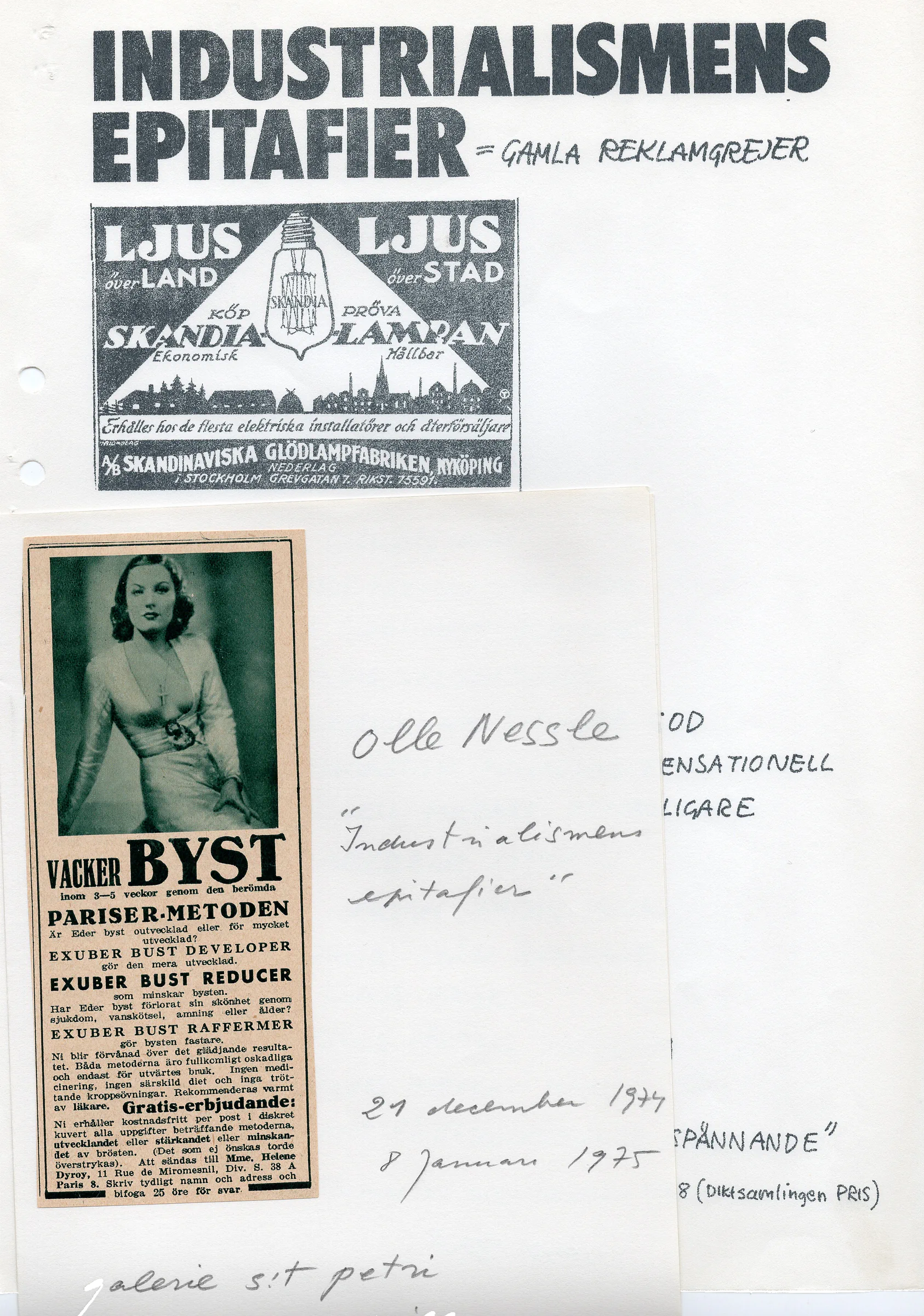
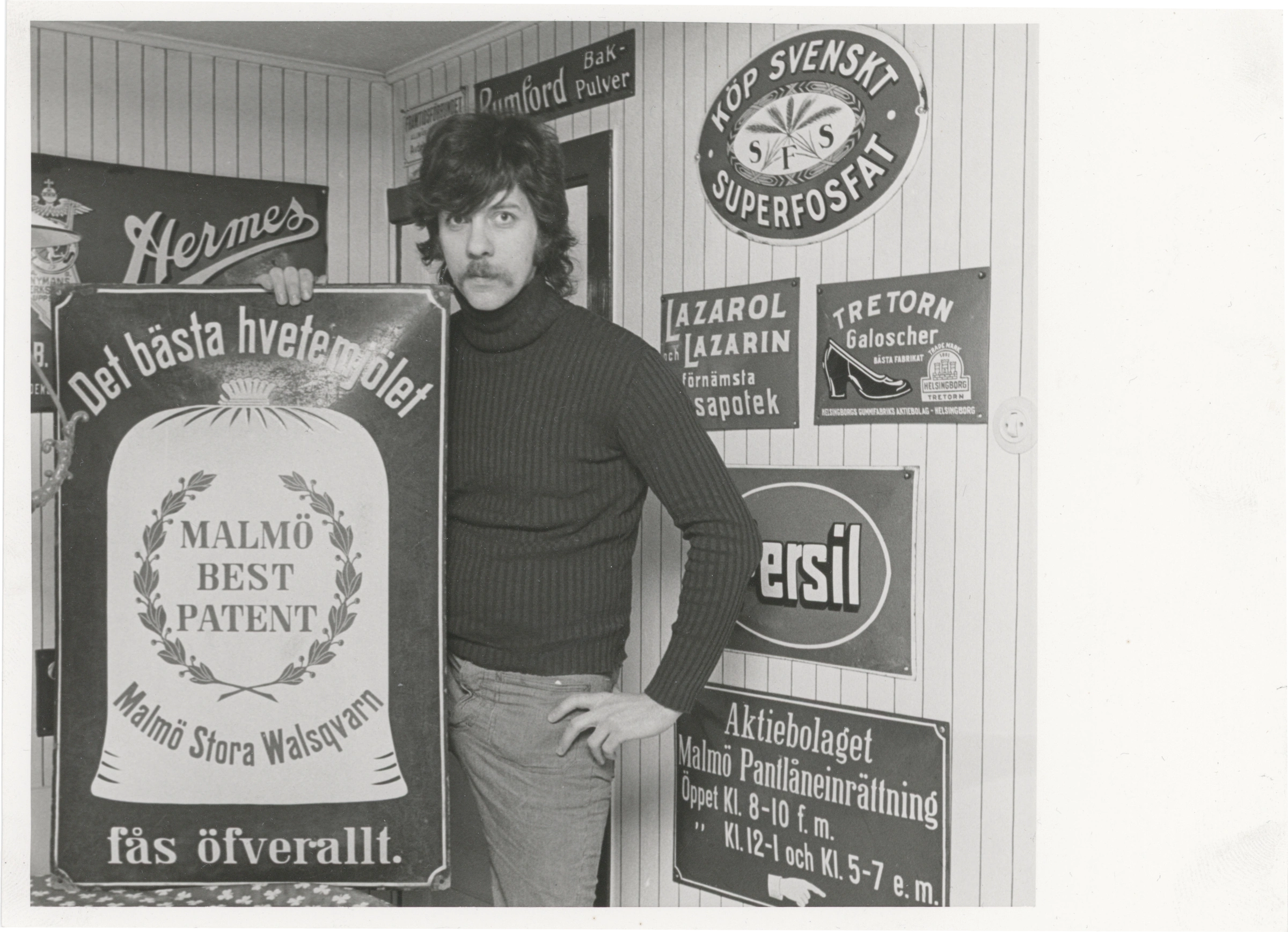
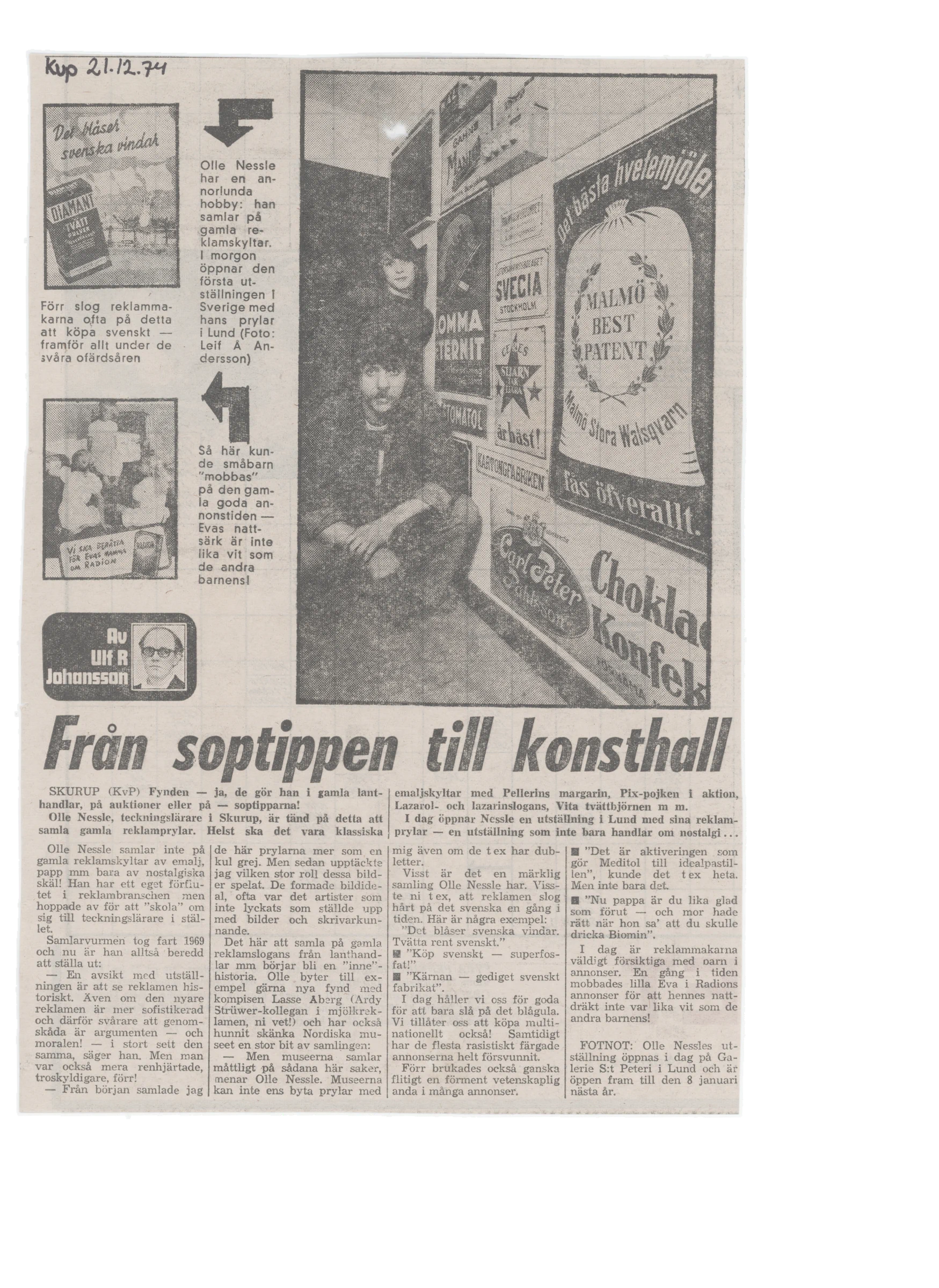
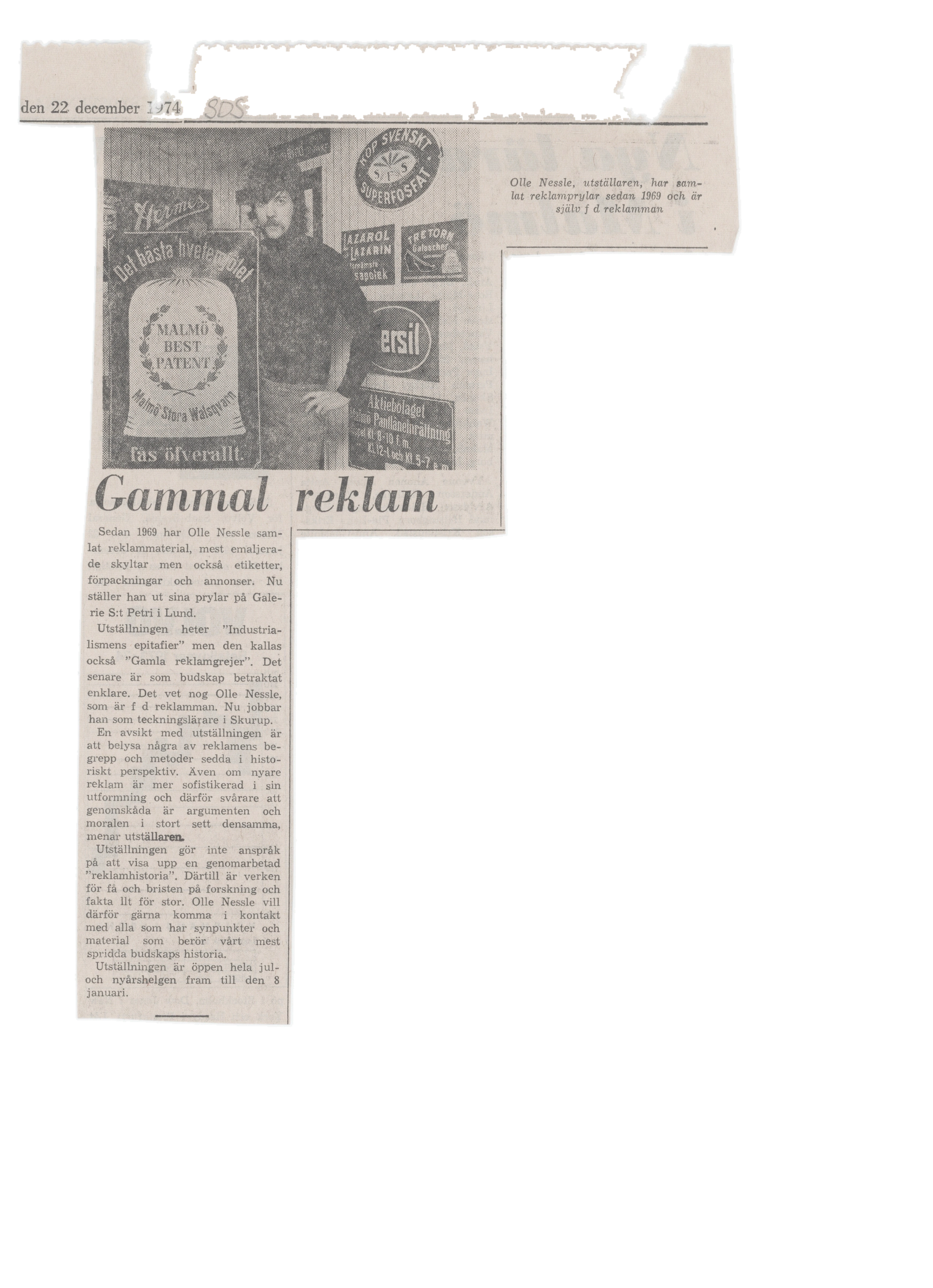
On December 21 at 12 noon, an exhibition opens at Galerie S:t Petri, Lund, entitled “Epitaphs of Industrialism,” or more simply, “Old Advertising Stuff.” The exhibitor is Olle Næssle, former advertising designer, now working as a drawing teacher in Skurup.
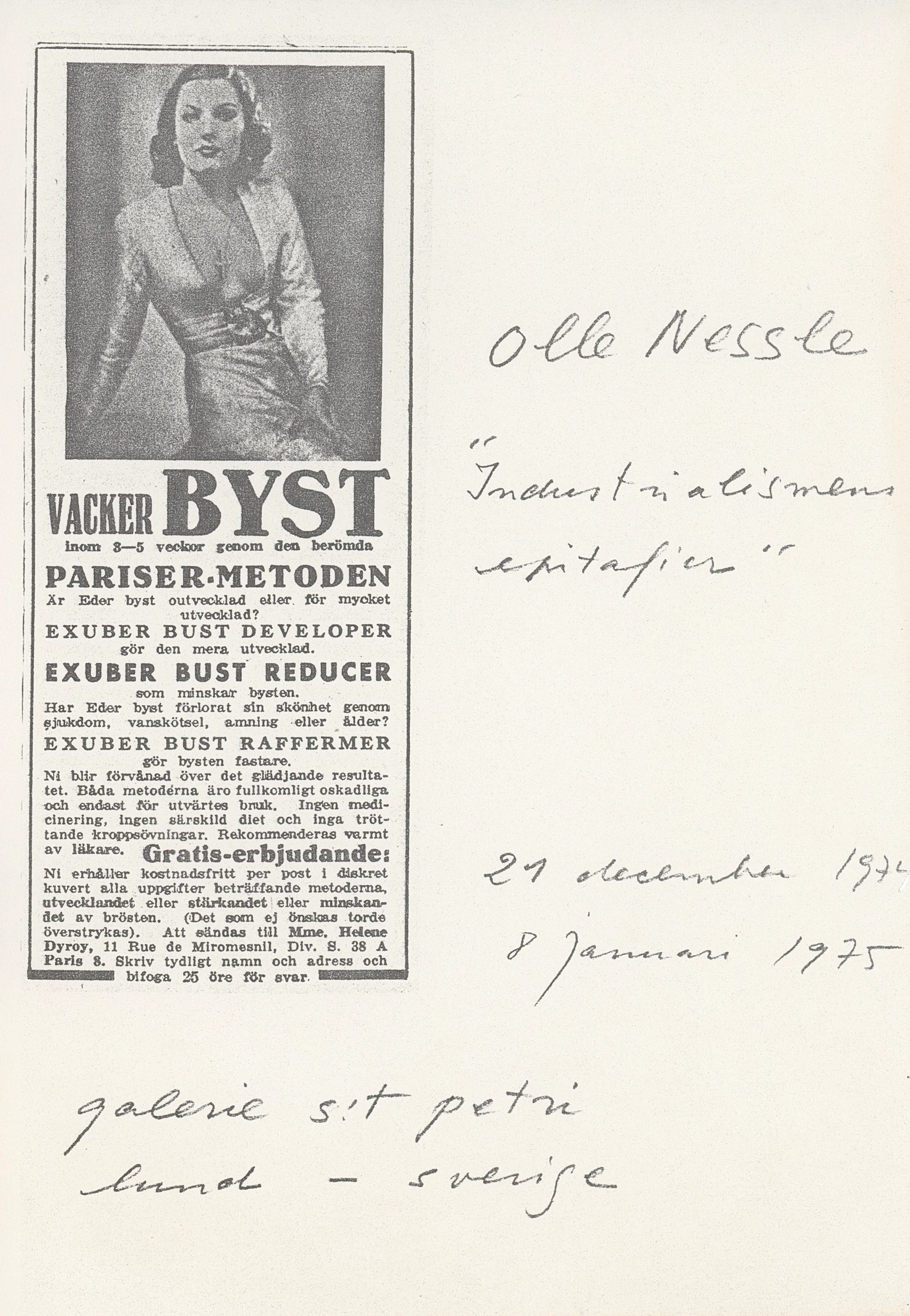
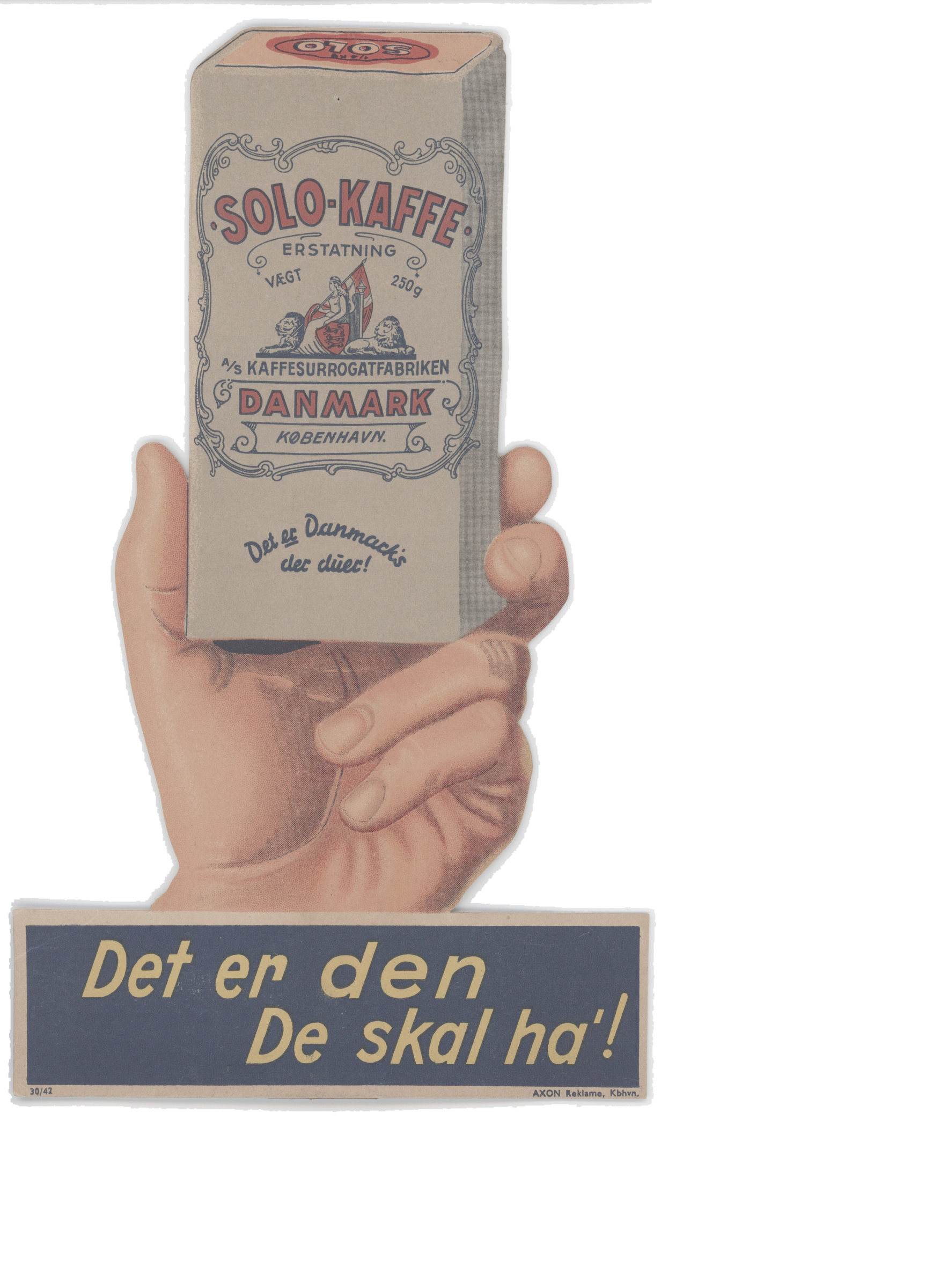
Since 1969, he has collected old advertising material — mostly enameled advertising signs, but also other types of signs, labels, packaging, and quite a few advertisements.
The purpose of the exhibition is to shed light on some of the concepts and methods of advertising, seen from a historical perspective. Even though newer advertising is more sophisticated in its design and therefore more difficult to see through, the arguments and the underlying morality are largely the same.
Although the relatively limited material cannot provide a broad overview of different arguments and methods, the exhibition may still offer some insight into the ways advertising operates. Since most of the material is from before the 1960s, the analysis becomes simpler and the images clearer. The exhibition does not claim to present a comprehensive “history of advertising.” The scarcity of works and the lack of research and factual data are striking. For that reason, Olle Næssle is very interested in getting in touch with anyone who has viewpoints or material related to the history of our most widely circulated messages.
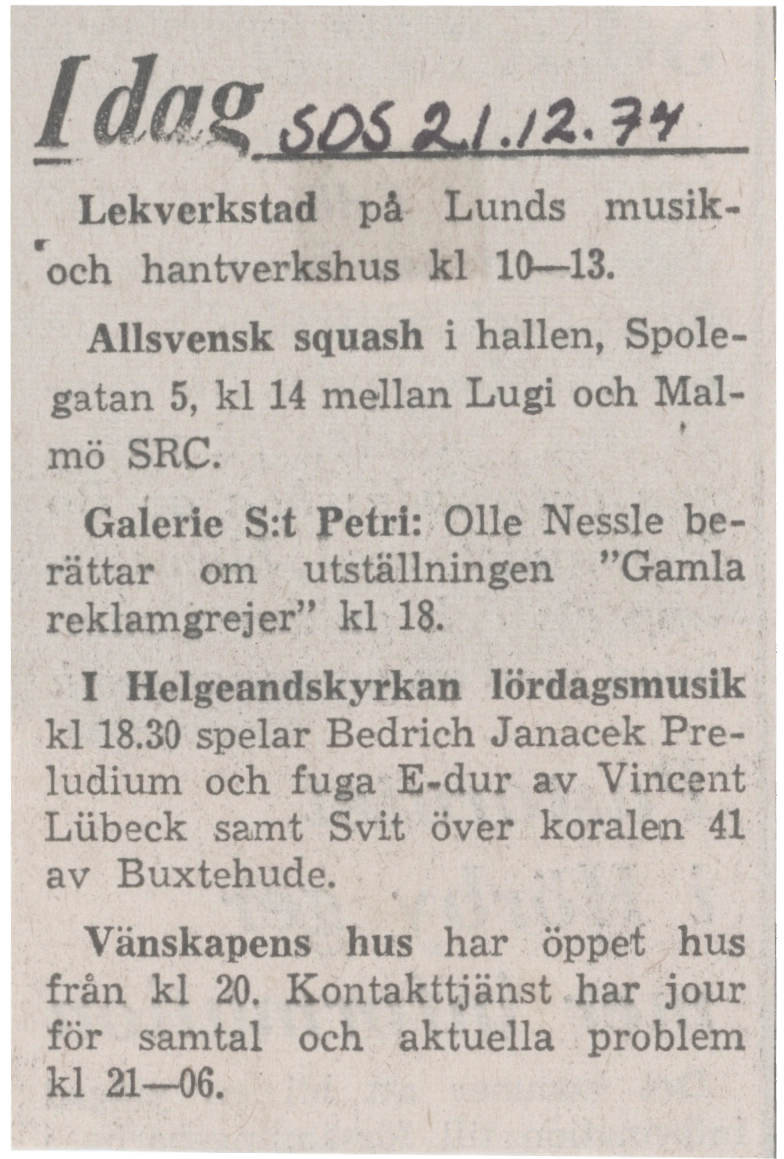
On Saturday, December 21, at 6 p.m., Olle Næssle will talk about his collection.
The exhibition is open throughout the Christmas and New Year holidays until January 8, 1975. Opening hours: weekdays 3–8 p.m., weekends 12–5 p.m.