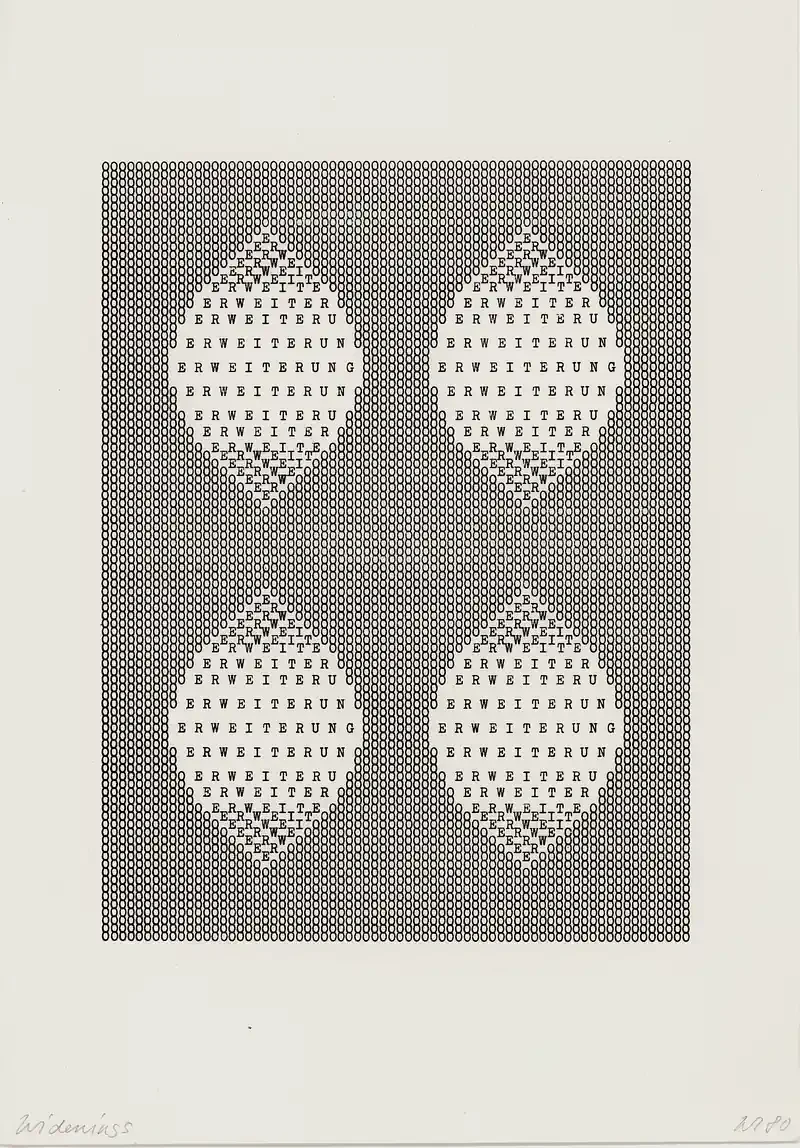
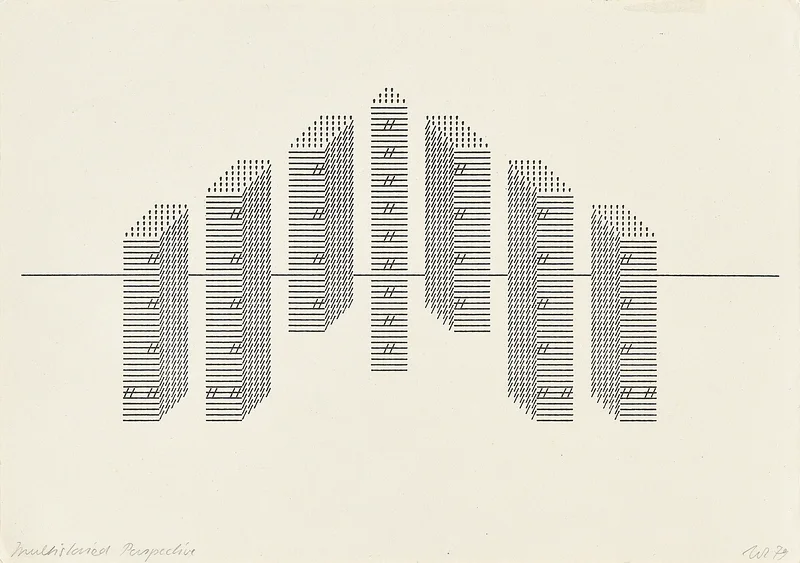
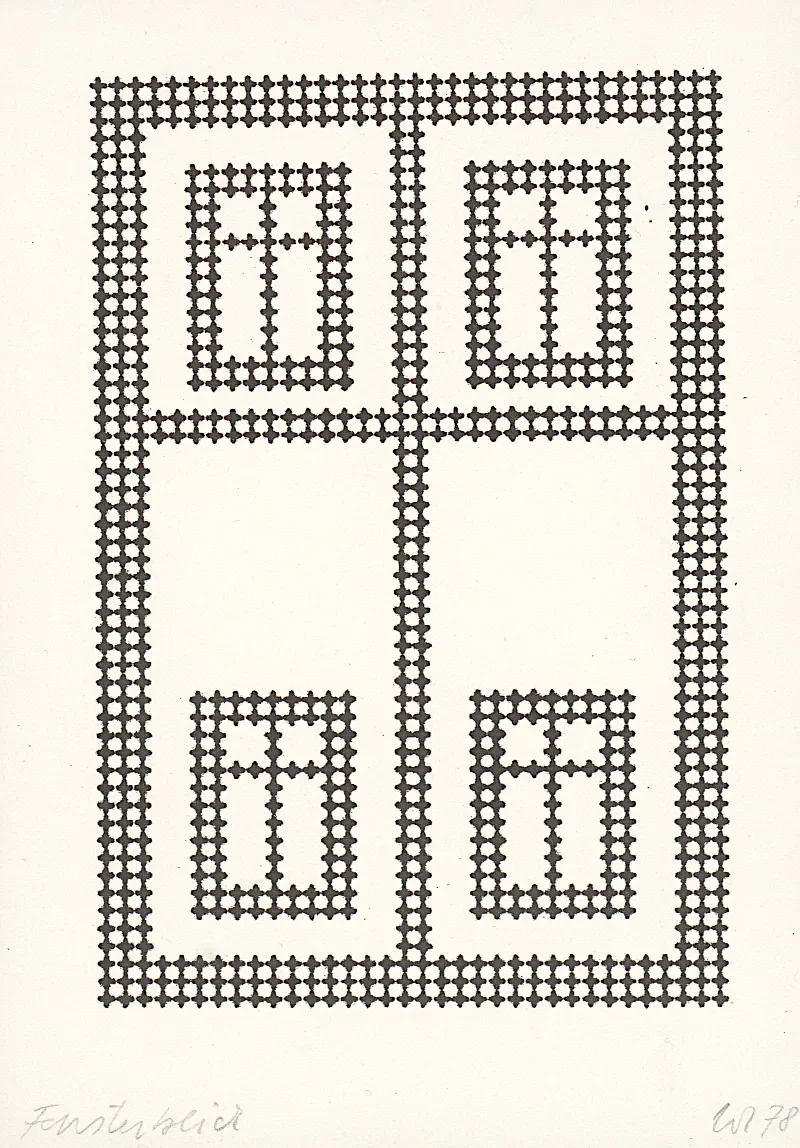
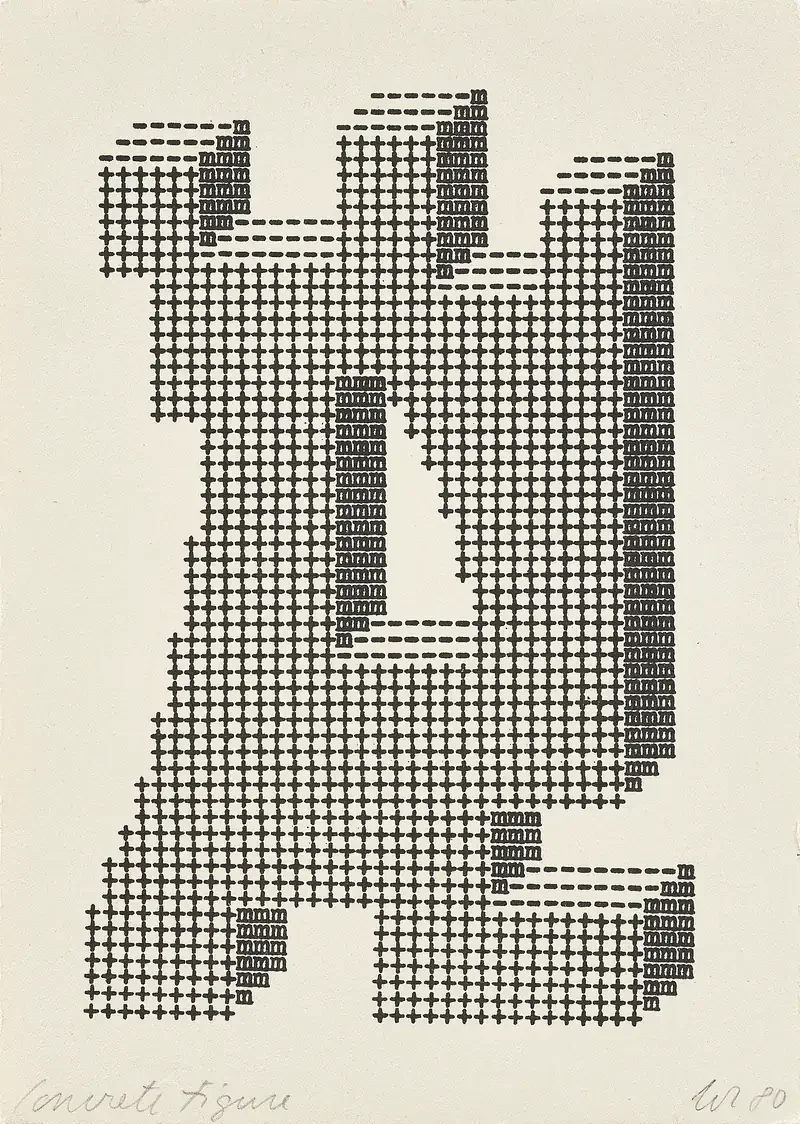
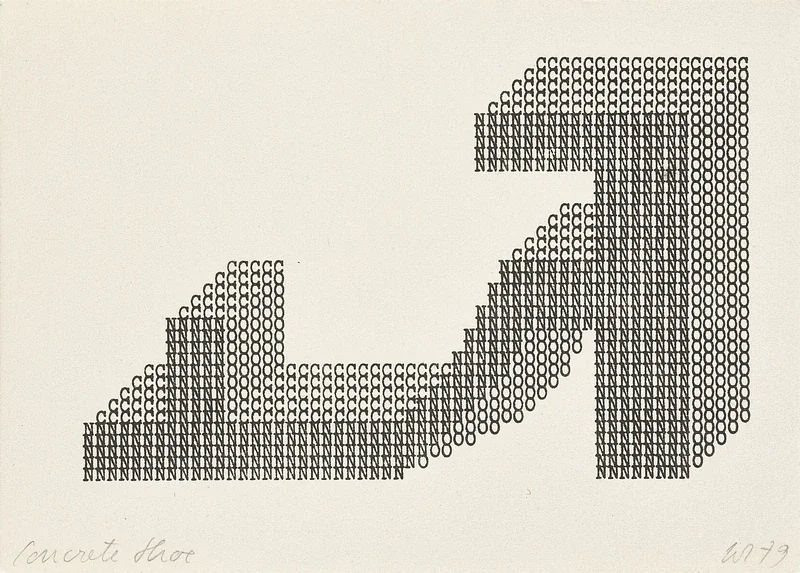
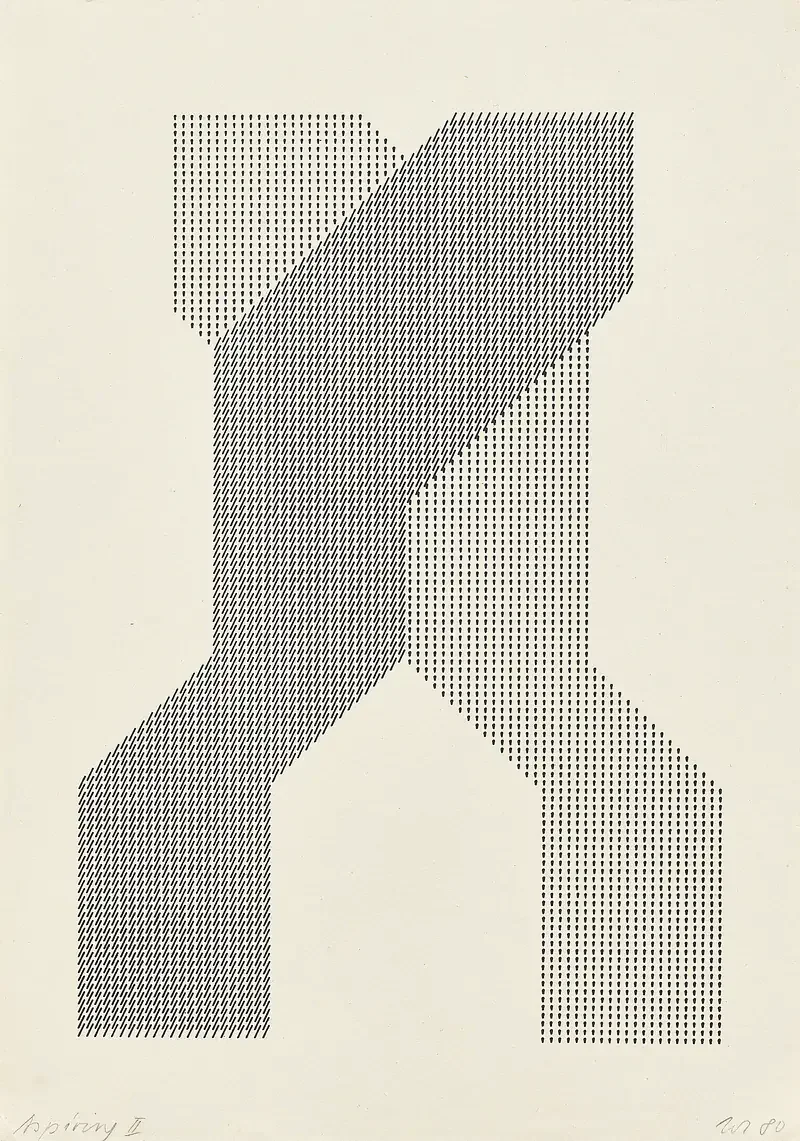
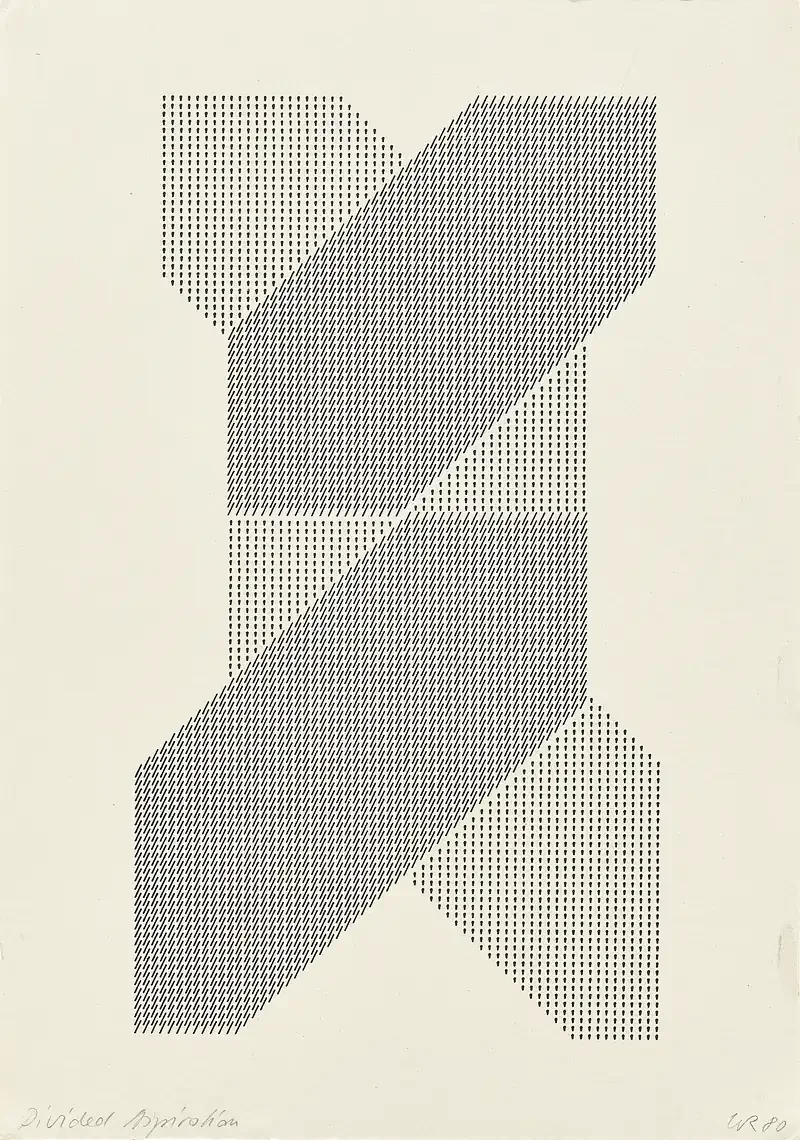
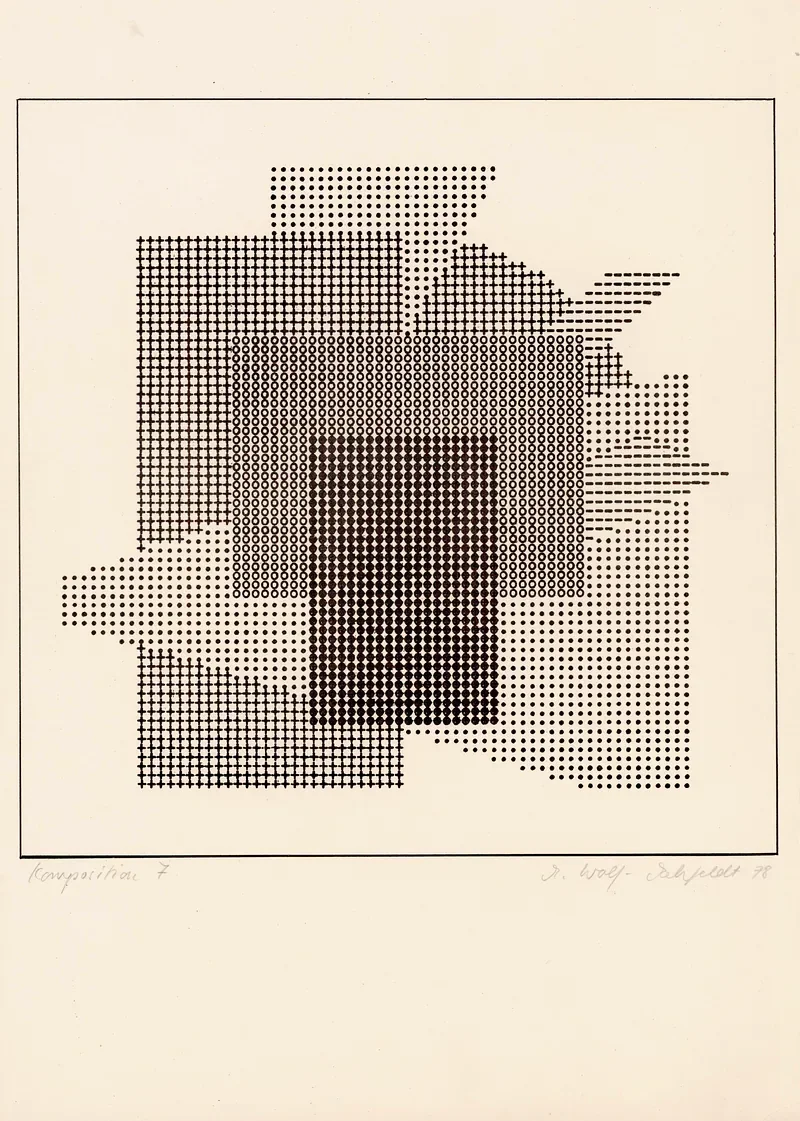
Diese Ausstellung versammelt originale Typoskripte und Zinkografien von Ruth Wolf-Rehfeldt aus den Jahren 1972 bis 1989. Im Zentrum stehen Arbeiten, in denen Schrift, Zeichen, Wiederholung und Struktur zu einer präzisen Form visuellen Denkens werden.
Wolf-Rehfeldts Werk verbindet konkrete Poesie, Mail Art und konzeptuelle Bildsprachen. Ihre Blätter entstehen aus elementaren typografischen Setzungen, die sich zu rhythmischen, oft architektonischen Kompositionen verdichten.
This exhibition brings together original typescripts and zincographs by Ruth Wolf-Rehfeldt from the years 1972 to 1989. The presentation focuses on works in which writing, signs, repetition and structure become a precise form of visual thinking.
Wolf-Rehfeldt’s work connects concrete poetry, Mail Art and conceptual visual languages. Her sheets are built from elemental typographic gestures that develop into rhythmic, often architectural compositions.
Cette exposition réunit des typoscripts originaux et des zincographies de Ruth Wolf-Rehfeldt réalisés entre 1972 et 1989. Elle met en avant des œuvres dans lesquelles l’écriture, le signe, la répétition et la structure deviennent une forme précise de pensée visuelle.
L’œuvre de Wolf-Rehfeldt relie poésie concrète, Mail Art et langages conceptuels. Ses feuilles naissent de gestes typographiques élémentaires qui se déploient en compositions rythmiques, souvent presque architecturales.
Diese Ausstellung präsentiert eine Auswahl von Typewritings, Zinkografien und Dokumenten von Ruth Wolf-Rehfeldt, die zwischen 1972 und 1989 in der DDR entstanden sind. Anhand dieser maschinengeschriebenen Arbeiten, in denen konkrete Poesie, Sprache, Bild und postalische Zirkulation aufeinandertreffen, möchte die Ausstellung eine künstlerische Praxis sichtbar machen, die sich ausserhalb institutioneller Strukturen und innerhalb transnationaler Mail-Art-Netzwerke während des Kalten Krieges entwickelte.
Wir danken Kurt Stäubli herzlich dafür, dass er uns für dieses Projekt willkommen geheissen und seinen Raum grosszügig zur Verfügung gestellt hat.
Emmanuelle Rapin und Raphaël Levy, Mai 2026
Ruth Wolf-Rehfeldt, 1932 in Wurzen, Sachsen, geboren, war eine autodidaktische Dichterin und Künstlerin. Sie lebte und arbeitete in Ost-Berlin, DDR, und blieb dort, im Berliner Stadtteil Pankow, bis zu ihrem Tod im Jahr 2024. Ihre ursprüngliche Ausbildung absolvierte sie als Industriekaufmann – ein Begriff, den sie bewusst in der männlichen Form verwendete. Parallel zu einem beständigen schriftstellerischen Schaffen in Form von Gedichten und Notizen entwickelte sie eine persönliche künstlerische Praxis. Nach Gemälden, Pastellbildern und Zeichnungen wandte sie sich Anfang der 1970er-Jahre den Kompositionen an der Schreibmaschine zu: den Typewritings, in denen sich konkrete Poesie, sprachliche Zeichen, Grafik und Konzeptkunst kreuzen.
Ihre Praxis entwickelte sich ausserhalb institutioneller Rahmen und fand in der Mail Art einen besonders fruchtbaren Raum der Verbreitung. So zählt sie zusammen mit ihrem Ehemann Robert Rehfeldt, ebenfalls Künstler, zu den Pionieren dieses transnationalen künstlerischen Austauschs aus der DDR. Mit dem Fall der Berliner Mauer 1989 und dem Tod von Robert Rehfeldt stellte sie jegliche künstlerische Tätigkeit ein. Seit 2016 erlebt ihr Werk, das lange Zeit kaum sichtbar war, eine internationale Wiederentdeckung, die insbesondere durch die Präsentation bei der Art Basel durch ChertLüdde eingeleitet und durch ihre Teilnahme an der documenta 14 im Jahr 2017 bestätigt wurde. Im Jahr 2021 widmete ihr das MAMCO Genf eine Ausstellung in seinem „Cabinet de poésie concrète“. Diese Anerkennung setzte sich mit der Verleihung des Gerhard-Altenbourg-Preises im Jahr 2021 und des Hannah-Höch-Preises im Jahr 2022 fort, kurz vor ihrem Tod am 26. Februar 2024.
Das Mail-Art-Archiv von Ruth Wolf-Rehfeldt und Robert Rehfeldt wird heute von der Berliner Galerie ChertLüdde aufbewahrt.
Ruth Wolf-Rehfeldt, Texte und Typewritings (1972–1989): eine Poetik des Übergangs zwischen Sprachen, Formen und Grenzen
„Ich stehe in Schuhen
Sie sind aus Blei
Ich trage ein Hemd
Aus Ketten
Mir wachsen Flügel
Aus Beton
Ich singe ein trauriges Lied
Der soll mich retten“
Dieses kurze Gedicht, undatiert und maschinengeschrieben, offenbart die Spannung, die das gesamte Werk und die Reflexionen von Ruth Wolf-Rehfeldt durchzieht: die eines Subjekts, das gefangen zwischen Schwung und Fessel ist, zwischen dem Wunsch nach Aufbruch und der Gefangenschaft, zwischen dem Lebendigen und der vom Menschen geschaffenen leblosen Materie. Diese Poetik des Aufbruchs und der Hemmung, in der die Flügel selbst aus Beton sind, bietet einen Zugang zu einem Werk, das sich im Zwischenraum entfaltet hat: zwischen den Sprachen, zwischen Texten und Bildern, zwischen Unbeweglichkeit und Bewegung sowie zwischen der Natur und den künstlichen Formen, die sie einschränken.
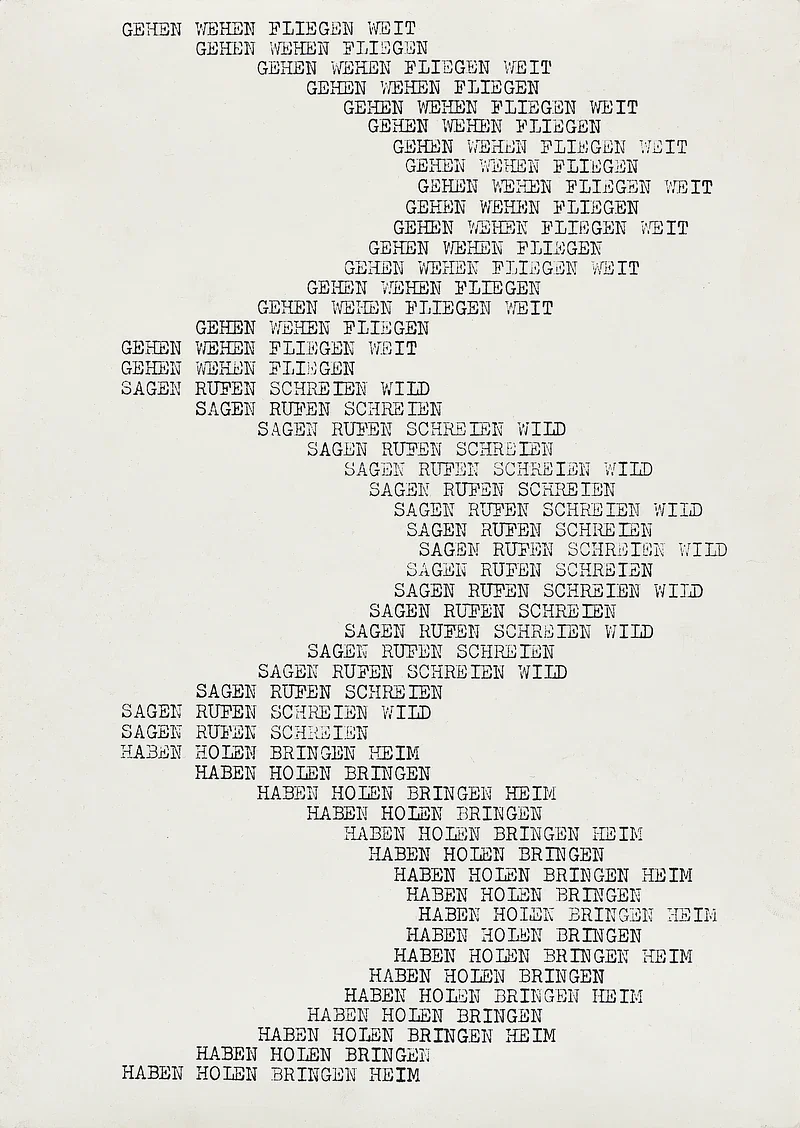
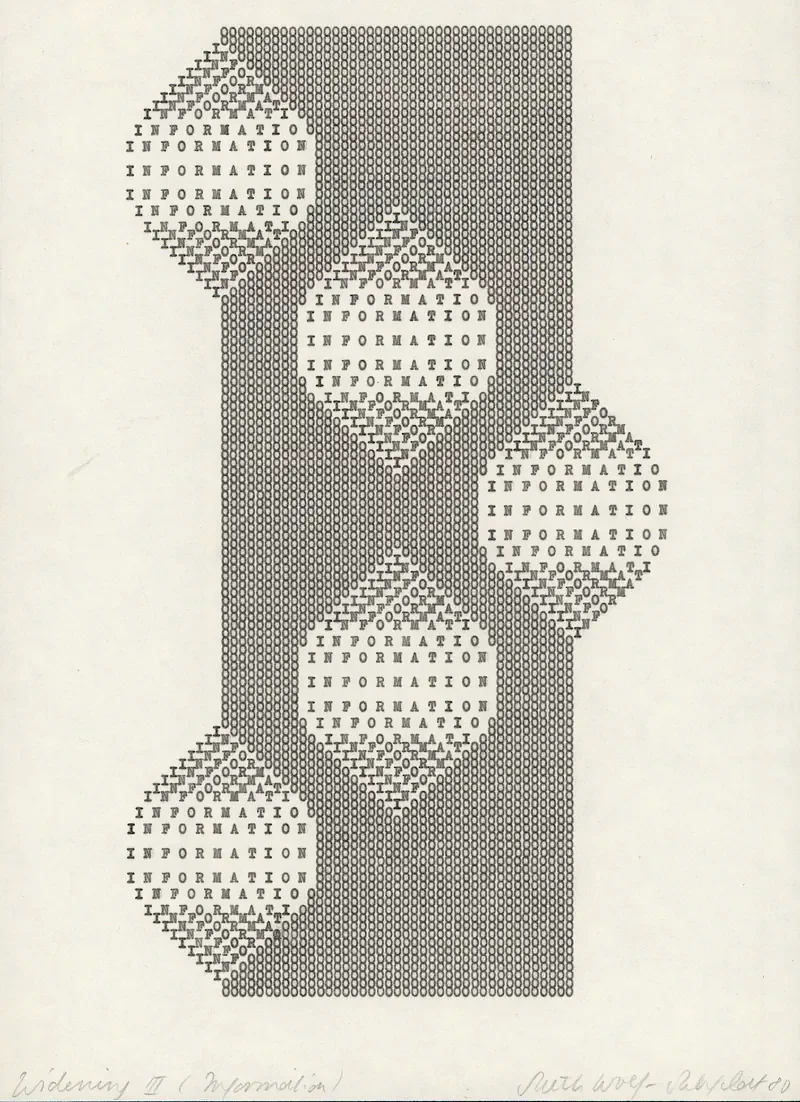
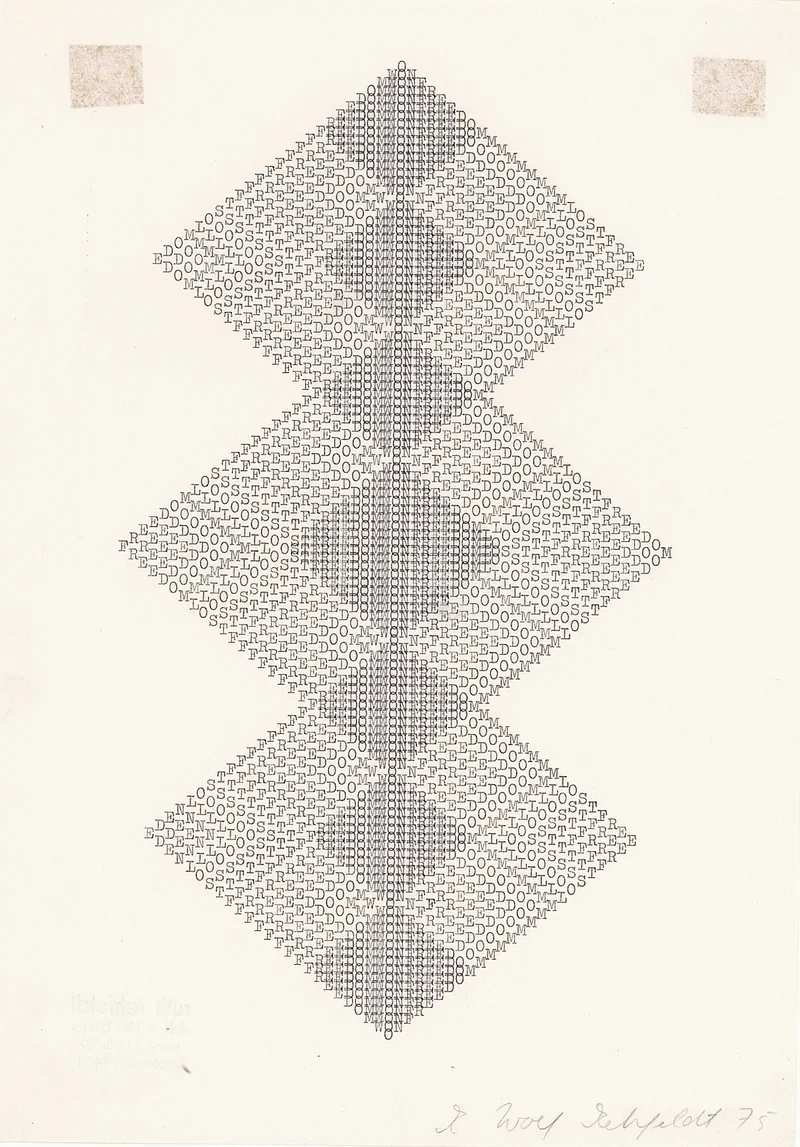
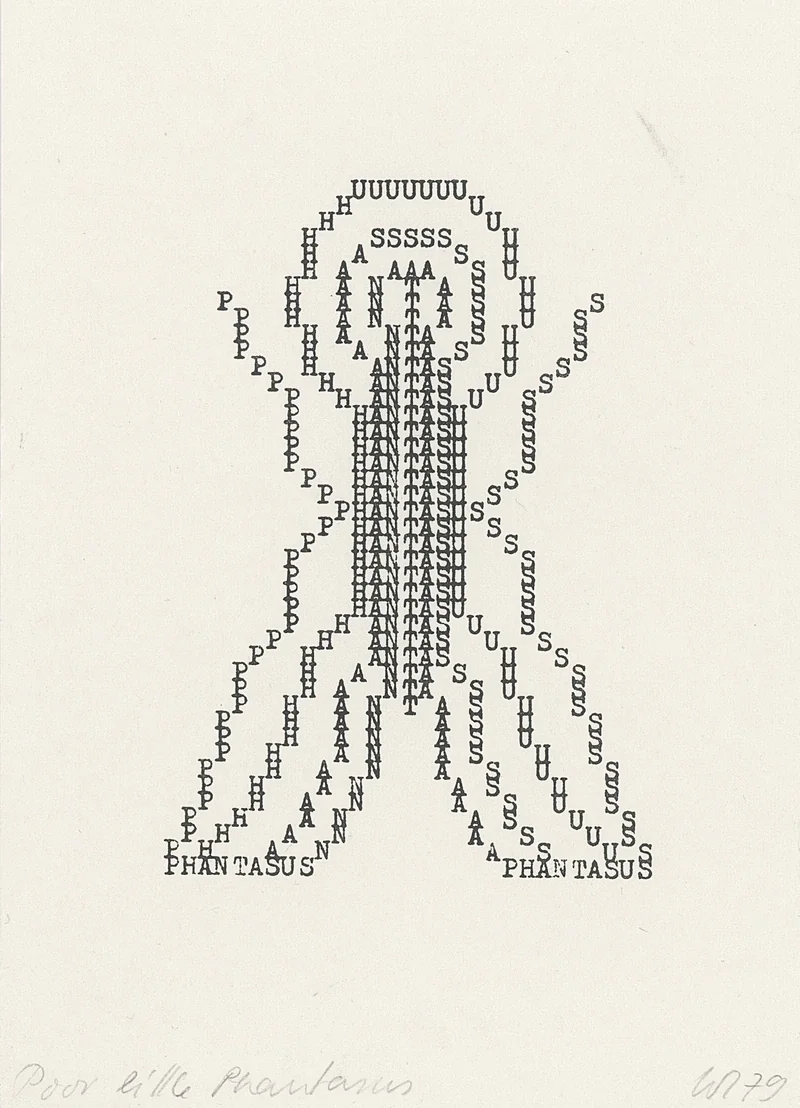
Im Laufe ihrer Forschungen verdichtete sich diese Spannung zu einer kompakten und einzigartigen Form, die von Wolf-Rehfeldt als „Typewritings“ bezeichnet wurde. In diesen meist im A4-Format — passend in einen Briefumschlag — verfassten maschinengeschriebenen Kompositionen werden ihre Überlegungen räumlich und visuell greifbar. Die Gedichte verdichten sich und werden zu strukturierten Bildern. Diese Konzentration verstärkt sowohl die Tragweite der Botschaft als auch die plastische Kraft des Werks und verleiht ihm eine Form, die sich für die Reproduktion und den Versand eignet.
Die Verbreitung ihrer Werke ermöglichte zudem Wolf-Rehfeldts systematischer Einsatz verschiedener Reproduktionstechniken, die ihr zur Verfügung standen, insbesondere der Zinkografie— Kopien von Dokumenten, Reproduktionen und Drucke von Büchern oder grafischen Werken waren in der DDR begrenzt und kontrolliert.
Diese formale Entwicklung ist untrennbar mit den materiellen und politischen Bedingungen verbunden, unter denen die Künstlerin arbeitete. Die leichten und reproduzierbaren Typewritings fanden ihren Platz in den transnationalen Kunstnetzwerken über den Postverkehr, der sich damals im Rahmen der „Mail Art“ entwickelte. Diese Übereinstimmung beruht nicht nur auf dem Format der Werke, sondern auch auf ihrer formalen und sprachlichen Subtilität.
Die Texte, die oft auf minimale Strukturen reduziert und durch den Einsatz der Schreibmaschine — Wiederholung von Zeichen, räumliche Anordnung, typografische Verschiebungen — verzerrt oder auf Englisch verfasst sind, geben ihre Bedeutung nicht sofort preis. Diese relative Undurchsichtigkeit, ohne systematisch eine Umgehungsstrategie zu sein, konnte dazu beitragen, die Botschaft weniger direkt lesbar zu machen und in bestimmten Fällen Formen der Kontrolle und Zensur zu unterlaufen.
In diesem Kontext ermöglichten die Typewritings Ruth Wolf-Rehfeldt, ihre Arbeit über die Grenzen hinweg zu verbreiten, zu kommunizieren und ihr von Ost-Berlin aus, wo sie lebte, eine Präsenz jenseits des Eisernen Vorhangs zu verschaffen. So wurde sie zu einer der aktivsten Vertreterinnen unter den Künstler*innen der DDR, die sich in diesen transnationalen Netzwerken der Mail Art engagierten.
Am 10. Juni 1981 präsentierte die Galerie S:t Petri – Archiv für experimentelle und marginale Kunst in Lund eine der ersten Ausstellungen im Westen, die Ruth Wolf-Rehfeldt gewidmet war. Die in Pankow, im Norden von Ost-Berlin, lebende Künstlerin sowie ihr Ehemann Robert Rehfeldt, der ebenfalls eingeladen war, konnten nicht anreisen. Im Begleittext zur Ausstellung wurde zudem darauf hingewiesen, dass den beiden Künstlern die Ausreise nicht gestattet worden war.
Das Werk zirkulierte also ohne seine Schöpferin: durch die versandten, vervielfältigten und aus der Ferne ausgestellten maschinengeschriebenen Blätter. Obwohl die Werke von Wolf-Rehfeldt vor dem Hintergrund von Reisebeschränkungen und Kontrollmassnahmen entstanden sind, stellen sie keinen expliziten und frontalen oppositionellen Diskurs dar. Diese Einschränkungen sind in der Form der Werke selbst verankert, in ihrer Ökonomie der Mittel, in ihrer Fernzirkulation.
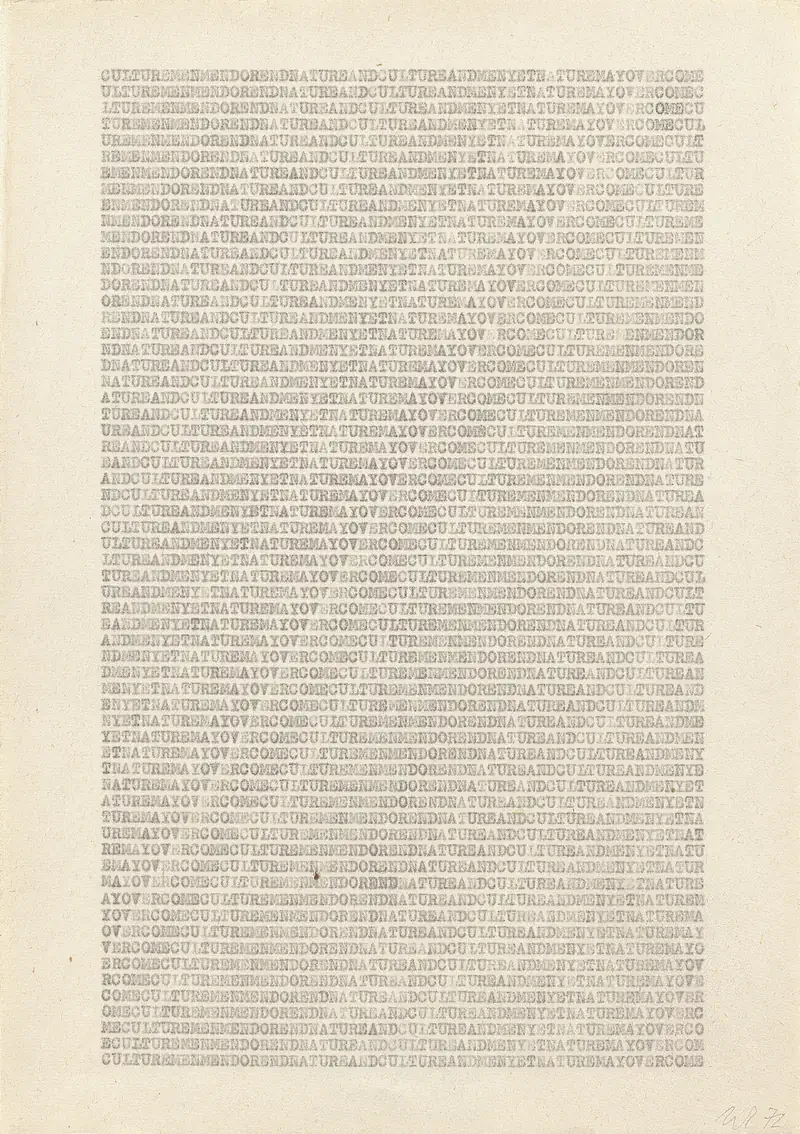
So ist unter den in dieser Ausstellung präsentierten Werken das Werk Evolution (Nature and Men), 1972, beispielhaft dafür, wie die Künstlerin die Sprache als visuelle Form und als Trägerin von Bedeutung artikuliert.
Es baut auf einer repetitiven und reduzierten Struktur auf, gleitet nach und nach entlang einer Punktesäule und bildet eine räumliche und zeitliche Trennlinie, die Beziehung zwischen „Nature“ und „Men“ bis zu ihrem Bruch, der durch den Übergang von „And“ zu „End“ verkörpert wird und in der klanglichen Kontinuität einen sowohl sprachlichen als auch visuellen Umschwung markiert.
Dieses Werk fasst die Themen zusammen, die sich bei Wolf-Rehfeldt weiterentwickeln werden: der ständige Gebrauch und das Spiel mit Sprachen — auf Deutsch und Englisch —, die angespannte Beziehung zwischen Mensch und Natur sowie die Fähigkeit der auf wenige Zeichen reduzierten Sprache, eine Krise der Beziehungen sichtbar zu machen: zu anderen, zu sozialen und politischen Strukturen sowie zum Lebendigen.
Die Verwendung des Englischen hat hier einen besonderen Stellenwert: Im Kontext der DDR war Englisch als mit dem Westen assoziierte Sprache nicht neutral. Bei Wolf-Rehfeldt erweitert dieser Gebrauch die Lesbarkeit der Werke innerhalb der Mail-Art-Netzwerke und wird zugleich zu einem poetischen Prinzip: die Wörter gleiten von einer Sprache zur anderen, von einer Bedeutung zur anderen, manchmal bis hin zur Mehrdeutigkeit.
In diesem Werk aus Zeichen, bescheidenen Formaten und begrenzten Mitteln entwickelt Ruth Wolf-Rehfeldt eine diskrete, aber kraftvolle Poetik des Zirkulierens, des Widerstands und der Kommunikation.
Diese Fernkommunikation und dieser Austausch von Werken und Ideen stehen im grösseren Kontext des Kalten Krieges und der Veränderungen, die auf die Vereinbarungen von Helsinki von 1975 folgten. Die am 1. August 1975 von 35 Staaten unterzeichnete Schlussakte der KSZE — Konferenz über Sicherheit und Zusammenarbeit in Europa —, bei der die Schweiz durch Bundespräsident Pierre Graber vertreten war, eröffnete einen beispiellosen diplomatischen Raum zwischen Ost und West.
Für die Schweiz, die damals noch kein Mitglied der UNO war, stellte diese Konferenz zudem einen wichtigen Moment des Engagements in einer paneuropäischen Politik dar. Die Schlussakte bekräftigte insbesondere die Notwendigkeit, „einer breiteren Verbreitung von Informationen“ sowie die Entwicklung des kulturellen Austauschs, des Verkehrs von Werken und die Kontakte zwischen Menschen über Grenzen hinweg zu fördern.
In diesem Zusammenhang stellten die Mail-Art-Netzwerke und der Postverkehr, an denen Ruth Wolf-Rehfeldt, Robert Rehfeldt und zahlreiche osteuropäische Künstler beteiligt waren, nicht nur alternative Formen der Kunstverbreitung dar: sie trugen konkret dazu bei, Ideen, Zeichen, Bilder und zwischenmenschliche Beziehungen in einem durch den Eisernen Vorhang zersplitterten europäischen Raum in Umlauf zu bringen.
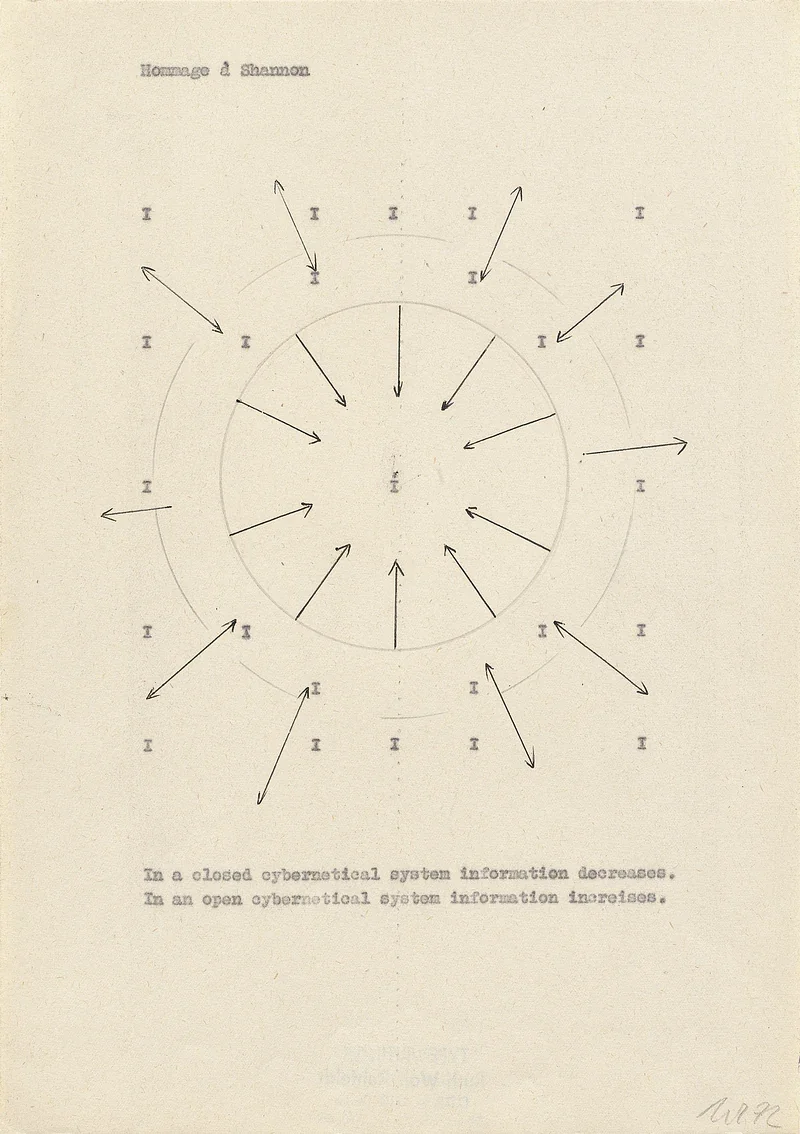
Werke wie Hommage à Shannon (1972) oder Evolution (Nature and Men) vermitteln durch minimale Strukturen und sprachliche Verschiebungen die Spannungen einer Welt, die von der nuklearen Bedrohung, politischen Spaltungen und Ungleichgewichten zwischen Mensch, Technik und Natur geprägt ist. Sie zeugen aber auch von einem beharrlichen Willen, Formen der Kommunikation, des Austauschs und der Zirkulation über politische, sprachliche und ideologische Grenzen hinweg aufrechtzuerhalten.
Emmanuelle Rapin, Mai 2026
Aus dem Französischen übersetzt; Übersetzungslektorat: Emma Levy.
This exhibition presents a selection of Typewritings, zincographs and documents by Ruth Wolf-Rehfeldt, produced in the GDR between 1972 and 1989. Through these typewritten works — at the intersection of concrete poetry, language, image and postal circulation — the exhibition highlights an artistic practice developed outside institutional frameworks and within the transnational Mail Art networks of the Cold War period.
We would like to warmly thank Kurt Stäubli for generously welcoming this project and making his space available to us.
Emmanuelle Rapin and Raphaël Levy, May 2026
Ruth Wolf-Rehfeldt, born in 1932 in Wurzen, Saxony, was a self-taught poet and artist. She lived and worked in East Berlin, in the GDR, in the district of Pankow, where she remained until her death in 2024. Her initial training was as an Industriekaufmann — an industrial clerk — a term she was particularly keen to use in its masculine form. Alongside a continuous writing practice, consisting of poems and notes, she developed a personal artistic practice. After paintings, pastels and drawings, she turned, in the early 1970s, to typewriter compositions: the Typewritings, in which concrete poetry, linguistic signs, graphic design and conceptual art intersect.
Her practice developed outside institutional frameworks and found a particularly fertile space for circulation in Mail Art. Thus, alongside her husband Robert Rehfeldt, also an artist, she ranks among the pioneering figures of these transnational artistic exchanges from the GDR. With the fall of the Berlin Wall in 1989 and the death of Robert Rehfeldt, she ceased all artistic activity. Since 2016, her work, which had long remained largely unseen, has been the subject of an international rediscovery, initiated notably by its presentation at Art Basel by ChertLüdde, and confirmed by her participation in documenta 14 in 2017. In 2021, MAMCO Geneva dedicated an exhibition to her in its Cabinet of Concrete Poetry. This recognition continued with the award of the Gerhard-Altenbourg-Preis in 2021 and the Hannah-Höch-Preis in 2022, shortly before her death on 26 February 2024. The Mail Art archive of Ruth Wolf-Rehfeldt and Robert Rehfeldt is now held by the Berlin gallery ChertLüdde.
Ruth Wolf-Rehfeldt, texts and Typewritings (1972–1989): a poetics of transition, between languages, forms and borders
„Ich stehe in Schuhen
Sie sind aus Blei
Ich trage ein Hemd
Aus Ketten
Mir wachsen Flügel
Aus Beton
Ich singe ein trauriges Lied
Der soll mich retten“
“I stand in shoes
They are made of lead
I am wearing a shirt
Made of chains
Wings are growing
Made of concrete
I sing a sad song
That is supposed to save me”
This short, undated, typewritten poem reveals a tension that runs through Ruth Wolf-Rehfeldt’s entire work and thinking: that of a subject caught between impulse and constraint, between the desire for passage and confinement, between the living and the inert matter constructed by human beings. This poetics of flight and obstruction, in which even the wings are made of concrete, offers an entry into a body of work that unfolded in the in-between: between languages, between texts and images, between immobility and circulation, and between nature and the artificial forms that constrain it.
As her research developed, this tension crystallised into a concise and distinctive form: what Wolf-Rehfeldt termed “Typewritings”. In these typewritten compositions, often in A4 format and able to fit into an envelope, her reflections become spatialized and visualized. The poems contract and turn into structured images. This concentration reinforces both the impact of the message and the visual power of the work, while giving it a form suited to reproduction and mailing.
Wolf-Rehfeldt’s systematic use of the various reproduction techniques available to her, notably zincography — at a time when document copies, reproductions and the printing of books or graphic works were limited and controlled in the GDR — also gave her works the capacity to circulate.
This formal evolution is inextricably linked to the material and political conditions in which the artist worked. The Typewritings, being lightweight and reproducible, found their place within transnational artistic networks via the postal exchanges that were developing at the time through the Mail Art movement. This adequacy did not depend solely on the format of the works; it also rested on their formal and linguistic subtlety.
The texts, often reduced to minimal structures and obscured by the use of the typewriter — repetition of characters, spatial arrangement, typographical shifts — or written in English, do not immediately reveal their meaning. This relative opacity, whilst not systematically a strategy of circumvention, could help to make the message less directly legible and, in some cases, to evade forms of control and censorship.
In this context, the Typewritings enabled Ruth Wolf-Rehfeldt to circulate her work across borders, to communicate and to give it a presence beyond the Iron Curtain, from East Berlin where she lived. She thus became one of the most active representatives among GDR artists engaged in these transnational Mail Art networks.
On 10 June 1981, the S:t Petri Gallery – Archive of Experimental and Marginal Art in Lund presented one of the first exhibitions in the West dedicated to Ruth Wolf-Rehfeldt. Based in Pankow, in the north of East Berlin, the artist, along with her husband Robert Rehfeldt, who was also invited, were unable to attend. The exhibition’s introductory text noted that the two artists had not been permitted to travel.
The work thus circulated without its creator: through the typed sheets that were sent, reproduced and exhibited from afar. Although Wolf-Rehfeldt’s works were created within this context of travel restrictions and forms of control, they do not present themselves as a discourse of direct and explicit opposition. These constraints are embedded in the very form of the works, in their economy of means, and in their circulation at a distance.
Thus, among the works presented in this exhibition, the piece Evolution (Nature and Men), 1972, exemplifies the way in which the artist articulates language as a visual form and as a vehicle of meaning.
It is constructed from a repetitive and stripped-back structure, gradually sliding along a column of dots, forming a spatial and temporal dividing line, the relationship between “NATURE” and “MEN” until its rupture, materialised by the transition from “AND” to “END”, marking, in the continuity of sound, a shift that is both linguistic and visual.
This work encapsulates the themes that will develop in Wolf-Rehfeldt’s work: the constant use of and play with languages — in German and English —, the tense relationship between humans and nature, and the capacity of language, reduced to a few signs, to communicate this crisis in relations with others, with social and political structures, as well as with the living world.
Bilingualism holds a particular status here within the context of the GDR. The use of English was not neutral as a language associated with the West; in Wolf-Rehfeldt’s work, it broadened the readability of the works within Mail Art networks, while also becoming a poetic principle: words slip from one language to another, from one meaning to another, sometimes to the point of ambiguity.
In this work, composed of signs, modest formats and constrained means, Ruth Wolf-Rehfeldt develops a discreet yet powerful poetics of circulation, resistance and communication.
This communication at a distance, and the circulation of works and ideas, should be understood within the broader context of the Cold War and the transformations that followed the 1975 Helsinki Accords. Signed on 1 August 1975 by thirty-five states, including Switzerland represented by the President of the Confederation, Pierre Graber, the Final Act of the CSCE — Conference on Security and Cooperation in Europe — opened up an unprecedented diplomatic space between East and West.
For Switzerland, which was not yet a member of the UN at the time, this conference also marked an important moment of engagement in pan-European politics. The Final Act affirmed, in particular, the need to promote “a wider dissemination of information”, as well as the development of cultural exchanges, the circulation of works and contacts between people across borders.
In this context, the Mail Art networks and postal exchanges engaged in by Ruth Wolf-Rehfeldt, Robert Rehfeldt and numerous artists from Eastern Europe were not merely alternative forms of artistic dissemination. They played a tangible role in circulating ideas, symbols, images and human connections across a European landscape fragmented by the Iron Curtain.
Works such as Hommage à Shannon (1972) and Evolution (Nature and Men) convey, through minimalist structures and linguistic shifts, the tensions of a world gripped by the nuclear threat, political divisions and the imbalances between humanity, technology and nature. Yet they also bear witness to a persistent desire to maintain forms of communication, exchange and circulation across political, linguistic and ideological borders.
Emmanuelle Rapin, May 2026
Translated from the French.
Cette exposition présente une sélection de Typewritings, de zincographies et de documents de Ruth Wolf-Rehfeldt, réalisés entre 1972 et 1989 en RDA. À travers ces œuvres dactylographiées, où se croisent poésie concrète, langage, image et circulation postale, l’exposition souhaite mettre en lumière une pratique artistique développée à la marge des institutions, au sein des réseaux transnationaux du Mail Art pendant la guerre froide.
Nous remercions chaleureusement Kurt Stäubli de nous avoir généreusement accueillis et d’avoir mis son espace à disposition pour ce projet.
Emmanuelle Rapin et Raphaël Levy, mai 2026
Ruth Wolf-Rehfeldt, née en 1932 à Wurzen, en Saxe, était une poète et artiste autodidacte. Elle vécut et travailla à Berlin-Est, en RDA, dans le quartier de Pankow, où elle demeura jusqu’à sa mort en 2024. Sa formation initiale fut celle d’Industriekaufmann — employé de commerce dans l’industrie —, terme qu’elle tenait à employer sous sa forme masculine. Parallèlement à un travail d’écriture constant, composé de poèmes et de notes, elle développa une pratique artistique personnelle. Après des peintures, des pastels et des dessins, elle se tourna, au début des années 1970, vers les compositions à la machine à écrire : les Typewritings, où se croisent poésie concrète, signes linguistiques, graphisme et art conceptuel.
Sa pratique se développa en dehors des cadres institutionnels et trouva dans le Mail Art un espace de circulation particulièrement fécond. Ainsi, avec son mari Robert Rehfeldt, également artiste, elle compte parmi les figures pionnières de ces échanges artistiques transnationaux depuis la RDA. Avec la chute du Mur de Berlin en 1989 et la mort de Robert Rehfeldt, elle cessera toute activité artistique. Depuis 2016, son œuvre, longtemps restée peu visible, fait l’objet d’une redécouverte internationale, amorcée notamment par sa présentation à Art Basel par ChertLüdde, puis confirmée par sa participation à documenta 14 en 2017. En 2021, le MAMCO Genève lui consacra une exposition dans son Cabinet de poésie concrète. Cette reconnaissance se poursuit avec l’attribution du Gerhard-Altenbourg-Preis en 2021 et du Hannah-Höch-Preis en 2022, peu de temps avant sa mort, le 26 février 2024.
L’archive de Mail Art de Ruth Wolf-Rehfeldt et Robert Rehfeldt est aujourd’hui conservée par la galerie berlinoise ChertLüdde.
Ruth Wolf-Rehfeldt, textes et Typewritings (1972–1989) : une poétique du passage, entre langues, formes et frontières
„Ich stehe in Schuhen
Sie sind aus Blei
Ich trage ein Hemd
Aus Ketten
Mir wachsen Flügel
Aus Beton
Ich singe ein trauriges Lied
Der soll mich retten“
« Je me tiens dans des chaussures
Elles sont de plomb
Je porte une chemise
De chaînes
Des ailes me poussent
De béton
Je chante une chanson triste
Qui doit me sauver »
Ce court poème, non daté, dactylographié, révèle la tension qui traversa toute l’œuvre et les réflexions de Ruth Wolf-Rehfeldt : celle d’un sujet pris entre élan et entrave, entre désir de passage et enfermement, entre le vivant et la matière inerte construite par l’humain. Cette poétique de l’envol et de l’empêchement, où les ailes elles-mêmes sont de béton, offre une entrée dans une œuvre qui s’est déployée dans l’entre-deux : entre les langues, entre les textes et les images, entre l’immobilité et la circulation, et entre la nature et les formes artificielles qui la contraignent.
Au fil de ses recherches, cette tension se condensa en une forme resserrée et singulière : celle que Wolf-Rehfeldt a nommée des Typewritings. Dans ces compositions dactylographiées souvent de format A4 — tenant dans une enveloppe —, ses réflexions se spatialisent et se visualisent. Les poèmes se resserrent et deviennent des images structurées. Cette concentration renforce à la fois la portée du message, la force plastique de l’œuvre, et donne une forme adaptée à la reproduction et à l’envoi.
L’usage systématique que fit Wolf-Rehfeldt des différentes techniques de reproduction qui lui étaient accessibles, notamment la zincographie, alors que les copies de documents, les reproductions et les impressions de livres ou d’œuvres graphiques étaient limitées et contrôlées en RDA, a également donné à ses œuvres la capacité de circuler.
Cette évolution formelle est inséparable des conditions matérielles et politiques dans lesquelles l’artiste travaillait. Les Typewritings, légers et reproductibles, trouveront leur place dans les réseaux artistiques transnationaux via les circulations postales qui se développaient à l’époque avec le Mail Art. Cette adéquation ne tient pas seulement au format des œuvres : elle repose aussi sur leur subtilité formelle et linguistique.
Les textes, souvent réduits à des structures minimales et brouillés par l’usage de la machine à écrire — répétition des signes, disposition spatiale, glissements typographiques — ou écrits en anglais, ne livrent pas immédiatement leur sens. Cette relative opacité, sans être systématiquement une stratégie de contournement, pouvait contribuer à rendre le message moins directement lisible et, dans certains cas, à déjouer les formes de contrôle et de censure.
Dans ce contexte, les Typewritings permettaient à Ruth Wolf-Rehfeldt de faire circuler son travail au-delà des frontières, de communiquer et de lui donner une présence hors du Rideau de fer, depuis Berlin-Est où elle vivait. Elle deviendra ainsi l’une des représentantes les plus actives parmi les artistes de la RDA engagés dans ces réseaux transnationaux du Mail Art.
Le 10 juin 1981, la Galerie S:t Petri – Archive of Experimental and Marginal Art, à Lund, présenta l’une des premières expositions à l’Ouest consacrées à Ruth Wolf-Rehfeldt. Installée à Pankow, au nord de Berlin-Est, l’artiste, ainsi que son mari Robert Rehfeldt, également invité, ne purent s’y rendre. Le texte de présentation de l’exposition précisait d’ailleurs que les deux artistes n’avaient pas été autorisés à voyager.
L’œuvre circula donc sans son auteure : par les feuilles dactylographiées envoyées, reproduites et exposées à distance. Bien que les œuvres de Wolf-Rehfeldt se soient élaborées dans ce contexte de restrictions de circulation et de formes de contrôle, elles ne se proposent pas comme un discours d’opposition frontal et explicite. Ces contraintes s’inscrivent dans la forme même des œuvres, dans leur économie de moyens, leur circulation à distance.
Ainsi, parmi les œuvres présentées lors de cette exposition, Evolution (Nature and Men), 1972, est exemplaire de la manière dont l’artiste articule la langue comme forme visuelle et comme porteuse de sens.
Elle se construit à partir d’une structure répétitive et dépouillée ; elle fait glisser progressivement, le long d’une colonne de points, une ligne de partage — spatiale et temporelle — entre « Nature » et « Men », jusqu’à sa rupture matérialisée par le passage de « And » à « End », marquant, dans la continuité sonore, un basculement à la fois linguistique et visuel.
Cette œuvre synthétise les thèmes qui vont se développer chez Wolf-Rehfeldt : l’usage et le jeu constants avec les langues — en allemand et en anglais —, la relation tendue entre humain et nature, et la capacité du langage, réduit à quelques signes, à communiquer cette crise des relations aux autres, aux structures sociales et politiques, ainsi qu’au vivant.
Le bilinguisme a ici un statut particulier : l’usage de l’anglais n’était pas neutre en tant que langue associée à l’Ouest. Chez Wolf-Rehfeldt, cet usage élargit la lisibilité des œuvres dans les réseaux du Mail Art, mais devient également un principe poétique : les mots glissent d’une langue à l’autre, d’un sens à l’autre, parfois jusqu’à l’ambiguïté.
Dans cette œuvre faite de signes, de formats modestes et de moyens contraints, Ruth Wolf-Rehfeldt élabore une poétique discrète mais puissante de la circulation, de la résistance et de la communication.
Cette communication à distance et cette circulation des œuvres et des idées s’inscrivent dans le contexte plus large de la guerre froide et des transformations qui suivent les accords d’Helsinki de 1975. Signé le 1er août 1975 par trente-cinq États, dont la Suisse représentée par le président de la Confédération Pierre Graber, l’Acte final de la CSCE — Conférence sur la sécurité et la coopération en Europe — ouvrit un espace diplomatique inédit entre l’Est et l’Ouest.
Pour la Suisse, qui n’était alors pas encore membre de l’ONU, cette conférence constitua également un moment important d’engagement dans une politique paneuropéenne. L’Acte final affirmait notamment la nécessité de favoriser « une plus large diffusion de l’information », ainsi que le développement des échanges culturels, de la circulation des œuvres et des contacts entre les personnes au-delà des frontières.
Dans ce contexte, les réseaux du Mail Art et les circulations postales investis par Ruth Wolf-Rehfeldt, Robert Rehfeldt et de nombreux artistes d’Europe de l’Est ne constituaient pas seulement des formes alternatives de diffusion artistique. Ils participaient concrètement à la mise en circulation d’idées, de signes, d’images et de relations humaines à travers un espace européen fragmenté par le Rideau de fer.
Des œuvres comme Hommage à Shannon (1972) ou Evolution (Nature And Men) traduisent, à travers des structures minimales et des déplacements linguistiques, les tensions d’un monde traversé par la menace nucléaire, les divisions politiques et les déséquilibres entre humain, technique et nature. Mais elles témoignent aussi d’une volonté persistante de maintenir des formes de communication, d’échange et de circulation au-delà des frontières politiques, linguistiques et idéologiques.
Emmanuelle Rapin, Mai 2026
Ausgewählte Werke
Selected works
Œuvres choisies
Ruth Wolf-Rehfeldt
Faltung, 1978
Typoskript auf Papier
29,7 × 21 cm
Ruth Wolf-Rehfeldt
Faltung, 1978
Typescript on paper
29.7 × 21 cm
Ruth Wolf-Rehfeldt
Faltung, 1978
Typoscript sur papier
29,7 × 21 cm
Ruth Wolf-Rehfeldt
Faltung, 1978
Typoskript auf Papier
29,7 × 21 cm
Ruth Wolf-Rehfeldt
Faltung, 1978
Typescript on paper
29.7 × 21 cm
Ruth Wolf-Rehfeldt
Faltung, 1978
Typoscript sur papier
29,7 × 21 cm
Ruth Wolf-Rehfeldt
Faltung, 1978
Typoskript auf Papier
29,7 × 21 cm
Ruth Wolf-Rehfeldt
Faltung, 1978
Typescript on paper
29.7 × 21 cm
Ruth Wolf-Rehfeldt
Faltung, 1978
Typoscript sur papier
29,7 × 21 cm

