

CLICK TO VIEW PRESS RELEASE
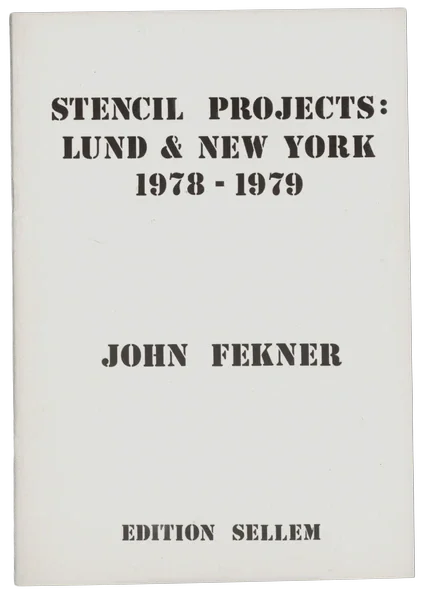
JOHN FEKNERNO TV/READSTENCIL PROJECT press release01.11 - 12.11.1979
Why do people so often discuss TV programs instead of talking about their own lives with each other? Why do we allow ourselves to be so strongly influenced by TV that we soon live almost entirely through the characters in the shows, imitating their lifestyle and attitudes and forgetting to think for ourselves?
John Fekner from the USA has long experienced TV as a distracting medium. When, in addition, American television contains commercials telling people what to buy, where to go, and how to dress, it becomes even more dangerous. We constantly let ourselves be influenced by external factors and seldom think very deeply about them.
At the exhibition in Galerie S:t Petri in Lund, John Fekner therefore displays the international “No Parking” sign — not against parking but against TV — on a magnified scale. The symbol is placed in the gallery’s first room, where the large display windows face the street, allowing him to connect with the people outside.
Usually, John Fekner works with the environment, the direct surroundings. His “environmental” projects in and outside New York are not conventional art objects but belong to and exist within the specific environment. Thus, he often works with young people in the neighborhoods where he plans projects, to activate them, to get them interested in other things than drugs, alcohol, or TV.
To get people to think for themselves, to become more aware of their own opinions, is important to John Fekner. That is why, for example, he has painted a number of dates and years along the highways outside various major cities in the USA, where people spend a large part of their lives. In doing so, he wants them to think, to associate with something that happened earlier in their lives or that may happen in the future.
At the exhibition in Galerie S:t Petri, he has also painted various dates so that visitors will remember and talk with each other about pleasant or less pleasant episodes in their lives. Perhaps, in this way, we might start to communicate with one another again, to rediscover each other, to become curious — instead of being numbed by TV.
The exhibition runs from November 1–12, 1979, and is open weekdays from 3–8 p.m., Saturdays and Sundays from 12–5 p.m.
