OPEN EVENT ARCHIVE
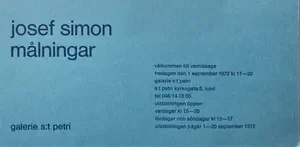
[JEANSELLEM VIEWER] — 01-20.09.1972 JOSEF SIMON — Categories: press, photo, letters — Keywords: Galerie S:t Petri, Jean Sellem, archive — Category: press — The World of the Child and the AdultAmidst the tools stood a crib. Behind it, a school shelf: a little girl sat there, immersed in a shape game, hands placed on a glass panel, eyes focused on a lightbox.Around the play area, a sense of calm and order prevailed — broken only by the child’s own activity, by speaking or playing or living.Bruno Knutman wished to show a world — a reality as perceived by a child — and so chose to only include the most essential elements of the adult world.A child’s view of the world differs from an adult’s: it is not rational. One does not need to be Freudian to understand that a child’s relation to the world is more open and fluid.This relation develops as the child becomes more self-aware. It is thus crucial to understand how much social structures and institutional frameworks influence what a child can perceive and how they combine things.If one forgets this, there is a risk of interpreting reality merely as a social process, where consciousness is either the product of reality or an external force that imposes order.But perception is not just language: the child uses images, colour and form to express what they cannot yet say. Play itself is also a form of interpretation.Thus, the artist’s task today is not to reproduce an “objective reality,” but to shape subjective perceptions and complex structures of meaning.Bruno Knutman tries to portray what it is like to live as a child — not in a childish way, but as a full existential experience.At the S:t Petri Gallery, he allowed those who know the meaning of childlike subjectivity to speak.Simple figures and objects evoke the world of children’s games, without clearly assignable meanings.This gives the exhibition an open, poetic form, where meaning drifts and resonates rather than fixes.The use of colour is also notably vibrant and sensitive.At Konstfrämjandet, the autumn series of graphic prints shows a wide range of approaches.Many of the images are direct, both in technique and expression.They depict anxiety, melancholy, unease.Women artists often depict children, women crying, foggy landscapes or memories of the sea.Many images show people alone — sitting by themselves at a table, in a garden, in the soft dusk of a late August evening. — — — “Puss” and the Justice Chancellor – Exhibition TopicsKrognoshuset opened an exhibition on Saturday featuring images and texts from the magazine Puss.According to Lars Hillerström, the main reason behind the exhibition is last year's complaint submitted to the Justice Chancellor (JK), and the previously unpublished response to that complaint.The response is now displayed on the west wall of the first floor at Krognoshuset.Also featured is the controversial drawing of former People's Party leader Krister Wickman, which has been described as antisemitic.The JK, however, acquitted him of any wrongdoing.Most of the material in the exhibition had previously been published in Puss.From September 1st to 20th, the Hungarian artist Josef Simon will exhibit around 20 paintings at the S:t Petri Gallery. — — — Category: press — Konstronden Arbetet, 09.09.1972, Torsten Weimark — Gallery CircuitGALLERY S:T PETRI, LundS:t Petri Kyrkogata 5, open Mon–Fri 3–8 pm, Sat–Sun 12–5 pm.As an introduction to viewing the very personal paintings by Josef Simon, one could say:"You must know and understand the fundamentals in order to consciously break away from them."This definitely applies to Simon: he can draw, but he has developed a visual language that avoids anything too legible or figurative.He is not a painter who tries to express thoughts through symbolic imagery – his works are consistently abstract. Perhaps fragments of sentences at best. — — — Category: press — Art (Trelleborgs Allehanda, 1 September 1972) — JOSEF SIMON, a Hungarian artist living in Stockholm, is exhibiting around 20 paintings at Gallery S:t Petri from 1–20 September.He has studied at the Academy of Fine Arts in Vienna, the Konstfack school in Stockholm, and the Beaux-Arts in Paris.Josef Simon’s painting is deeply connected to his homeland. He is especially interested in the music of Hungarian composer Zoltán Kodály.Kodály collected old folk melodies, but his own compositions, says Josef Simon, are much more advanced in comparison – and the tones become visual impressions of colour.Kodály abstracts nature; through these tones, Simon creates images of landscapes that he then attempts to reproduce on his canvases. — — — Category: press — Arbetet, Friday 1 September 1972 — Find Yourself in My Works! Motto of a Hungarian Artist LUND: Josef Simon, a Hungarian artist based in Stockholm, is exhibiting around 20 paintings at Gallery S:t Petri in Lund from 1 to 20 September.This is his first exhibition in Lund.Josef Simon studied at the Academy of Fine Arts in Vienna, the Konstfack school in Stockholm, and the Beaux-Arts in Paris.His painting is closely connected to his homeland. He is deeply interested in the music of the Hungarian composer Zoltán Kodály.Kodály collected old folk melodies, but his own music, says Josef Simon, is far more advanced in relation to those, and the tones become visual impressions of colour.LOVE AND FRIENDSHIPThrough Kodály's tones, Simon creates images of landscapes that he then tries to reproduce on canvas.Speaking about his art, Josef Simon says:— I want to free you from a dogmatic view. What is love for me may be just friendship for you. Your personal experience of my art is what matters most.— Only I can feel and understand the background of my work. But I hope you find something of yourself in it. That you come as close as possible to experiencing and understanding it. That we, together, reach a shared subjective meaning. — — — Category: press — Art – Helsingborgs Dagblad, 1972 — JOSEF SIMON, a Hungarian artist living in Stockholm, is exhibiting around 20 paintings at Galerie S:t Petri from 1 to 20 September.He has studied at the Academy of Fine Arts in Vienna, the Konstfack School in Stockholm, and the Beaux-Arts in Paris.Josef Simon’s painting is strongly connected to his homeland.He is greatly interested in the music of Hungarian composer Zoltán Kodály.Kodály collected old folk melodies, but his own music, says Josef Simon, is much more advanced compared to those traditional pieces, and the tones become visual impressions of colour.Kodály abstracts nature; through those tones, Simon creates images of landscapes that he then tries to reproduce on his canvases. — — — Category: press — SKÅNSKA DAGBLADET – Tuesday, 5 September 1972. Image caption: Josef Simon exhibits landscapes at the S:t Petri Gallery. — Hungarian Art at Galerie S:t PetriJosef Simon, a Hungarian artist residing in Stockholm, is exhibiting about 20 paintings at Galerie S:t Petri from 1 to 20 September. He studied at the Academy of Fine Arts in Vienna, the Konstfack School in Stockholm, and the Beaux-Arts in Paris.Josef Simon’s painting is deeply connected to his homeland. He is greatly inspired by the music of Hungarian composer Zoltán Kodály. Kodály collected old folk melodies, but his own music, says Josef Simon, is much more complex, and the tones become visual impressions of colour. Kodály abstracts nature. From these tones, Simon creates images of landscapes that he then attempts to reproduce on his canvases.Simon says the following about his art:I want to free you from dogmatic perceptions. What is love to me might be only friendship to you. Your personal experience of my art is what matters most.Only I can feel and understand the background of my art, but I hope you find something of yourself in it — that you can experience and understand it as closely as possible, so that together we arrive at a shared subjective meaning. — — — Category: photo — Front. Joseph Simon, photograph ©Kjell Samuelsson — — — Category: photo — Front. Joseph Simon, photograph ©Kjell Samuelsson — — — Category: photo — Back. Joseph Simon, photograph ©Kjell Samuelsson — — — Category: photo — Front. Joseph Simon, photograph ©Kjell Samuelsson — — — Category: photo — Front. Joseph Simon, photograph ©Kjell Samuelsson — — — Small portfolio published by Galerie S:t Petri for the Joseph Simon exhibition, number of copies unknown, 1972 — — — Price list of works in the exhibition. — — — Category: letters — Letter from J. Simon to J. Sellem containing an invitation card for an exhibition, 1973 1/2 — — — Category: letters — Typed letter dated 22 August and signed Josef & Gurun, addressed to Marie and Jean. — 22/8Marie and Jean,At last, we're sending the 15 photographs. We had so much trouble with the photographer. Someone had promised to help us, but then simply never showed up. In the end, we had to hire a photographer here at Sveriges Radio. He is keen that his name be mentioned in the newspapers if the photos are published. – We’ll call or speak with you more closely about how everything will go next week.Hugs and greetings,Josef and Gurun — — — Category: letters — Invitation card for an exhibition by J. Simon, 1973 2/2 — — — Receipt dated 22 July 1972, Henrik Lindståhls Bookshop — Lindståhls – an Almqvist & Wiksell companyODENGATAN 25 – 104 32 STOCKHOLM – PHONE 23 44 25CASH RECEIPTHst Deli-Fix at 2.35Total paid: 11.00 SEKVAT included in the amount: 2.66 SEKPaid atHenrik Lindståhls BookstoreStamp: July 20ᵗʰ 1972 — — — Swedish postal payment form (INRIKES POSTANVISNING) completed by J. Simon — Domestic Money OrderRecipient’s Section (to be detached by the payee)Typing or handwriting must be done using typewriter, ink, or ballpoint pen.Maximum allowed amount: 2,000 SEKSender (name and postal address):Josef SimonDalhemsstigen 218264 DjursholmMessage to the payee: (may also be written on the back)Amount: 30 kronor, 0 öre — — — Category: letters — Front. Handwritten postcard, unsent, from Sweden to Hungary (Julla ZELE Budapest), undated — — — Category: letters — Back. Handwritten postcard, unsent, from Sweden to Hungary (Julla ZELE Budapest), undated — Addressee:Zele JullaBudapest, District V5 Báthory Street, 1st floor, Apt. 3Phone: 311-836Moderna Museet StockholmWork: Changing of the Guard, 1917Artist: Otte Sköld (1894–1958)Handwritten note: Trolleybus: 78, 70