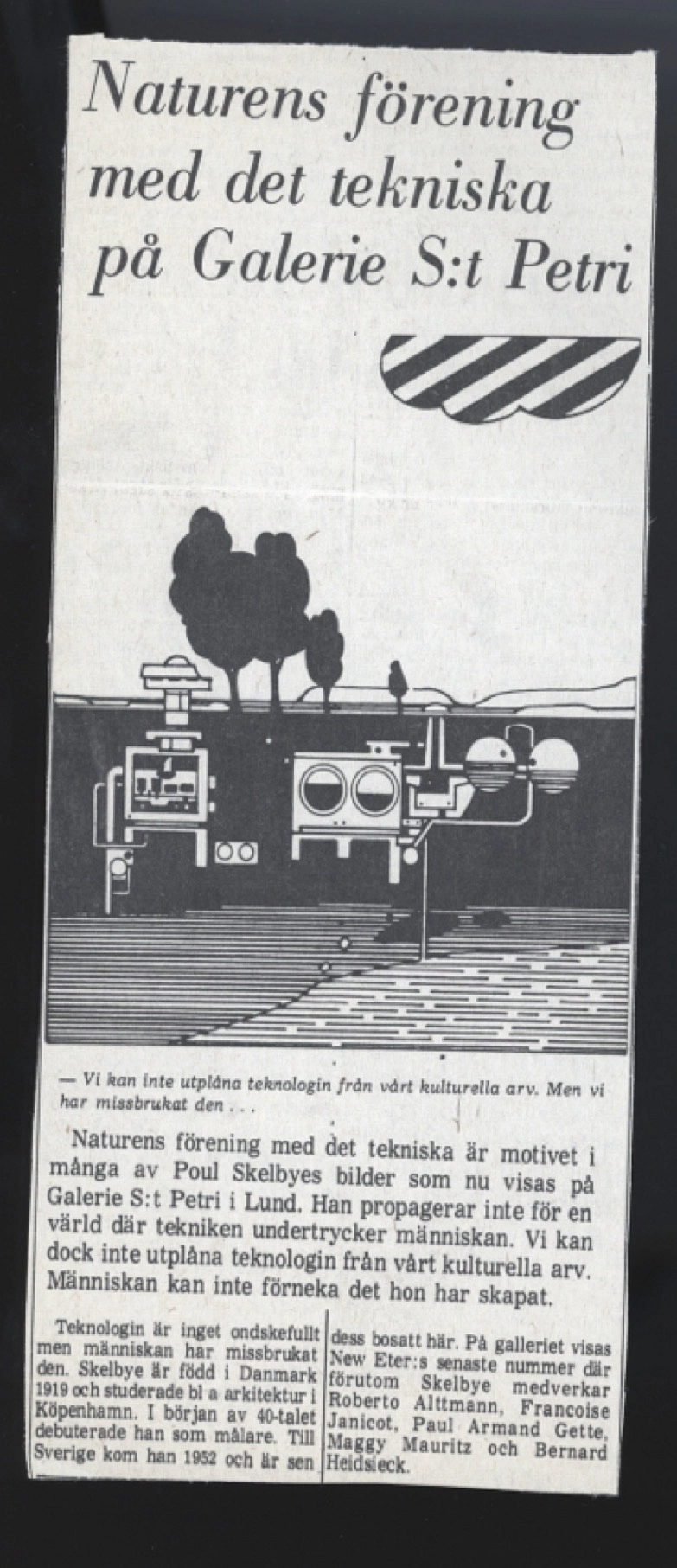
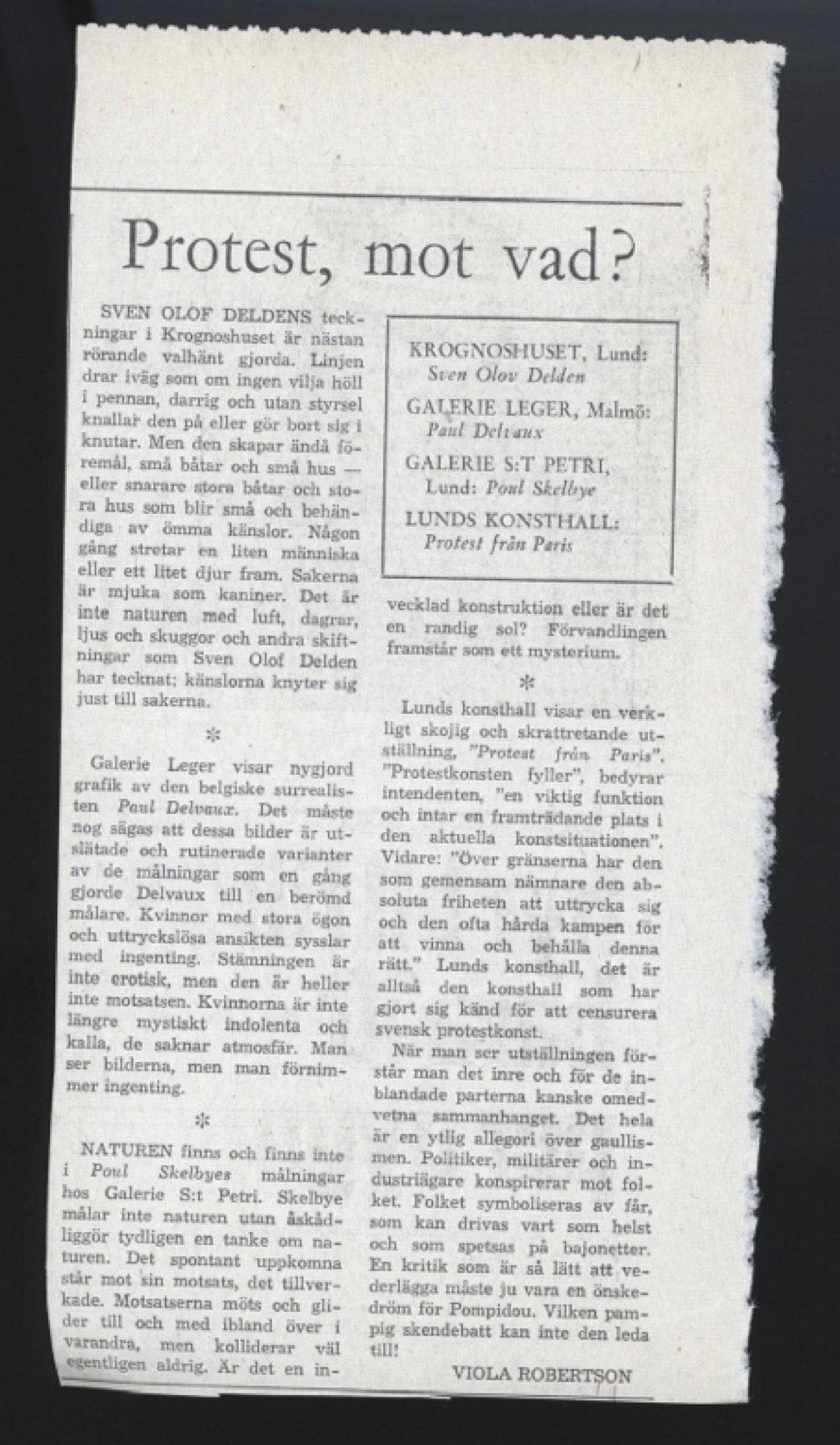
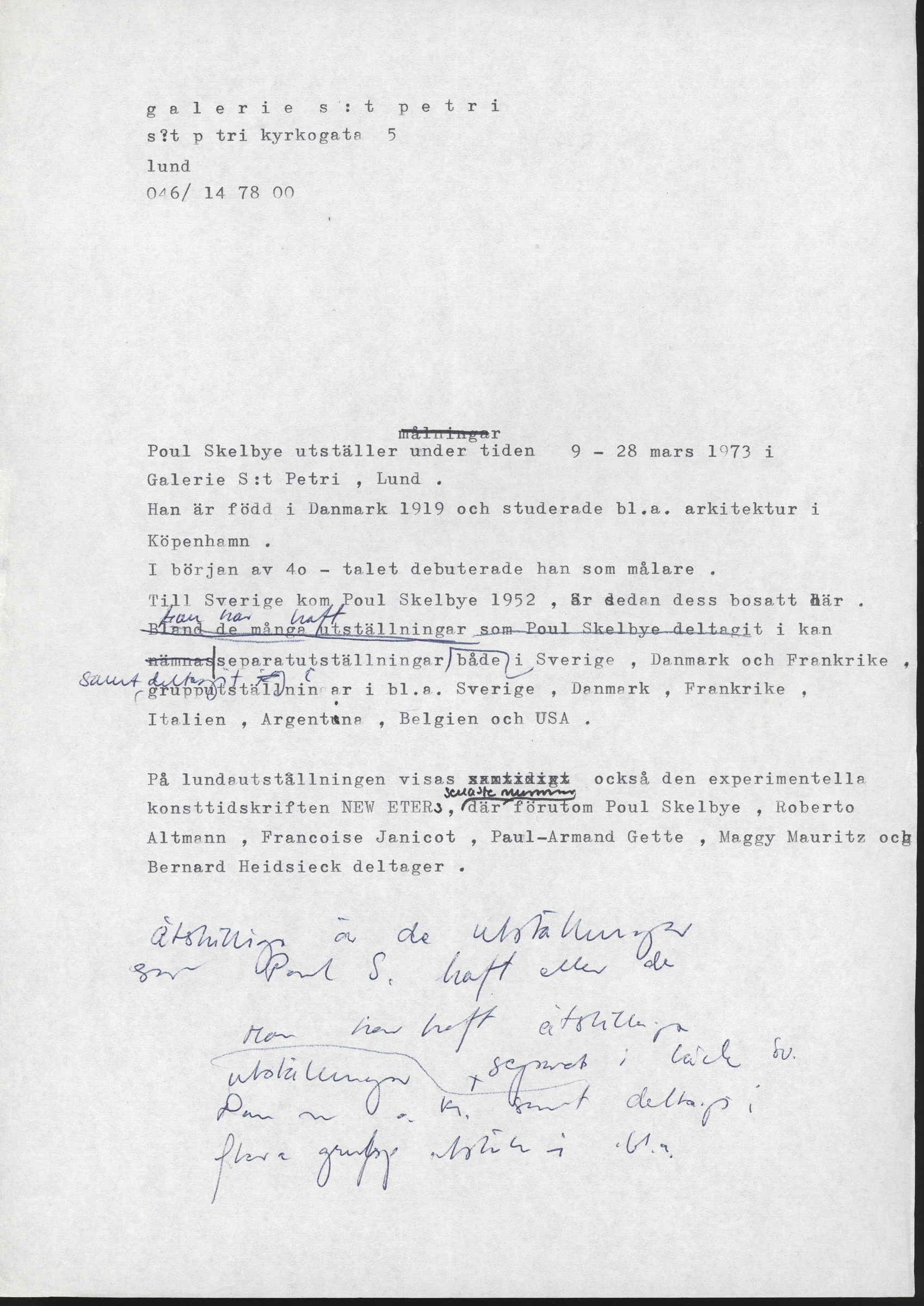
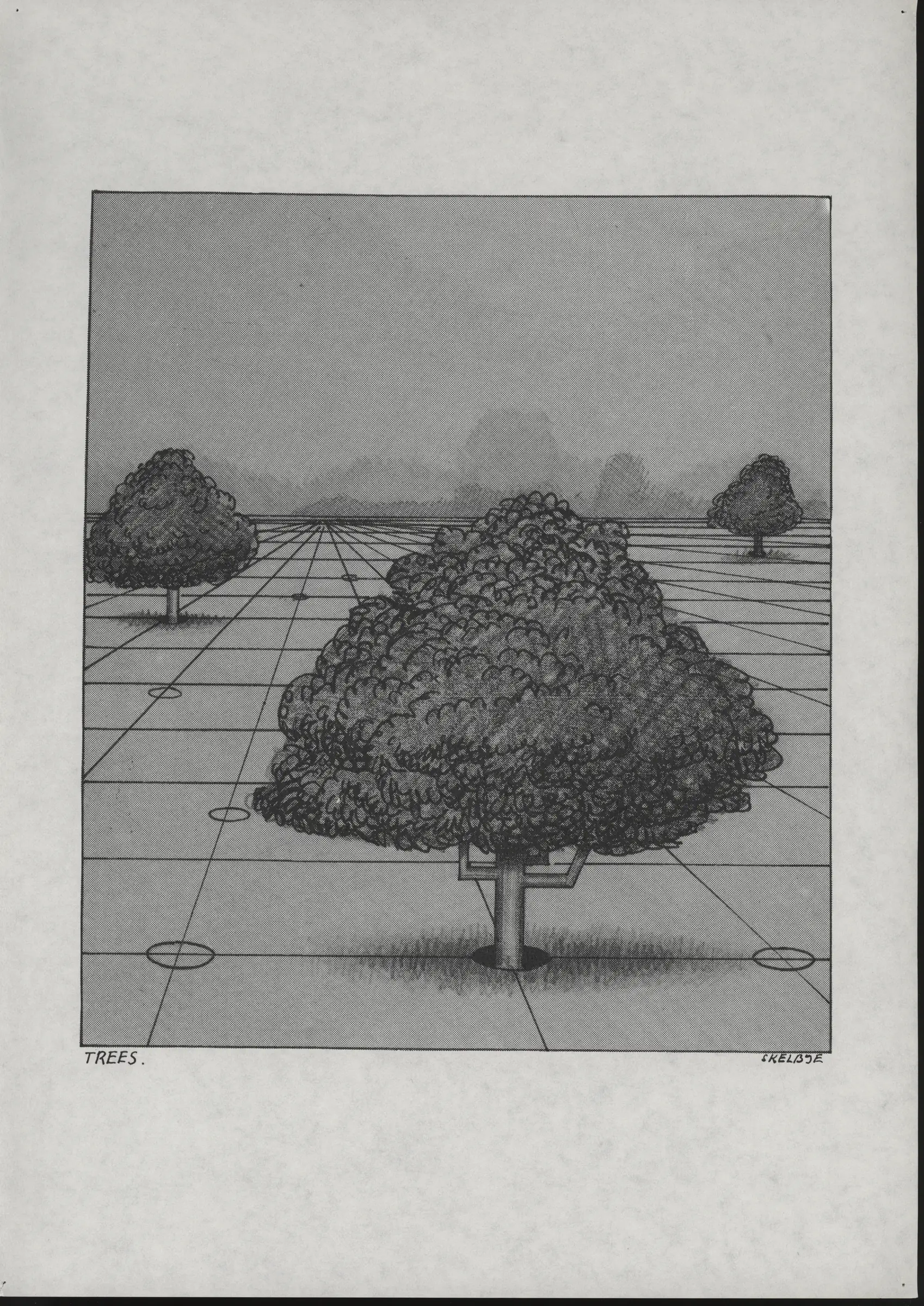
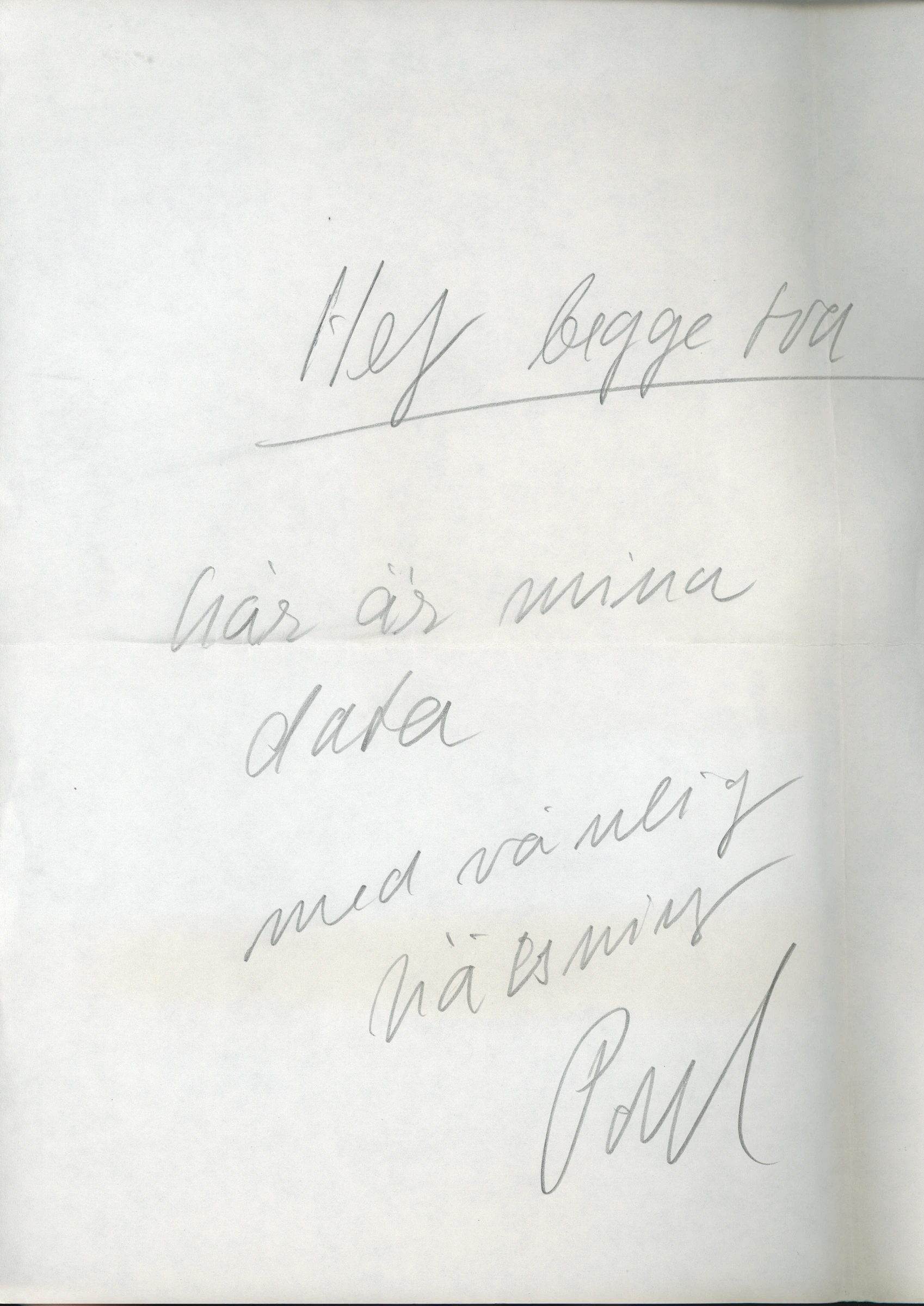
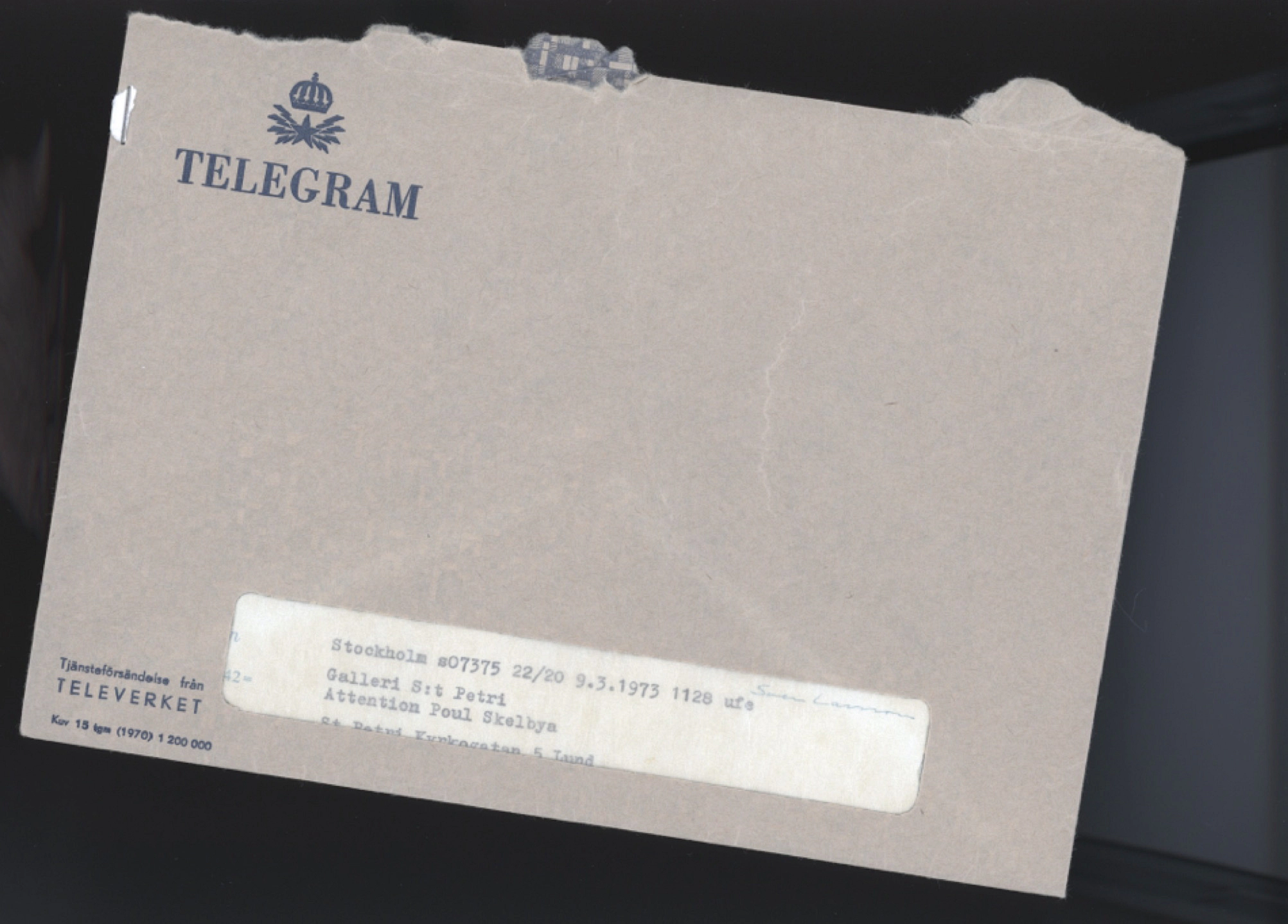
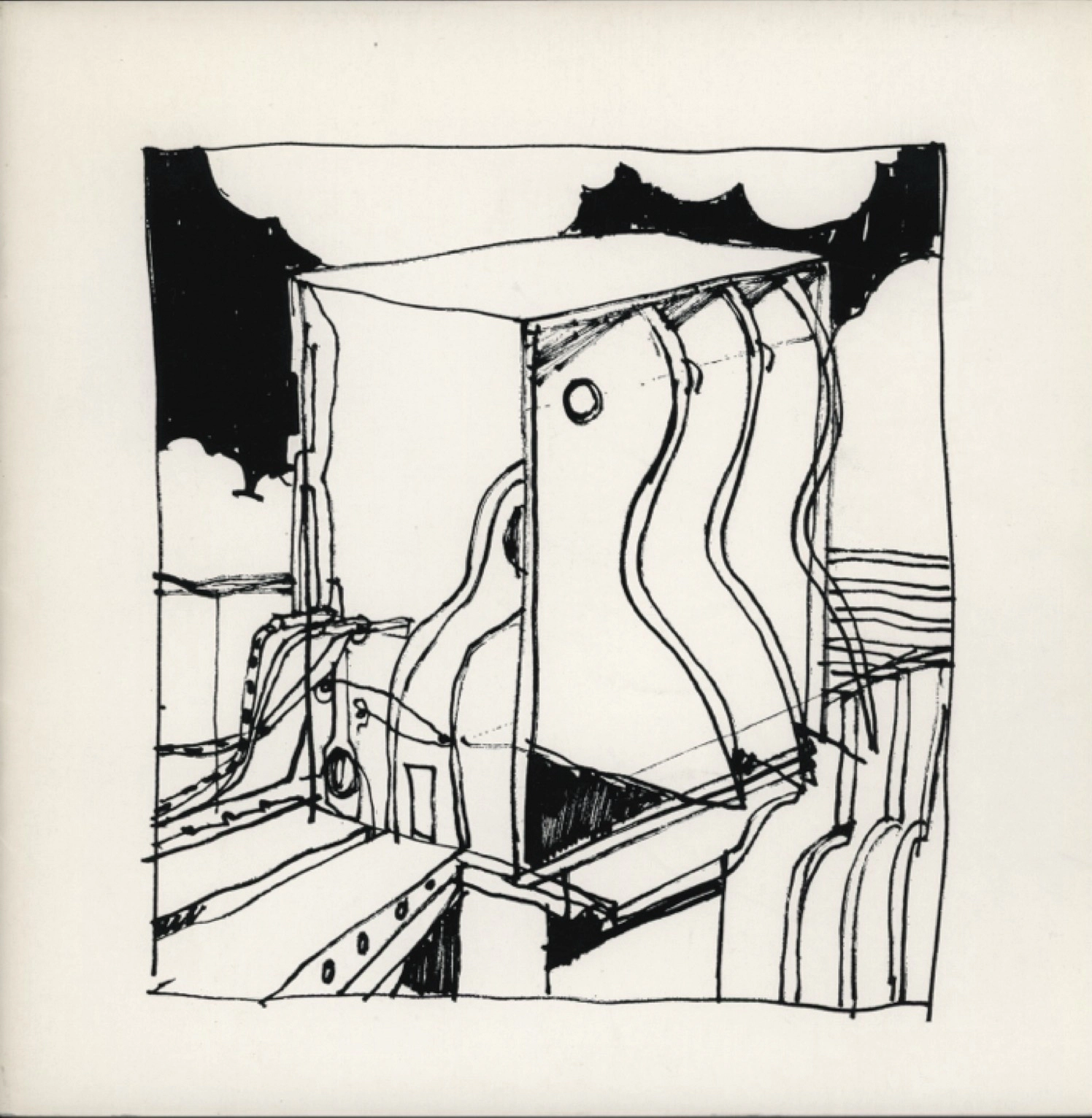
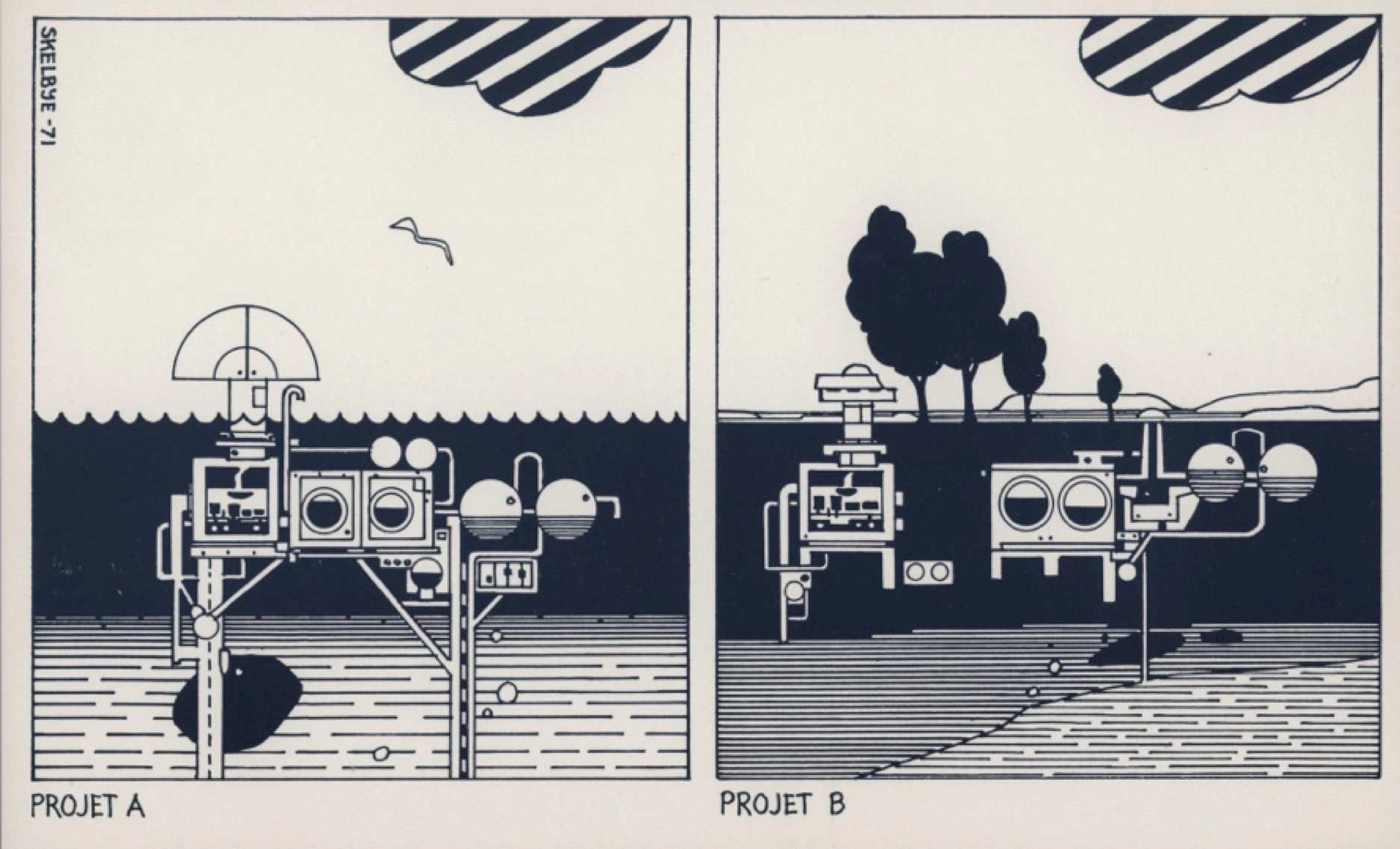
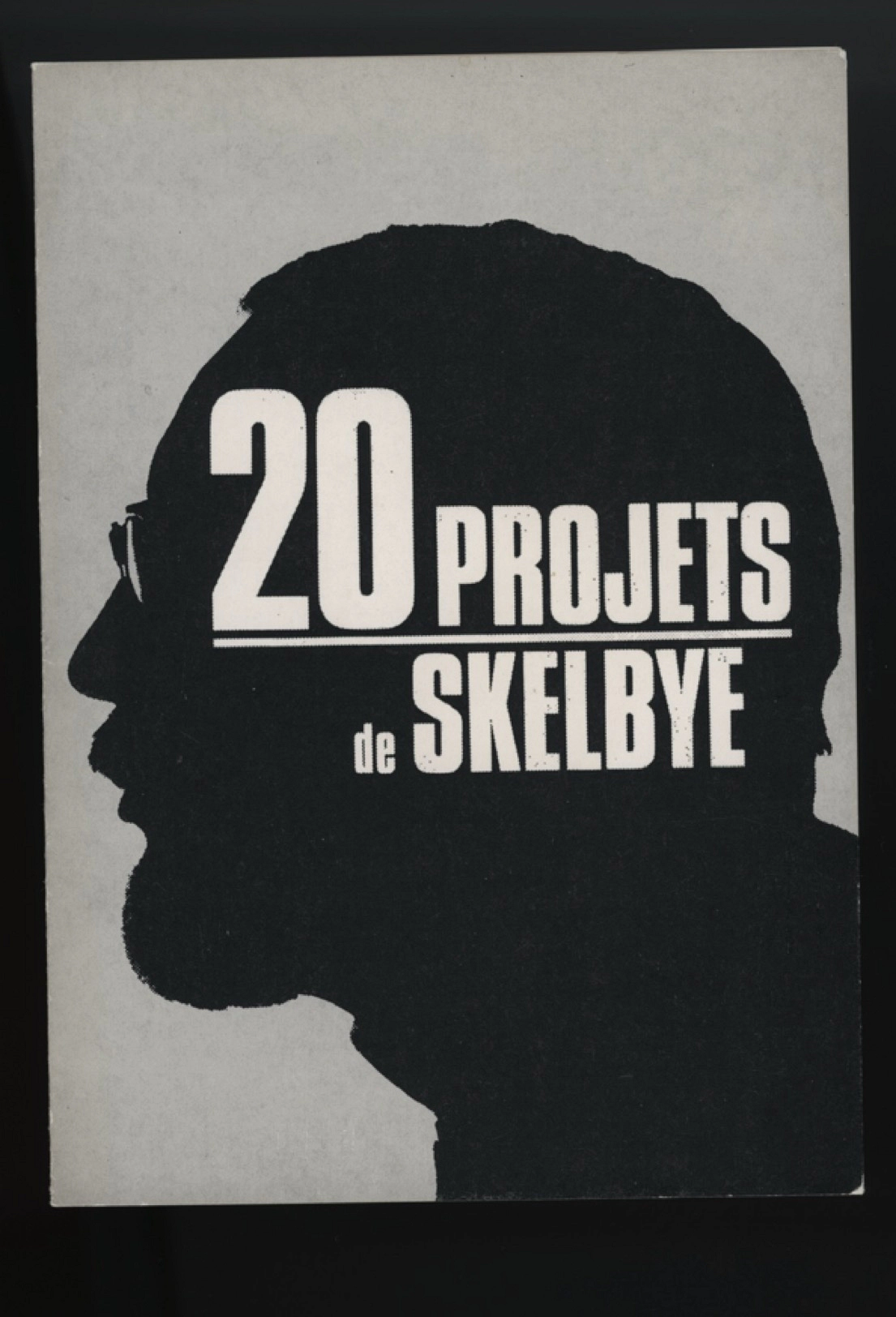
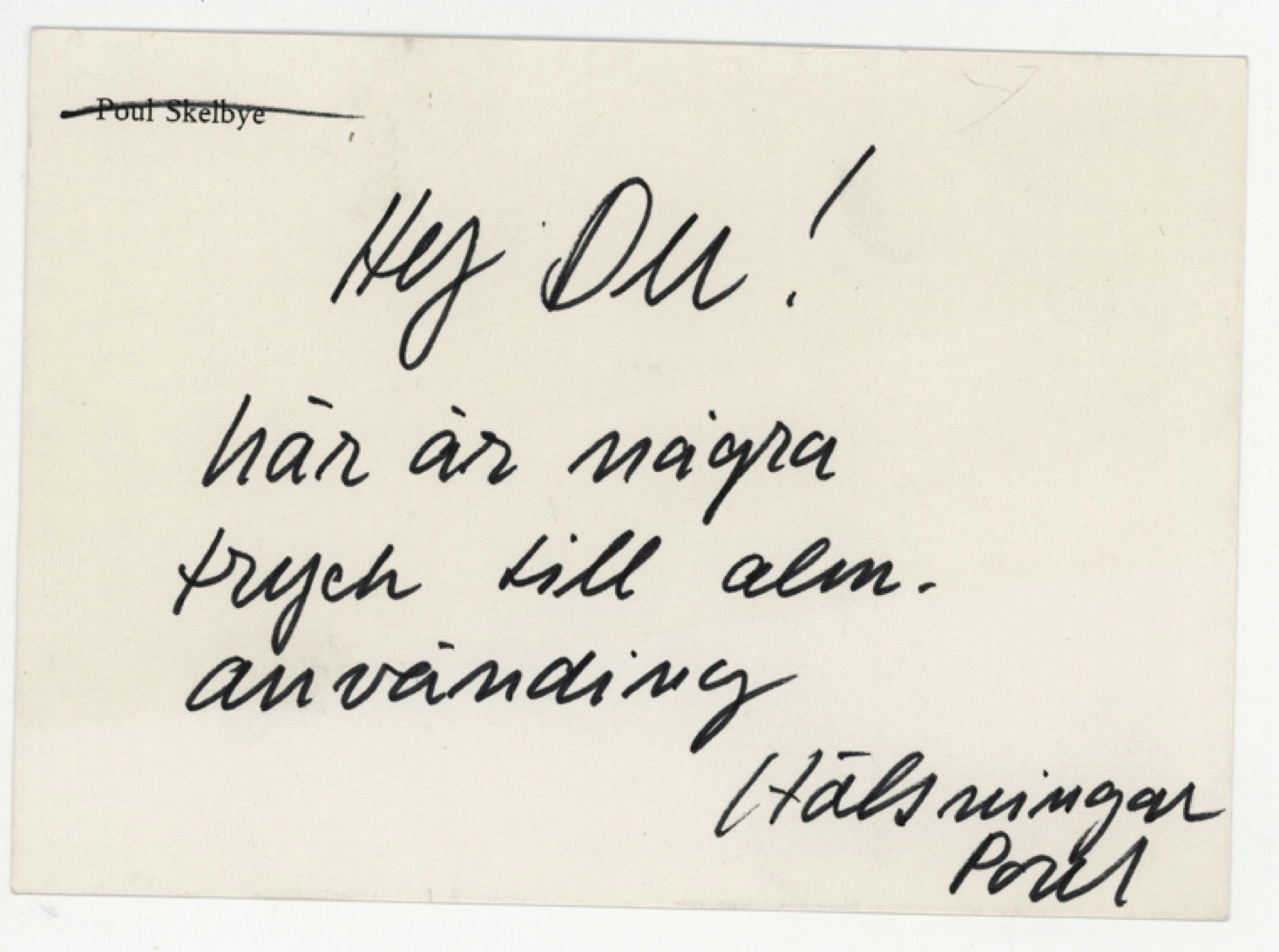
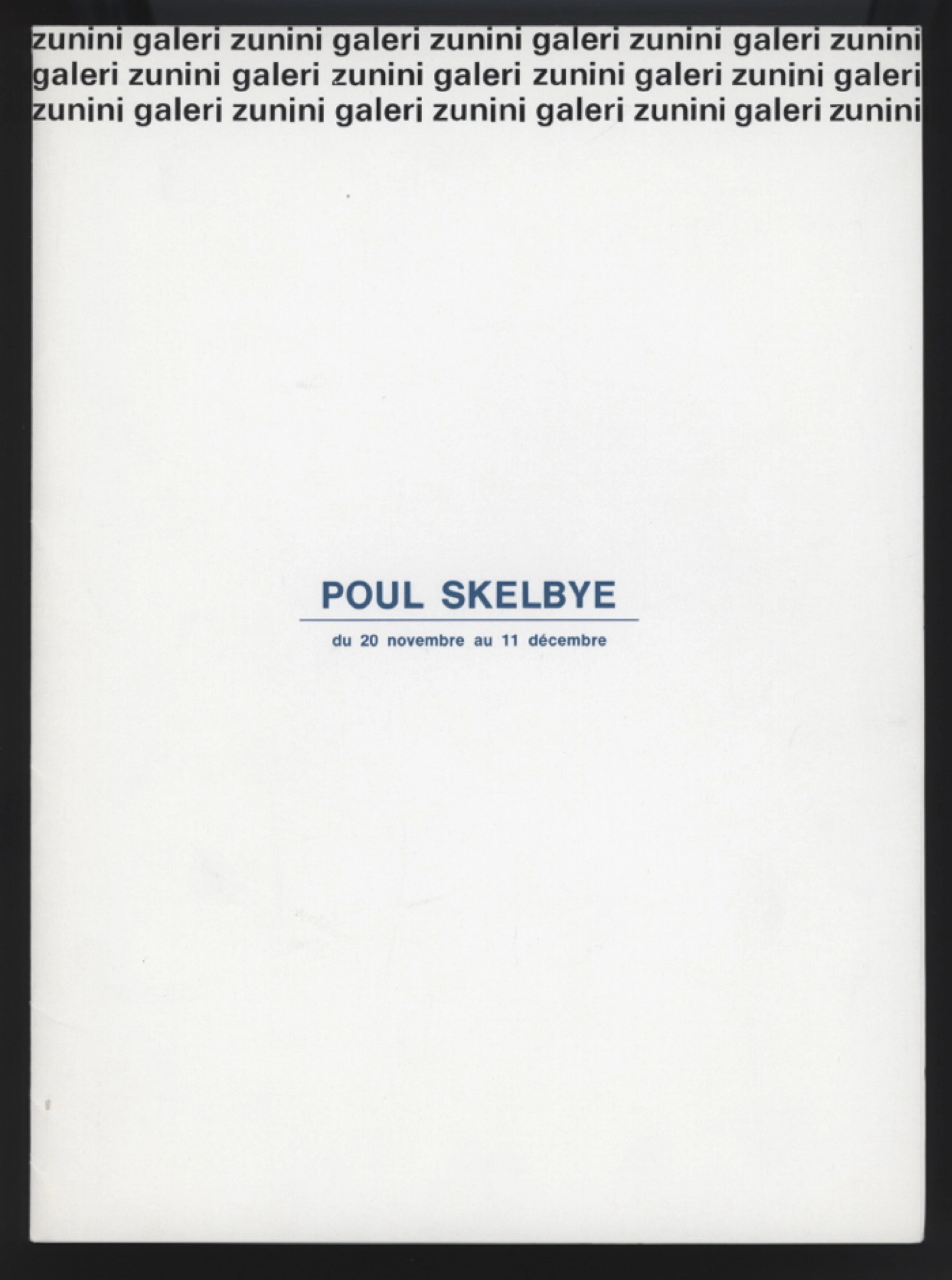
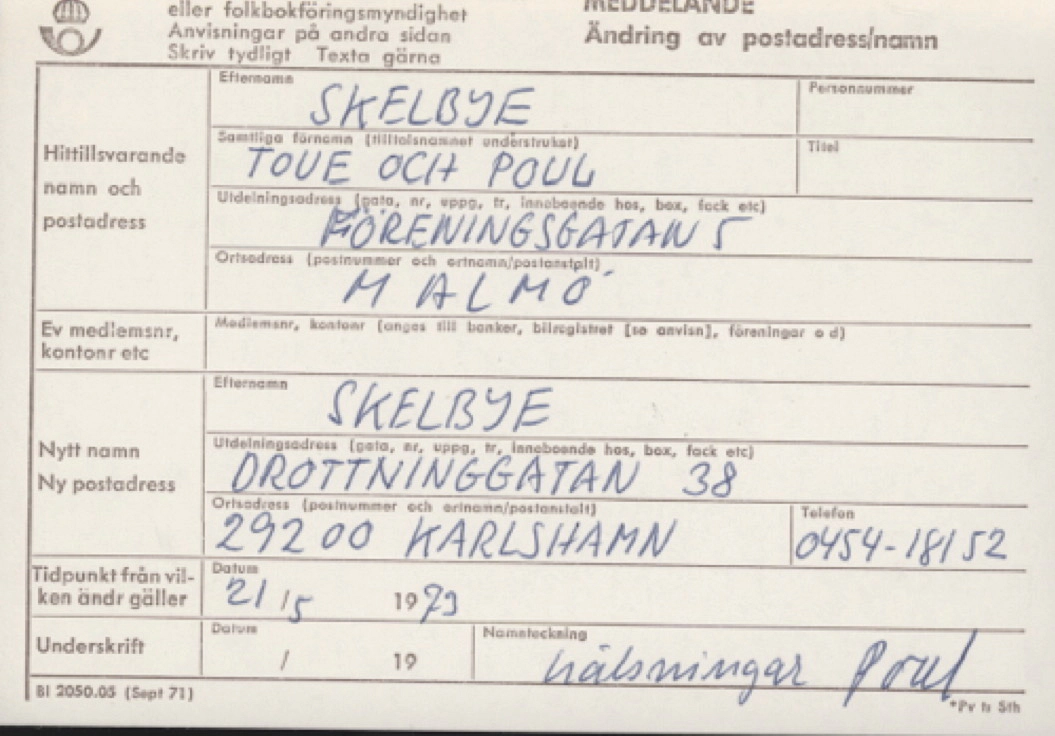
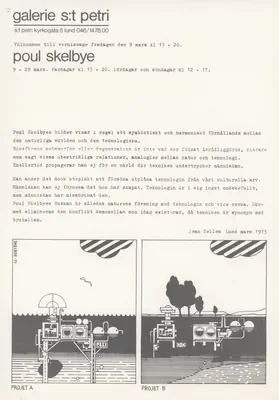
[JEANSELLEM VIEWER] — 09- 28.03.1973 POUL SKELBYE — Categories: press, docs, visual, letters — Keywords: Galerie S:t Petri, Jean Sellem, archive — Category: press — <p>Skånska Dagbladet, 9 March 1973. Press article on Poul Skelbye, “Naturens förening med det tekniska på Galerie S:t Petri” Handwritten annotation on the verso: SKD 9.3.73.</p> — The union of naturewith the technicalat Galerie S:t Petri— We cannot erase technology from our cultural heritage. But we have misused it...“The union of nature with the technical is the motif in many of Poul Skelbye’s images currently shown at Galerie S:t Petri in Lund. He does not advocate a world in which technology suppresses human beings. However, we cannot erase technology from our cultural heritage. Human beings cannot deny what they have created.Technology is not something evil, but human beings have misused it. Skelbye was born in Denmark in 1919 and studied, among other things, architecture in Copenhagen. At the beginning of the 1940s, he made his debut as a painter. He came to Sweden in 1952 and has lived here since. At the gallery the latest issue of New Eter is shown, in which, besides Skelbye, Roberto Altmann, Françoise Janicot, Paul Armand Gette, Maggy Mauritz and Bernard Heidsieck participate.” — — — Category: press — <p><em>Sydsvenska Dagbladet,</em> 23 March 1973. Press article “Protest, mot vad?”, on several exhibitions in Lund and Malmö (Sven Olof Delden, Paul Delvaux, Poul Skelbye). Handwritten annotation on the verso: SDS 23.3.73.</p> — Protest, against what?Sven Olof Delden’s drawings at Krognoshuset are almost touchingly well made. The line runs off as if no will held the pen, trembling and without direction, it moves on or tangles itself in knots. Yet it still creates objects, small boats and small houses, or rather large boats and large houses that become small and manageable through tender feelings. At times, a small human being or a small animal struggles forward. Things are soft like rabbits. It is not nature with air, daylight, light and shadow and other variations that Sven Olof Delden has drawn; the feelings attach themselves precisely to the objects.*Galerie Leger presents recent prints by the Belgian surrealist Paul Delvaux. It must probably be said that these images are smoothed-out and routine variations of the paintings that once made Delvaux famous. Women with large eyes and expressionless faces are occupied with nothing. The atmosphere is not erotic, but neither is it the opposite. The women are no longer mysteriously indolent and cold; they lack atmosphere. One sees the images, but one perceives nothing.*Nature exists and does not exist in Poul Skelbye’s paintings at Galerie S:t Petri. Skelbye does not paint nature but rather makes visible a thought about nature. The spontaneous calls forth its opposite, the manufactured. The opposites meet and even sometimes slide into one another, but never really collide. Is it a complex construction or a finite sun? The transformation appears as a mystery.*Lunds konsthall presents a truly factual and ironically amusing exhibition, “Protest from Paris”. “Protest art fulfills,” asserts the curator, “an important function and occupies a prominent place in the current art situation.” Furthermore: “Across borders it has as a common denominator the absolute freedom to express oneself and the often harsh struggle to win and maintain this right.” At Lunds konsthall — that is, the art hall known for having censored Swedish protest art. When one sees the exhibition, one understands the internal and perhaps unconscious connection for the parties involved. The whole is a superficial allegory of Gaullism. Politicians, military figures and industrial leaders conspire against the people. The people are symbolised as sheep that can be driven anywhere and impaled on bayonets. A critique so easy to refute must be a dream for Pompidou. What pompous pseudo-debate that may lead to.VIOLA ROBERTSON — — — Category: docs — <p>Exhibition preparation document, typewritten text relating to the publication <em>New Eter</em>, presenting the artists Roberto Altmann, Paul-Armand Gette, Bernard Heidsieck, Françoise Janicot, Maggy Mauritz and Poul Skelbye. Document connected with the presentation of <em>New Eter </em>in the context of Poul Skelbye’s exhibition at Galerie S:t Petri, Lund, 9–28 March 1973.</p> — galerie s:t petris:t petri kyrkogata 5lund046/ 14 78 00paintingsPoul Skelbye exhibits during the period 9–28 March 1973 atGalerie S:t Petri, Lund.He was born in Denmark in 1919 and studied, among other things, architecture inCopenhagen.At the beginning of the 1940s he debuted as a painter.Poul Skelbye came to Sweden in 1952 and has lived here since.[deleted: Among the many exhibitions in which Poul Skelbye has participated may be mentioned solo exhibitions in Sweden, Denmark and France][handwritten note: he has had a number of exhibitions][handwritten note: solo and group][handwritten note: exhibitions][handwritten note: in Sweden][handwritten note: Denmark and France][handwritten note: as well as abroad e.g.]group exhibitions in, among others, Sweden, Denmark, France,Italy, Argentina, Belgium and USA.At the Lund exhibition, the experimental art journal NEW ETER is also shownsimultaneously, where, in addition to Poul Skelbye, RobertoAltmann, Françoise Janicot, Paul-Armand Gette, Maggy Mauritz andBernard Heidsieck participate.[handwritten note at bottom][illegible] — Roberto Altmann Paul-Armand Gette Bernard Heidsieck Françoise Janicot Maggy Mauritz Pouk Skelbye → … do not constitute a group, although they sometimes appear together. The only feature that unites them, as in the experimental art journal New Eter, is non-conformism. Roberto Altmann – painter, engraver, draughtsman – perfectly masters the media in order to make us discover his “hypergraphics” or drawn bands. About these, xxx can without exaggeration be said to be entirely outside our world. Paul-Armand Gette does not deal with colour effects but prefers to record temperature variations. He uses methods borrowed from the scientific field, but applies them differently. Bernard Heidsieck – a poet who works with tape recorders, sound tapes and recordings – also produces text-collage series: “Les foules” and “machines à mots”. Françoise Janicot – painter, who above all photographs. She is obsessed with hidden things, hides herself or her drawings (“dessins cachés”). Maggy Mauritz – painter who explores signs and fibres and engraves them. Poul Skelbye shows us a very precise vision in the form of plans or projects of his world. Here it is not a question of confused assumptions but of a super-reality, where trees are mechanically but correctly rendered, where the earth usually lies ploughed under a natural sky whose clouds are striped, where women from another century are enclosed in a display case originating from some museum. NEW ETER — — — Category: docs — <p>Typewritten working text, preparatory draft for Poul Skelbye’s exhibition at Galerie S:t Petri, Lund, [1973]. The document formulates principles for reading the work, notably the relationship between nature and technology.</p> — Poul Skelbye’s images generally show a symbiotic and harmonious relationship between the natural world and the technological one.The metamorphosis of the biosphere or its degeneration is not what is presented to the viewer, but rather, as already stated, certain indisputable relations, analogies between nature and technology.However, he does not advocate for a world in which technology oppresses human beings.He nevertheless considers it utopian to attempt to eliminate technology from our cultural heritage. Human beings cannot deny what they have created. Technology in itself is not something evil, but humans have misused it.Poul Skelbye’s wish is thus the union of nature with technology and vice versa. In this way, the conflict between them that exists today would be eliminated, since technology is synonymous with brutality. — — — Category: press — <p>Typewritten working text with handwritten corrections, revised version of a preparatory draft for Poul Skelbye’s exhibition at Galerie S:t Petri, Lund, 1973. Handwritten annotation: “Jean Sellem, Lund, March 1973”.</p> — Poul Skelbye’s images generally show a symbiotic and harmoniousand [handwritten insertion: and] [deleted: and aesthetic] relationship between the natural world and thetechnological one. The metamorphosis or degeneration of the biosphere is not what is primarilymade visible, but rather, as x has said, certain indisputable relations, analogies between nature and technology.However, he does not advocate a world in which technology oppressesthe human being. He nevertheless considers it utopian to try to erase technology fromour cultural heritage. Human beings cannot deny what they have created.Technology is in itself nothing evil, but human beings havemisused it. Poul Skelbye’s wish is thus the union of nature with technologyand vice versa. Thereby the conflict between them whichexists today is eliminated, since technology is synonymous with brutalism.[handwritten annotation]JEAN SELLEMLUND, MARCH 1973 — — — Category: docs — Poul Skelbye’s images generally show a symbiotic and harmonious relationship between the natural world and the technological one.The metamorphosis or degeneration of the biosphere is not what is primarily made visible, but rather, as stated, certain indisputable relations, analogies between nature and technology. However, he does not advocate a world in which technologyoppresses human beings. He nevertheless considers it utopian to attempt to eliminate technology from our cultural heritage. Human beings cannot deny what they have created. Technology in itself is not something evil, but human beings have misused it. Poul Skelbye’s wish is thus the union of nature with technology and vice versa. Thereby the conflict between them which exists today is eliminated, since technology is synonymous with brutalism.What is striking in the plastic formulation in Poul Skelbye’s work, from a psychological, historical as well as scientific point of view, is not only the connection or the relation between the functional and the rational, but even more the same feeling, the same future vision, which one finds among different creators, a creative need, an obsession where intuition is sine qua non with the eternal complexity of moving matter; the rational represents the development of all living forces, the functional represents the disturbances that have been caused by human actions.Let us listen to the rustling of the tree, which grows in the courtyard:jean sellemlund, march 1973 — — — Category: visual — <p>Black-and-white reproduction of a work by Poul Skelbye.</p> — Poul Skelbye. Handwritten note, undated. Loose sheet accompanying the shipment. — — — Category: letters — <p>Envelope and contents of a telegram addressed to Galerie S:t Petri, for the attention of Poul Skelbye, sent from Stockholm on 9 March 1973. Congratulatory message signed by Karl-Erik.</p> — [envelope]TELEGRAMStockholm 807375 22/20 9.3.1973 1128 ufeGalerie S:t PetriAttention Poul SkelbyaSt Petri Kyrkogatan 5 Lund[handwritten note: Sven Lann…] [illegible] — [content]telegramFromStockholm s07375 22/20 9.3.1973 1128 ufeGalerie S:t PetriAttention Poul SkelbyaSt Petri Kyrkogatan 5 LundGood luck.I will come another day and have a lookKarl-ErikIN SUPPORT OF THE STRUGGLE AGAINST HEART AND VASCULAR DISEASES — — — Category: docs — <p>SDS-Hallen, Malmö. Exhibition catalogue, 1970. Printed by Sydsvenska Dagbladets AB, Malmö.</p> — SDS-Hallen, Malmö. Exhibition catalogue, 1970. Printed by Sydsvenska Dagbladets AB, Malmö. — — — Category: docs — <p>Poul Skelbye. Project A and B, 1971. Printed document.</p> — Poul Skelbye. Project A and B, 1971. Printed document. — — — Category: docs — <p>Galerie Le Soleil dans la Tête, Paris. Invitation card for the exhibition of Poul Skelbye, 4–25 May 1971.</p><p>Includes a handwritten card by the artist</p> — Galerie Le Soleil dans la Tête, Paris. Invitation card for the exhibition of Poul Skelbye, 4–25 May 1971. — Inside of the invitation card:GalleryLE SOLEIL DANS LA TÊTE ("The sun in the head")10, Rue de Vaugirard, Paris 6th · Odéon metroPoul Skelbye, born in 1919 in Kastrup, Denmark. Begins studying building techniques and architecture in Copenhagen. Starts as a painter in the same city in 1943. First solo exhibition in 1944. Then works as an illustrator and layout designer, then for a certain time as an architect for industrial exhibitions. Settles in Sweden in 1952.Solo exhibitions.Copenhagen art gallery.S. D. S. Hallen, Malmö.Galerie Zunini, Paris.Group exhibitions.Kunstrenes Efterårsudstilling, Copenhagen. Young Danish Art, Galerie Moderne, Silkeborg. Skånes Konstförening jubilee, Malmö Museum. Skånes Konstförening, Lunds Konsthall. Stockholm Salon, Liljevalchs Konsthall. Multiplication, Södertälje Konsthall.Galerie Zunini, Paris. Museum of Fine Arts, Le Havre. Museum of Fine Art, Nantes. Salon XI Grand et Jeunes d’aujourd’hui, Paris. International Book Festival of Nice. Art in the City Manifestation, Fontainebleau.La Galleria de “Il GIORNO”, Milan.“Museo Dr. Genaro Pérez”, Córdoba, Argentina.Exhibitionfrom 4 to 25 May 1971.Openingon 4 May 1971from 6 p.m. to 9 p.m. — (Small handwritten card)Hi you!here are someprints for generaluseGreetingsPoul — — — Category: docs — <p>Galerie Zunini, Paris. Invitation poster, 1968</p> — Galerie Zunini, Paris.Invitation poster (folded publication) for the exhibition of Poul Skelbye,20 November – 11 December 1968. — — — Category: docs — Swedish administrative form for change of address (and name), completed and signed by Poul Skelbye, 1973
CLICK TO VIEW PRESS RELEASE
POUL SKELBYE
09- 28.03.1973
POUL SKELBYE09- 28.03.1973
Galerie S:t Petri S:t Petri Kyrkogata 5 Lund 046/14 78 00
Poul Skelbye exhibits paintings during the period 9–28 March 1973 at Galerie S:t Petri, Lund. He was born in Denmark in 1919 and studied, among other things, architecture in Copenhagen. In the early 1940s, he debuted as a painter.
Poul Skelbye came to Sweden in 1952 and has lived here since.
He has had numerous solo exhibitions in both Sweden, Denmark, and France, as well as participated in several group exhibitions in, among others, Sweden, Denmark, France, Italy, Argentina, Belgium, and the USA.
At the Lund exhibition, the latest issue of the experimental art magazine NEW ETERs is also presented, with contributions from, besides Poul Skelbye, Roberto Altmann, Françoise Janicot, Paul-Armand Gette, Maggy Mauritz, and Bernard Heidsieck.