

CLICK TO VIEW PRESS RELEASE
BARRY BRYANT
M
17.05.1972
BARRY BRYANTM17.05.1972
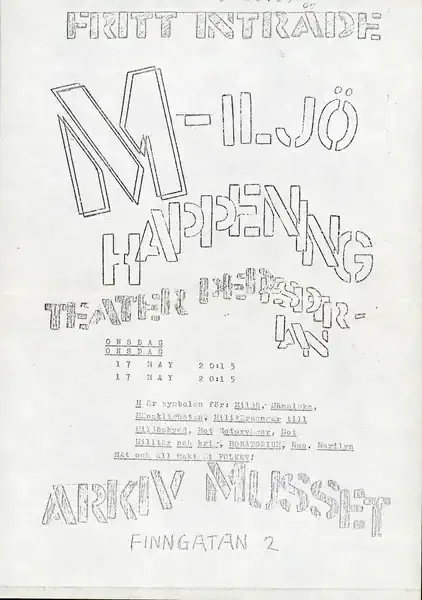
[JEANSELLEM VIEWER] — 17.05.1972 BARRY BRYANT — Categories: press, photo, letter, poster, invitation — Keywords: Galerie S:t Petri, Jean Sellem, archive — Category: press — “The ‘M’ on Stortorget in Lund”Barry Bryant and Flemming Röder, representing Teater Pedestrian, take this opportunity to explain their view of the environment and how Teater Pedestrian acts in this context — and they describe the “M” painted on Stortorget in Lund.Teater Pedestrian’s exhibition and the painting of the “M” on Stortorget in Lund have attracted attention of various kinds. Among other things, it has been mentioned in a letter to the editor (SDS 27/5) in disparaging terms.Let the “M” rest in peace: it was painted on 17 May at 3 a.m. by friends of the environment, as part of Teater Pedestrian’s exhibition “Smakprov på M” (“A Taste/Preview of M”) at the Arkivmuseet in Lund.The “M” (5 × 5 metres), a public artwork, was executed in less than a minute in light blue, light orange and white. The origin and meaning of the letter—as a comment on a local art forum—are just as much in harmony with the “environment” as Lund’s historic artworks and buildings. As the rumour has it, the “M” also expresses its own time: it reaches beyond time; it is now available to everyone and will eventually disappear. We can all regard it as ours.The meaning of Stortorget’s “M” (like Teater Pedestrian’s “No Traffic”, painted on Madison Avenue on commission from New York’s mayor Lindsay) becomes clear as soon as it is placed in the right context. The “blue Stortorget” lies very close to Lund Cathedral (Finn’s “temple”) and in front of the City Hall: the latest acquisition, a Chillida sculpture (for almost half a million kronor), has been erected in front of the newest building. At the same time as Lund inaugurated Chillida’s sociologically significant black granite sculpture, Teater Pedestrian performed a “silly” theatre piece titled “M”, conceived as an act of collective creation.The “M” is an “urban scape” painting of the kind that Pontus Hultén, Gunnar Bråhammar and many other art experts around the world have accepted as art. Like Teater Pedestrian’s earlier works, Stortorget’s “M” was carried out by the people for the people. It reflects the attitude of an alternative society: no money — art free — no money; and it was painted in a spirit of collective creation, as so-called “primitive” art once was.Teater Pedestrian’s action clearly shows how the artist expresses commitment: art as art, environment as environment, art as environment and environment as art. The “M” painted on Stortorget’s stone paving is a prompt to reflect both on society’s oppression of the individual and on the difference in attitude between the generation that buys art and the generation that recognises the importance of free art.The “M” represents the anger the artist feels at the destruction of our planet—a destruction that is partly financed by the fact that staggering sums continue to be paid for artworks. The same money could be used to sustain artists and to build community centres where free art could be created.“M” as a symbol of our environment makes us aware of:1) the environment in itself,2) what the environment means to us,3) what we do—or fail to do—to protect the environment,4) our understanding of the environment.It has been claimed that painting the “M” on Stortorget is “environmental destruction”. Before we assert that, we should ask what the word “environment” means. The definition (words to explain) reads: “surroundings, the world around us, field of activity”. According to that interpretation, the “M” is not environmental destruction, but environment; and Teater Pedestrian’s action concerns the “environment”.If we ask ourselves what “environment” means, we should first ask what environment means for Skåne, for the Nordic region, and what the Nordic region means for the rest of the world. Rather than condemning those who painted the “M”, the people of Lund who react to what happened should perhaps try to understand what Teater Pedestrian is trying to say with its action. Then it also becomes possible to understand why Gunnar Bråhammar invited them to come to Lund. It also becomes possible to grasp what is happening outside this “environment”: people everywhere in the world are dissatisfied with social, economic, political and cultural conditions.“M” stands for Miljö, Människa, Möjlighet—Environment, Human Being, Possibility. It is a sign against war, hunger, poverty and environmental destruction. The “M” reminds us of oppression around the world.The Arkivmuseet invited Teater Pedestrian so that, through their performance and exhibition, they could express their commitment. As thanks for this, the exhibition has been interrupted, and the city authorities are talking about erasing a public, free work of art and demanding that those involved be brought before the courts. If that is the case, then Gunnar Bråhammar and others should be as well.The artwork the Arkivmuseet should be proud of is “New Deal” by Diego Rivera, who—by working with “environment” as a condition—managed to bring the revolutionaries’ exhibition into local art institutions. Rivera writes:“With Rockefeller’s money (i.e., the money the Rockefeller lords sucked out of the workers) I painted a suite of 21 images at the New Worker’s School in New York. Rockefeller tried to prevent me from speaking to the people by destroying the fresco at the Center. In reality they only made my expression clearer, more intense and more human… I painted it for New York’s workers and for the first time in my life I worked among my own; for the first time I painted on a wall that belonged to the workers.”“New Deal”, picture no. XV. Diego Rivera, Mexico City, Feb. 1934.Doesn’t the behaviour of the Arkivmuseet and the city of Lund reflect the same kind of oppression that Rockefeller practised? Aren’t Swedes in 1972 as oppressed as Americans in 1934?Barry Bryant Flemming Röder — — — Category: photo — The “M” will be very expensive to remove from the paving stones. — Does “MILJÖ-M” improve the environment in Lund?By Mats NihlénLUND: The environment must be protected! That is the view of the American artist Barry Bryant. Together with eight companions, he therefore painted a large part of Stortorget in Lund early on Wednesday morning.Using bright colours, the environmental activists painted a large “M” right next to the Child sculpture. — This is clear vandalism, says Carl-Eric Holmberg, head of the municipal building department, adding that he intends to report the incident to the city council. We will probably try to identify those responsible. We are very upset about what has happened.After discussions with Carl-Eric Holmberg, however, it appears that the act will not be classified as vandalism. — Whoever did this photographed themselves and left a large part of the equipment at the site, which makes the whole thing rather unusual, he said.A police investigation may nevertheless be required. In an interview with Arbetet yesterday, Barry Bryant admitted that he was one of the people behind the “work.” — Early Wednesday morning, I and eight others painted the square. The action can be seen as a contribution to the environmental debate.POINTLESS— A completely pointless contribution, says Larry Andow, night watchman at the City Hall, who was the one who discovered the damage in the morning. — How can one claim to defend the environment while at the same time messing things up like this, he wonders indignantly.EXPENSIVEThe vandalism may become a costly affair for the city of Lund. In the worst case, the painted paving stones will have to be removed and replaced with new ones, which could cost tens of thousands of kronor.Carl-Eric Holmberg, head of the municipal building department: — From earlier experience, I know that removing this kind of paint is very expensive. The last time someone painted the square, it was extremely difficult to get the paint off.This is not the first time Barry Bryant has acted in this way. He has previously demonstrated in the USA, among other places by writing slogans on Madison Avenue in New York. He has also been active in Denmark, where he has made many enemies. In Lund, after this action, he is likely to be anything but popular.Carl-Eric Holmberg: — I could hardly believe my eyes when I saw what he had done. How can anyone even come up with something like this?Larry Andow: — Because of this action, the municipality will have to spend several thousand kronor. That money could have been used for something far more useful, for example environmental initiatives! — — — — — Front — — — Back — — — insert[crossed out]page 3 #2uttering the words of the phoenix bird rising out ofthe ashes:plastic to plasticdust to dustcloset to closetmust to rustplastic to plasticdeath to deathmouth to mouth to moth[moth to mouth is an allusion to a prophecyin the Bible (possibly the Book of Daniel) in whichit is said that the old order shall hang in thecloset like old garments and be consumed by moths.]butterflyjaponaiserieto commit suicide by societyAntonin Artaud suffered greatlyXXX[signature]19/8/72 — — — For grain land. 1967–72 Money Madness Making Mass Myth - signe Barry — — — Category: letter — Document p.1/2 — The Rebirth of the M[handwritten addition: sorrow / spontaneism]Teater Pedestrian, a street-theatre group, was founded in New York in 1970.On Madison Avenue, enormous letters were painted reading:NO TRAFFIC – OXYGEN.Automobile traffic was stopped. The theatre group wished to protestagainst an increasingly unhealthy, mechanised society —a society that almost completely ignores the existence and rightsof the individual human being.From this theatre collective emerged, some time ago,the much-debated “M”.Kastrup became the first location in Scandinavia for Teater Pedestrian’sM-actions. An M measuring xxxx metres was painted in the autumn of 1971near the airport.Marigolds and daisies were planted as a silent protest against aircraftnoise. This was followed by actions at the following locations:Copenhagen (Christiania, January 1972), Lund (May),Sturup (June), Stockholm (Moderna Museet, Environmental Forum, June),and Kassel (alternative Documenta, July).Teater Pedestrian is currently more concerned with inner humandifficulties than with external environmental problems.The aim is to free the human being from material captivity,to rescue her from a destructive, polluted society,and to give her the opportunity for self-realisation. — — — Category: press — Document p. 2/2 — On St. Lucia’s Day, the M was reborn near the Childida sculpture.Against the background of these facts, one may perhaps more easilyunderstand why the M reappeared on St. Lucia’s Day near the Childidasculpture. About fifty black-clad, masked individuals had gathered therefor a dance of death, intended to awaken people to reflectionbefore time runs out.The group figuratively demonstrated the human being’s liberationfrom the pressure of society —the black garments were replaced by white ones —which was manifested in the rebirth of the Mat the same location as in May. — — — Category: poster — Non-sequential notes from 17 May 1972, p.1/3 — Non-sequential notes from 17 May 1972,the day TEATER PEDESTRIAN stormed the Arkiv Museet in Lund, Sweden.Title: Birth InstitutionSubtitle: Environmental theatre piece — William Blake’s IslandAction: The creation of a ruin and its simultaneous restoration by M, drawing on Hindu cosmology, Shiva’s dance.Staging: A Taste of MAn exhibition combining posters, stencils, photography, artists’ notebooks,films, slides, music and poetry, including: an alarm clock; a balcony constructed as an actors’ preparation space (after Jean Genet’s *The Balcony*, c. 1957); a pouch of Samson tobacco (“the king of tobaccos”); a copy of the *I Ching*, the Book of Changes; a large postcard reproduction of an archangel from a Greek monastery wall; a reproduced drawing of a lion; a piece of cut crystal; a broken African drum; a green canvas army bag with a white painted hand.All props installed in a room filled with monumental Swedish sculptureand painting (large plaster casts, neo-classical Norse monuments,mostly under 200 years old, including contemporary works).Theme of William Blake’s Island: Survival. Is it possible to live on this bloody planet? Is there time to create anything not dictated by necessity? Should everyone be able to create and inhabit their own living theatre — laboratory, kitchen, workshop — within ten minutes of earth time?Actors: 6 actors from Teater Pedestrian; 30 participant-spectator co-conspirators; 5 frightened bureaucrats representing the institutions.Philosophical qualities under experimentation: independent action vs culture; consecutive action vs interdependent action; individual creation vs tribal collective creation; art for money vs art as a gratuitous act; art as appeasement vs art as provocation; fascist art oligarchy vs people’s art.Non-sentient characters. — — — Non-sequential notes from 17 May 1972, p.2/3 — Theatre piece *William Blake’s Island* begins as the actor known as Jerome(Greek, the sacred, holy name) plays the tape-recorded song “It’s onlya matter of time.” He finishes this song by turning off the tape recorderafter the listener has heard the words: de-unioned dis-affectioned of the whole man kind man un kindHe proceeds to play the alarm clock, ringing the bell as in a Buddhistceremony (the clock is set at five, which is when the workers are “set free”).He notices a hollow, gold-leaf-painted rectangular box constructed fromwire and plaster and decides to use it as a drum to beat the universalrhythm of the peoples’ revolution (the tune known as “HO HO HO CHI MINH”).As poet–high-priest he begins relentlessly calling, naming the R/EVOLUTION,raising the SPIRIT ENERGY.The fact is that the life-force energy, the energy of the permanent revolutionrepresented in the tune “HO HO HO CHI MINH,” is the energy of CHANGE unending,IMMORTAL, ad infinitum, etc., etc., etc., and shall not be stopped no matterhow many paranoid-schizophrenic neurotics obsessed with pre-Jungian artoligarchists who wish to preserve forever intact their sweet little Romanimperialist neo-fascist love nest attempt (in the depth of their fears,symptoms manifested physically in tightened-up, shrunken-up cunts &retracted testicles, and iron-grip assholes — a psychological syndromeknown as anal retention, symptoms manifested psychologically in shrunken hearts).Simplification of the above:NO MATTER HOW MANY STUPID PREDICTABLE SOCIETAL SOCIAL-MASK GAMESthat the power-elite bureaucrat capitalist institutionalist plays and plays againand again (like some idiot boob-tube American soap-opera re-run),HE SHALL NEVER BE ABLE TO STOP THE CONSTANT MIRACLE OF THE PEOPLES’NON-VIOLENT REVOLUTION.As our friends, contemporary Iranian poets under the yoke of the Shah’s“white revolution,” have said,il faut pas ecrire des chants revolutionnaires pour participer a larevolution. il faut faire cette revolution avec le peuple; avec lepeuple les chants viendront seuls et d’eux-memes.And so, in the process of praising and creating the r/evolution, Jerome ruined(created a ruin out of) the above-mentioned gold-leaf box which was onpermanent exhibition in the institution known as ARKIV MUSEET, or MUSEUMOF MONUMENTS. However, when he destroyed the supposedly unchangeable heinstantly created a work which might be described historically as: THE GREAT POST-ANTE-DILUVIAN CUBISM CRACKED-EGG SLEEPING MEDITATION HABITATION FOR ONE ANTHROPOMORPHIC (precedent: Salvador Dali’s bronze sleeping-egg, Paris circa 1920) — — — Category: press — Non-sequential notes from 17 May 1972, p.3/3 — 3.1. he entered the box to take shelter from the plague which was now raging all around the museum & which he had whole-heartedly provoked2. he placed various objects in & on top of the box including a drawing of a lion a broken african drum arcangel postcard silver M sticker to complete the act of restoration (marriage of silver & gold is the highest marriage recognized by ancient alchemists) [handwritten in margin: insert moth to moth]3. he [crossed out words] dedicated a copy of the i ching to the museum and placed it on top of the box4. he dipped his hands in red paint & made five hand prints to the entra- nce of his cave and one last inside. he held the position for a long time creating himself as a monument to the unknown soldier5. he pronounced the words: when an elephant (hindu cosmology ganesh, the god of artists and thieves) when an elephant shits, he shits huge circus turds when a lion makes a big entrance he roars as Leo is Leo is Leo is Sol when a small lamb is frightened it looks for a hole to run into (PROTEKTION) when the unknown soldier is mortally wounded he looks for a place to diemusic by j.s. bach recorded by jerome & played on tape recorder afterjerome too shelter inside the plaster drum:2-part invention number 13 (numerologically death)variation on 2-part invention number 1 (symbolizes completion of life cycle)american composer john cage says so where in SILENCE, every artist is a criminal! When he creates an act, all the people (whether willing or unwilling participants) share in the crime and are created as fellow criminals to the artist. [line crossed out]this is a VIA NEGATIVA [blacked out] to the universal rite of COMMUNION.COMMUNION means MIR KOMMUNIKATION → [handwritten: media media]NOTE: Truth is not contained by its expressions, nor fathomed by its definitions,nor revealed by its titles. It is, because without it there would beno reality; it is not because everything which is literally impliesa limitation. A principle in itself is undindigent, not in need ofanything; i.e. having an exempt transcendancy by which it is beyondnecessity in respect of, & wholly unaffected by anything, of anythingwhich it issues or ordinates.quotation from the diamond sutra & the sutra of hui nengtranslated by A?? Price & Wong Mon-Lam1969 Shambala Publications Ltd Berkely Califtranscribed on this day, the so-called 19 MAJ, 1972by[M symbol / signature] — — — Category: invitation — This Swedish document, page 2, is the logical continuation of a page 1 in Swedish that we haven't find yet. This document has an English counterpart (already translated), but it appears to be a parallel version, not a direct translation. The English counterpart to this Swedish document is titled: — — 2 —This spring, Teater Pedestrian came to Lund at the invitation of the Arkivmuseet. The night before the Chillida sculpture “Fredens rymdfält” (“Peace’s Space Field”) was to be inaugurated, the paving stones in front of the sculpture on Stortorget were “decorated” with a large M. In the most unexpected places in the city, the people of Lund could spot the M.The City of Lund, which was in the process of removing the cobblestones from Södergatan for asphalting, declared the painting of the M as vandalism.A few hours after the sculpture’s inauguration, Teater Pedestrian’s newly opened exhibition was shut down. The poet Jerome, on the evening of the vernissage, had wandered around like a peripatetic with a ringing alarm clock, shouting: “Nobody comes out!” (No one gets out!).In the museum, which owns a valuable revolutionary painting by Diego Rivera, a gold-painted plaster mold had been smashed.Many wonder what the M, the 13th letter of the alphabet, actually stands for. If you wish, we can read the encyclopedia together. What do we find? Here it is:Madame Bovary, Madame Butterfly, Madonna, Maharishi Mahesh, Mailis Mayonnaise, Power, Malaria, Malmö, Museum, Malraux, Mammon, Mmau’t Mandarin, Mania, Manifesto, Manipulation Man Ray, Maneuver, Mao, Marcel Marceau, Marcuse, Marco Polo, Marquis de Sade Margarine, Marijuana, Marionette, Marmalade, Marseillaise, Marx Masochism, Massage, Masturbation, Medal, Average Swede Melancholy, Light Beer, Mercantile, Mescaline, Metaphysics, Michelangelo Gelo, Military, Milieu, Minority, Abuse, Museum of Modern Art— 2 — Moment, Mona Lisa, Monogamy, Marilyn Monroe, Monte Carlo, Motorcross Moulin Rouge, Mussolini, Mutation, Mother Courage, Human, etc. — — — — — Lena Dager, AB2, Spring 1973 - THE STORY OF A PEACE SYMBOL, p.1/5 — Lena Dager, AB2, Spring 1973THE STORY OF A PEACE SYMBOLFor a peace symbol, it has sparked an unusually large number ofcontroversies — Chillida’s granite sculpture at Stortorget in Lund.If not open conflicts, then at least heated and irritated attacks,mostly driven by economic motives disguised within the debate,but with aesthetic values tucked in the back pocket.One might wonder whether the two council members who submittedthe motion for decorating Stortorget in 1957 would have withdrawnit had they known what storm of emotions it would provoke inthe years to follow.One thing is certain: everyone has had an opinion — whether positiveor negative didn’t really matter — about the 26-ton stone boulder.And by “everyone,” I include everything from art historians andmunicipal dignitaries to strolling tourists and the city’s dogs.And maybe that’s always something worth beginning a summary with...In fact, the debate over the design of Stortorget began as earlyas the 1930s and resulted in a design competition in 1935.It was Axel Malmberg’s proposal that won — a giant named Finnholding a tree. Folk humor quickly nicknamed the design“the insane botanist,” and Lund’s fine art community wasprobably relieved.In 1935, the argument was that “the design must harmonize withthe town hall,” and when the Stortorget issue resurfaced inthe late 1960s, the talk of “harmony” now concerned Stadshallen.The Lund Art Commission, formed in 1957, was tasked with producinga proposal for decoration — one that would give the city’s leaderssome prestige and simultaneously leave a sizable hole in the budget.Chairman of the commission, Professor Philip Sandblom, discussedwith his colleagues and with Stadshallen’s architect Hans Asplundwhich artist might be suitable as a designer for Stortorget.They decided to contact Eduardo Chillida. — Who is he, andwhy him in particular? That was surely a question more thanone person asked themselves.Eduardo Chillida was born in 1924 in San Sebastián, Spain, andis represented with his works in many notable contextsin the Western world. He prefers working in granite, as forthe Pearl Harbor monument outside the World Bank in Washington,but also in steel and iron. In Düsseldorf, for example, thereis a 70-ton work consisting of a single block. — — — Category: press — Lena Dager, AB2, Spring 1973 - THE STORY OF A PEACE SYMBOL, p.2/5 — ...cast steel. In addition, one can view a Chillida sculptureoutside the UNESCO building in Paris and one in Basel.Chillida received the City of Venice Award at the 1958 Biennaleand was also awarded the Graham Prize in Chicago.He is thus a widely recognized sculptor who, after many twists and turns,is now represented in Lund — the only place in Sweden.Professor Sandblom contacted Chillida in connection with an exhibitionthe artist held in Paris in 1967.The model that Sandblom chose at the exhibition was considered one of theartist's finest works — and the same year, the art committee receivedthe first proposal model for the decoration.In Lund's Art Committee’s 1967 report, one can read thatarchitect Asplund considered the proposal — a sculpture in the center,possibly surrounded by a water basin — too heavy and dominant.After several rounds, however, they were able to present, in February 1969,the "peace block" in granite to the Finance Committee, which approved theproposal and granted 325,000 SEK in funding.The battle for the peace block had begun!The sculpture, which the artist calls *Campo Espacio de Paz*(“Space of Peace”), is a colossal 26-ton piece measuring275 x 225 x 155 cm, consisting of six interlocking granite blocks.“A gathered space of peace,” the artist says — in opposition to battlefieldsand war. He explains that peace is symbolically engraved to be preservedintact within its stone frame. The day war no longer rules our earth,a stone will be lifted — and peace will be set free.The sculpture, in its black granite, can be seen as a symbol of good and evil —a timeless work that waits.Newspapers that began reporting on the artist and his peace blockdid so with a mix of admiration and dismay. Soon, they were collectingpiles of letters from "angry taxpayers."Chillida became a serial topic in the press, and people began toengage — both for and against — often indignantly:"What does this even mean?", exclaimed old Lund residents,nearly unanimously, unlike the appointed Stortorget experts.The State Antiquarian Anders Åhrensson called for a historicalconnection to Lund, as did Associate Professor Ragnar Blomqvist,former State Antiquarian and chairman of the association *Old Lund*.— "A perfect choice," argued, on the other hand, curatorGunnar Bråhammar, among others. — — — Category: letter — Lena Dager, AB2, Spring 1973 - THE STORY OF A PEACE SYMBOL, p.3/5 — In March, it was time for the city council members to decide onthe Chillida sculpture issue — or rather, whether to allocate funds or not.According to the 1957 statutes of the Art Committee, it is stated that“the Art Committee is authorized to independently make purchaseswithin the framework of the approved budget,” which indirectly meansthat the council has no say in the selection of the artwork.During the five sessions in which the issue was discussed,none of the members wanted to comment on the artistic qualityof the sculpture. The aesthetic considerations, however,were constantly in the background as unspoken judgments,and the matter was postponed by 22 votes to 19.In April, the matter was finally settled by the city council.The Art Committee and the Finance Chamber receivedsupport from 33 council members. Eight voted against,mainly centrists, and an equal number abstained.Lecturer Gösta Lindeborg (Moderate Party), member of the*Old Lund Association*, read out a letter criticizing the sculpturechoice, supported by fellow party and centrist members —but it had no effect.The peace sculpture was thus to be constructed, andA&F Fernström’s granite industry in Karlshamn was assignedthe task of producing it based on precise drawings from the artist,using the same type of granite typically used for gravestones.The new chairman of the Art Committee, Rune Brodström,the Konsthall assistant Ingvar Svensson, and Eduardo Chillidawith his wife were present at the stone workshop for inspection.The artist was also sent a 20 kg block of granite to test-carvethe surface that the final sculpture should have —all in the name of perfection.Of the 325,000 SEK allocated by the city of Lund for the decoration,200,000 SEK were for the invoice from the stonemason,with Chillida to receive the remainder.At that time, the US dollar was devalued, which providedan economic advantage to the city of Lund, but a setback for Chillida.That setback would soon grow larger.While the stoneworkers in Karlshamn labored over the six granite blocks,debates continued about how to install them on the square.Since the sculpture would be very heavy, and the square was waterlogged,this raised serious concerns… — — — Category: press — Lena Dager, AB2, Spring 1973 - THE STORY OF A PEACE SYMBOL, p.4/5 — It was essential that the pressure was evenly distributed.The artwork had to be firmly anchored into the ground,while also ensuring that no damage was done to the utility linesrunning underneath the square.The transport from Karlshamn proved difficult, and the installationwas closely monitored by the architect Anselm,construction chief G. E. Holmberg, and a representativefrom the stone masonry company. Everything went smoothlywithout any incident.Finally – inauguration or unveiling! On May 17, 1972,the chairman of the Art Committee, Rune Brodström, officiallyhanded over Chillida’s sculpture to the chairman of the city council,Arne Anmo, during a festive ceremony.All VIPs were present, and one can assume there weremany sighs of relief – Stortorget had finally received itsmuch-debated peace block. But the discussion did not end there…One week after the sculpture had been installed, early morningwalkers could see a small green question mark painted on the stone.Someone had questioned the artwork – perhaps not the object itself,but rather its symbolic role as an expression of capitalist society.Just before the inauguration, the well-known word “Met”had been painted in king-size format on the stone ground of Stortorget,by the anarchist and squatter Barry Bryant.“Met” stood for concepts like environment, humanity, and solidarity –a sign of protest against war, hunger, poverty, and environmental destruction.That this 5 × 5 meter “Met” had been placed next to theChillida sculpture was seen as an indirect protest againstthe oppressive actions of the city of Lund.The next protest came in the form of a red-painted sentence –“class against class” – repeating a pro-ESA slogan.No hesitation was shown in using terms like “vandals”,“heinous act,” etc. The city’s park workers were dispatchedwith brushes and cleaning agents to restore the peace block.No sooner had they finished than another slogan appeared:“Our struggle is class against class – the dictatorshipof the proletariat!” painted on the stone.In addition, glass inside the sculpture had been shattered,and a small red flower had been placed on top.The parks department and journalists once again had work to do,and it was pointed out that this was no longer an impulsive act:the letters had been painted using stencils. — — — Lena Dager, AB2, Spring 1973 - THE STORY OF A PEACE SYMBOL, p.5/5 — People protested wildly against the wild protests.After the summer’s “vandalism,” it was revealedthat the sculpture itself was not flawless.Poorly glued joints were discovered, and it was fearedthat the stone could crack if the flaws weren’t fixed before winter.The Art Committee immediately demanded that the supplierreplace one of the six parts with a new block.As the payment hadn’t yet been made, they insisted:no new block, no money.The company, in turn, maintained that the sculpture had alreadybeen approved. The Art Committee argued that only the individual partshad been approved – never the complete whole.The municipal office began negotiations with the company, andin November, the stonemasonry firm **Kullgrens Enka AB** in Malmöreplaced the largest block, which weighed seven tons.The job required a 15-meter crane truck, and the companywas said to have lost about 25,000 kronor on the exchange.Eventually, the damaged block might be reused for gravestones.How did the artist himself react to these protests and demonstrationsby those meant to enjoy his symbol of peace?One can say for certain that he was dissatisfied with the executionof the sculpture, especially with the prominent joints.Since the master himself wasn’t pleased, he agreed to cover the costsof refining the joints – practically a labor cost of 9,000 kronor.Chillida’s work now stands with its enclosed peace,like a small, unreachable puzzle piece – clearly visible to all passersby.Perhaps it no longer stirs the same emotional reactionsas it did a few years ago, and perhaps even the mostresolute opponents have come to accept the peace blockas a natural part of Lund’s urban landscape.Maybe new revolutionary “acts of sabotage” are being planned,on an even larger scale than a painted question mark.Still, **Campo Espasio de Paz** stands there,heavy and immovable in its place – for now.Because peace itself still seems nowhere in sight... — — — Category: press — Photocopy of Diego Riviera's handwritten text (Mexico, February 1933) — With Rockefeller’s money (that is, with the moneyRockefeller and the exploiters had extracted fromthe workers), I painted a series of 21 images at theNew Workers School in New York. Rockefeller triedto prevent me from speaking to the people bydestroying the mural in his Center. In reality, theyonly managed to make my expression clearer,more intense and more diverse.I painted it for the workers of New York,and for the first time in my life,I painted among my own. For the firsttime, I painted on a wall that belongedto the workers.This image Diego Rivera, Mexico City, February 1934 — — — Category: press — THE MEANING OF THE STORTORGET M – LUND SWEDEN, p.1/2 — THE MEANING OF THE STORTORGET M – LUND SWEDENPainted on May 17th at 3:00 AM by some friends of the Miljö as part of the Arkivmuseet teater Pedestrian exhibition, summer 1972.As public art the Stortorget M (5 M x 5 M – painted in light blue, yellow, soft orange, and white) was completed in less than one minute. Its original significance was expression of the tribal art form as harmonious with the milieu as the primitive artifacts and architecture is set around Lund: it like the stone carvings is an expression of its time which transcends time. And like the stone carvings is available for everyone to appreciate and possess and will giveaway with time’s age.The meaning of the Stortorget M (like No TRAFFIC on Madison Avenue) takes on a significance placed in its environment–milieu. The Miljö M is placed in Stortorget, a car free sector of the city and cultural center for this area of Skåne – stands next to the Chillida sculpture, the StadsHallen and in the shadow of Lund’s Domkyrka (Finns church) and many centuries old art and architecture marvels of Scandinavia.The M is an Urban Scape painting the type Pontus Hultén, Gunnar Bråhammar and many other art aficionados of the world have acknowledged as Art. Like past works of NO! and teater Pedestrian the Stortorget M was made by the people for the people. It cost no money. It is the product of the collective creation, and is owned by the people.The M placed on the Stortorget the same day as the dedication of the Chillida Sculpture (at a price of 500,000 S Kr) illustrates well the concern for art as art, Milieu as Miljö, art as Milieu, milieu as art reflecting the community’s feelings towards visual expression, the right of the individual, the community, the understanding of differences of attitudes of the generation who buys art and those who realize the importance of free art and anguish the artist feels for the destruction of the planet being sponsored by the continuation of the systems of paying outrageous sums of money for art objects when that same money could support hundreds of young aspiring artists or build a community center for the people to create free art.M as Miljö M as Miljö – a symbol raises a public consciousness to: 1) the Miljö 2) what does Miljö mean to each of us? 3) What are we doing about the preservation of the Miljö? 4) Miljö understandings.Some say that placing the M on Stortorget is Milieu Destruction. Before we make this statement we should ask ourselves: What does Miljö mean?The translation from the "Om Att Bedömma" (Swedish) says surrounding, the world around, the piece to be (omgivning, omvärld, verksamhetsområde). — — — Category: press — THE MEANING OF THE STORTORGET M – LUND SWEDEN, p.2/2 — According to the Swedish dictionary, the definition of miljö (environment) is “miljö is miljö” – and Teater Pedestrian, accused of guerrilla art actions, were justified in creating the M on Stortorget. “Stortorget is the surrounding,” an expression concerning “the world around,” and Stortorget was the “space to act.”In asking the question “what does miljö mean,” we should ask ourselves: what does the miljö of Lund mean to Skåne? Skåne to Scandinavia? Scandinavia to the world? Rather than condemning Teater Pedestrian for their actions, perhaps the people of Lund opposing the M should try to understand what Teater Pedestrian meant. Maybe if they took time to do this, they might understand why Gunnar Bråhammar invited them to Lund. They might also understand more of what is happening outside this miljö – why people around the world are dissatisfied with the present social, political and cultural conditions of the earth.If for miljö, man, mankind, anti-war, hunger, poverty, and preservation of nature are reminders of distant (yet not so distant) repressions enslaving this planet, the Arkivmuseet invited Teater Pedestrian to Lund to perform and exhibit their expression of this concern. For doing this, the exhibition has been cancelled. The city fathers are talking about removing a piece of free public art and demanding that the people involved be brought to court. If that is the case, the first person to be summoned should be Gunnar Bråhammar and the other people of the Swedish institution responsible for the Arkivmuseet.Now we ask ourselves: what is miljö? what is miljö understanding? Is inviting foreign artists to your town to show their concerns about miljö, and then condemning them for their expression, miljö understanding? Then we should ask what is art, and what constitutes the right of the Bråhammars to decide what is art in this miljö?The proudest (and rightfully so) possession of the Arkivmuseet is the New Deal Diego Rivera used to advertise the revolutionary attitude of the local art institution. → (insert Rivera quote)Doesn’t the act of the Arkivmuseet and the City of Lund reflect the same repression as Rockefeller? Aren’t the people of Sweden 1972 equally repressed as the Americans of 1932?(Handwritten note) On May 18, Anders Dahlman closed the exhibition without reason. (Temporary replacement for Gunnar Bråhammar)


