

1972 RINGSJÖN
Ouvrir la page ↗1974 JARDINS BOTANIQUES
Ouvrir la page ↗1975 PÄ PROMENAD
CHRISTIAN BOLTANSKI PAUL-ARMAND GETTE JEAN LE GAC ANNETTE MESSAGER
Ouvrir la page ↗1980 MODELS
NATHALIE TALEC FANNY VOLATIER (FANNY VIOLLET) PAUL-ARMAND GETTE
Ouvrir la page ↗CLICK TO VIEW PRESS RELEASE
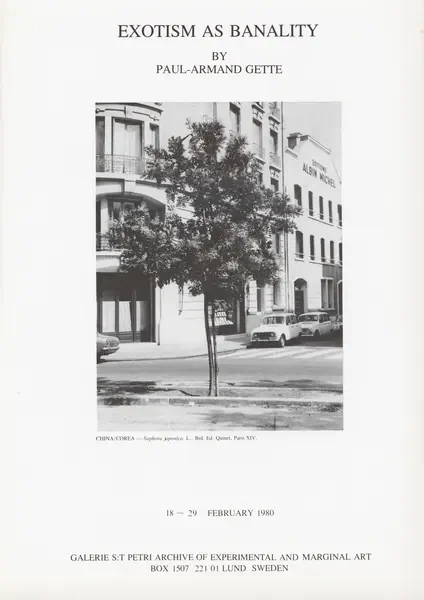
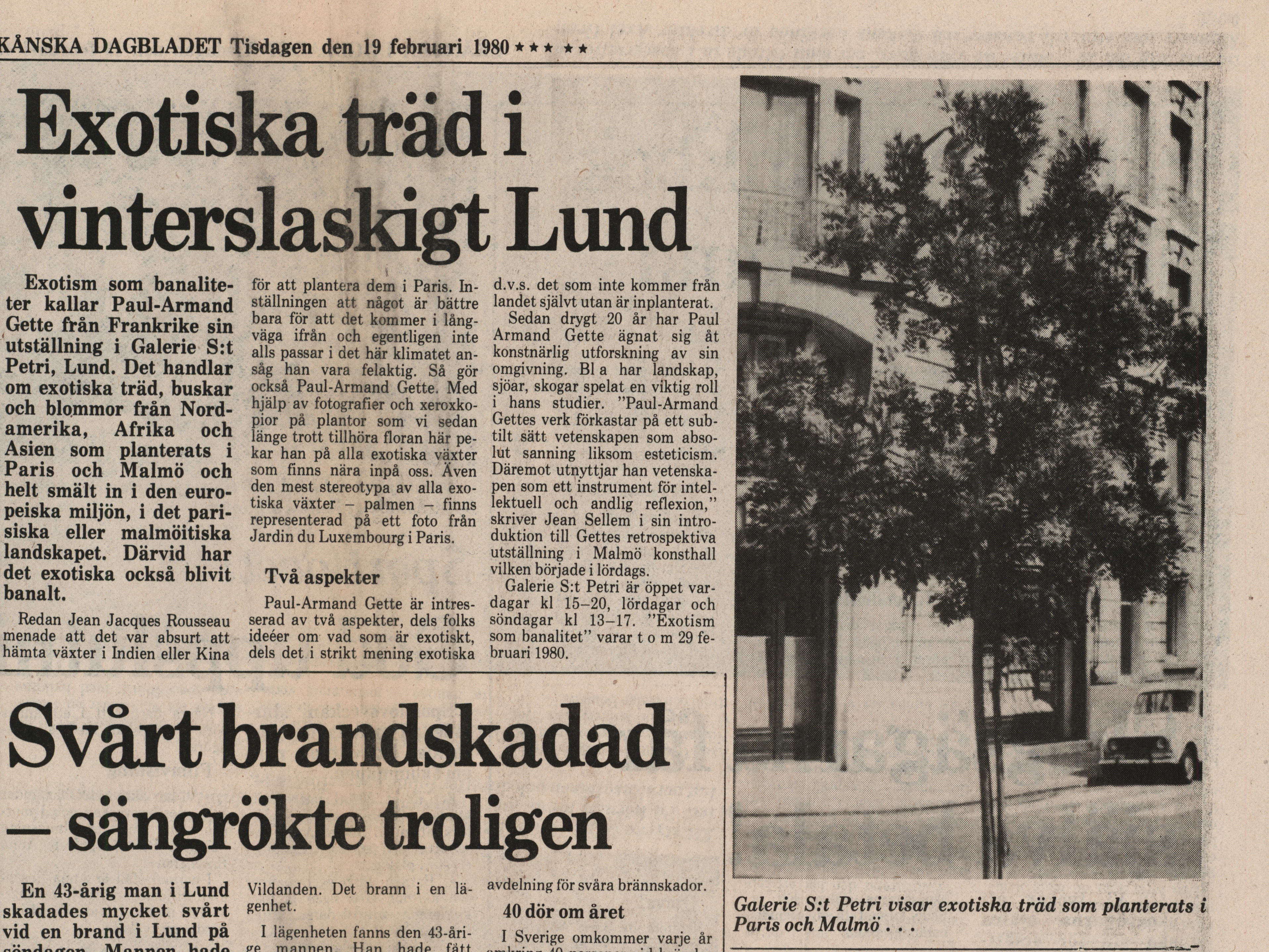
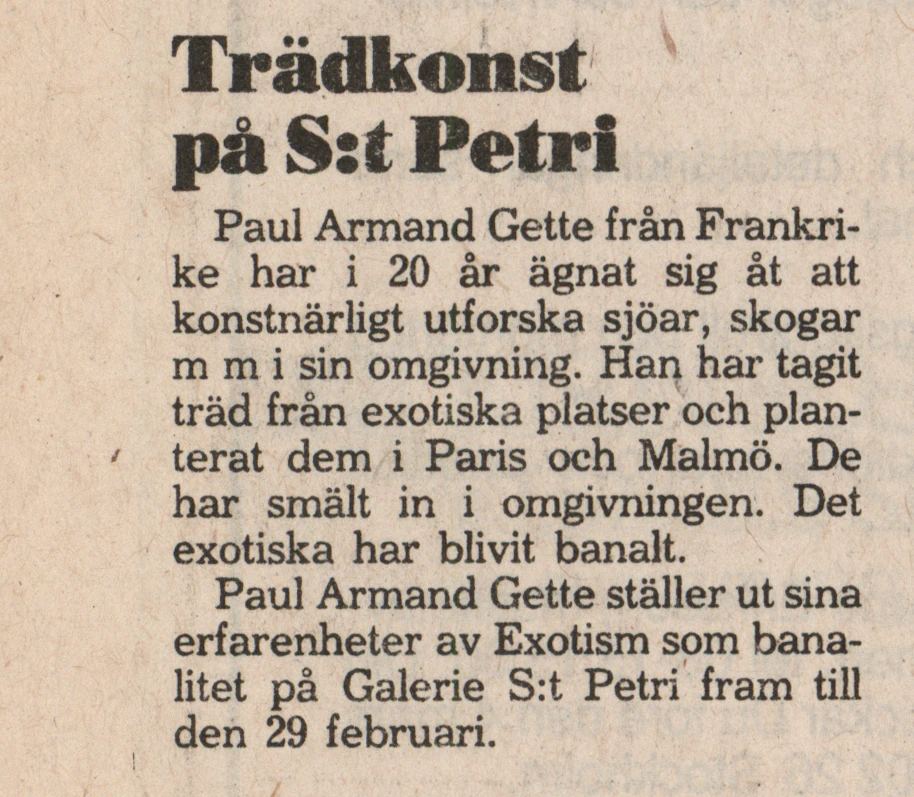
Exotism as Banality is the title Paul-Armand Gette from France has given to his exhibition at Galerie S:t Petri in Lund. It deals with exotic trees, bushes, and flowers from North America, Africa, and Asia that have been planted in Paris and Malmö and have completely blended into the European environment — into the Parisian or Malmö landscape. In this way, the exotic has also become banal.
Jean-Jacques Rousseau already considered it absurd to bring plants from India or China to be planted in Paris. The attitude that something is better simply because it comes from far away and does not actually belong in the local climate, he regarded as mistaken. So does Paul-Armand Gette. With the help of photographs and photocopies of plants long believed to belong to the local flora, he points to all the exotic plants that exist right next to us. Even the most stereotypical of all exotic plants — the palm — is represented by a photograph from the Jardin du Luxembourg in Paris.
Paul-Armand Gette is interested in two aspects: partly people’s ideas of what is exotic, and partly in the strict sense of the word — that which is not native but imported.
For more than twenty years, Paul-Armand Gette has devoted himself to artistic exploration of his surroundings. Landscapes, lakes, and forests have played an important role in his studies. “Paul-Armand Gette’s work subtly rejects science as absolute truth as well as aestheticism. Instead, he uses science as an instrument for intellectual and spiritual reflection,” writes Jean Sellem (see below) in his introduction to Gette’s retrospective exhibition at Malmö Konsthall, which opened last Saturday.
Galerie S:t Petri is open weekdays 15:00–20:00, Saturdays and Sundays 13:00–17:00. The exhibition Exotism as Banality runs until 29 February 1980.
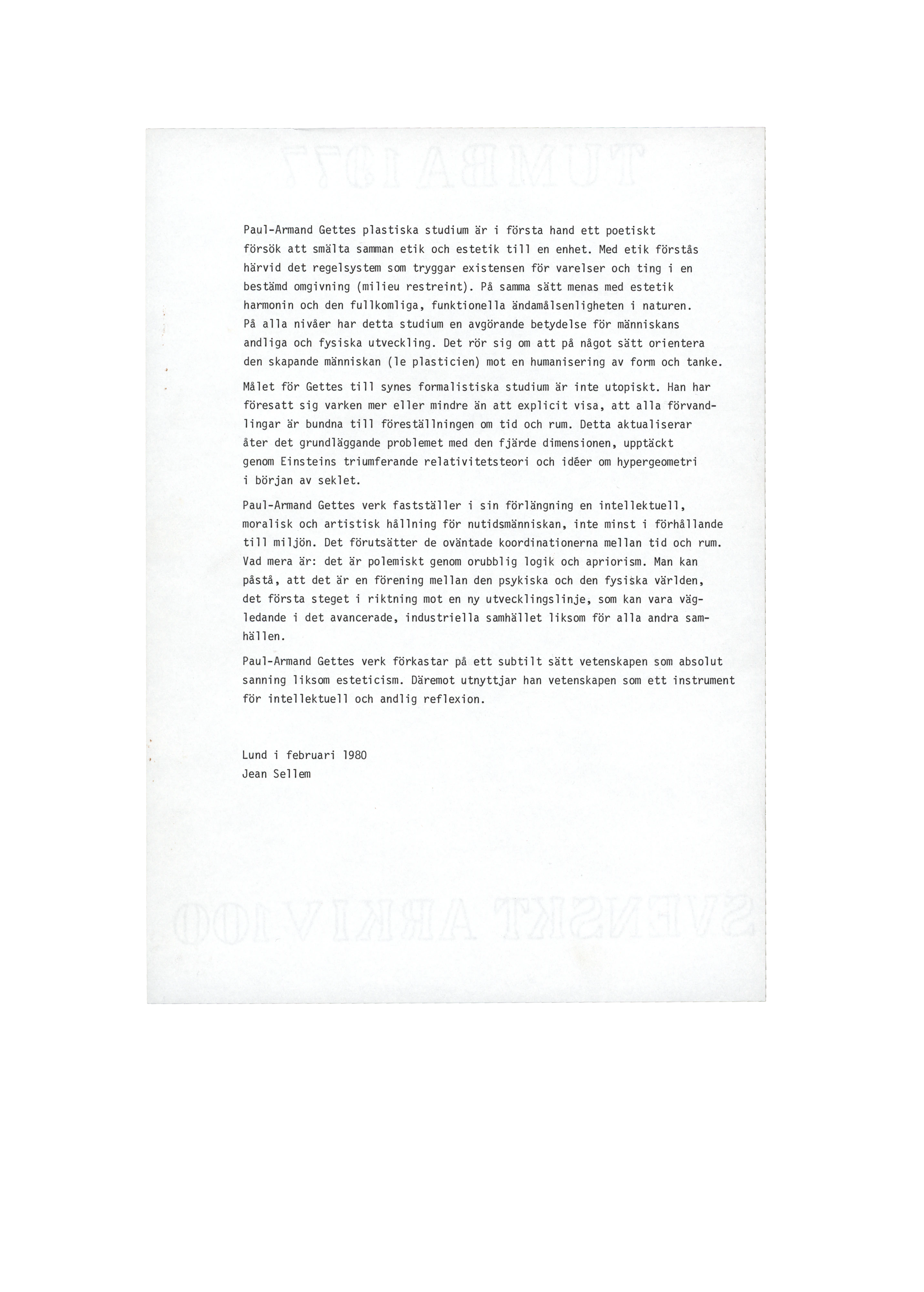
Paul-Armand Gette’s plastic study is above all a poetic attempt to merge ethics and aesthetics into a single unity. By ethics is meant here the system of rules that ensures the existence of beings and things within a defined environment (milieu restreint). In the same way, aesthetics refers to the harmony and complete functional purposefulness of nature. On all levels, this study has a decisive significance for the spiritual and physical development of human beings. It concerns in some way orienting the creative human (le plasticien) toward a humanization of form and thought.
The goal of Gette’s seemingly formalistic study is not utopian. He has set out, neither more nor less, to show explicitly that all transformations are bound to the concepts of time and space. This again raises the fundamental problem of the fourth dimension, discovered through Einstein’s triumphant theory of relativity and ideas of hypergeometry at the beginning of the century.
Paul-Armand Gette’s work asserts, as a continuation, an intellectual, moral, and artistic attitude for contemporary humanity, especially in relation to the environment. It presupposes the unexpected coordination between time and space. Moreover, it is polemical through unshakable logic and a priori reasoning. One may say that it unites the psychic and the physical worlds, taking a first step toward a new line of development that may be leading for advanced industrial society as well as for all other societies.
Paul-Armand Gette’s work subtly rejects science as an absolute truth as well as aestheticism. Instead, he uses science as an instrument for intellectual and spiritual reflection.
Lund, February 1980
Jean Sellem
