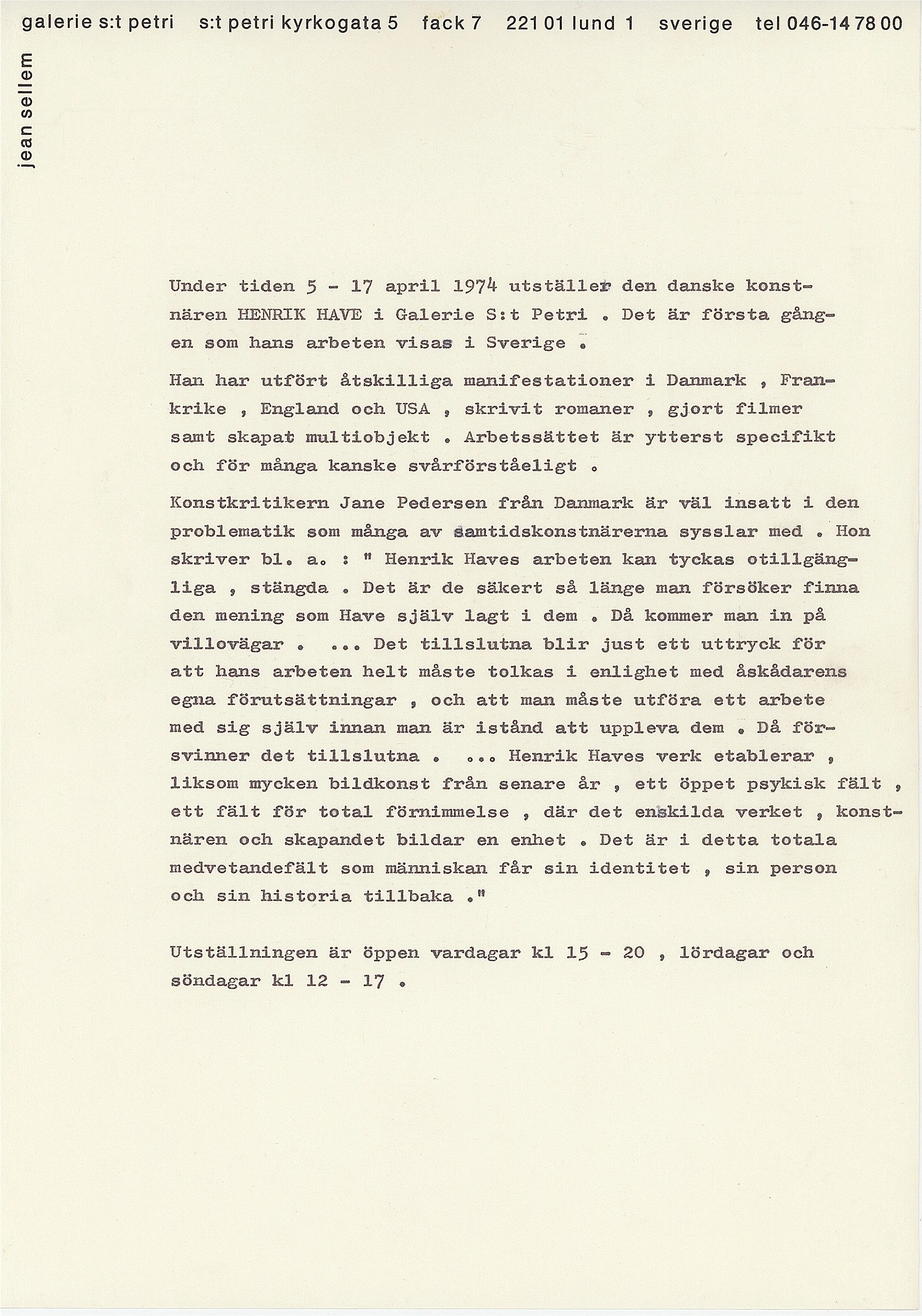
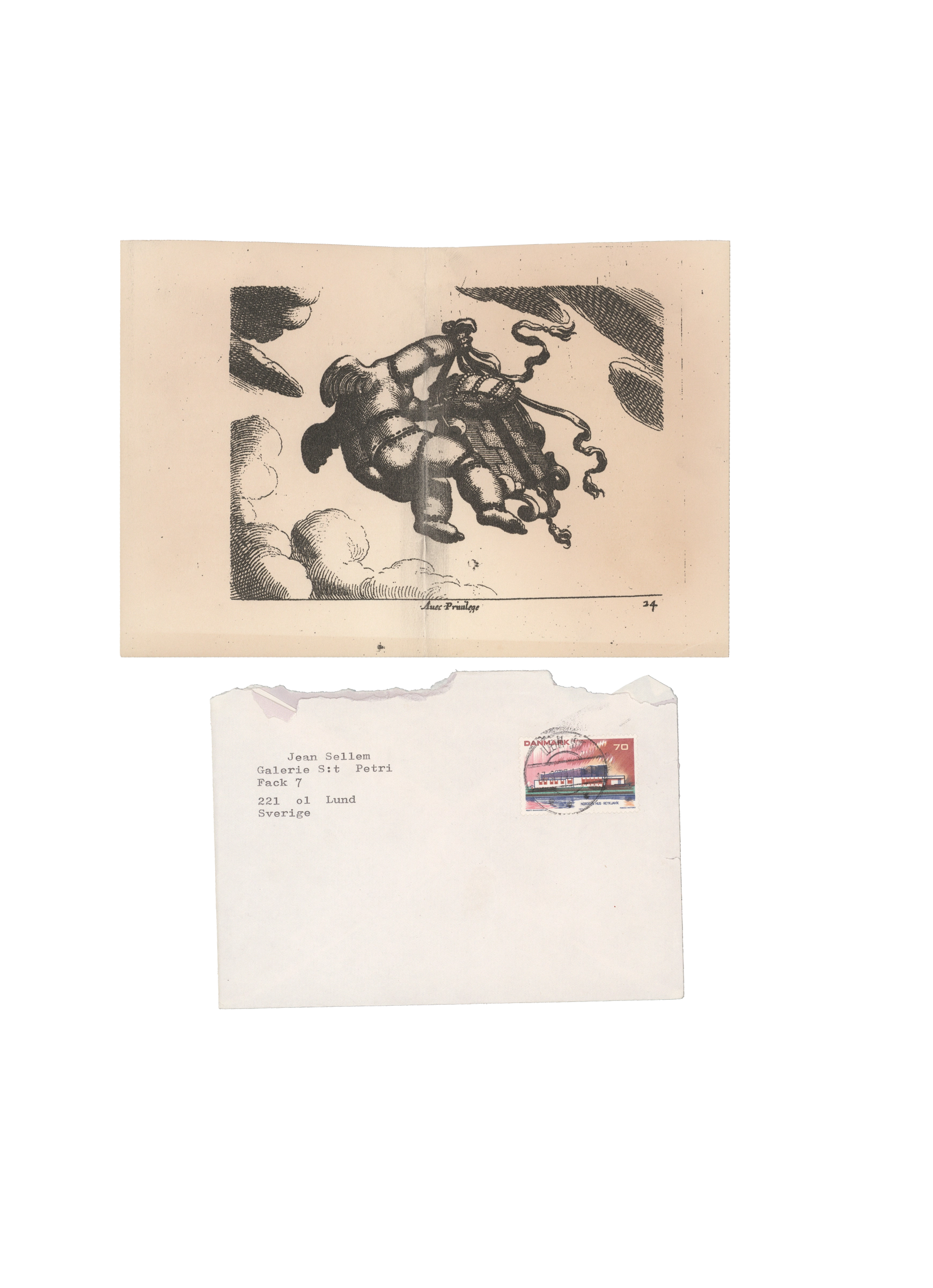
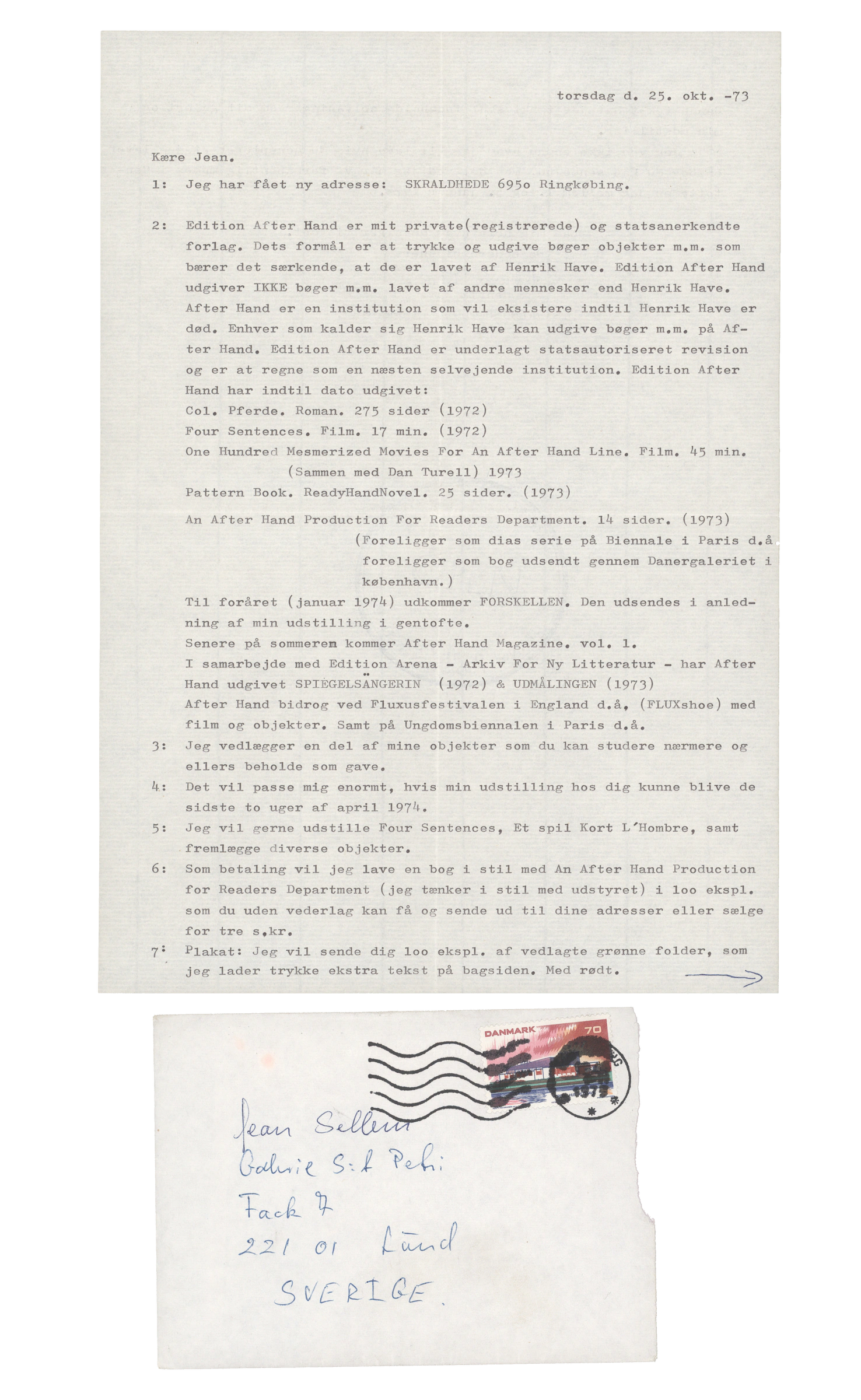
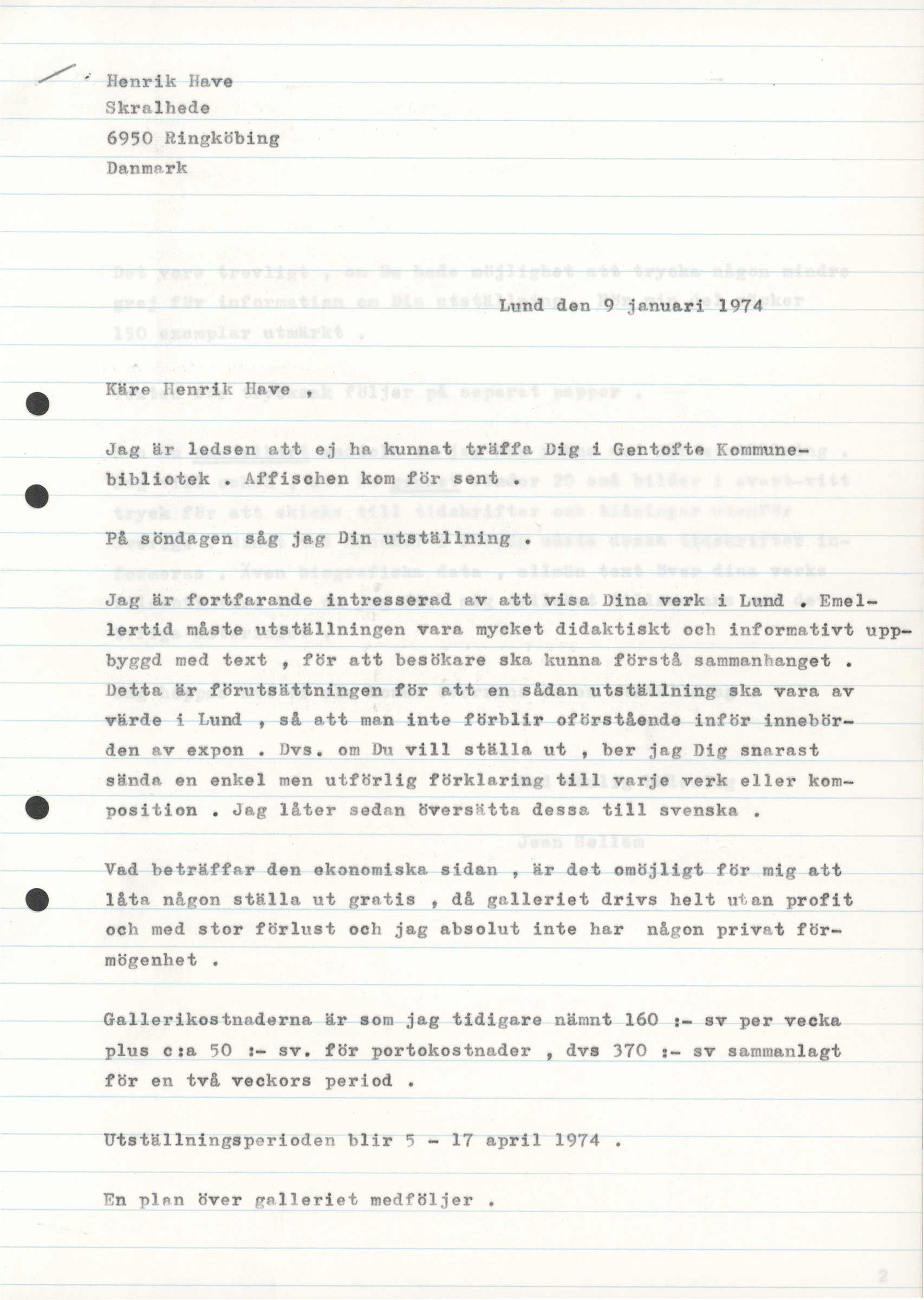
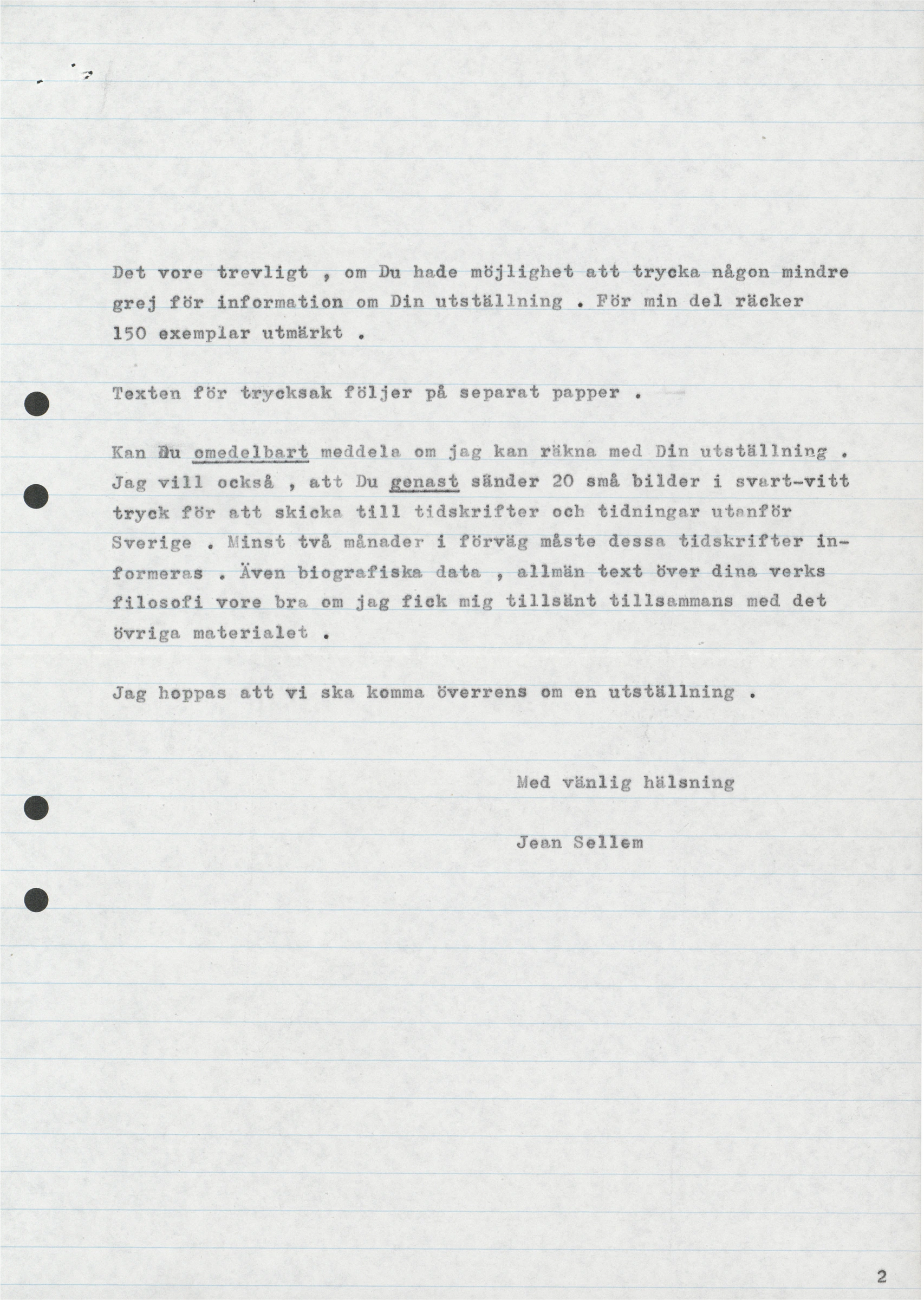
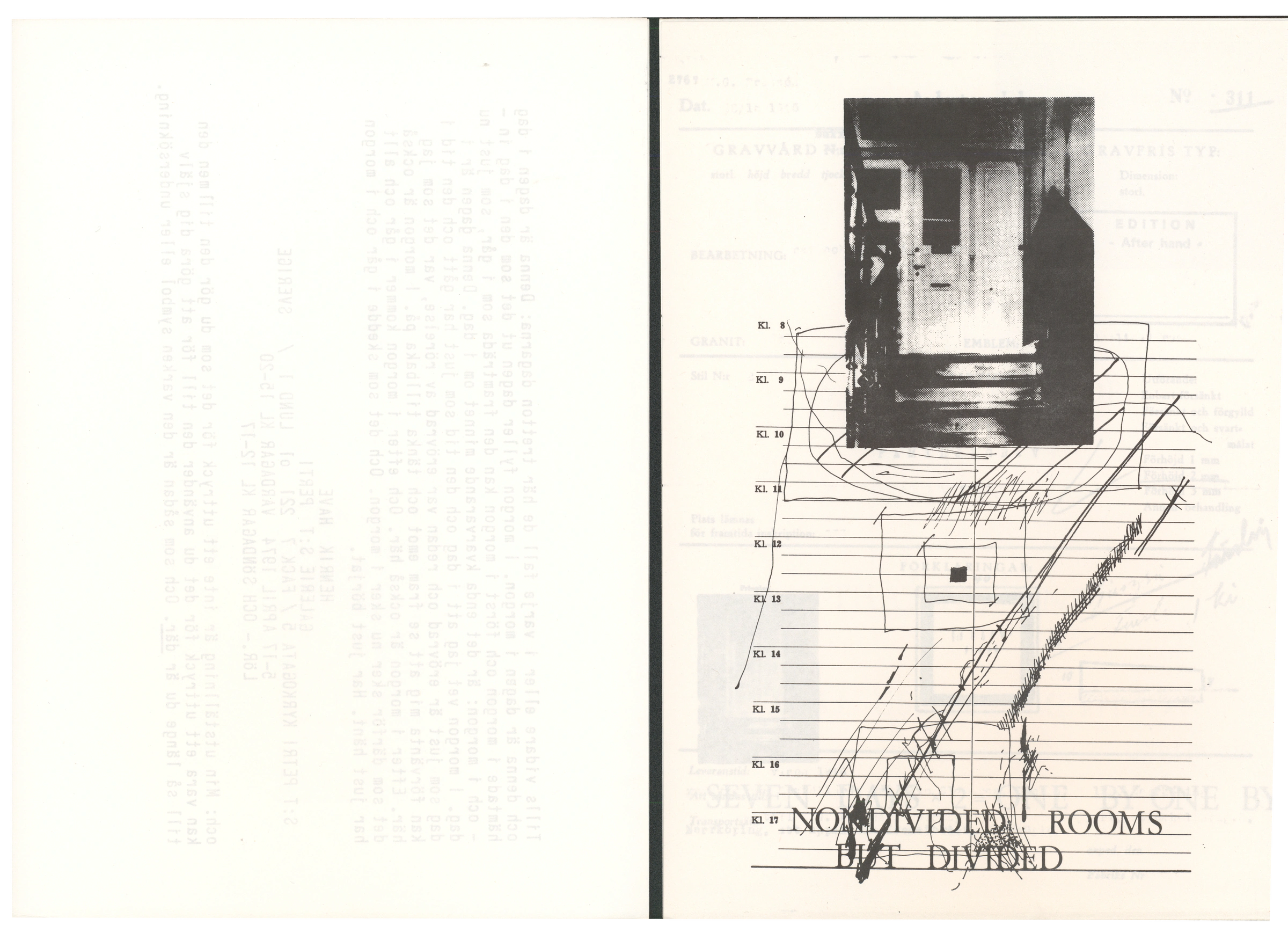
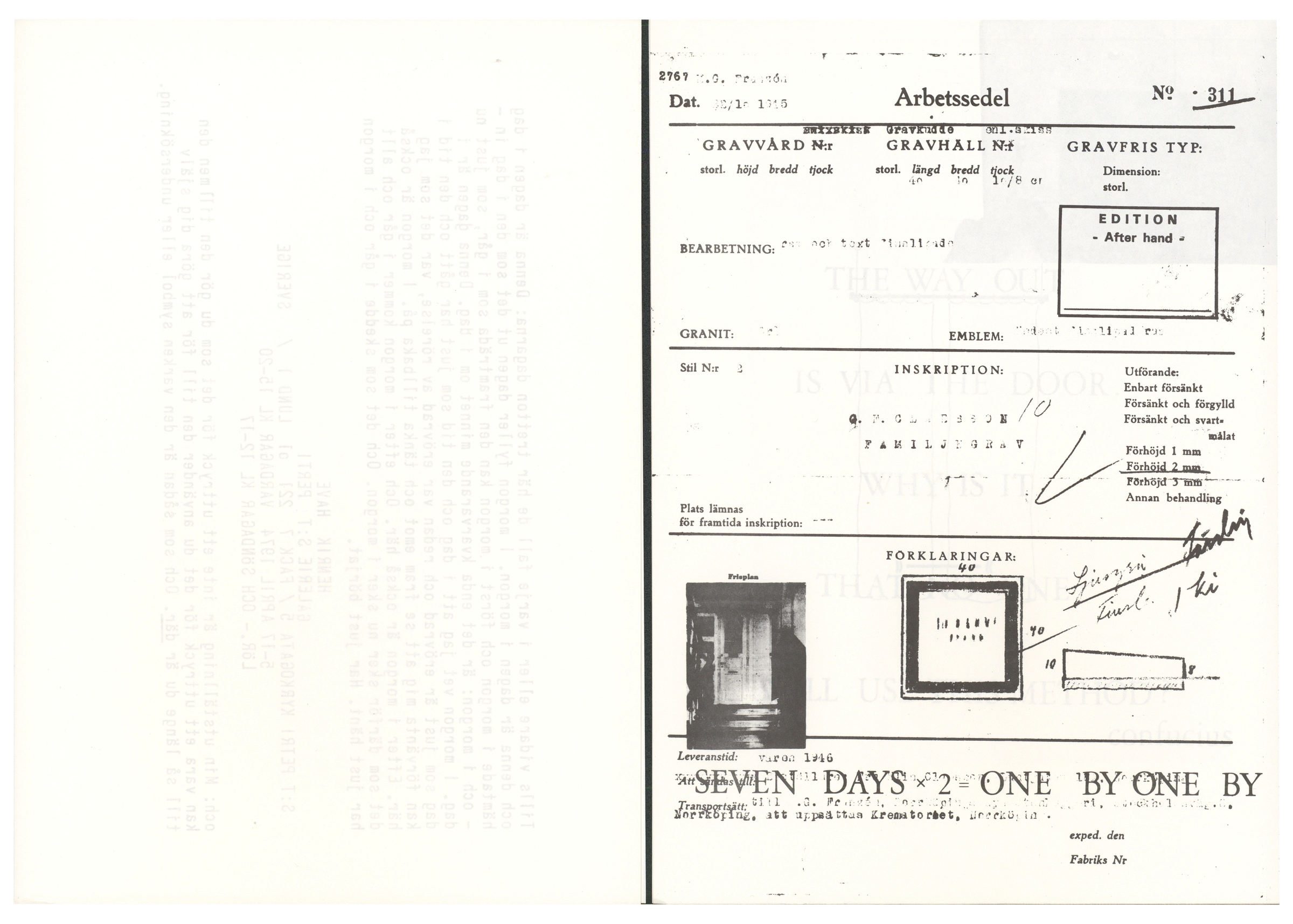
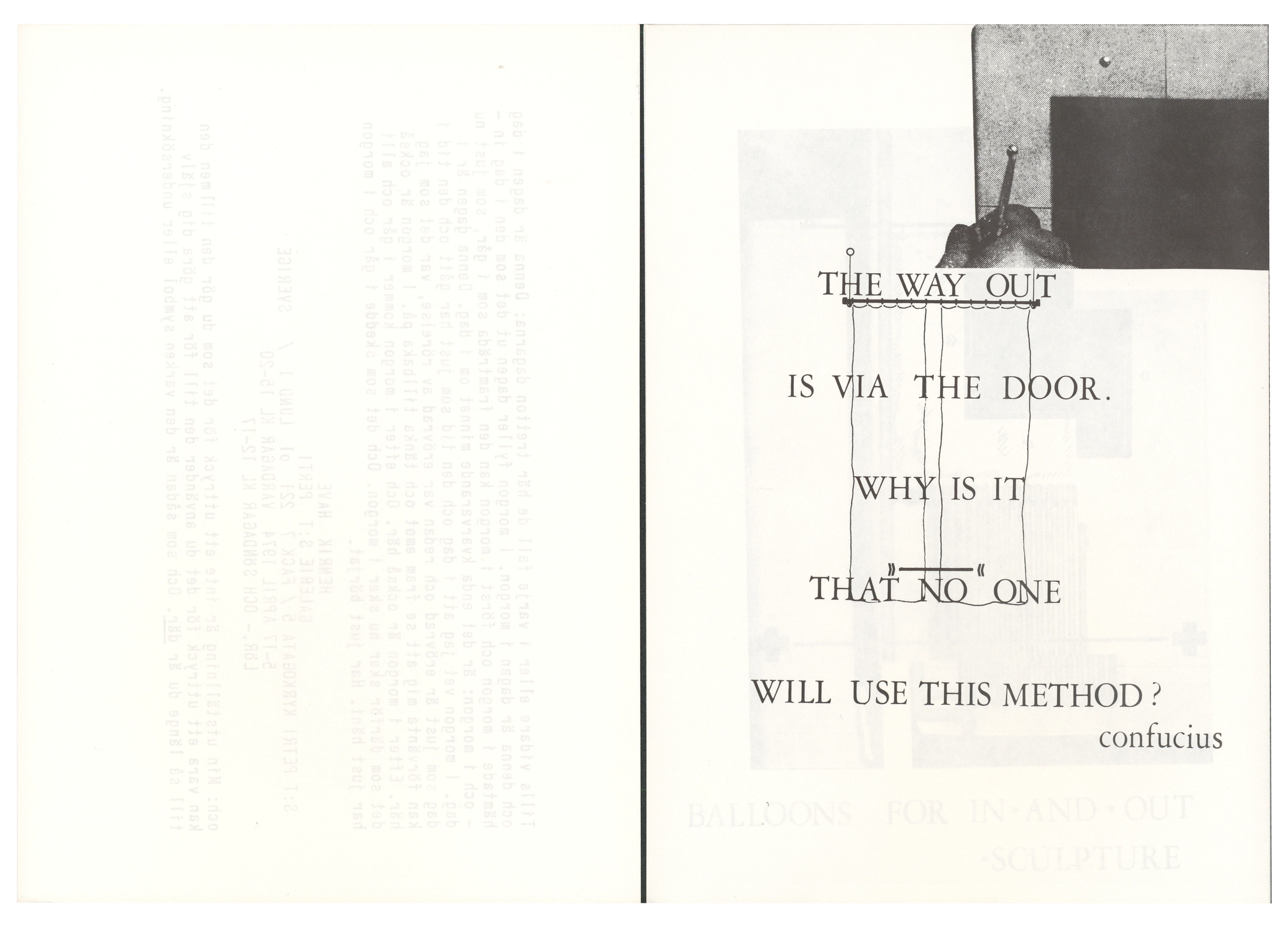
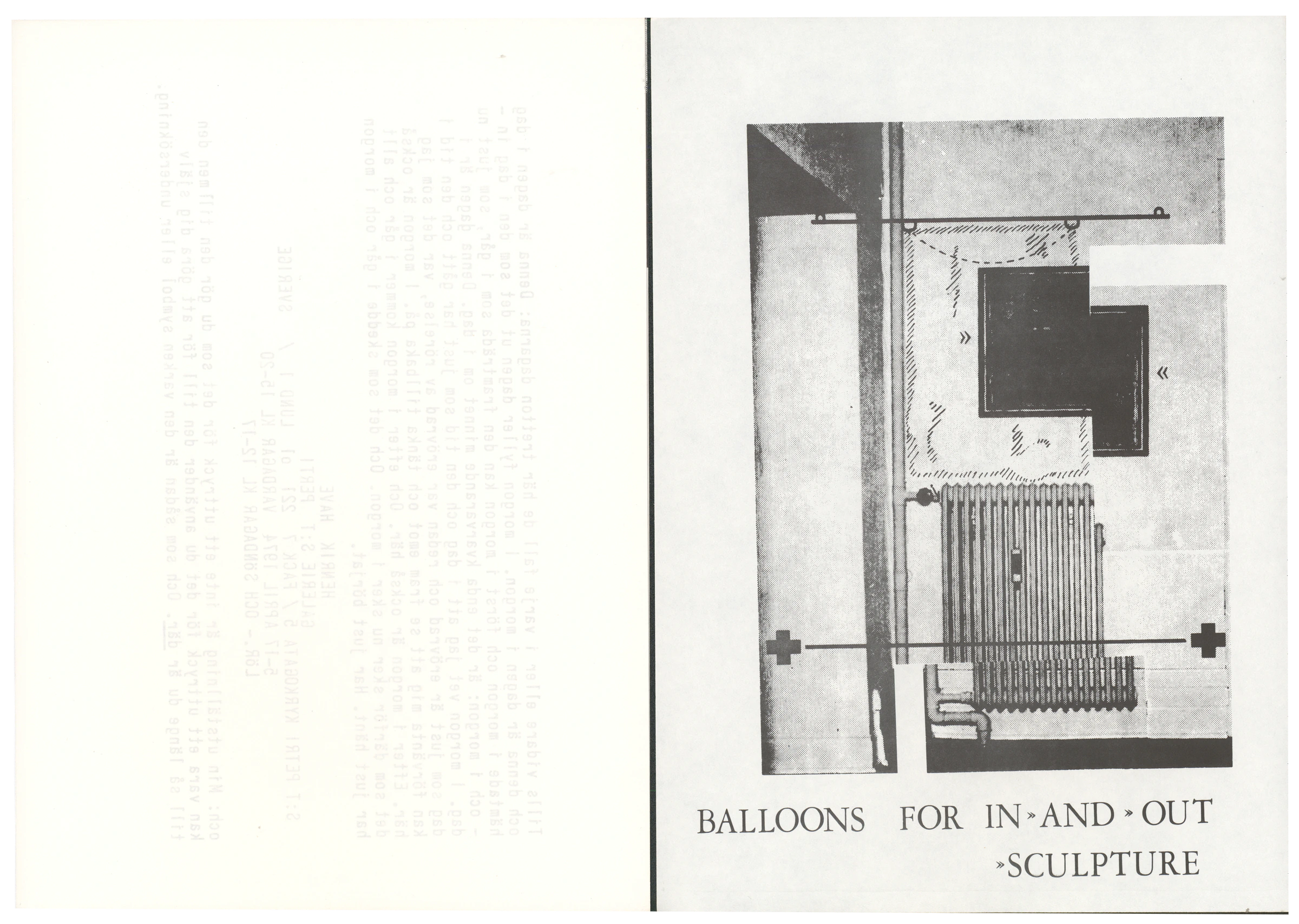
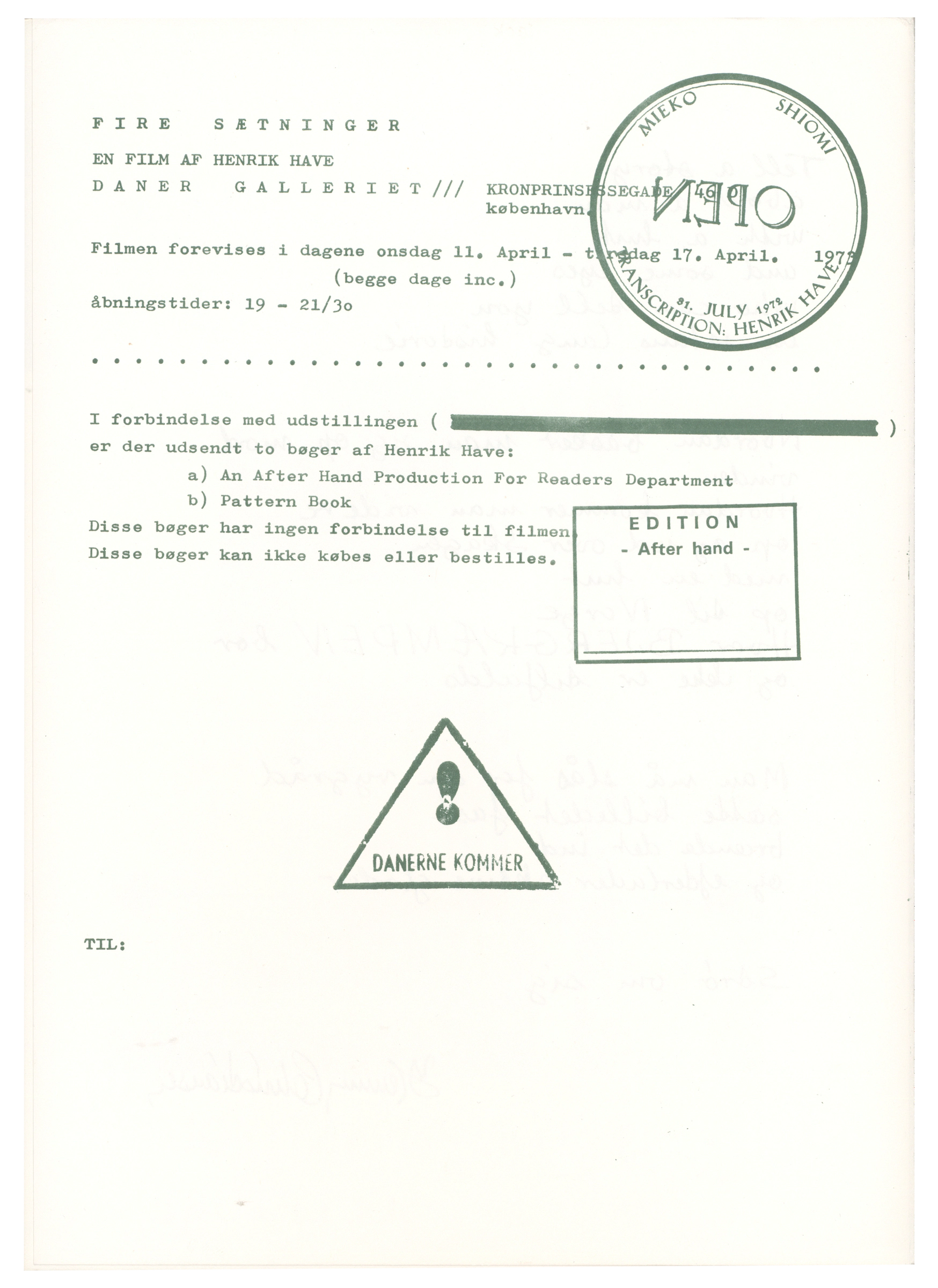
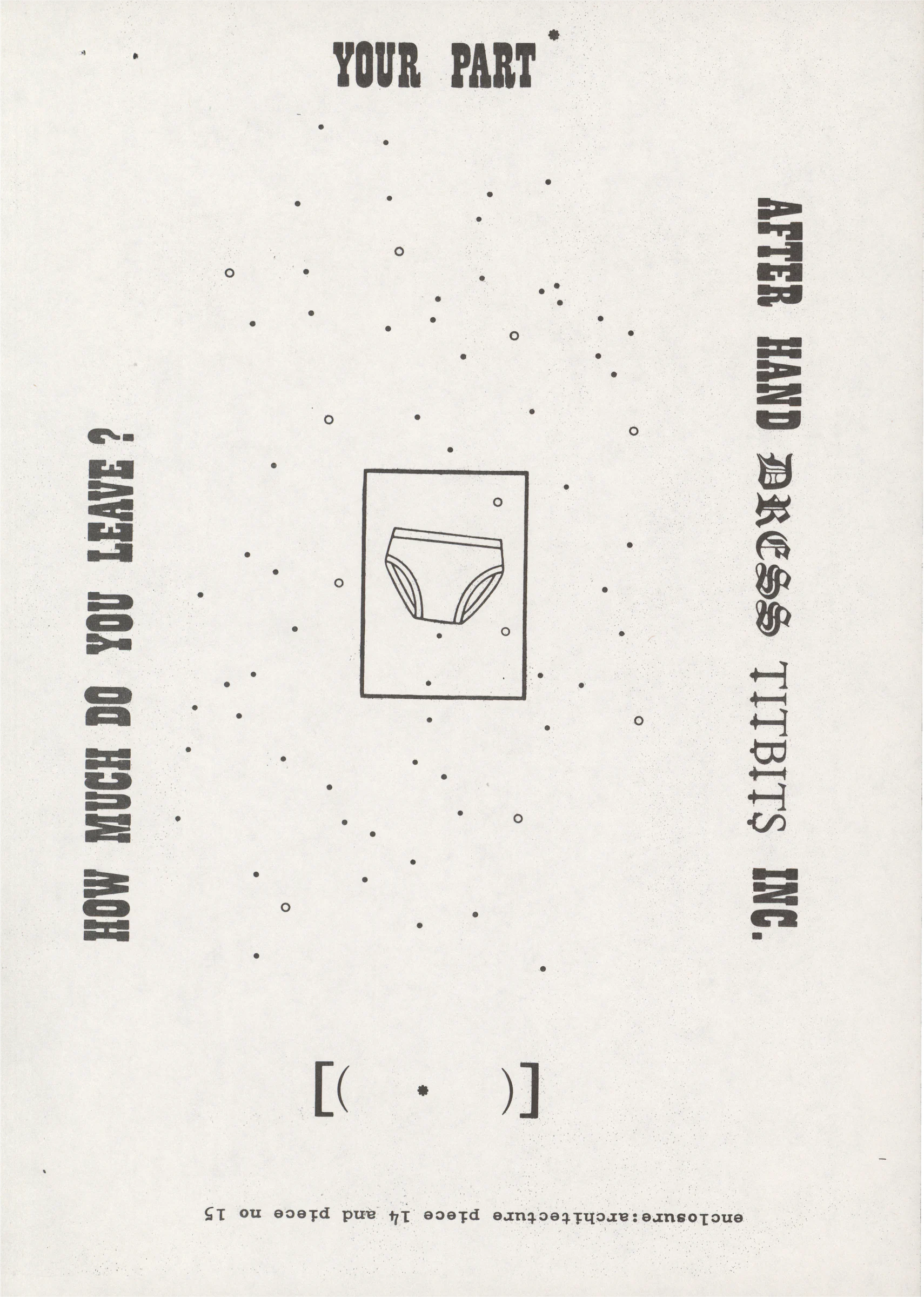
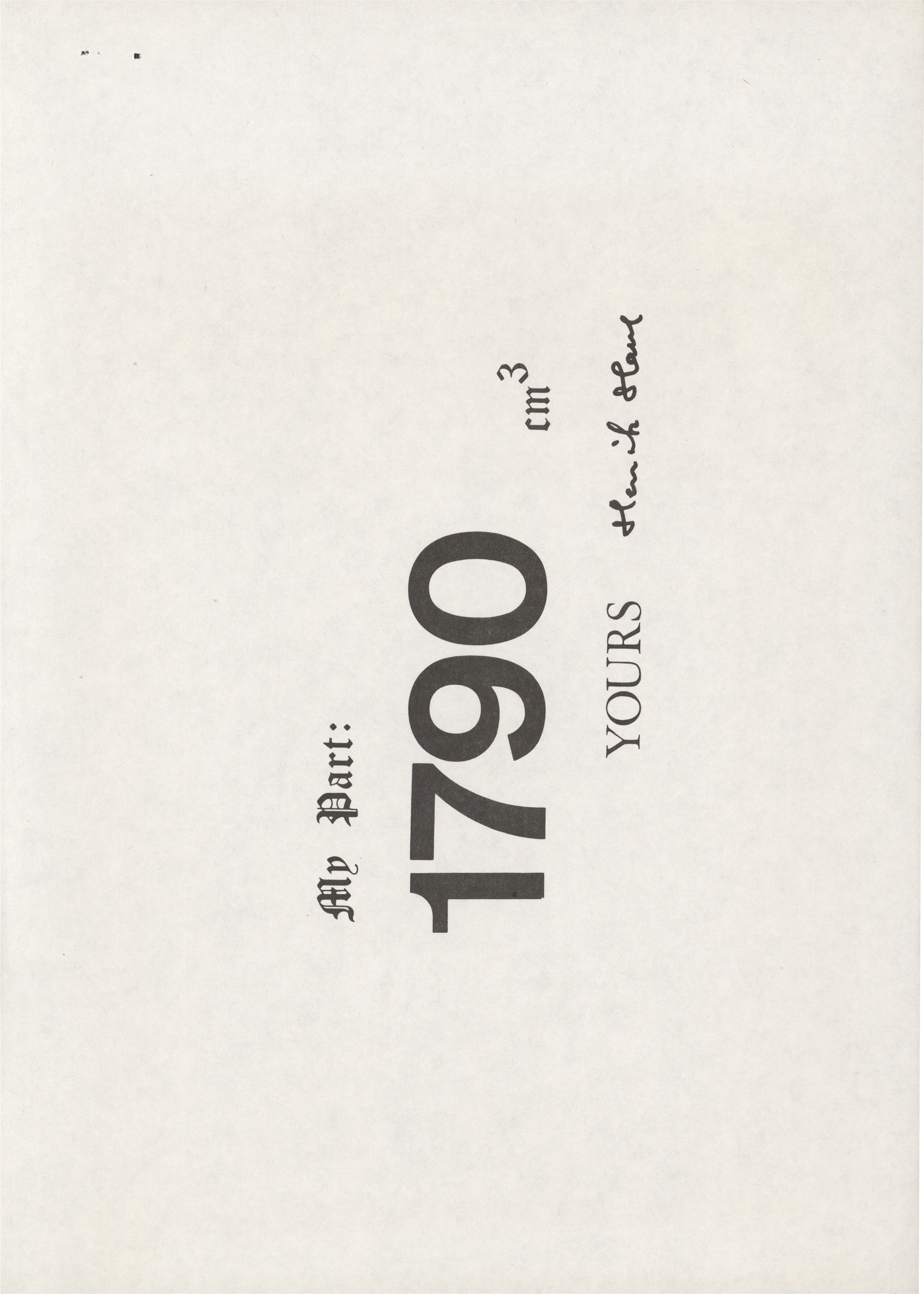
From 5 to 17 April 1974, the Danish artist Henrik Have is exhibiting at Galerie S:t Petri. This is the first time his works have been shown in Sweden.
He has carried out numerous events in Denmark, France, England and the United States, written novels, made films and created multi-objects. His working method is highly specific and may be difficult for many people to understand.
The Danish art critic Jane Pedersen is well acquainted with the issues that concern many contemporary artists. She writes, among other things:
“Henrik Have’s works may seem inaccessible, closed. They certainly are as long as one tries to find in them the meaning that Have himself has placed there. That leads one astray. […]
This closed character becomes precisely an expression of the fact that his works must be interpreted entirely according to the viewer’s own conditions, and that one must undertake a process of work on oneself before being able to experience them. Then the closed character disappears. […]
Henrik Have’s works establish, like much visual art of recent years, an open psychic field, a field of total perception in which the individual work, the artist and the creative act form a unity. It is within this total field of consciousness that the human being regains their identity, their person and their history.”
The exhibition is open on weekdays from 3 to 8 p.m., and on Saturdays and Sundays from 12 to 5 p.m.
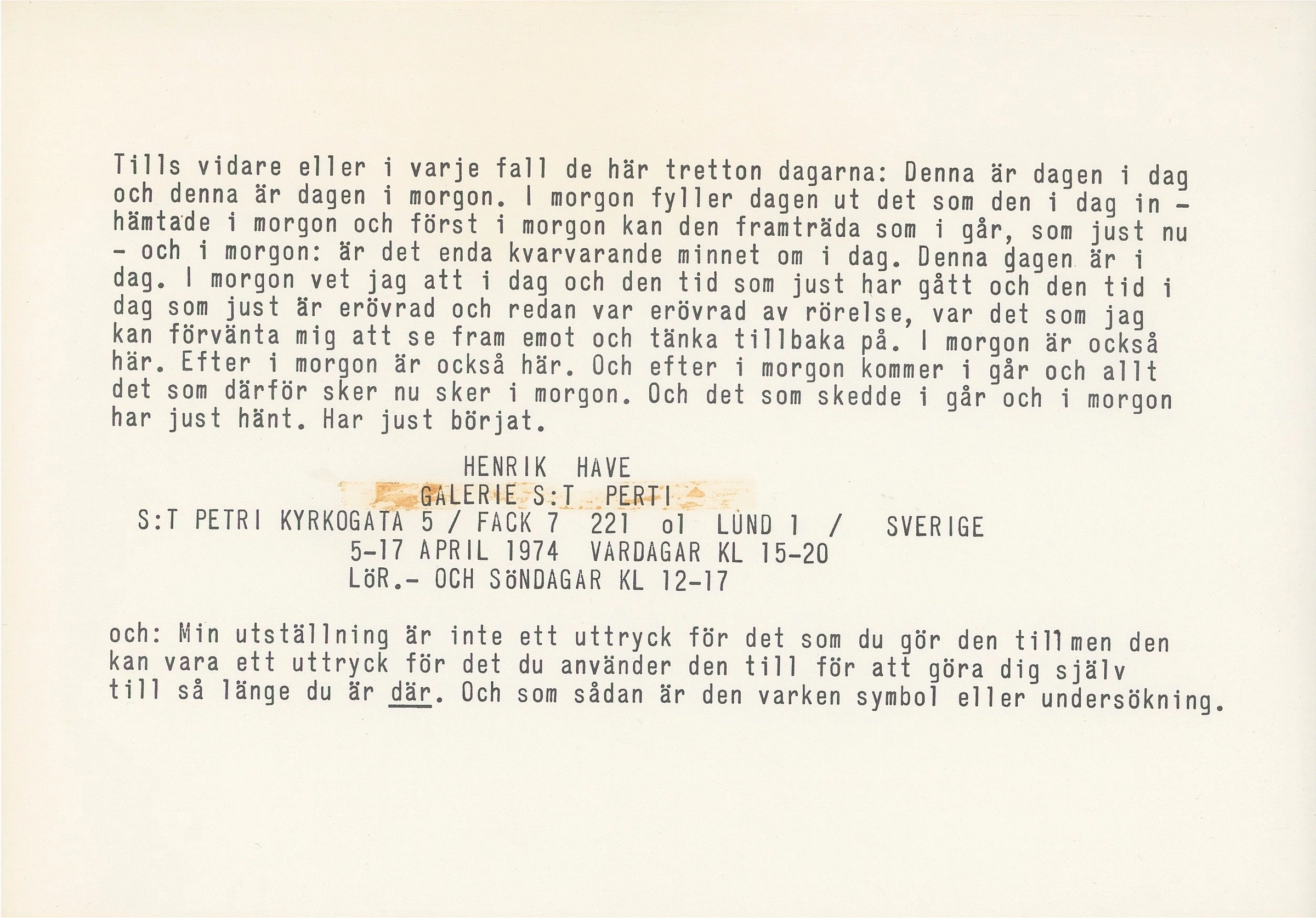
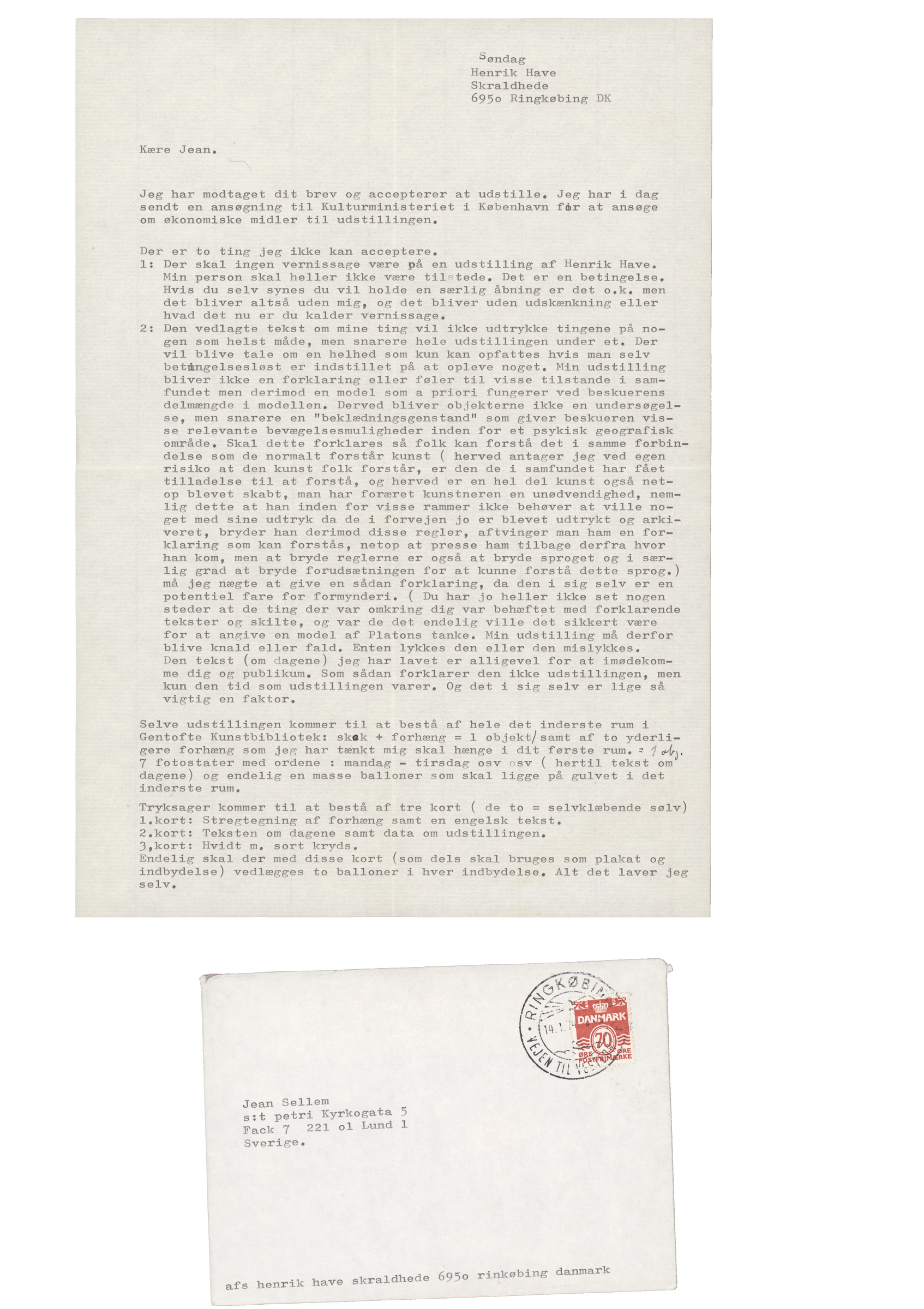
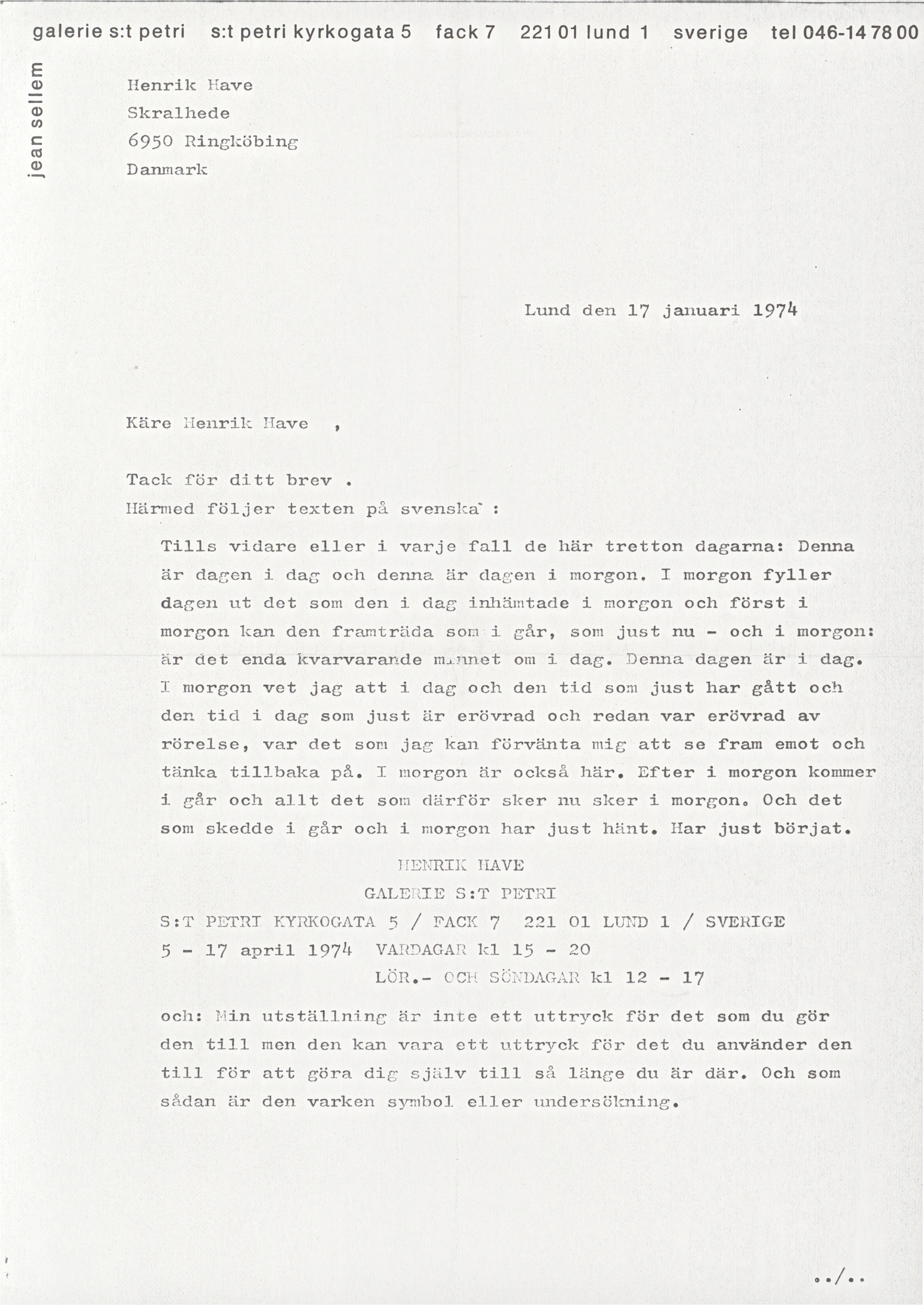
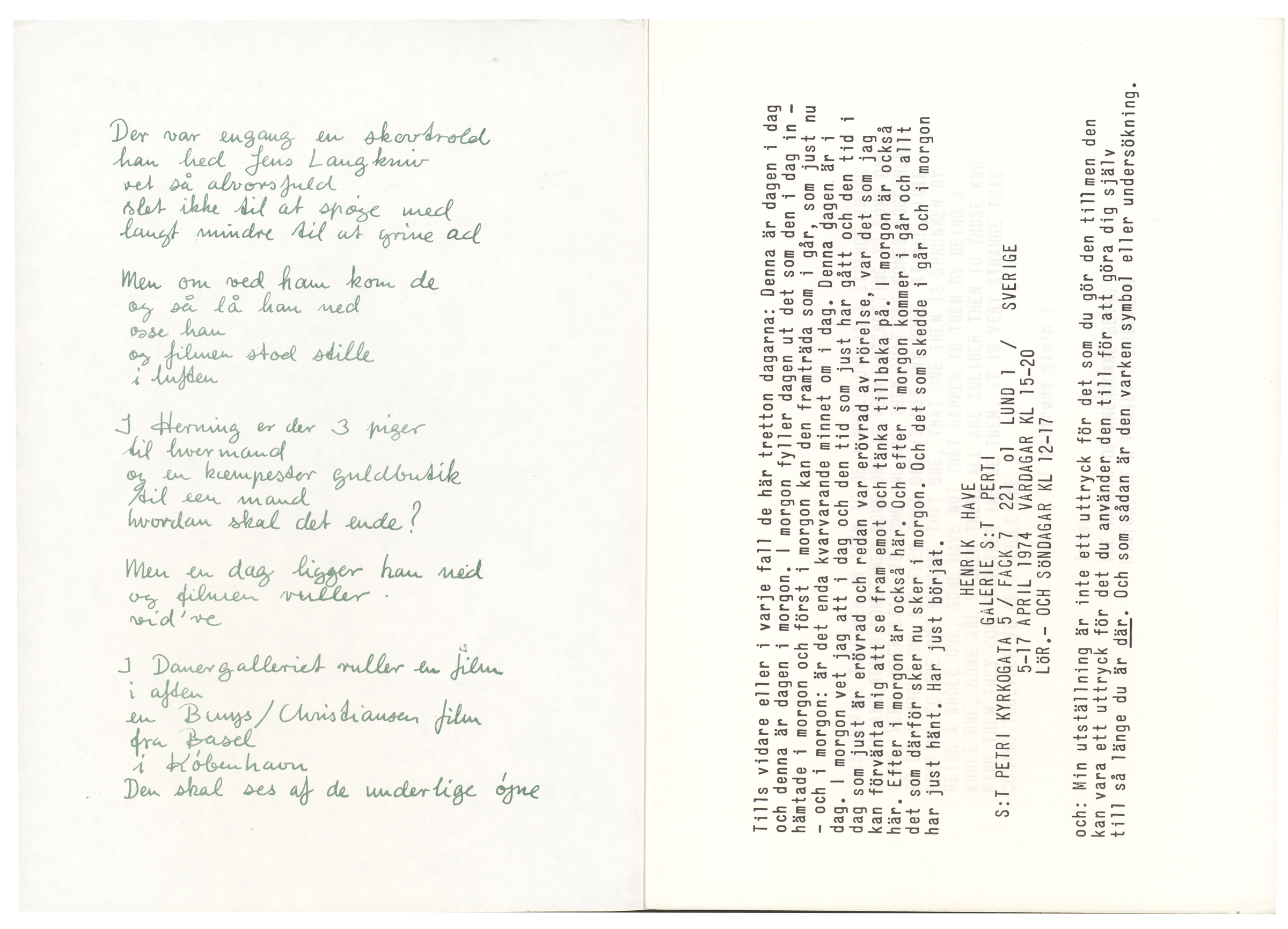
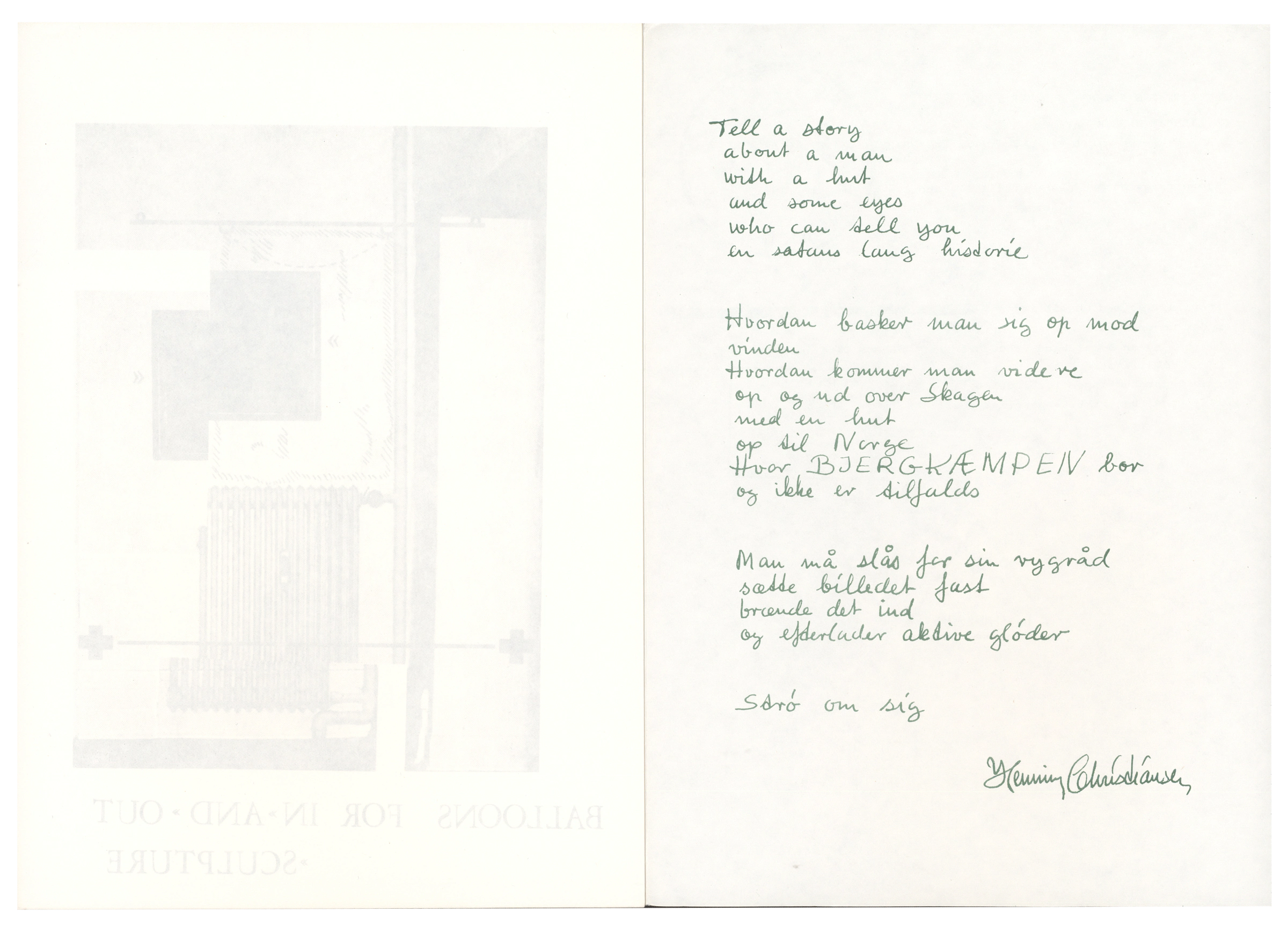
SECONDE IMAGE: For the time being, or at least for these thirteen days: this is the day today and this is the day tomorrow. Tomorrow, the day completes what it gathered today, and only tomorrow can it appear as yesterday, as just now — and tomorrow: it is the only remaining memory of today.
This day is today. Tomorrow I know that today, and the time that has just passed, and the time today that has just been conquered and had already been conquered by movement, were what I could expect to look forward to and to think back upon.
Tomorrow is also here. The day after tomorrow is also here. And after tomorrow comes yesterday, and everything that therefore happens now happens tomorrow. And what happened yesterday and tomorrow has just happened. Has just begun.
HENRIK HAVE Galerie S:t Petri S:t Petri Kyrkogata 5 / Fack 7 / 221 01 Lund 1 / Sweden 5–17 April 1974 Weekdays: 3–8 p.m. Saturdays and Sundays: 12–5 p.m.
And: my exhibition is not an expression of what you make it into, but it can be an expression of what you use it for in order to make yourself into, for as long as you are there. And as such, it is neither a symbol nor an investigation.
Du 5 au 17 avril 1974, l’artiste danois Henrik Have expose à la Galerie S:t Petri. C’est la première fois que ses œuvres sont présentées en Suède.
Il a réalisé de nombreuses manifestations au Danemark, en France, en Angleterre et aux États-Unis, écrit des romans, réalisé des films et créé des multi-objets. Sa manière de travailler est extrêmement spécifique et peut-être difficile à comprendre pour beaucoup.
La critique d’art danoise Jane Pedersen connaît bien les problématiques auxquelles s’intéressent de nombreux artistes contemporains. Elle écrit notamment :
« Les œuvres de Henrik Have peuvent sembler inaccessibles, fermées. Elles le sont certainement tant que l’on cherche à y trouver le sens que Have lui-même y aurait placé. On s’engage alors sur de fausses pistes. […]
Ce caractère fermé devient précisément l’expression du fait que ses œuvres doivent être entièrement interprétées en fonction des dispositions propres au spectateur, et qu’il faut effectuer un travail sur soi-même avant d’être en mesure de les éprouver. Alors, ce caractère fermé disparaît. […]
Les œuvres de Henrik Have établissent, comme une grande partie de l’art visuel de ces dernières années, un champ psychique ouvert, un champ de perception totale dans lequel l’œuvre individuelle, l’artiste et l’acte de création forment une unité. C’est dans ce champ de conscience total que l’être humain retrouve son identité, sa personne et son histoire. »
L’exposition est ouverte en semaine de 15 h à 20 h, le samedi et le dimanche de 12 h à 17 h.
SECONDE IMAGE Pour le moment, ou en tout cas pendant ces treize jours : ce jour est aujourd’hui et ce jour est demain. Demain, le jour accomplit ce qu’il a recueilli aujourd’hui, et ce n’est que demain qu’il peut apparaître comme hier, comme à l’instant même — et demain : c’est le seul souvenir qui subsiste d’aujourd’hui.
Ce jour est aujourd’hui. Demain, je sais qu’aujourd’hui, le temps qui vient de passer et le temps d’aujourd’hui qui vient d’être conquis, et qui avait déjà été conquis par le mouvement, étaient ce que je pouvais m’attendre à voir devant moi et à repenser rétrospectivement.
Demain est également ici. Après-demain est également ici. Et après-demain vient hier, et tout ce qui se produit maintenant se produit donc demain. Et ce qui s’est produit hier et demain vient juste d’avoir lieu. Vient juste de commencer.
HENRIK HAVE Galerie S:t Petri S:t Petri Kyrkogata 5 / Fack 7 / 221 01 Lund 1 / Suède 5–17 avril 1974 En semaine : 15 h–20 h Samedi et dimanche : 12 h–17 h
Et : mon exposition n’est pas une expression de ce que tu en fais, mais elle peut être une expression de ce à quoi tu l’utilises afin de te faire toi-même, aussi longtemps que tu es là. Et en tant que telle, elle n’est ni symbole ni recherche.
Vom 5. bis 17. April 1974 stellt der dänische Künstler Henrik Have in der Galerie S:t Petri aus. Es ist das erste Mal, dass seine Arbeiten in Schweden gezeigt werden.
Er hat zahlreiche Aktionen in Dänemark, Frankreich, England und den USA durchgeführt, Romane geschrieben, Filme gedreht und Multiobjekte geschaffen. Seine Arbeitsweise ist äußerst spezifisch und für viele vielleicht schwer verständlich.
Die dänische Kunstkritikerin Jane Pedersen ist mit den Fragestellungen, mit denen sich viele zeitgenössische Künstler beschäftigen, bestens vertraut. Sie schreibt unter anderem:
„Henrik Haves Arbeiten können unzugänglich, verschlossen erscheinen. Das sind sie sicherlich so lange, wie man versucht, den Sinn zu finden, den Have selbst in sie hineingelegt hat. Dann gerät man auf Irrwege. […]
Gerade dieses Verschlossene wird zum Ausdruck dafür, dass seine Arbeiten vollständig entsprechend den eigenen Voraussetzungen des Betrachters interpretiert werden müssen und dass man zunächst an sich selbst arbeiten muss, bevor man in der Lage ist, sie zu erleben. Dann verschwindet das Verschlossene. […]
Henrik Haves Werke schaffen, wie ein großer Teil der bildenden Kunst der letzten Jahre, ein offenes psychisches Feld, ein Feld totaler Wahrnehmung, in dem das einzelne Werk, der Künstler und der schöpferische Vorgang eine Einheit bilden. In diesem umfassenden Bewusstseinsfeld erhält der Mensch seine Identität, seine Person und seine Geschichte zurück.“
Die Ausstellung ist werktags von 15 bis 20 Uhr, samstags und sonntags von 12 bis 17 Uhr geöffnet.
ZWEITES BILD Vorläufig, oder jedenfalls während dieser dreizehn Tage: Dieser Tag ist heute und dieser Tag ist morgen. Morgen vollendet der Tag das, was er heute aufgenommen hat, und erst morgen kann er als gestern erscheinen, als gerade eben – und morgen: Er ist die einzige verbleibende Erinnerung an heute.
Dieser Tag ist heute. Morgen weiß ich, dass heute und die Zeit, die gerade vergangen ist, sowie die heutige Zeit, die eben erst erobert wurde und durch Bewegung bereits erobert war, das waren, was ich erwarten konnte, vor mir zu sehen und woran ich zurückdenken konnte.
Morgen ist ebenfalls hier. Übermorgen ist ebenfalls hier. Und nach morgen kommt gestern, und alles, was daher jetzt geschieht, geschieht morgen. Und was gestern und morgen geschah, ist gerade geschehen. Hat gerade begonnen.
HENRIK HAVE Galerie S:t Petri S:t Petri Kyrkogata 5 / Fack 7 / 221 01 Lund 1 / Schweden 5.–17. April 1974 Werktags: 15–20 Uhr Samstags und sonntags: 12–17 Uhr
Und: Meine Ausstellung ist kein Ausdruck dessen, wozu du sie machst, aber sie kann ein Ausdruck dessen sein, wozu du sie benutzt, um dich selbst zu machen, solange du dort bist. Und als solche ist sie weder Symbol noch Untersuchung.
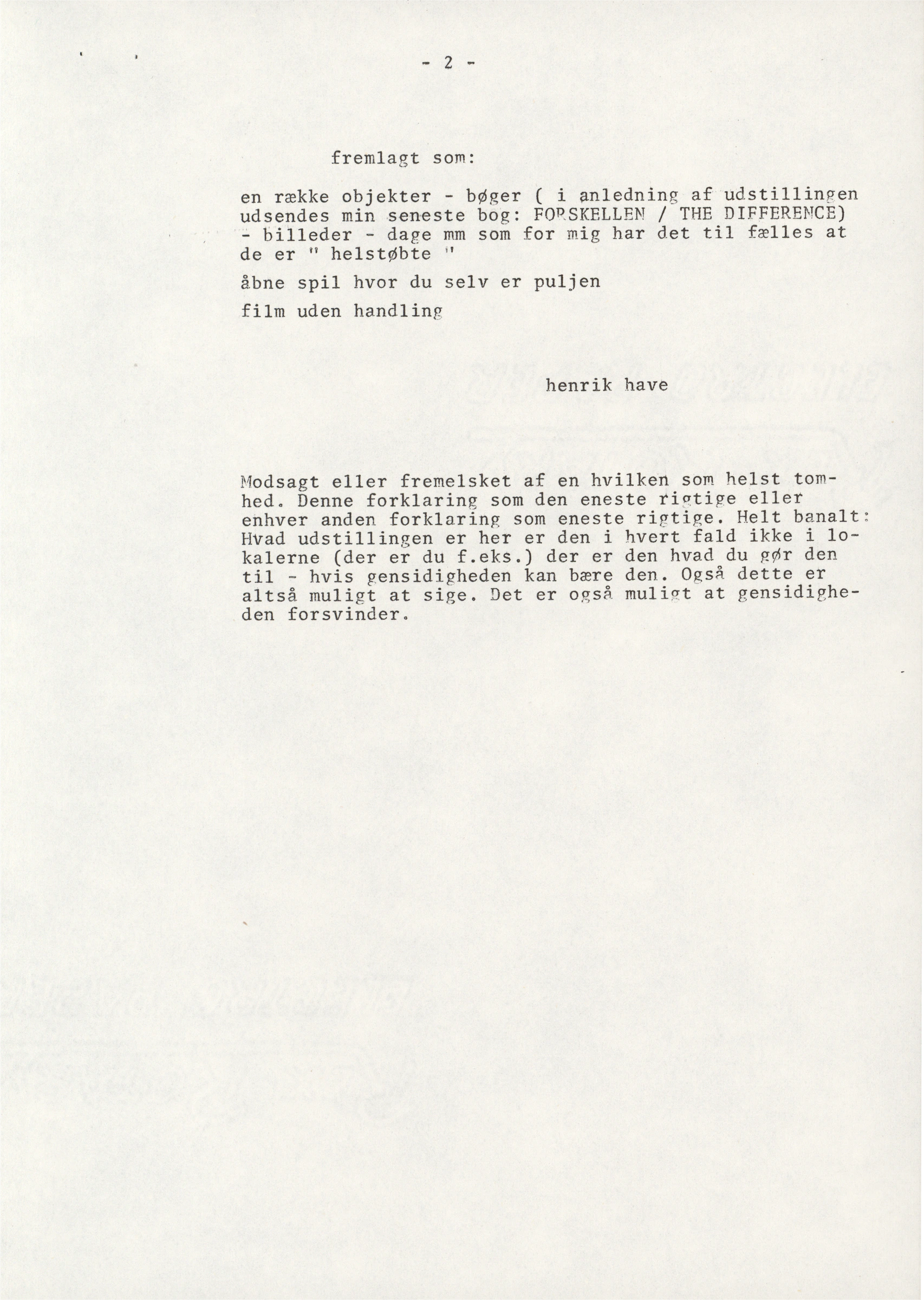
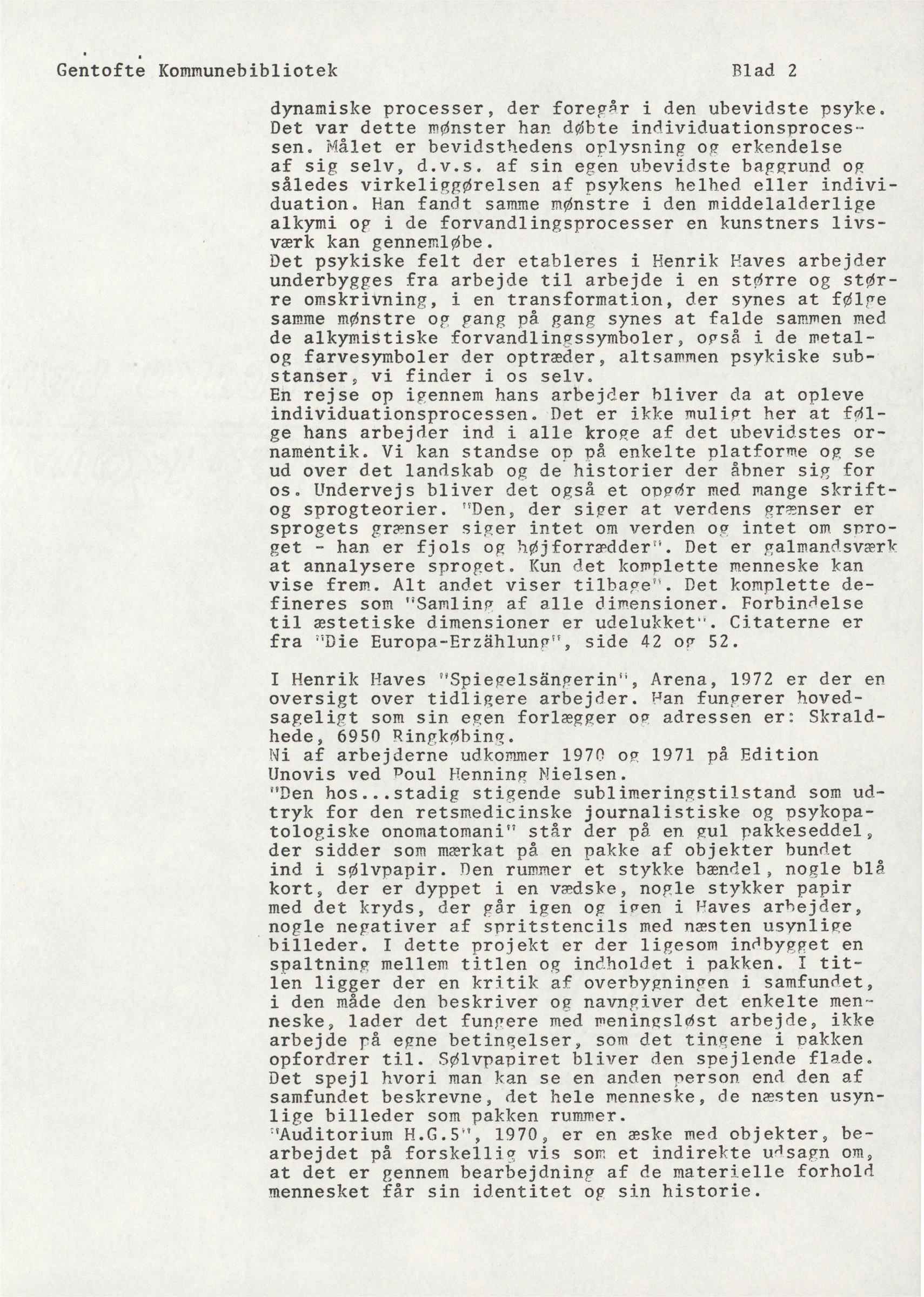
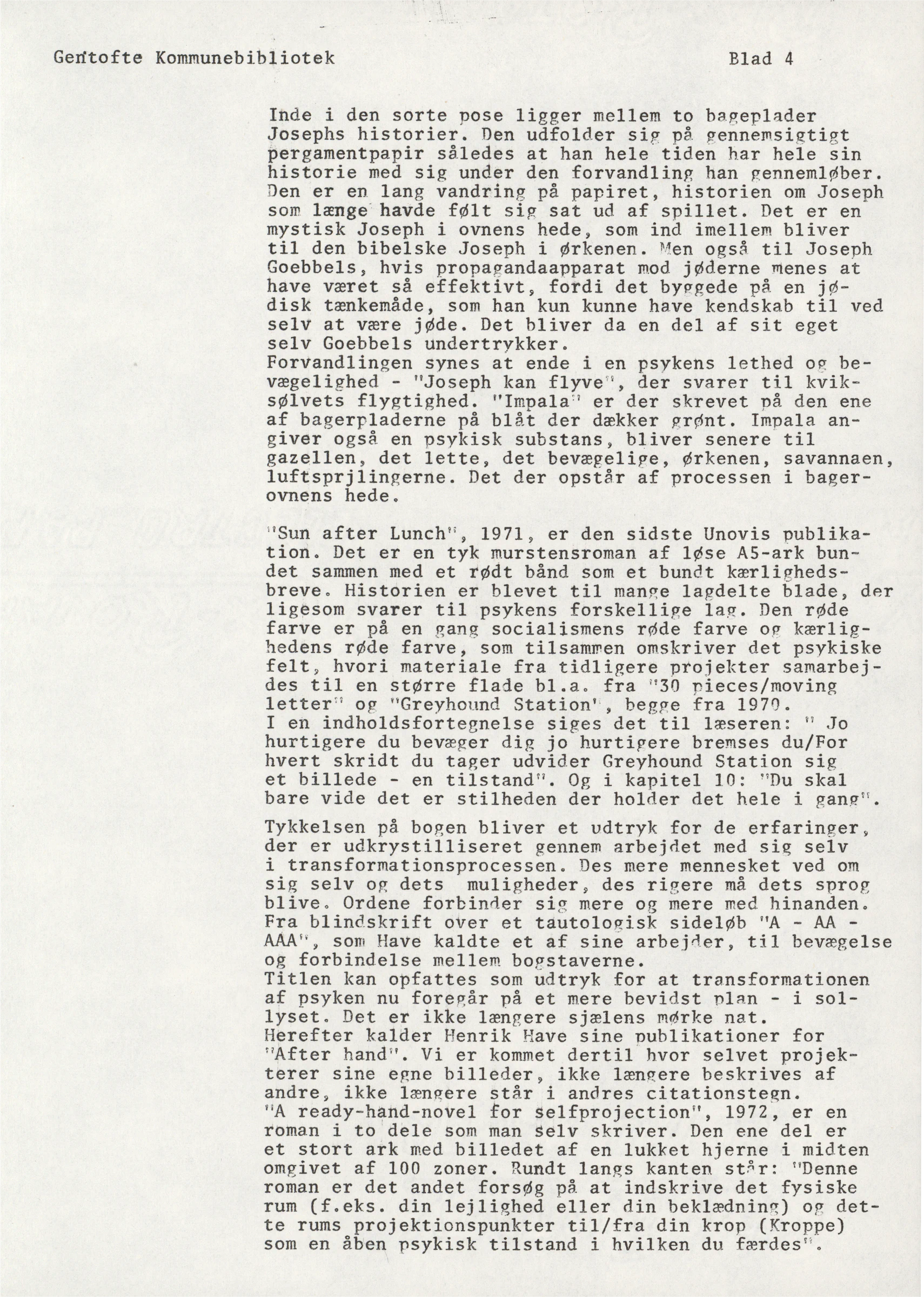
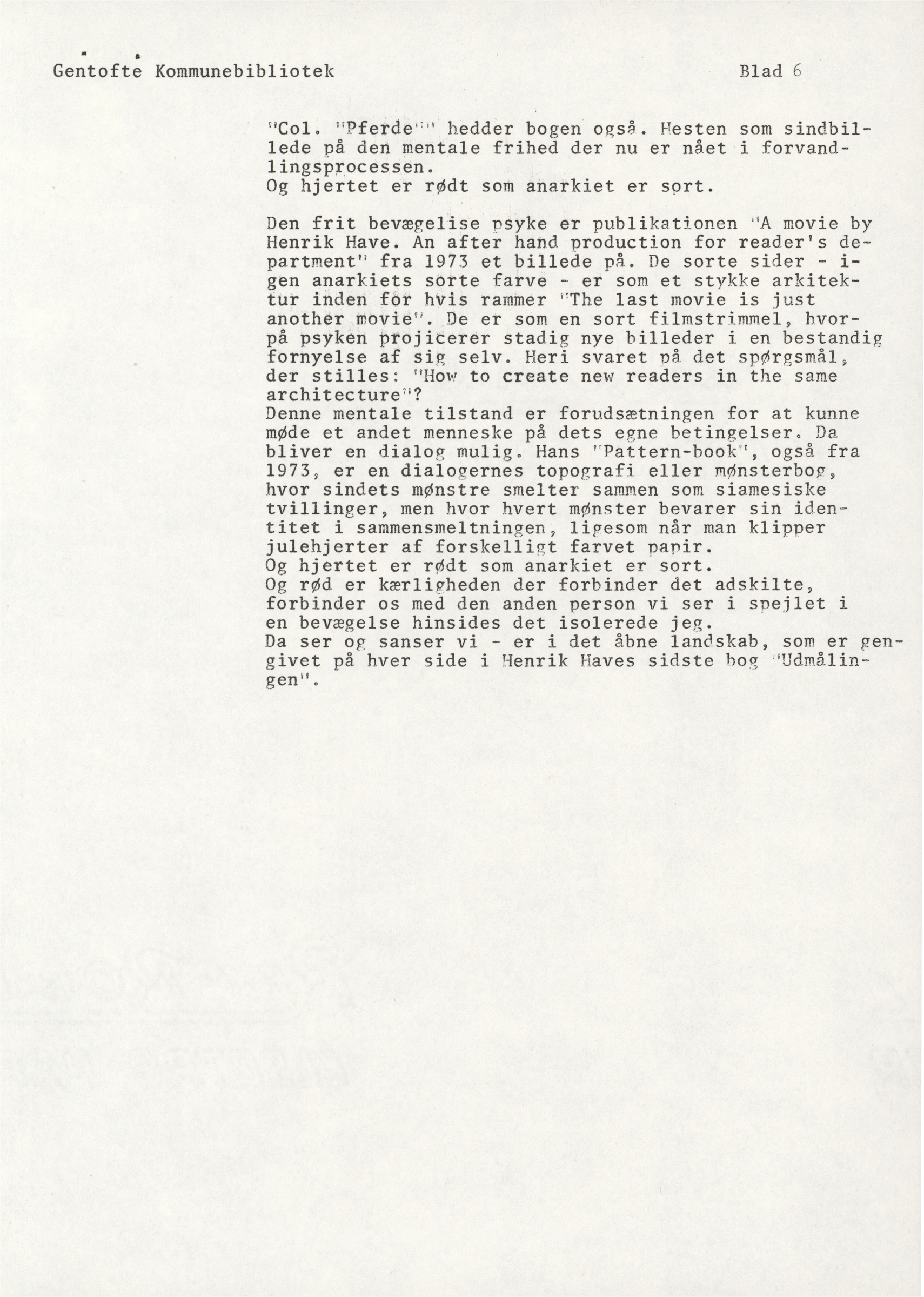
[JEANSELLEM VIEWER] — 1974 HENRIK HAVE — Categories: press, docs, letters, visual — Keywords: Galerie S:t Petri, Jean Sellem, archive — Category: press — From 5 to 17 April 1974, the Danish artist HENRIK HAVE is exhibiting at Galerie S:t Petri. This is the first time his works have been shown in Sweden.He has carried out numerous manifestations in Denmark, France, England and the USA, written novels, made films and created multi-objects. His working method is highly specific and, for many, perhaps difficult to understand.The Danish art critic Jane Pedersen is well acquainted with the issues that concern many contemporary artists. She writes, among other things: “Henrik Have’s works may seem inaccessible, closed. They certainly are, as long as one tries to find the meaning that Have himself has put into them. That leads one astray. ... The closed quality becomes precisely an expression of the fact that his works must be interpreted entirely according to the viewer’s own premises, and that one must undertake a process of work upon oneself before being able to experience them. Then the closed quality disappears. ... Henrik Have’s works establish, like much visual art of recent years, an open psychic field, a field of total perception, in which the individual work, the artist and the act of creation form a unity. It is within this total field of consciousness that the human being regains his identity, his person and his history.”The exhibition is open weekdays from 3–8 p.m., Saturdays and Sundays from 12–5 p.m. — — — Category: docs — For the time being, or at least for these thirteen days: This is the day today and this is the day tomorrow. Tomorrow the day completes what it gathered today for tomorrow, and only tomorrow can it appear as yesterday, as right now — and tomorrow: it is the only remaining memory of today. This day is today. Tomorrow I know that today, and the time that has just passed, and the time today that has just been conquered and had already been conquered by movement, was what I can expect to look forward to and look back upon. Tomorrow is also here. The day after tomorrow is also here. And after tomorrow comes yesterday, and everything that therefore happens now happens tomorrow. And what happened yesterday and tomorrow has just happened. Has just begun.HENRIK HAVEGALERIE S:T PETRIS:T PETRI KYRKGATA 5 / P.O. BOX 7 · 221 01 LUND 1 / SWEDEN5–17 APRIL 1974 · WEEKDAYS 3–8 P.M.SATURDAYS AND SUNDAYS 12–5 P.M.and: My exhibition is not an expression of what you make it into, but it can be an expression of what you use it for in order to make yourself into, for as long as you are there. And as such it is neither a symbol nor an investigation. — — — Category: letters — <p><span style="color: rgb(17, 17, 17);">Lund, 9 October 1973</span></p> — Dear Henrik Have,Thank you for your letter.I have tried several times to telephone you, but unfortunately have not been able to reach you.I am in principle interested in a two-week exhibition next spring, but nothing can be fully arranged until we have met and discussed the matter at your exhibition in January at Gentofte Art Library.Would it be possible for you to set aside 100 posters without text from the Gentofte exhibition, so that something could perhaps be printed on them for the exhibition in Lund?The gallery operates on a non-commercial and non-institutional basis, i.e. each exhibitor pays SEK 160 per week, and no commission is charged. Postage and printed matter are paid for by the artist.However, there is little point in sending out large quantities of unnecessary information material; it is better to concentrate on a few important people who may be valuable for your work. I know that the Gentofte library can afford to print relatively expensive posters. One should therefore think carefully about the possibility of making use of this opportunity.Another thing: Could you send me more material about Edition After Hand?Best regards,Jean SellemP.S. You may have forgotten me, but about five years ago I helped you arrange an exhibition in the basement of the Royal Danish Academy of Fine Arts in Copenhagen. — — — Category: letters — To the director of Galerie S:t Petri.For some years I have followed the development of your gallery, and it seems to me to be a good gallery. I am writing to ask what the conditions are for exhibiting with you. More specifically, I have made a short film (10 min.), Super 8, without sound, consisting of four sequences in English. If possible, I would like to show the film with you and, secondarily, present my books written during the years 1969–1974. If it is possible for you to show the film, I could imagine having an exhibition sometime during the spring of 1974, since by that time I will also have completed two books which will be published by my own publishing house. One... — ...of the books deals mainly with my language experiments, which have been set in relation to my participation in Fluxshoe in England this year. No more for now, but more if you wish to know more.Best regards,Henrik Have“Vestfarm”6940 Lem St.Denmark[Stamp]EDITION– After hand – — — — Category: letters — <p>16 September 1973</p><p><br></p> — Dear Jean,I haven’t phoned you because I think there is still plenty of time for the exhibition we discussed to become a reality, so we can surely simply correspond about it for the time being.If there is to be an exhibition, it could take place in November of this year or not until February 1974. If it is to be in November, I would suggest showing the film and only the film. It lasts only 15 minutes and consists of just four sentences (in English). I myself feel that the film follows directly from everything I have done up to now, whether in literature or image-making — that is, something that to a very large extent borders on conceptual art. Some people think it is a pure piece of minimal art — but perhaps that amounts to the same thing when it is film we are talking about.If the film is to be included in an exhibition at your gallery at the beginning of 1974, I would suggest that you visit my exhibition at Gentofte Kunstbibliotek, Tranegårdsvej 73, Hellerup (in Copenhagen), from 5 to 25 January 1974, and there find out what I am doing and perhaps select yourself what you would like to include in the exhibition.There is one thing I would like to know before we go too far into the actual planning of the exhibition, namely how you normally organize exhibitions: what about finances, publications, invitations, etc.?Warm regards,Henrik — — — Category: letters — <p>Thursday, 25 October 1973</p><p><br></p> — Dear Jean,1: I have a new address: SKRALDHEDE 6950 Ringkøbing.2: Edition After Hand is my private (registered) and officially recognized publishing house. Its purpose is to print and publish books, objects, etc., distinguished by the fact that they are made by Henrik Have. Edition After Hand does NOT publish books, etc., made by anyone other than Henrik Have. After Hand is an institution that will exist until Henrik Have is dead. Anyone who calls himself Henrik Have can publish books, etc., through After Hand. Edition After Hand is subject to state-authorized auditing and may be regarded as an almost self-governing institution. To date, Edition After Hand has published:Col. Pferde. Novel. 275 pages (1972)Four Sentences. Film. 17 min. (1972)One Hundred Mesmerized Movies For An After Hand Line. Film. 45 min.(Together with Dan Turèll) 1973Pattern Book. ReadyHandNovel. 25 pages. (1973)An After Hand Production For Readers Department. 14 pages. (1973)(Exists as a slide series at the Paris Biennale this year; also exists as a book distributed through Danergalleriet in Copenhagen.)In the spring (January 1974), FORSKELLEN [THE DIFFERENCE] will be published. It will be issued in connection with my exhibition in Gentofte.Later in the summer, After Hand Magazine, vol. 1, will appear.In collaboration with Edition Arena – Archive for New Literature – After Hand has published SPIEGELSÄNGERIN (1972) & UDMÅLINGEN (1973).After Hand contributed films and objects to the Fluxus festival in England this year (FLUXshoe), as well as to the Youth Biennale in Paris this year.3: I am enclosing some of my objects, which you can study more closely and otherwise keep as a gift.4: It would suit me extremely well if my exhibition with you could take place during the last two weeks of April 1974.5: I would like to exhibit Four Sentences, a game of L’Hombre cards, and present various objects.6: As payment, I will make a book in the style of An After Hand Production for Readers Department (I mean in terms of its design) in an edition of 100 copies, which you may receive free of charge and send out to your addresses or sell for three Swedish kronor.7: Poster: I will send you 100 copies of the enclosed green folder, on the reverse of which I will have additional text printed. In red. — I have intended this text to contain information about your gallery and my exhibition.(P.S.) I do not yet know what I will make if you agree that I make a book that you can send out, but I will know when we hopefully meet in Gentofte one day between 1 and 5 January 1974.Let me know what you think about it.Best regards,Henrik HaveSKRALDHEDE 6950 Ringkøbing.[Stamp]Mieko ShiomiOPEN31 July 1972Transcription: Henrik Have — — — Category: letters — Lund, 9 January 1974Dear Henrik Have,I am sorry that I was unable to meet you at Gentofte Municipal Library. The poster arrived too late.On Sunday I saw your exhibition.I am still interested in showing your works in Lund. However, the exhibition must be presented in a very didactic and informative way, with texts, so that visitors can understand the context. This is the prerequisite for such an exhibition to be of value in Lund, so that people do not remain unable to understand the meaning of the exhibition. In other words, if you wish to exhibit, I ask you to send me as soon as possible a simple but detailed explanation of each work or composition. I will then have these translated into Swedish.As far as the financial side is concerned, it is impossible for me to allow anyone to exhibit free of charge, since the gallery is run entirely without profit and at a considerable loss, and I have absolutely no private means.The gallery costs are, as I mentioned earlier, SEK 160 per week plus approximately SEK 50 for postage, i.e. SEK 370 in total for a two-week period.The exhibition period will be 5–17 April 1974.A plan of the gallery is enclosed. — It would be nice if you had the possibility of printing some small item providing information about your exhibition. For my part, 150 copies would be quite sufficient.The text for the printed matter is enclosed on a separate sheet.Could you let me know immediately whether I can count on your exhibition? I would also like you to send immediately 20 small black-and-white images to be sent to magazines and newspapers outside Sweden. These publications must be informed at least two months in advance. It would also be good if you could send me biographical information and a general text about the philosophy of your works together with the other material.I hope that we can come to an agreement about an exhibition.Best regards,Jean Sellem — — — Category: letters — Dear Jean,I have received your letter and accept the invitation to exhibit. Today I sent an application to the Ministry of Culture in Copenhagen to apply for financial support for the exhibition.There are two things I cannot accept.1: There must be no vernissage at an exhibition by Henrik Have. Nor shall I myself be present. This is a condition. If you yourself feel that you want to hold a special opening, that is O.K., but it will therefore take place without me, and without the serving of drinks or whatever it is you call a vernissage.2: The enclosed text about my things will not express the things in any particular way, but rather the exhibition as a whole. It will be a matter of a totality that can only be perceived if one is oneself unconditionally prepared to experience something. My exhibition will not be an explanation or a feeler for certain conditions in society, but rather a model that functions a priori through the viewer's participation in the model. The objects thereby become not an investigation, but rather a "garment" that gives the viewer certain relevant possibilities of movement within a psychogeographical area. If this has to be explained so that people can understand it within the same framework in which they normally understand art (and here I assume, at my own risk, that the art people understand is the art they have been permitted by society to understand, and that a considerable amount of art has thereby also been created; the artist has been given a kind of dispensability, namely that within certain limits he does not need to intend anything with his expressions, since these have already been expressed and archived; if, on the other hand, he breaks these rules, one forces from him an explanation that can be understood, precisely in order to push him back to where he came from; but to break the rules is also to break language and, in particular, to break the prerequisite for being able to understand this language), then I must refuse to give such an explanation, since in itself it constitutes a potential danger of paternalism. (You have not seen anywhere that the things around you were supplied with explanatory texts and signs, and if they were, it would probably be in order to indicate a model of Plato's thought.) My exhibition must therefore be all or nothing. Either it succeeds or it fails. The text (about the days) that I have made is nevertheless intended to accommodate you and the public. As such, it does not explain the exhibition, but only the period during which the exhibition lasts. And that in itself is just as important a factor.The exhibition itself will consist of the entire innermost room of Gentofte Art Library: chess + curtain = 1 object; together with two additional curtains which I intend to hang in your first room. Seven photostats with the words: Monday – Tuesday, etc., etc. (together with the text about the days), and finally a large number of balloons that are to lie on the floor of the innermost room.The printed matter will consist of three cards (two of them self-adhesive silver):1st card: Line drawing of a curtain together with an English text.2nd card: The text about the days together with the dates of the exhibition.3rd card: White with a black cross.Finally, together with these cards (which are to be used partly as poster and invitation), two balloons are to be enclosed with each invitation. I will make all of this myself. — Here, then, are the texts:(Please translate this into Swedish and send it back to me immediately, as it is to go to the printer.)For the time being, or at any rate during these 14 days: This is the day today and this is the day tomorrow. Tomorrow the day completes what it has gathered today for tomorrow, and only tomorrow can it appear as yesterday, as just now — and tomorrow: is the only remaining memory of today. This is the day today. Tomorrow I know that today, and the time that has just passed, and the part of today that has just been conquered and had already been conquered by movement, was what I can expect to look forward to and think back upon. Tomorrow is here too. After tomorrow comes yesterday, and everything that therefore happens now happens tomorrow. And what happened yesterday and tomorrow has only just ended. Has only just begun.HENRIK HAVEGALERIE S:T PETRIS:T PETRI KYRKGATA 5 / P.O. BOX 7 · 221 01 LUND 1 / SWEDEN5–17 APRIL 1974 · WEEKDAYS 3–8 P.M.SATURDAYS AND SUNDAYS 12–5 P.M.and: My exhibition is not an expression of what you make it into, but it can be an expression of what you use it for in order to make yourself into, for as long as you are there. And as such it is neither a symbol nor an investigation.The English text is not quite finished, but it can quickly be completed.Here is the final sentence, taken from CONFUCIUS:The way out is via the door.Why is it that no one will use this method?With love,Henrik Have — — — Category: letters — Lund, 17 January 1974Dear Henrik Have,Thank you for your letter.Enclosed is the text in Swedish:For the time being, or at least during these thirteen days: This is the day today and this is the day tomorrow. Tomorrow, the day completes what today it gathered from tomorrow, and only tomorrow can it appear as yesterday, as just now — and tomorrow: is the only remaining memory of today. This day is today.Tomorrow I know that today and the time that has just passed, and the time today that has just been conquered and had already been conquered by movement, was what I can expect to look forward to and look back upon. Tomorrow is also here. After tomorrow comes yesterday, and everything that therefore happens now happens tomorrow. And what happened yesterday and tomorrow has just happened. Has just begun.HENRIK HAVEGALERIE S:T PETRIS:T PETRI KYRKOGATA 5 / P.O. BOX 7 221 01 LUND 1 / SWEDEN5–17 April 1974 WEEKDAYS 3–8 p.m.SATURDAYS AND SUNDAYS 12–5 p.m.and: My exhibition is not an expression of what you make it into, but it can be an expression of what you use it for in order to make yourself into, for as long as you are there. And as such it is neither symbol nor investigation.[continues] — — — Category: visual — — — Category: docs — — — Category: docs — — — Category: docs — THE MANL’hombre is a trump card game originating in Spain, where under the name fuego del tresillo (three-player game) it was already played more than 500 years ago. Only later was it given the name L’hombre (hombre = the man; in this case, the man who undertakes to play against two). With the Spanish princess Maria Theresa it came to France in the middle of the 17th century and soon became a well-known and popular game throughout most of the civilized world.It is played with an ordinary pack of cards from which the 8s, 9s and 10s have been removed. Usually four people take part. One of them sits out, namely the player opposite the dealer. Cards are dealt to the right, three at a time, nine to each player; the remaining thirteen cards form the talon and are placed face down on the table.Bidding then begins. Forehand, the player to the dealer’s right, bids first, followed by middle hand and finally rear hand. The ace of spades (Spadille) and the ace of clubs (Basta) are always respectively the highest and third-highest trumps; the second-highest trump (Manille) is the black two or the red seven. In the black suits the order of trumps is: Spadille, Manille, Basta, King, Queen, Jack, 7, 6, 5, 4, 3; in the red suits: Spadille, Manille, Basta, Ponto (red Ace), King, Queen, Jack, 2, 3, 4, 5, 6. Thus there is one more trump in a red suit than in a black one.In suits that are not trumps the order is somewhat different: in black, King, Queen, Jack, 7, 6, 5, 4, 3, 2; in red, King, Queen, Jack, Ace, 2, 3, 4, 5, 6, 7. Within each suit the cards beat one another according to this order, but even the lowest trump beats every non-trump card. A player may trump or discard as desired, but must follow suit whenever possible. An exception is made for the three Matadors, Spadille, Manille and Basta, with which one need not follow with a lower trump.The games on which one may bid are the so-called buying games. The principal ones are Spurt, Tourné and Tourné Respect; the latter are followed by Solo and Nolo. Spades are the best suit; the other suits are called simple. In Nolo the player must avoid taking any trick.The lowest bid is a simple buying game; it is overbid by Spurt in a suit, which is beaten by a Tourné, which in turn is overbid by a simple Solo, and this again by Solo in a suit or Tourné Respect. The last two rank equally, in which case forehand has priority. Nolo ought to outrank every other game because it involves the greatest risk, although many players nevertheless rank it equally with Tourné Respect and Solo in a suit.When bidding is finished and a buying game is to be played, the declarer discards cards he does not need and buys the same number face down from the top of the talon. The other two players may then buy as many or as few cards as they wish, in seating order; they are not obliged to buy. They act as partners against the declarer.In a Tourné, if the bidder has not been overbid, he turns over the top card of the talon and plays in that suit. Cards are then bought as in an ordinary buying game. Tourné Respect may be announced only by a player holding both black aces; these are placed openly on the table before play proceeds as in an ordinary Tourné. In Solo only the opponents buy, while in Nolo no one buys and all thirteen cards of the talon remain out of play.If all three players pass, the game becomes Caso (Kaske): instead of his original nine cards, a player takes the top nine cards of the talon and tries to make a playable hand. Forehand has first option and must take it if he holds Spadille (spadille forcé, more properly caso forcé); otherwise he may accept or pass. The same applies to the two other hands. Because the chance of winning a nine-card Kaske is small, the so-called Skydekaske was introduced: after laying down his nine cards, the player takes the top eight cards of the talon and may choose as his ninth card either one of his discarded cards or the ninth card of the talon.If he can thereby form a promising game, he names the suit in which he will play, after which the opponents may buy. If everyone passes the Kaske, the fourth player may take up the talon and form a game from it, called Mort, playing against the other three. If Mort is also passed, the cards are thrown in and a new deal begins.A buying game, Tourné, Solo or Kaske is won when the declarer takes more tricks than either opponent. If an opponent takes as many tricks as the declarer, the declarer loses and records one bete (remis); if an opponent takes more tricks, the declarer is codille and records two betes. A Mort is won with six tricks; the player records two betes for being one trick short and three for being two tricks short. In Nolo the player records two betes for the first trick taken and one additional bete for the second. A buying game, Kaske or Mort may under certain conditions be abandoned as remis; Solo and Nolo must always be played. A successful Nolo wins two betes; every other successful game wins one.C. G. Schiellerup. — GENRE PAINTINGGenre (French): kind, type, category; also manner or style.Genre painting, from the French genre, is the branch of painting that represents events and situations from human life in general. It therefore differs from portraiture, which depicts particular individuals, and from history painting, whose subjects are specific events whose existence is either historically real or derives its reality from carefully formed conceptions in religion, myth, etc. Genre painting depicts, according to its name, the type or kind characteristic of different times and places rather than the purely individual; its principal subject is popular and everyday life, human existence in its countless daily scenes.Genre painting does not, however, occupy an entirely precise place in artistic classification. The French expression genre du paysage, for example, lies outside the limits suggested above, and in a more specific French usage the term may include, besides scenes of popular life, architectural, animal, flower and still-life painting. Even without these extensions, the boundaries are vague. Genre may pass almost imperceptibly into history painting, as when historical figures are represented in everyday situations — historical genre — or into portraiture, for example when the sitters are placed in a particular dramatic relationship with one another. When the figures in a landscape acquire an independent importance equal to that of the landscape itself, one may speak of ‘landscape genre’.Although genre painting as an independent field belongs chiefly to modern times, numerous representations in ancient and medieval art enter its territory. Examples include Egyptian wall paintings, Greek vase painting and funerary images, in which sculpture and painting often work together, and especially a number of genre scenes from Pompeii. Through Pliny and others we also possess accounts of Greek genre painters such as Peiraikos, with his barbershops and kitchen scenes, the principal representative of rhyparography (‘dirty painting’), as the ancients somewhat unflatteringly called this nevertheless highly sought-after tendency. Antiphilos is said to have painted a weaver’s workshop, and so forth.In the Middle Ages, genre motifs gradually found their way into highly religious representations, and in miniatures, illustrations to love songs, etc., an interest in secular life became increasingly evident. Only in the naturalistic period of the 17th century did genre painting in the modern sense find its proper conditions for growth. In this connection one may mention that at approximately the same time in Japan Matahei is said to have invented ukiyo-e, ‘pictures of the floating world’, a field later brought in its own way to perfection by Hokusai.The true home of genre painting became the North, especially the Netherlands, where domestic life and the intimacy of the home took deeper root than in the more outward-looking social life of the South. Genre can certainly be found early in Italy, even in Giotto and later, among others, in Giorgione, but there it commonly retains the grand manner of history painting. The same applies to later works of similar subject matter by Bassano and Caravaggio, and in Italy and Spain by Velázquez and Murillo, although northern influence is often perceptible.Seventeenth-century Dutch genre painting, with its careful account of the small things of life and its representation of everyday existence in every detail — often on a small scale suited to the decoration and comfort of the home — can, like many other specialized branches of painting, be traced back to the Van Eycks’ oil painting, broad in subject matter, including purely genre themes, and meticulous in its rendering of detail. These northern genre pictures acquire a particular charm from the humour that runs through them.Woodcuts and engravings, for example those of Lucas van Leyden, prepared the way for interest in scenes of popular life. In the 16th century important representatives already included Pieter Bruegel the Elder, David Teniers the Elder and Lucas van Leyden. Seventeenth-century northern — Dutch and Flemish — genre is commonly divided according to subject into a ‘higher’ genre, representing refined and respectable social life, and a ‘lower’ genre. Although the boundary is fluid and some painters worked in both, representatives of the former include Ter Borch and Netscher, and painters of a more bourgeois milieu such as Gerrit Dou, Gabriel Metsu, Frans van Mieris, Pieter de Hooch and Johannes Vermeer of Delft. Jan Steen provides a transition toward the second group, the depiction of peasant and popular life in its exuberant licence. David Teniers the Younger, Adriaen Brouwer, Adriaen van Ostade and Cornelis Bega particularly distinguished themselves in this field.How strongly even Dutch history painting could take on a genre character can be seen in Rembrandt’s art. In the 18th century genre flourished especially in France, which already at the beginning of the 17th century had possessed an important genre artist in Callot. Watteau, Lancret, Pater and Boucher cultivated scenes of fêtes galantes and pastoral life; Chardin and Greuze cultivated bourgeois genre. In England, Hogarth appeared with his satirical and moralizing representations of popular life.For the later development of genre painting in individual countries, reference is made to the respective specialist articles on their art.A. Hk. — Gentofte Municipal Art LibraryTranegårdsvej 732900 HellerupTel.: HE 9128LN/TeJ4 January 1974Press release concerning my exhibition at Gentofte Art Library.Exhibition title: L’HOMBRESubtitle: — A Genre Picture —Theme (invented for today’s occasion):Criteria for and materializations of statements and, as a rule, corresponding myths.I maintain that language has only two (2) distinguishable properties:1: It refers historically backwards (= the condition that enables us at any time to communicate about anything whatsoever).2: Its usefulness can only be defined by its content of future (= the condition for being able to describe the present as movement).... which can subsequently be rationalized as:Movement appears conditioned — as language.Movement appears unconditioned — as myth (or total war, as Goebbels said).Expectations of the future are an archaeological hollowing-out of the road into the future. One might also say that the future’s only asset is language. That language’s only asset is capital, etc.That myth is a knot that can only be untied by language, precisely in order thereby to remain myth.That language is a knot that can only be opened by myth, precisely in order thereby to remain language (Sprache).That language is a myth in the same way that myth has always been language.That the world can only be changed by ignoring meanings.That the body becomes the sole asset. — — 2 —Presented as:a series of objects — books (in connection with the exhibition my latest book is being published: FORSKELLEN / THE DIFFERENCE)— images — days, etc., which for me have in common that they are ‘cast in one piece’open games in which you yourself are the stakefilms without actionhenrik haveContradicted or read aloud by any kind of emptiness whatsoever. This explanation as the only correct one, or any other explanation as the only correct one. Quite simply: whatever the exhibition is here, it is in any case not in the rooms (you, for example, are there); there it is what you make of it — if reciprocity can bear it. This too, therefore, can be said. It is also possible for reciprocity to disappear. — Gentofte Municipal Art LibraryTranegårdsvej 732900 HellerupTel.: HE 9128The people’s book on the defence of the country.On the works of Henrik Have. By Jane Pedersen.“A reader who is to find his way through an intricate narrative must not hack a large hole in it with his experiences, but cautiously allow himself to be led into the transitions that obstruct observation.”(Die Europa-Erzählung, p. 69)Henrik Have’s works may appear inaccessible, closed. They certainly are so as long as one tries to find the meaning that Have himself has placed in them. If one tries, one is led astray. The meaning he has put into his works has meaning only for himself. It is not necessarily the reader’s meaning.The closed quality becomes, in fact, an expression of the fact that his works must be read entirely on the reader’s own terms, and that one must undertake a process of work upon oneself before one is capable of experiencing them. Then the closed quality disappears; they become thick, exciting brick-like novels. The text may be like a chest that must be opened, but not in order to find Henrik Have’s stories inside. They are not there. We find the stories as states within ourselves. They are the legends, myths, folk tales, the “symbols” buried within us as psychic substances of the collective unconscious. Ultimately, what we experience is therefore a collective history.Like so much other visual art of recent years, Henrik Have’s works establish an open psychic field, a field of total perception in which the individual work, the artist and the viewer merge into a unity. It is a psychic field pointing beyond the mental division of which society’s superstructure is an expression. It is within this total field of consciousness that the human being regains his identity, his person and his history. Here a collective capacity for action is released that can abolish division, alienation and reification in class society.“Die Hände — Die Füsse” was the title of a box Have once made. Inside was a bundle of identically numbered slips bearing the words “Assimilation (total)” — assimilating the surrounding world with the whole body, thinking with hands and feet. There was room to record what had been sensed, to write one’s own history.Recovering one’s identity is a lengthy process that seems to follow a very definite pattern. Johannes Fabricius, for example, writes in “Ingmar Bergman and ‘The Dark Night of the Soul’”, Kosmorama 1967/68, pp. 173–82, that C. G. Jung was the first to discern a pattern in the — dynamic processes taking place in the unconscious psyche. Jung called this pattern the process of individuation. Its goal is the illumination of consciousness and the recognition of itself — that is, of its own unconscious background — and thus the realization of psychic wholeness, or individuation. He found the same patterns in medieval alchemy and in the processes of transformation through which an artist’s life-work may pass.The psychic field established in Henrik Have’s works is reinforced from work to work through an increasingly extensive rewriting, a transformation that appears to follow the same patterns and repeatedly seems to coincide with alchemical symbols of transformation, including the symbols of metals and colours that appear — all of them psychic substances that we find within ourselves.A journey through his works thus becomes an experience of the individuation process. It is not possible here to follow his works into every corner of the ornamentation of the unconscious. We can stop on certain platforms and look out over the landscape and the stories that open before us. Along the way, there is also a confrontation with many theories of writing and language. “The person who says that the limits of the world are the limits of language says nothing about the world and nothing about language — he is a fool and a traitor.” Analysing language is the work of a madman. Only the complete human being can show forward. Everything else points backward. “The complete” is defined as “the gathering of all dimensions. Connection to aesthetic dimensions is excluded.” The quotations are from Die Europa-Erzählung, pp. 42 and 52.Henrik Have’s Spiegelsängerin, Arena, 1972, contains a survey of earlier works. Have acts largely as his own publisher; his address is Skraldhede, 6950 Ringkøbing.Nine of the works appeared in 1970 and 1971 through Edition Unovis, Poul Henning Nielsen.“The ever-increasing state of sublimation as an expression of forensic-journalistic and psychopathological onomatomania” is written on a yellow parcel label attached to a package of objects wrapped in silver foil. It contains a piece of tape, several blue cards dipped in a liquid, pieces of paper bearing the cross that occurs again and again in Have’s works, and negatives of spirit-duplicator stencils with almost invisible images.This project contains, as it were, an inbuilt split between the title and the contents of the package. The title contains a critique of society’s superstructure, of the way it describes and names the individual and makes that individual function through meaningless work rather than work on his or her own terms, which is what the objects in the package invite. The silver foil becomes a reflecting surface, a mirror in which one can see a different person from the one described by society: the whole human being, the almost invisible images contained in the package.Auditorium H.G.5, 1970, is a box containing objects treated in different ways as an indirect statement that it is through working upon material conditions that the human being acquires identity and history. — On an old postcard from a provincial town, cut with zigzag scissors, the words “weeping and deprived of his thoughts” are written across it in German in Braille. Braille may be an expression for society’s outsiders, those who refuse to allow themselves to be described or who end in schizoid states because of mental divisions. Another piece of Braille is stapled together with, among other things, extracts from an old church register. It is given identity by being connected with collective history — the journey into the unconscious layers of the psyche.The box also contains some spirit-duplicator stencils with images, both positive and negative. Prints can be made from them. The positive is the image’s presence, the negative its absence. Again an image of the divided human being who must be made whole if our culture is to be cured of its illness. A tea bag dipped in a deep blue colour has been given a new dimension, the dimension that is now split off within the human being. In a yellow bag lies dirt from a vacuum cleaner that shifts when touched. The yellow bag becomes like a mummy whose dust lives in the realm of the dead in order to be recreated in another life. It is dead matter transformed into new life.All the objects in the box lie within a piece of white fabric. The white emptiness in which re-creation can take place. It is the colour of resurrection.At an exhibition at Jysk Kunstgalleri in 1971, Henrik Have exhibited two Joseph novels, a continuation of the novel concerning the further process of transformation.One consists of a suitcase containing various objects. It is a novel for two people. The suitcase is fastened with two large bolts, as though barricaded. One has to work to open it; one needs a wrench. Inside, among other things, is a blue blanket that one can wrap around oneself, adding a new dimension to oneself — the infinite blue.A novel for two: the union of the masculine and feminine within the psyche, the abolition of the divided ego. The union takes place on the unconscious plane, as in a dark coffin — it is the dark night of the soul.The following Joseph novel consists of a piece of black fabric sewn into a bag containing various objects. On the outside, Have’s cross is sewn in deep-red velvet edged with lace, indicating, as it were, the pattern of the transformation process. The bag evokes a sarcophagus. In channels in the fabric lie one hundred shining silver balls. In the exhibition they were removed and arranged in symmetrical patterns on two cushions covered in Bordeaux-red velvet, which also belong to the novel and give it an aura of fairy tale.One could play with them, but the game had to be invented by the player. At the same time they may recall drops of mercury running together into a reflecting surface in which one can mirror oneself and see the whole psyche after the union of opposites — mercury itself being an image of this: the dry water. The balls may also be understood as fertilizing rain, a bath of rejuvenation following confinement in the darkness of the sarcophagus. — Inside the black bag, between two baking trays, lie Joseph’s stories. They unfold on transparent parchment paper so that throughout the transformation he undergoes he always carries his entire history with him. It is a long journey across the paper, the story of Joseph, who for a long time had felt excluded from the game. It is a mystical Joseph in the heat of the oven, who at times becomes the biblical Joseph in the desert. But he also becomes Joseph Goebbels, whose propaganda apparatus against the Jews is said to have been so effective because it was based on a Jewish mode of thought that he could only have known by himself being Jewish. Goebbels would thus be repressing a part of his own self.The transformation seems to end in a lightness and mobility of the psyche — “Joseph can fly” — corresponding to the volatility of mercury. “Impala” is written on one of the baking trays, in blue covering green. Impala also designates a psychic substance, later becoming the gazelle: the light, the mobile, the desert, the savannah, leaps through the air. That which emerges from the process in the heat of the oven.Sun after Lunch, 1971, is the final Unovis publication. It is a thick brick-like novel consisting of loose A5 sheets tied together with a red ribbon like a bundle of love letters. The story has become many layered sheets, corresponding to the different layers of the psyche. The red colour is simultaneously the red of socialism and the red of love; together they redefine the psychic field in which material from earlier projects is gathered into a larger surface, including material from 30 pieces/moving letter and Greyhound Station, both from 1970.In a table of contents the reader is told: “The faster you move, the faster you are slowed down / With every step you take, Greyhound Station expands by one image — one state.” And in chapter 10: “You only need to know that it is silence that keeps the whole thing going.”The thickness of the book becomes an expression of the experiences crystallized through working upon oneself during the transformation process. The more the human being knows about himself and his possibilities, the richer his language must become. The words connect increasingly with one another. From Braille through a tautological progression, “A — AA — AAA”, as Have called one of his works, toward movement and connection between the letters.The title can be understood as an expression of the fact that the transformation of the psyche now takes place on a more conscious level — in sunlight. It is no longer the dark night of the soul. From this point Henrik Have calls his publications “After hand”. We have reached the stage at which the self projects its own images, is no longer described by others and no longer stands within other people’s quotation marks.A ready-hand-novel for selfprojection, 1972, is a novel in two parts that one writes oneself. One part is a large sheet containing the image of a closed brain in the centre, surrounded by one hundred zones. Around the edge is written: “This novel is the second attempt to inscribe physical space (for example your apartment or your clothing) and this space’s points of projection to/from your body (Bodies) as an open psychic state through which you move.” — This sheet is an image, a historical notation of something that has happened — an “After hand” notation. The situation is over: the situation of writing the novel oneself on the pad of one hundred sheets kept in a separate box. The box also contains one hundred self-adhesive numbers corresponding to the hundred zones. They can be placed anywhere in the apartment or on one’s own body. The area surrounding the number is that zone’s number. Every action occurring within a zone is recorded on the sheets. It is like keeping a diary of the zones, and keywords from these notes are entered on the pictorial diagram.In order to project one’s own images, when looking into the mirror one must be able to see another person than the person one has previously seen. One must become conscious of the whole human being within oneself. This is Spiegelsängerin, Arena, 1972.The silver coating of the mirror separates her from him, but in a process of transformation a fusion of the masculine and the feminine in the psyche takes place. It is here that the oppression of women ceases. The book thereby also becomes a statement that women’s liberation, understood merely as the liberation of the female sex in itself, is not the point. The point is to liberate the woman in both man and woman, to make the human being whole so that we refuse to play the roles in which we are presently placed — so that we refuse to participate in the history that is the history of officially male-dominated society.Spiegelsängerin is a new, larger surface and incorporates Have’s earlier projects. On its final text surface it says: “Nothing disappears. / new armour. (see-er) / larger surface / than the surface of the hand.” To see and be, instead of being seen. Sees and is.The refusal to accept one’s history is the subject of Die Europa-Erzählung, published around the time of the referendum on the EEC. It too is an “After hand” publication, issued by Jorinde and Joringel. Another brick-like novel of 2 × 258 A5 sheets held together by a large band, the black colour of anarchism, a further expansion of the red field of love and socialism in Sun after Lunch — a larger field whose subtitle identifies it as “The people’s book on the defence of the country”.On the pages of this book a story about Uriah is handwritten. After being shot down at the Uriah-post to which King David had sent him in order to obtain his wife Bathsheba, he refuses to accept his history. He walks backward through history to the point where it begins, where King David orders him to join the army. During this journey, the Uriah in whom he places his hope is King Solomon, whom Bathsheba bore to King David after Uriah’s death. The backward journey through time simultaneously becomes a journey forward into future time, which always ends at the point of now.It is by refusing to remain at the Uriah-post society assigns to us, and by finding one’s own history, that the different histories flow together and become the people’s book on the defence of the country. — The book is also called “Col. ‘Pferde’”. The horse as an image of the mental freedom now reached in the process of transformation.And the heart is red as anarchy is black.The freely moving psyche is represented by the 1973 publication A movie by Henrik Have. An after hand production for reader’s department. The black pages — once again the black colour of anarchism — are like a piece of architecture within whose framework “The last movie is just another movie”. They are like a black strip of film upon which the psyche continually projects new images in a constant renewal of itself. Here is the answer to the question posed: “How to create new readers in the same architecture”?This mental state is the prerequisite for being able to encounter another human being on his or her own terms. Dialogue then becomes possible. Have’s Pattern-book, also from 1973, is a topography of dialogues or a pattern book in which the patterns of the mind merge like Siamese twins, while each pattern retains its identity within the fusion, as when Christmas hearts are cut from differently coloured paper.And the heart is red as anarchy is black.And red is the love that connects what has been separated, that connects us with the other person we see in the mirror in a movement beyond the isolated ego.Then we see and sense — we are in the open landscape reproduced on every page of Henrik Have’s latest book, Udmålingen.