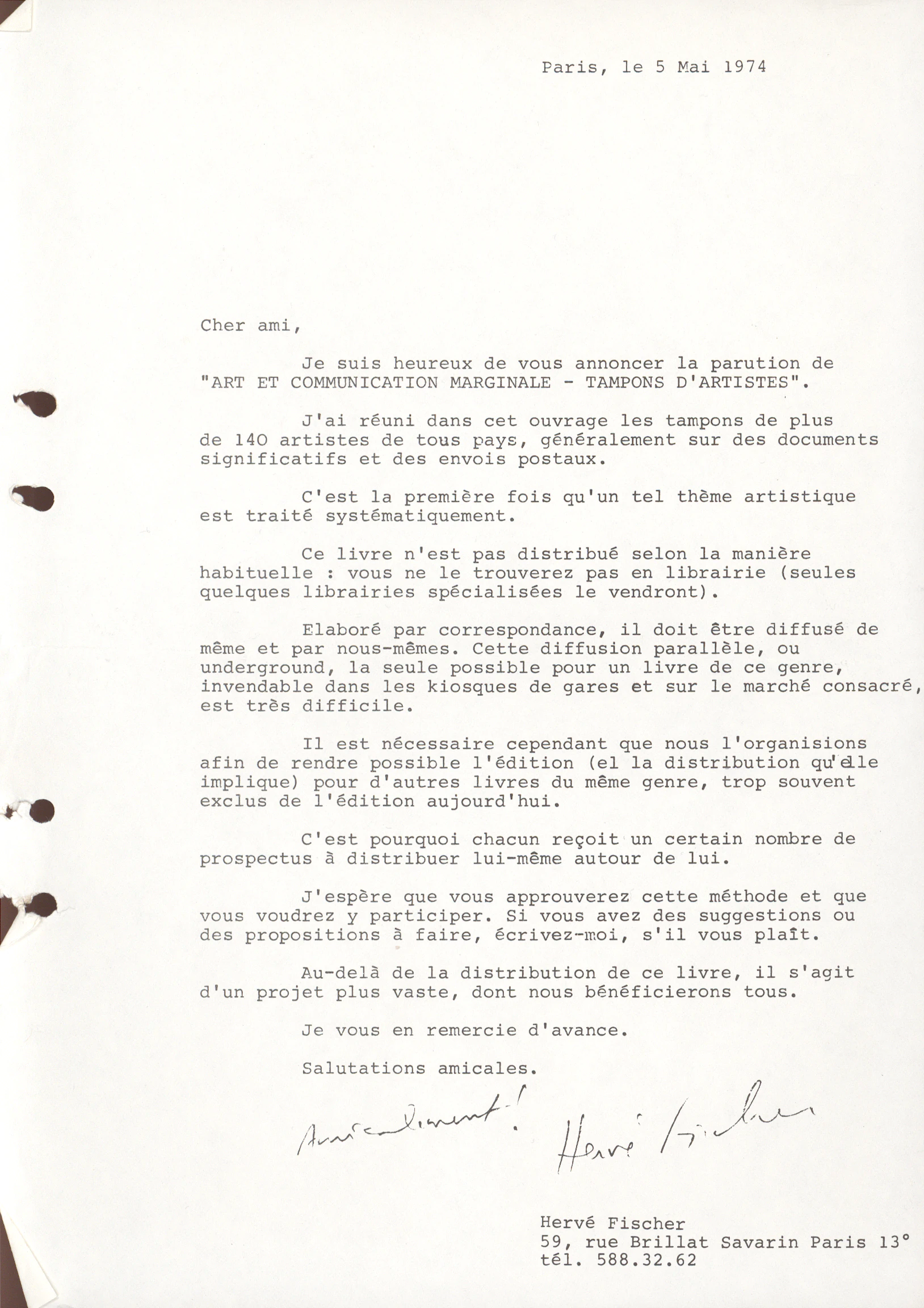
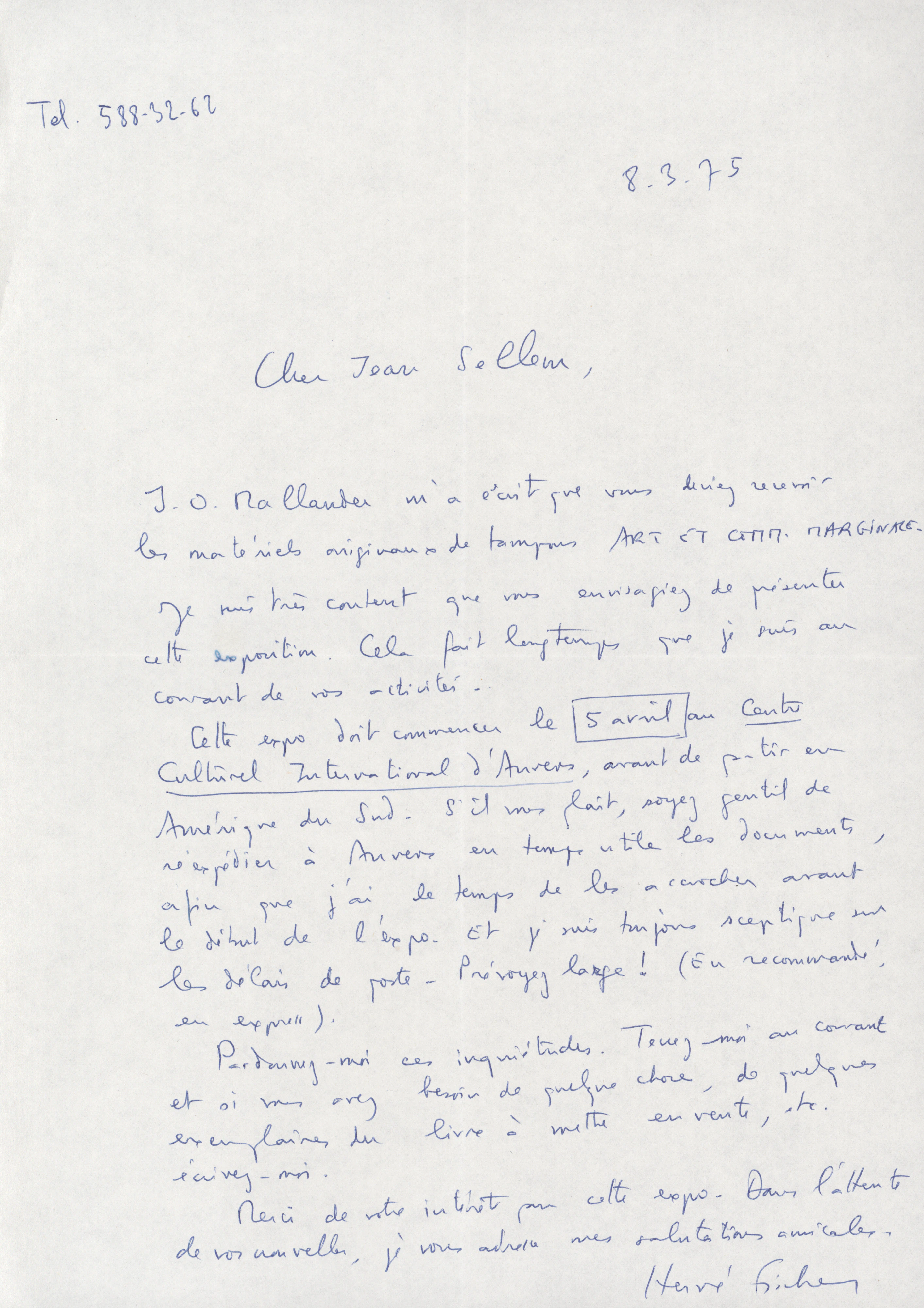
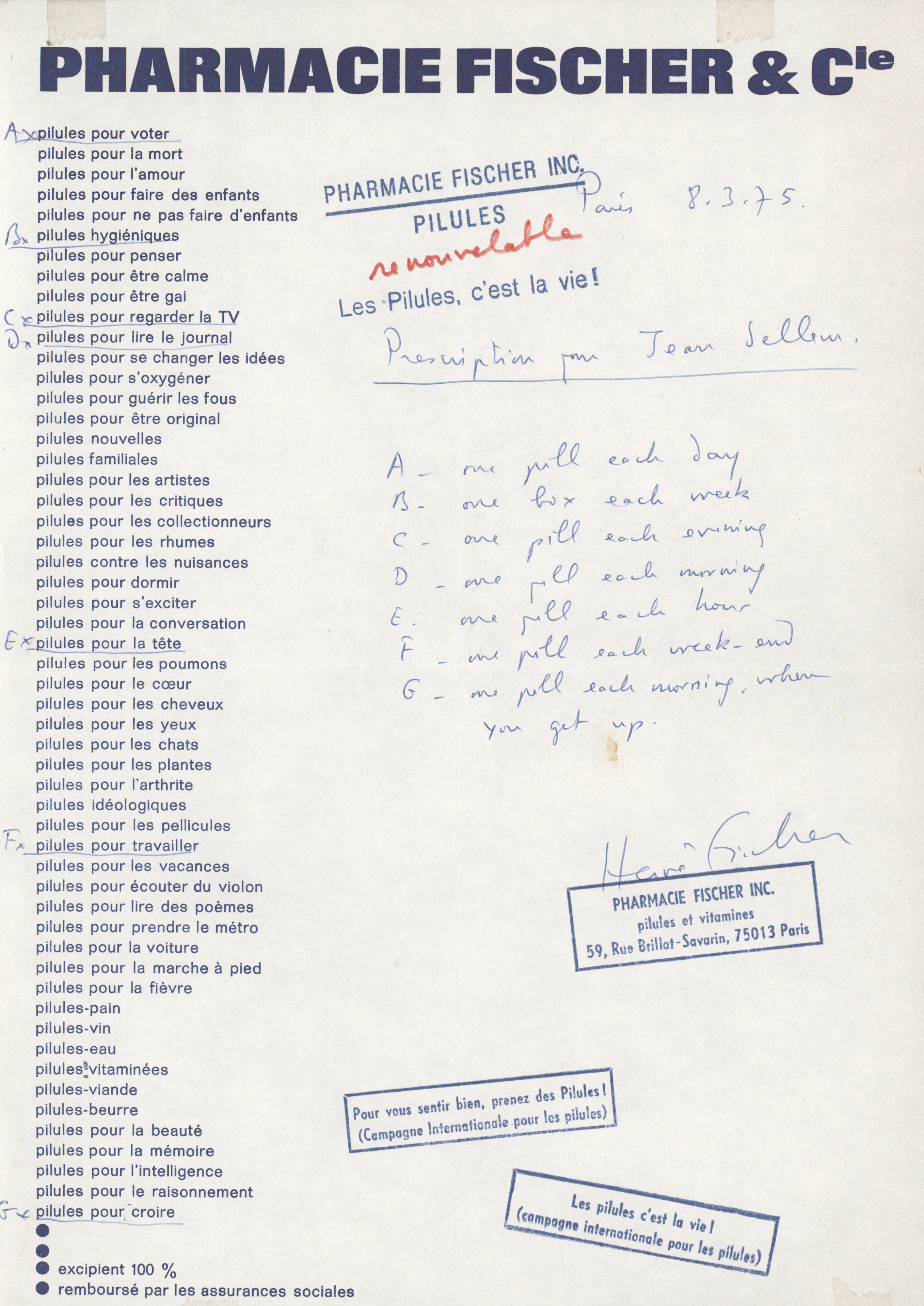
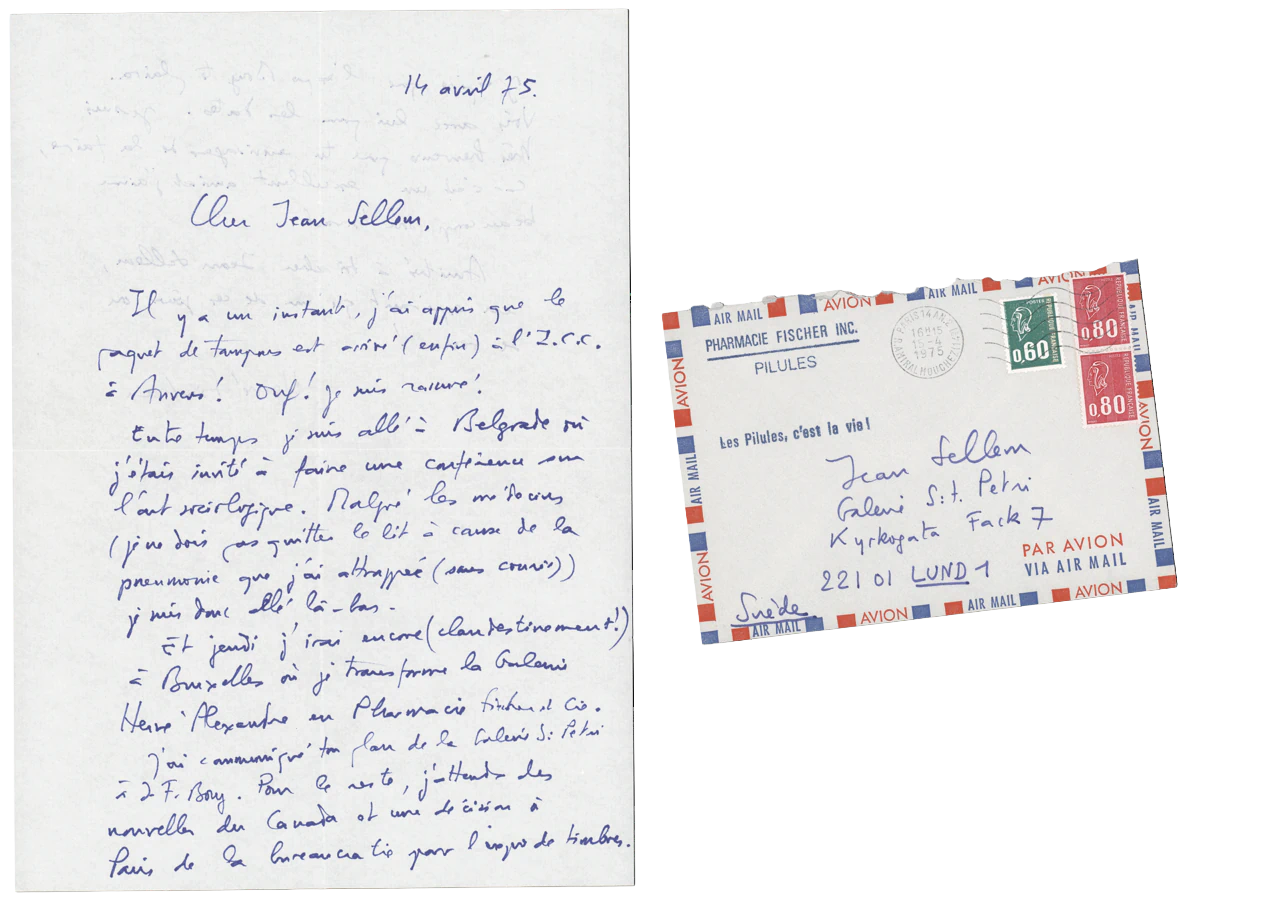
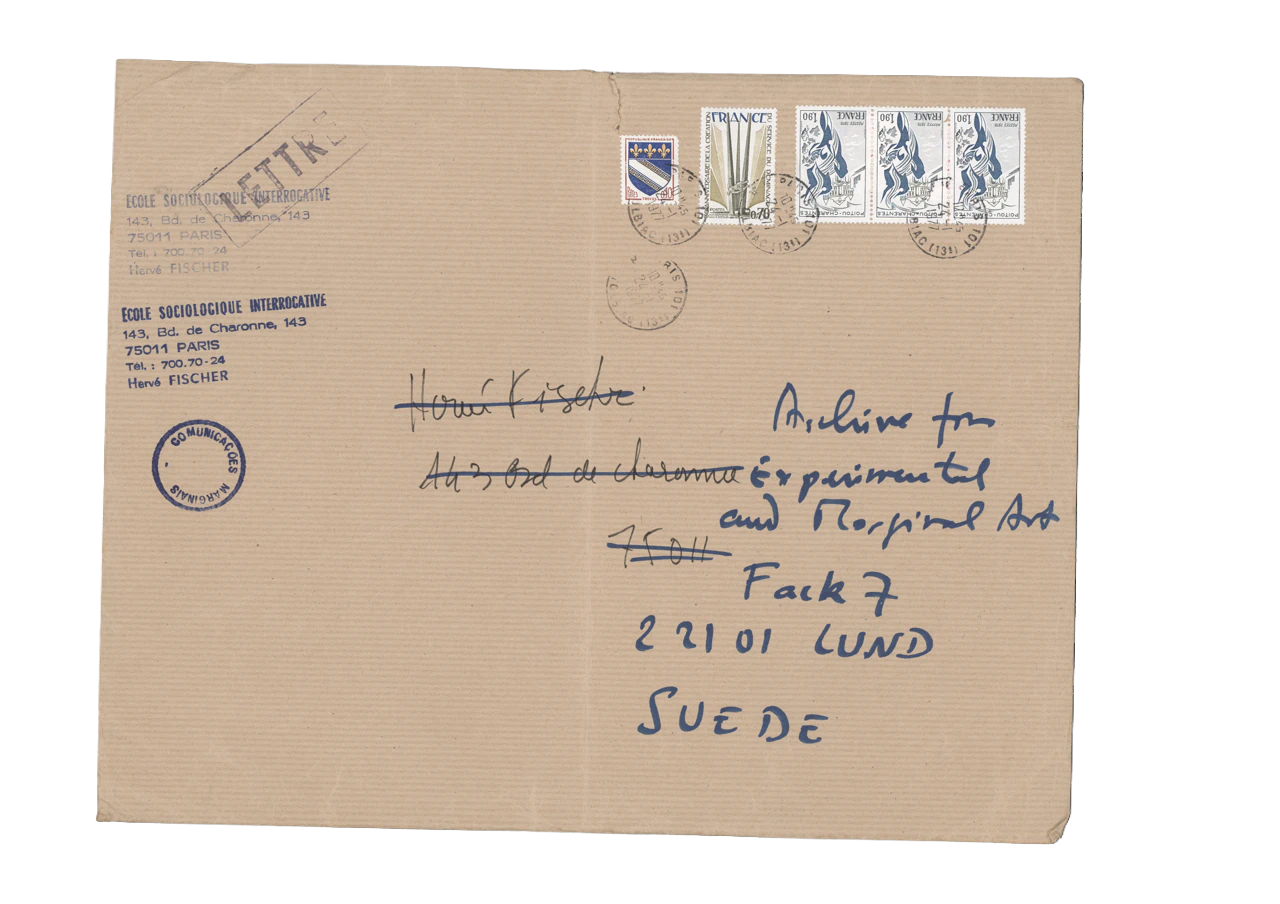
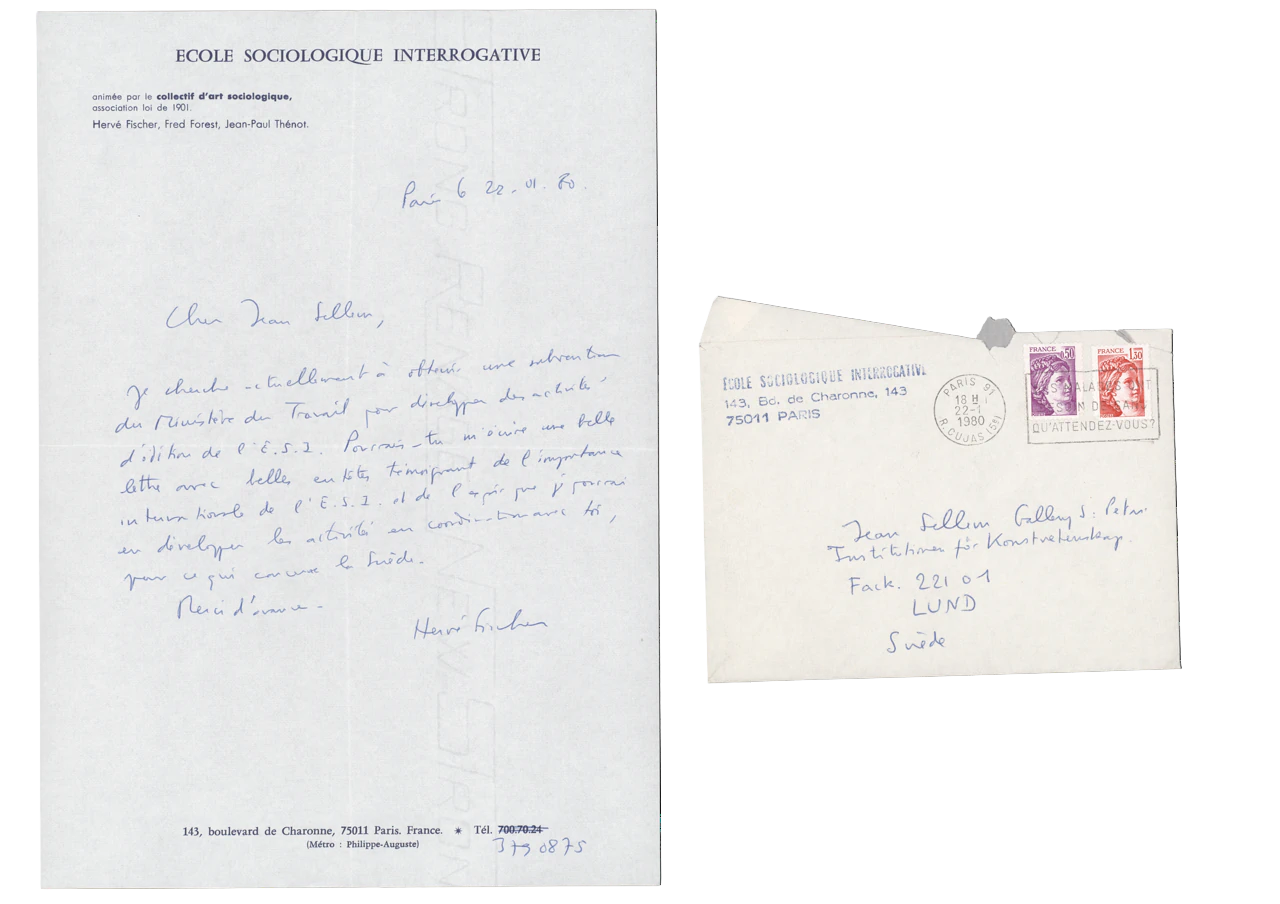
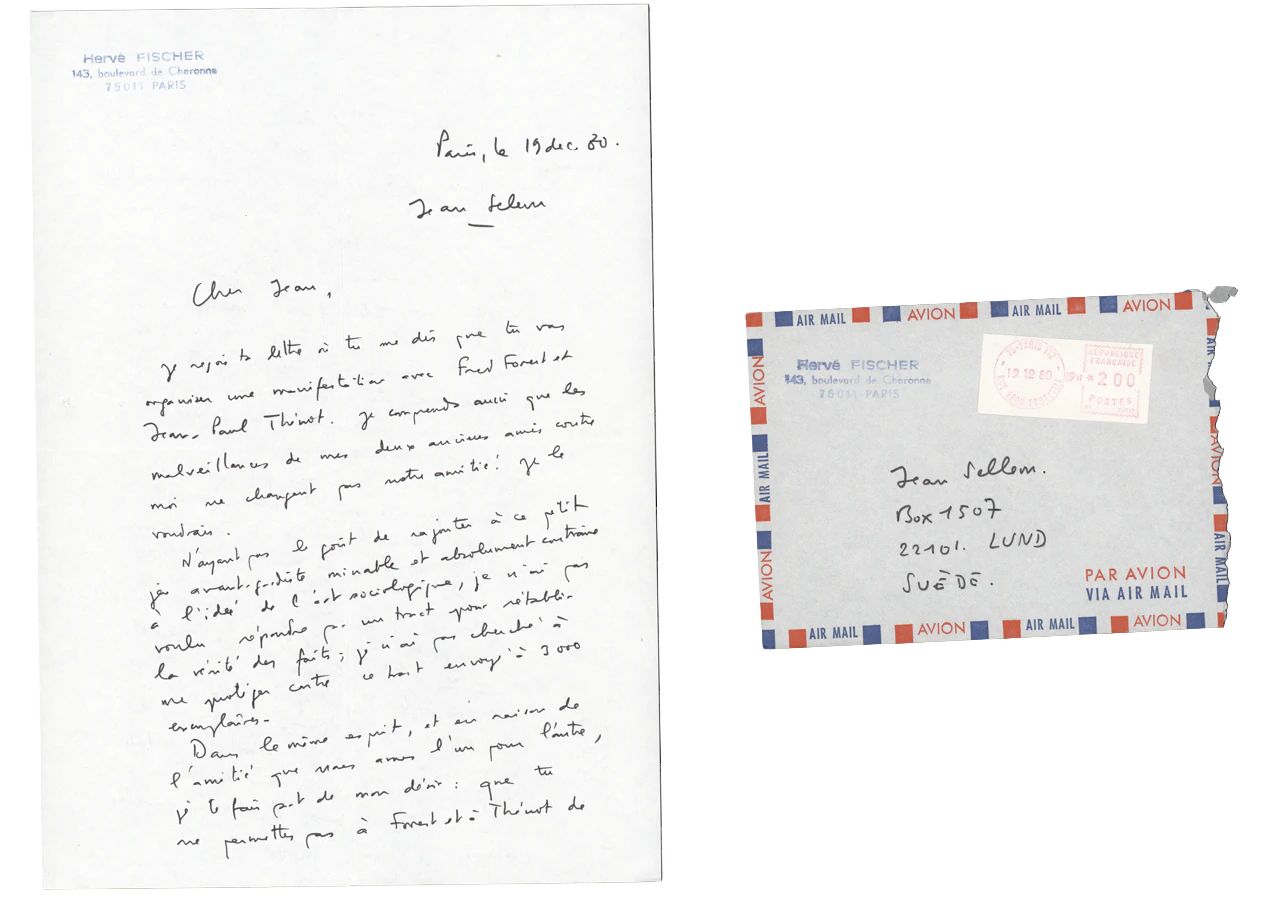
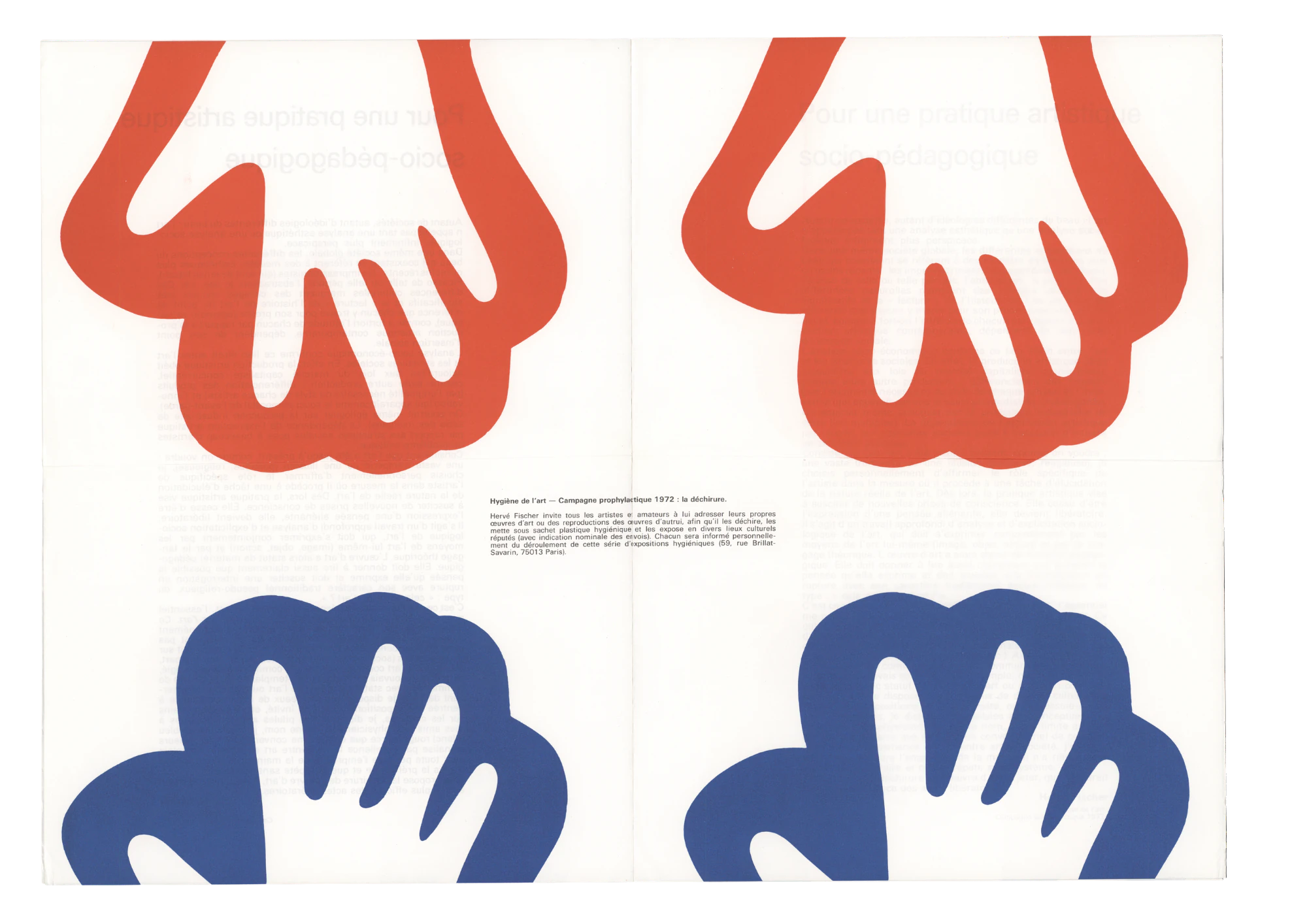
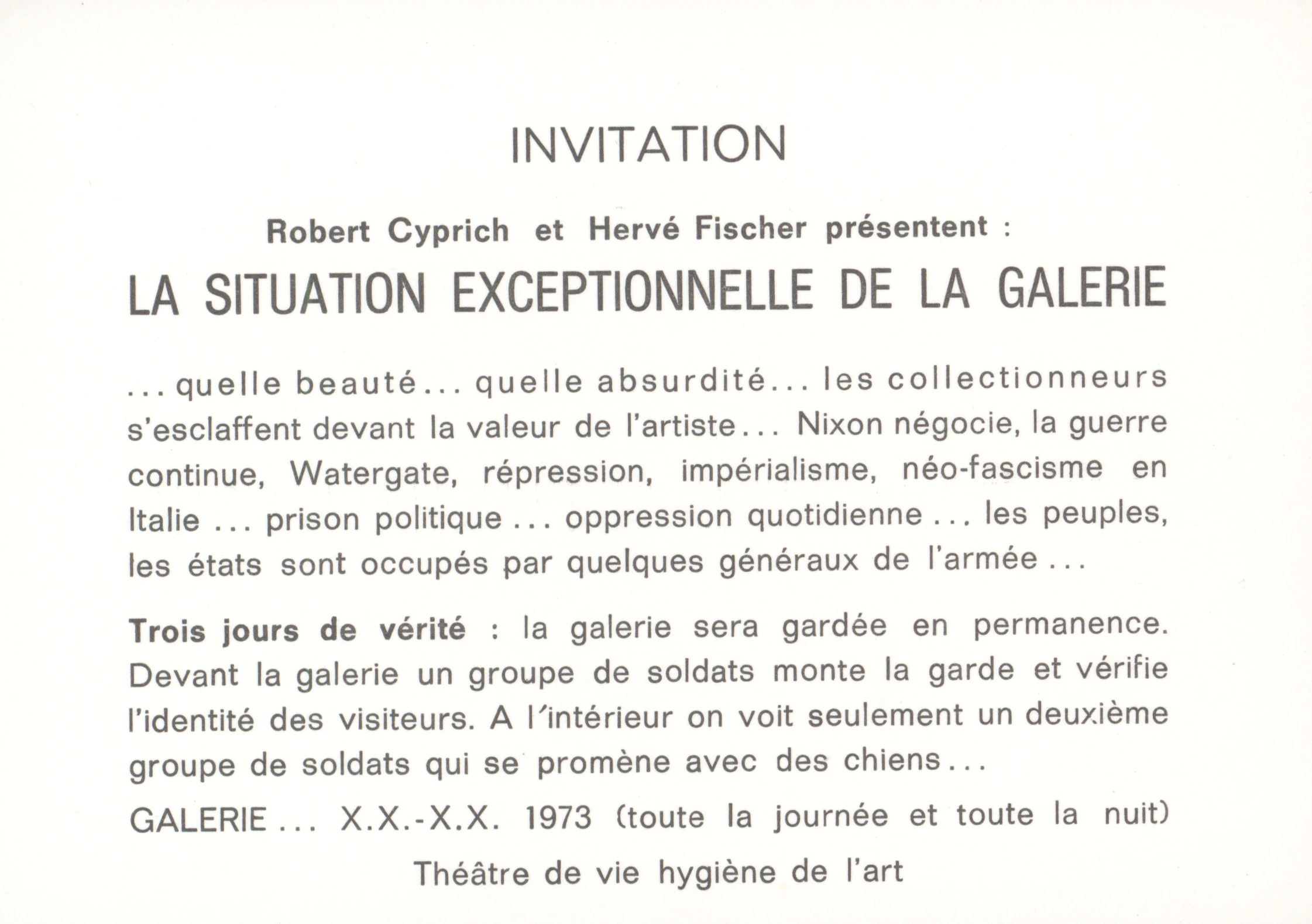
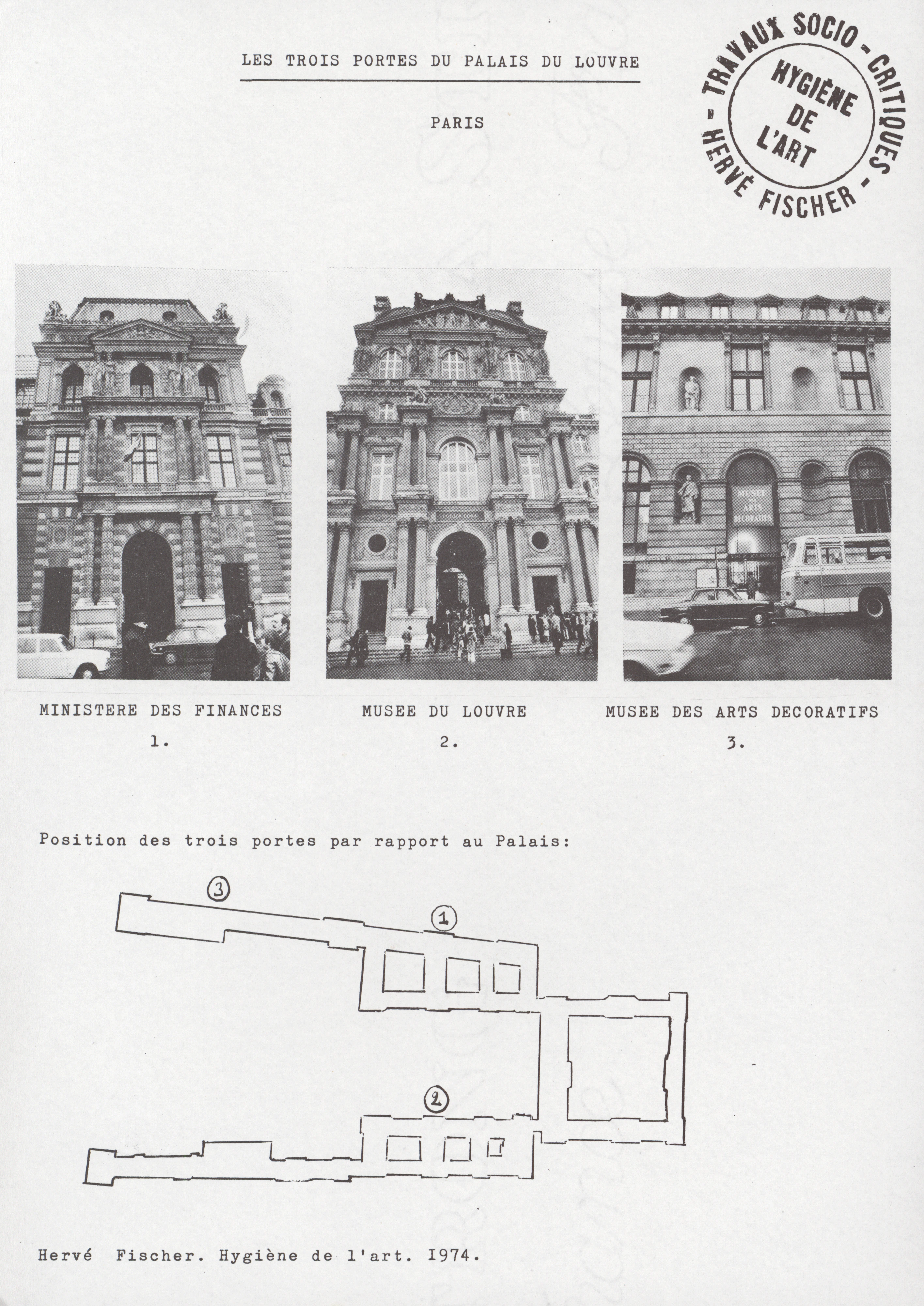
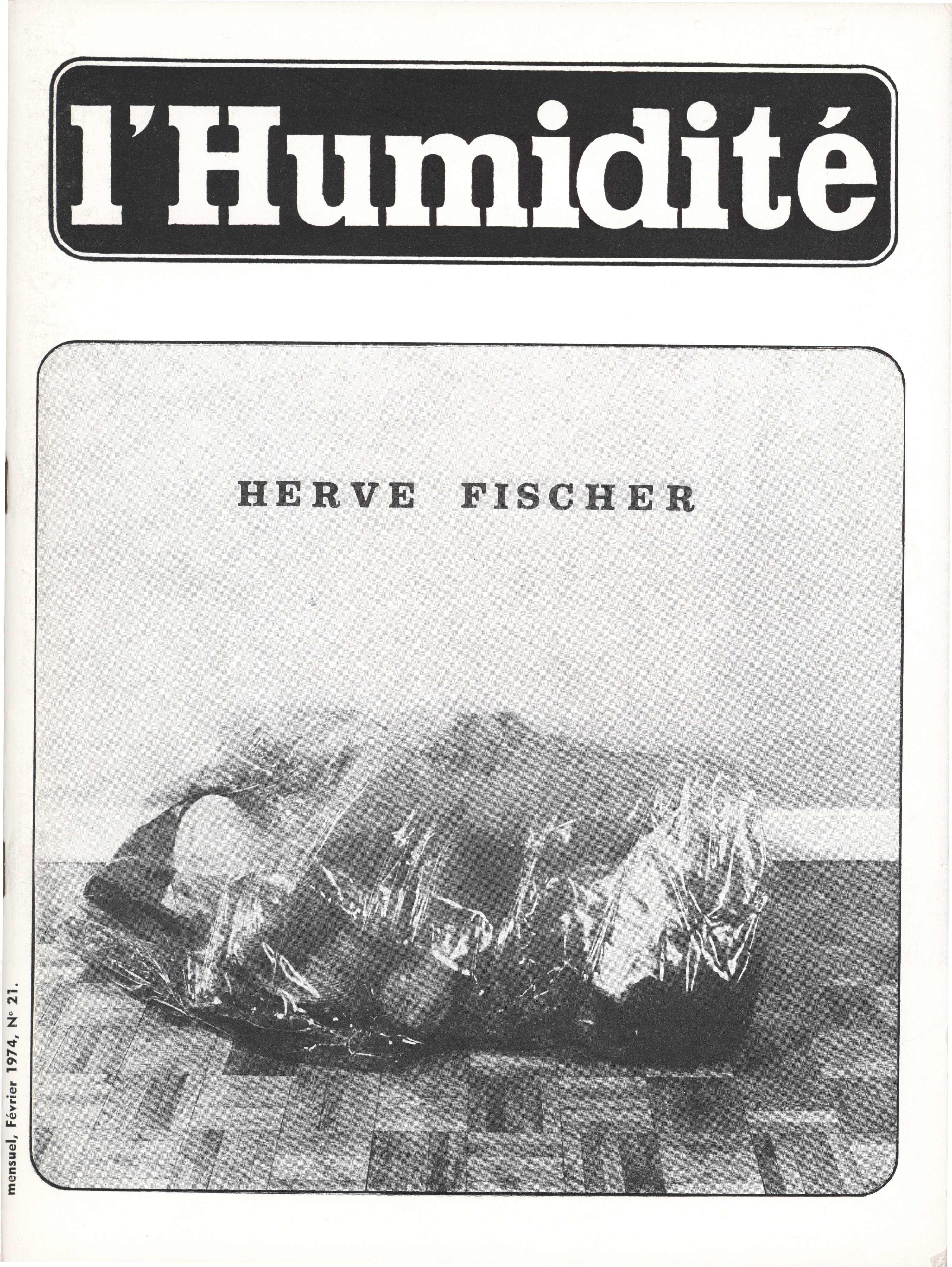
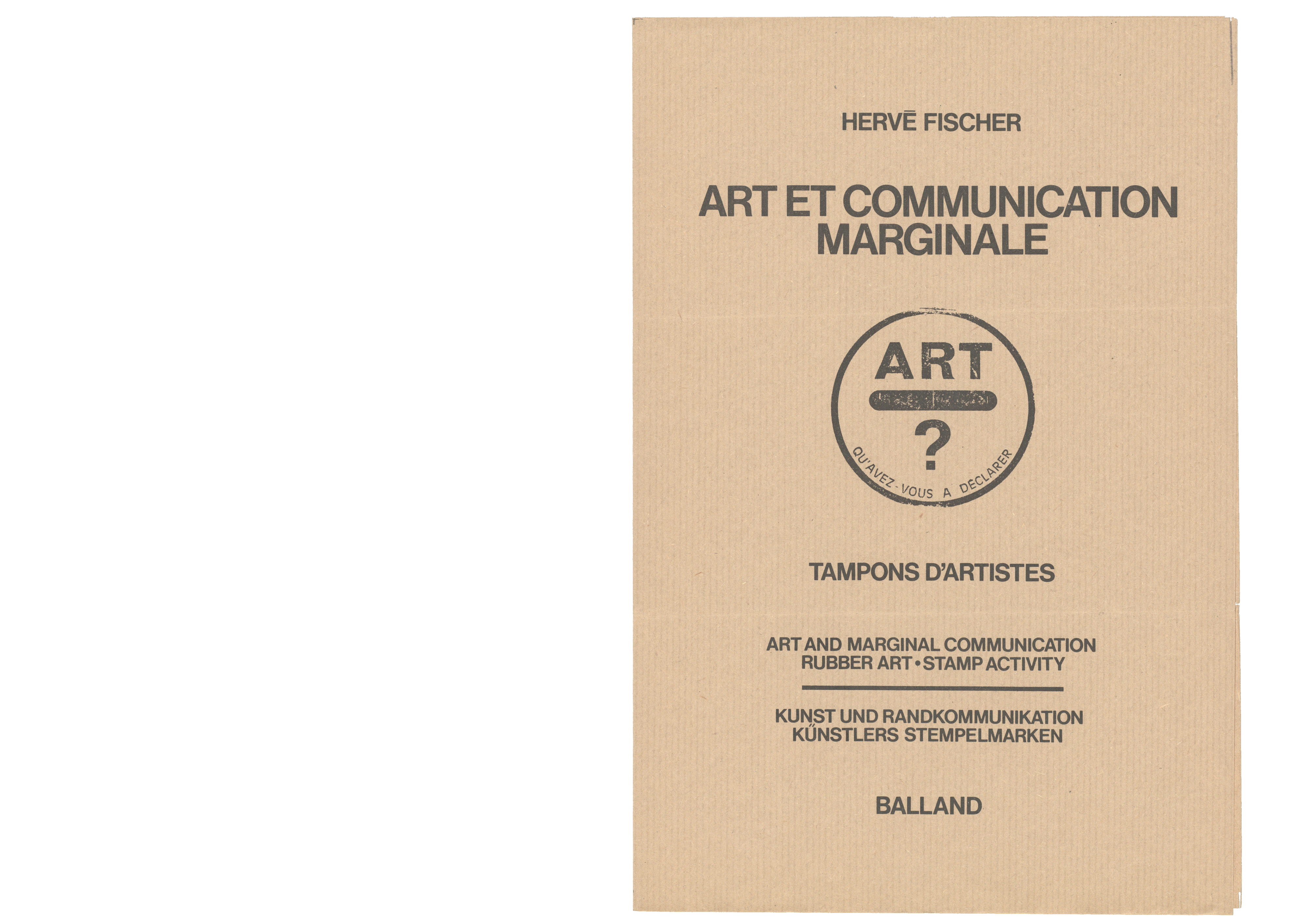
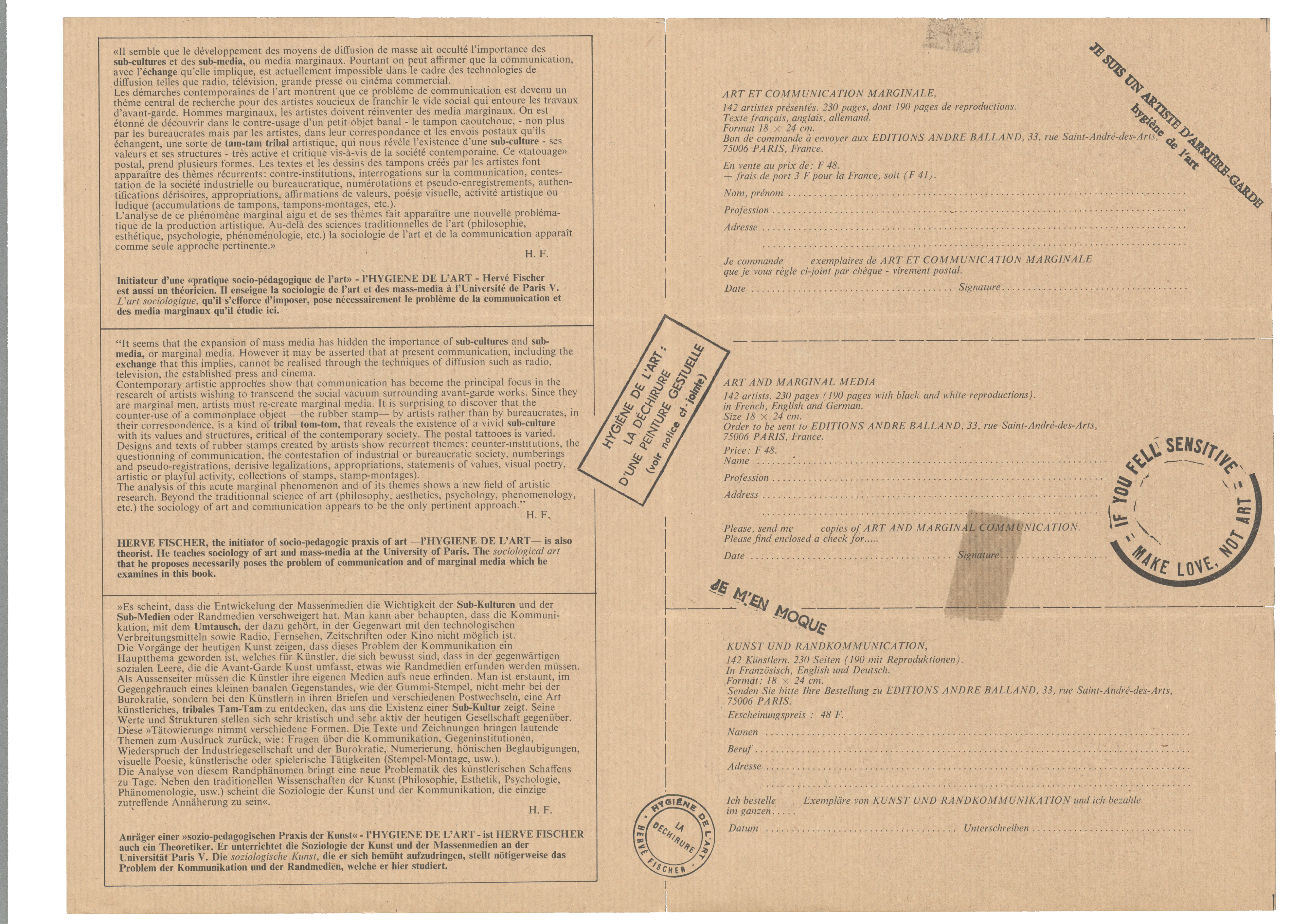
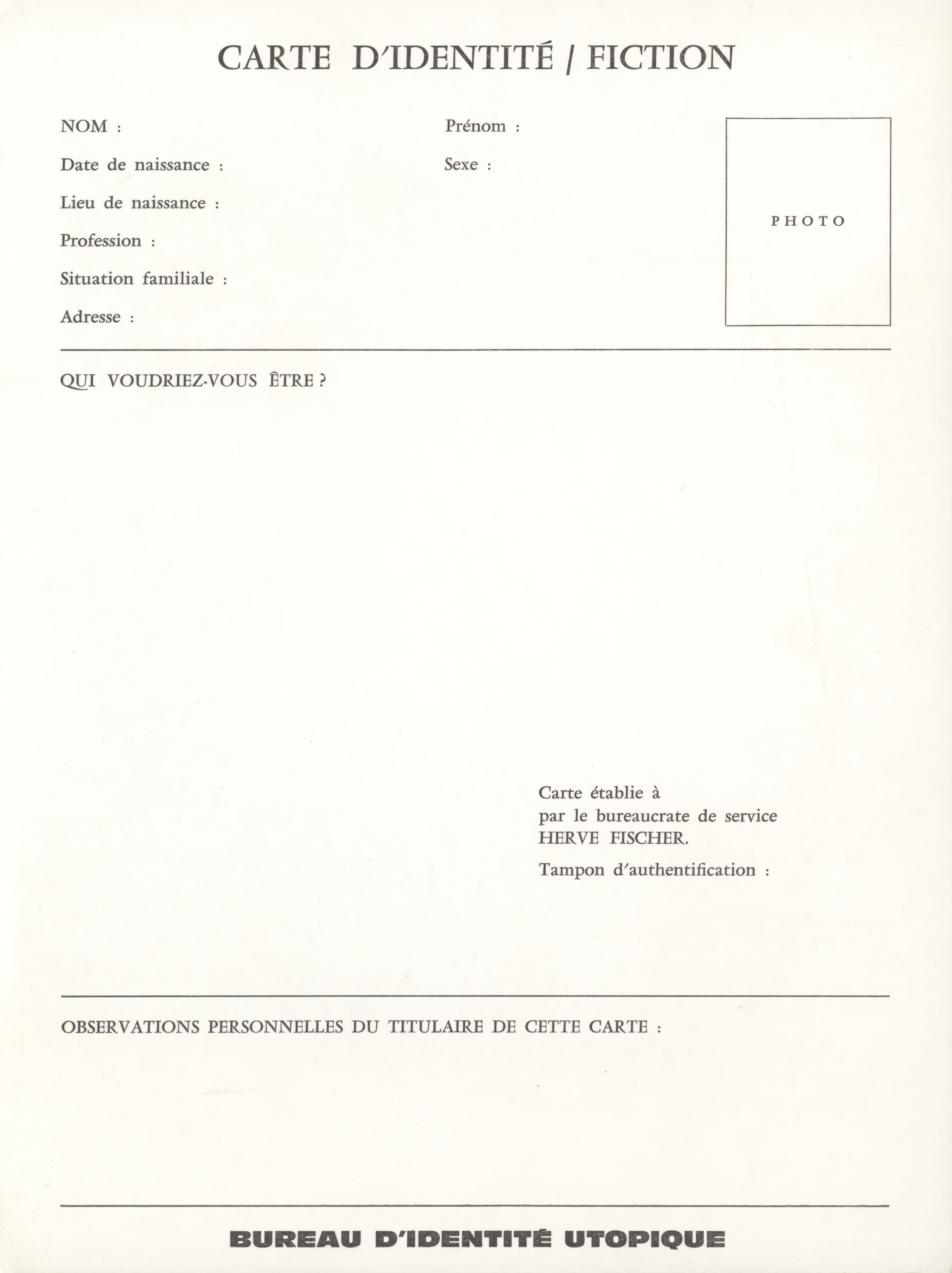
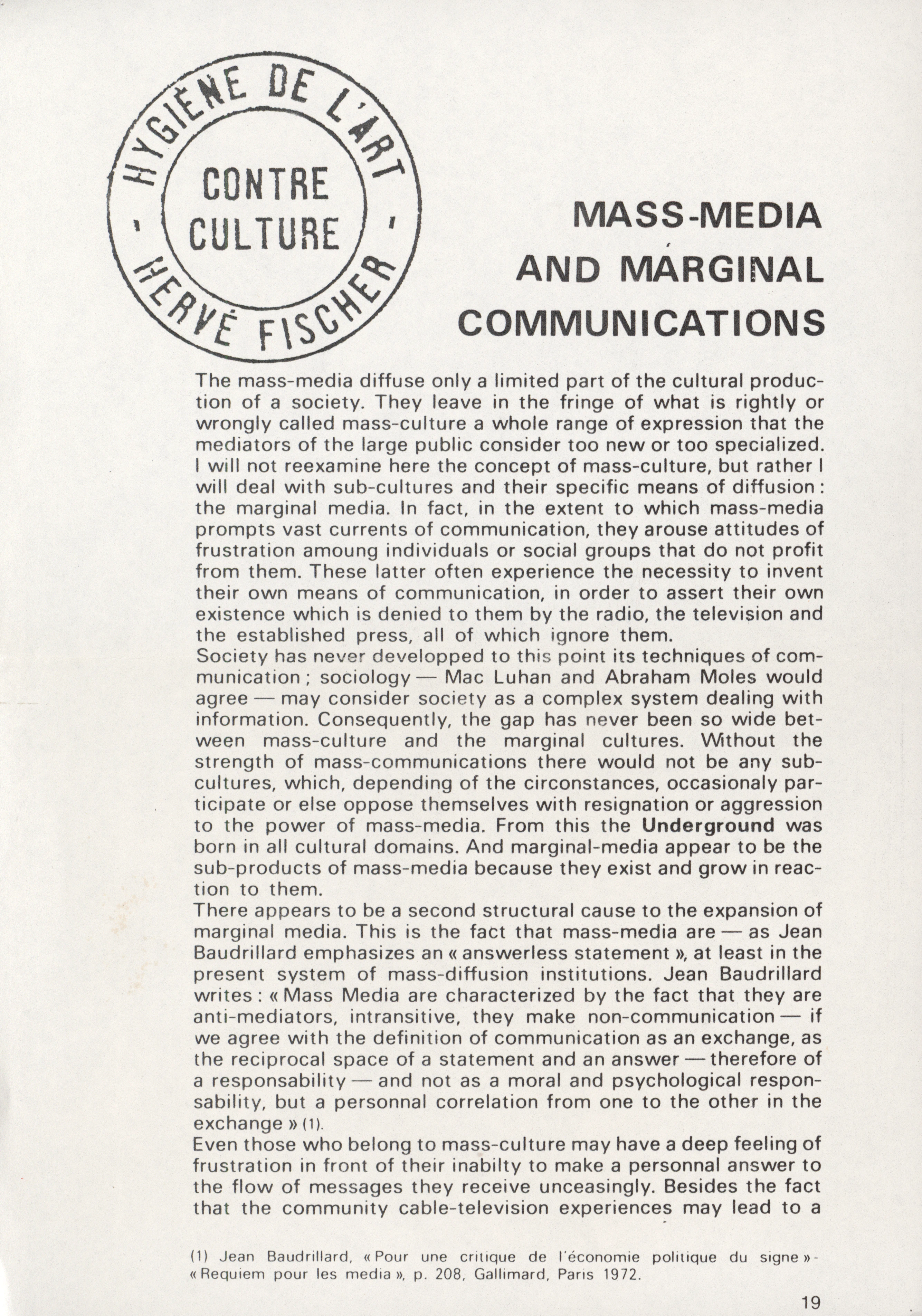
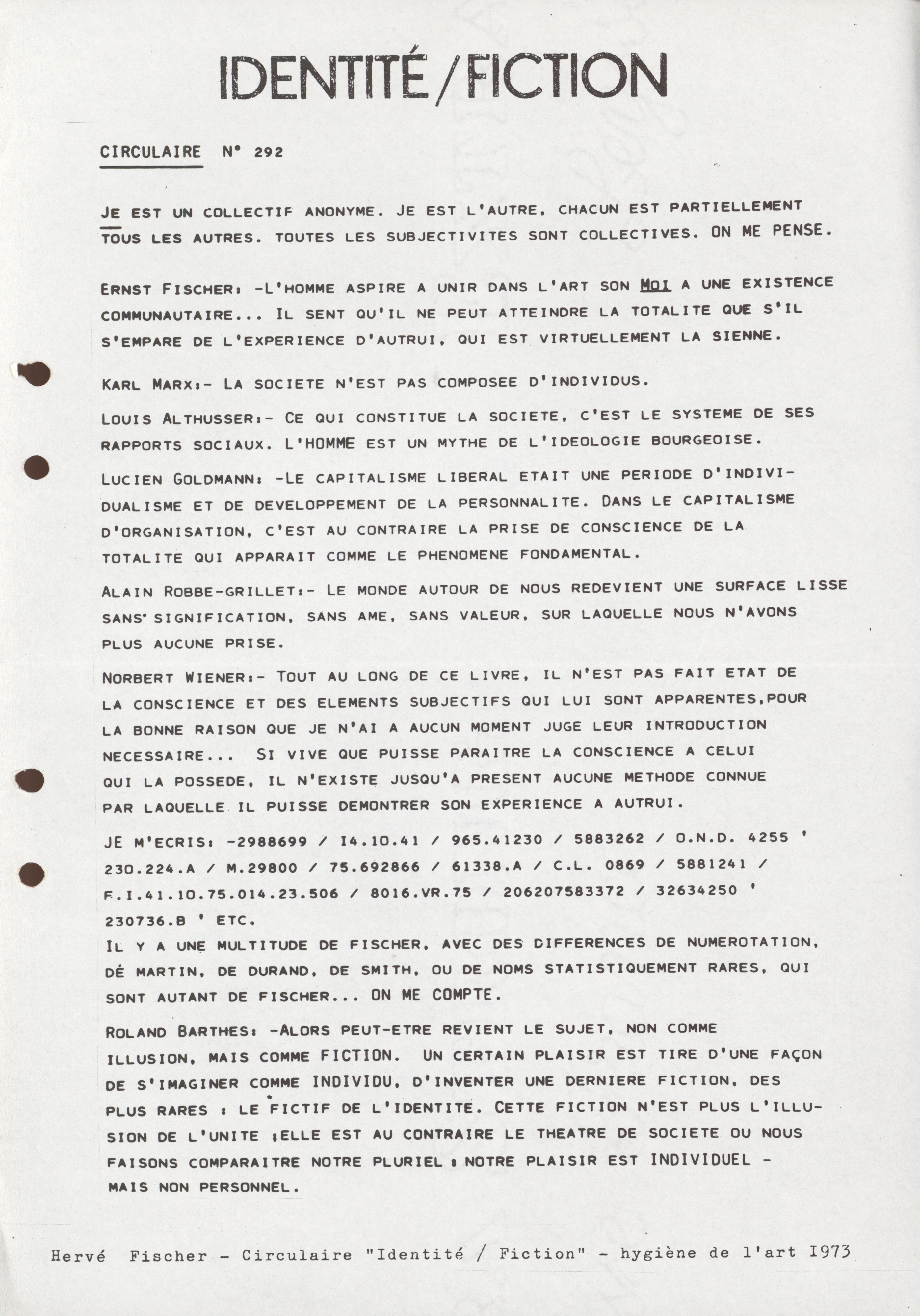
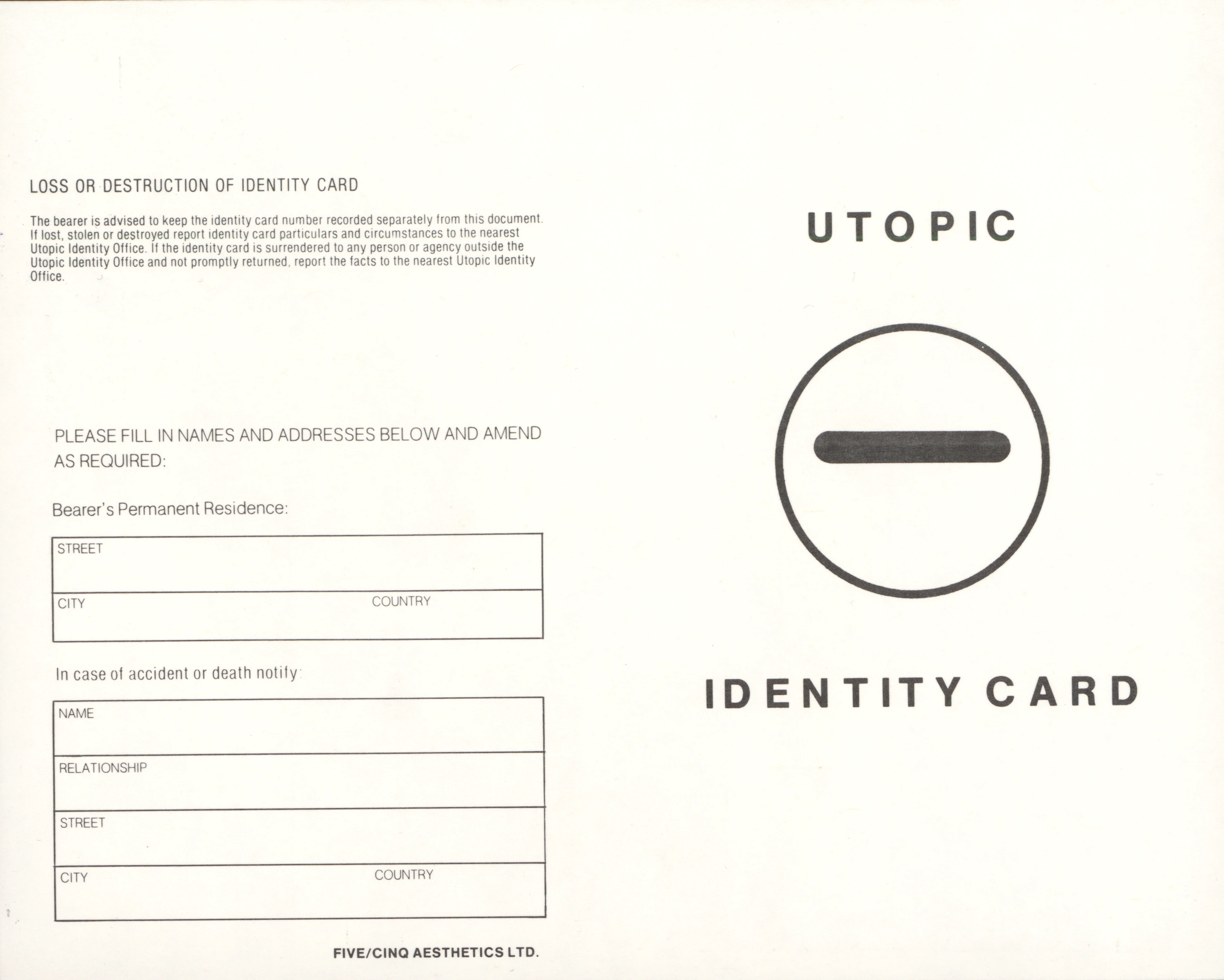
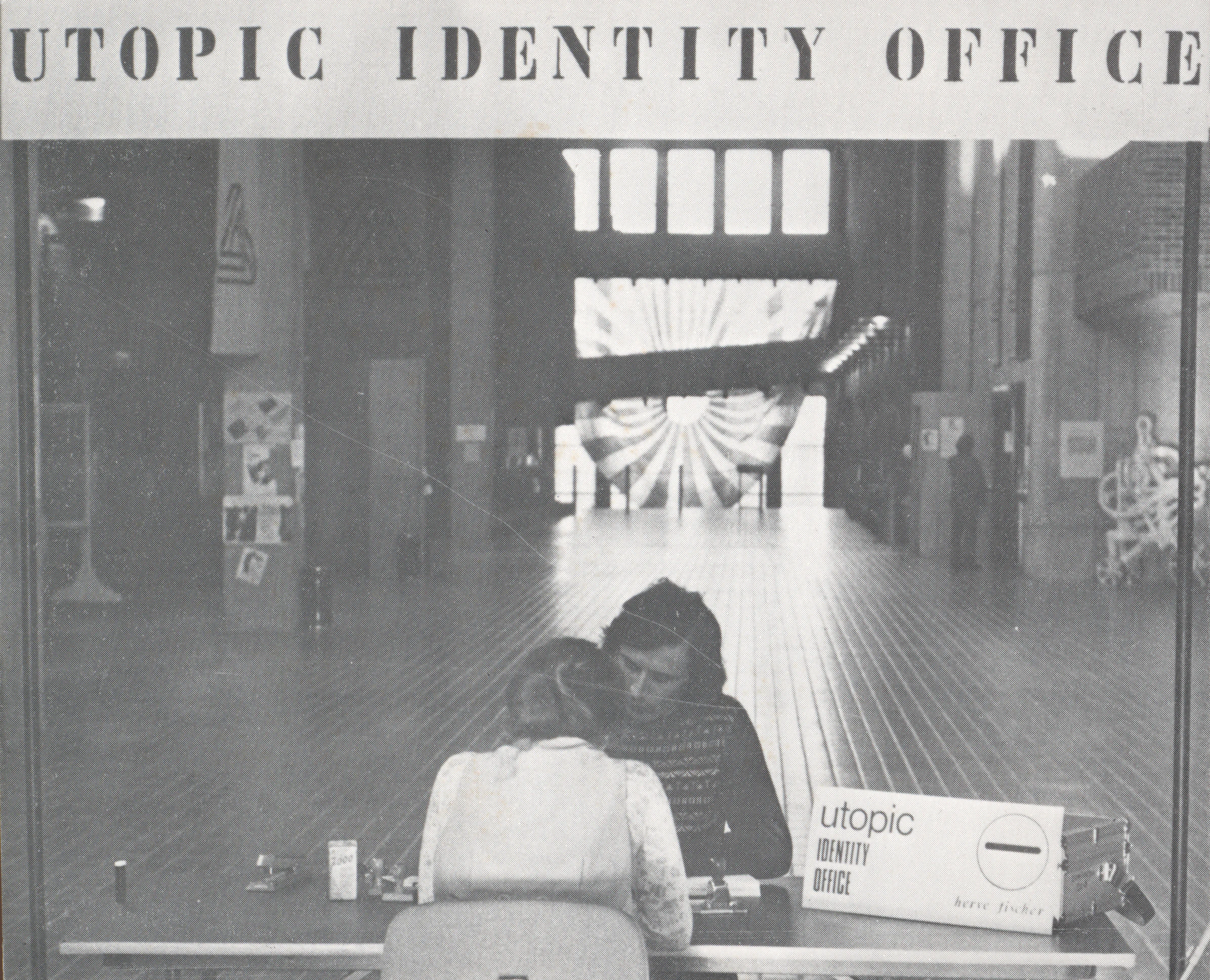
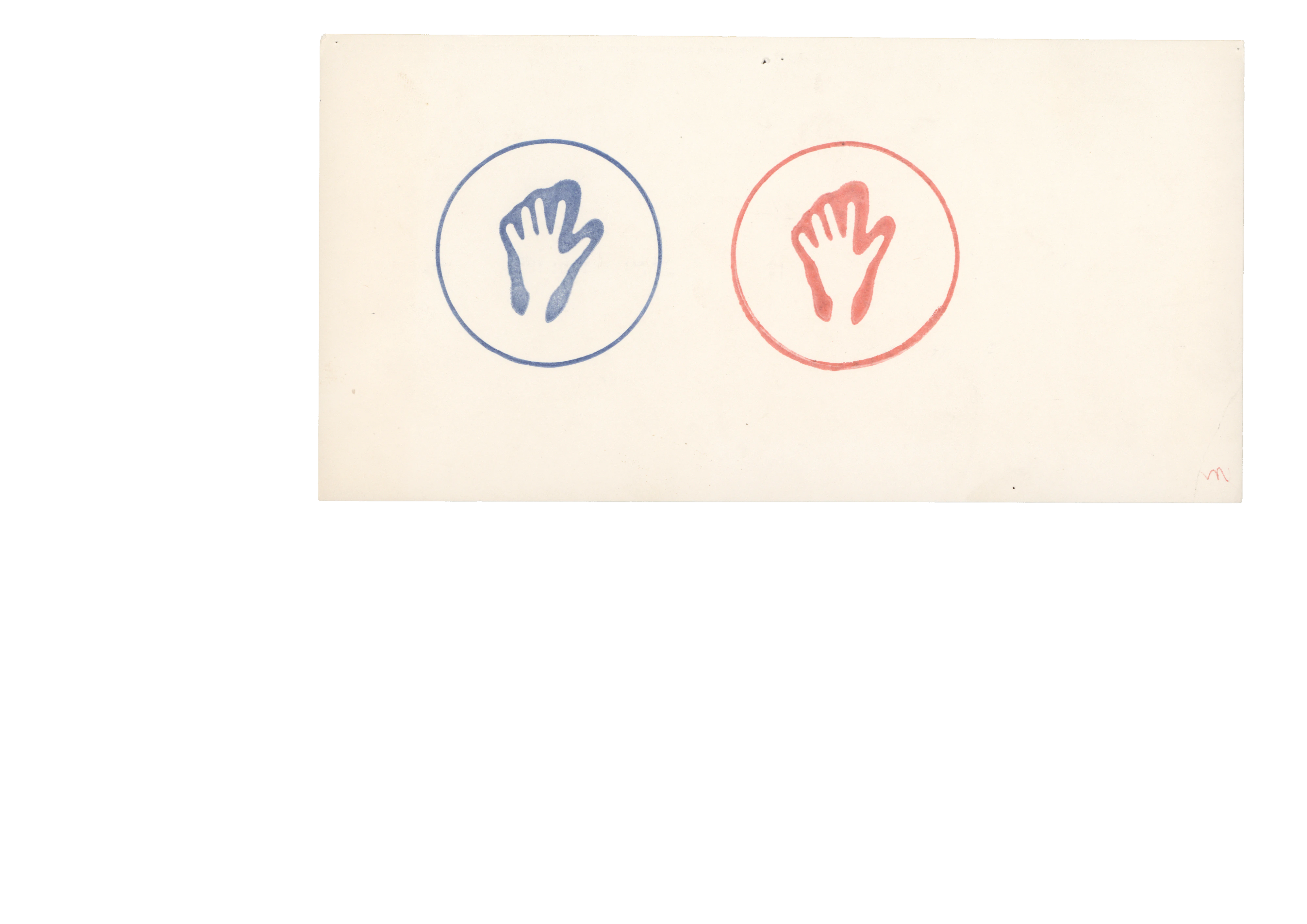
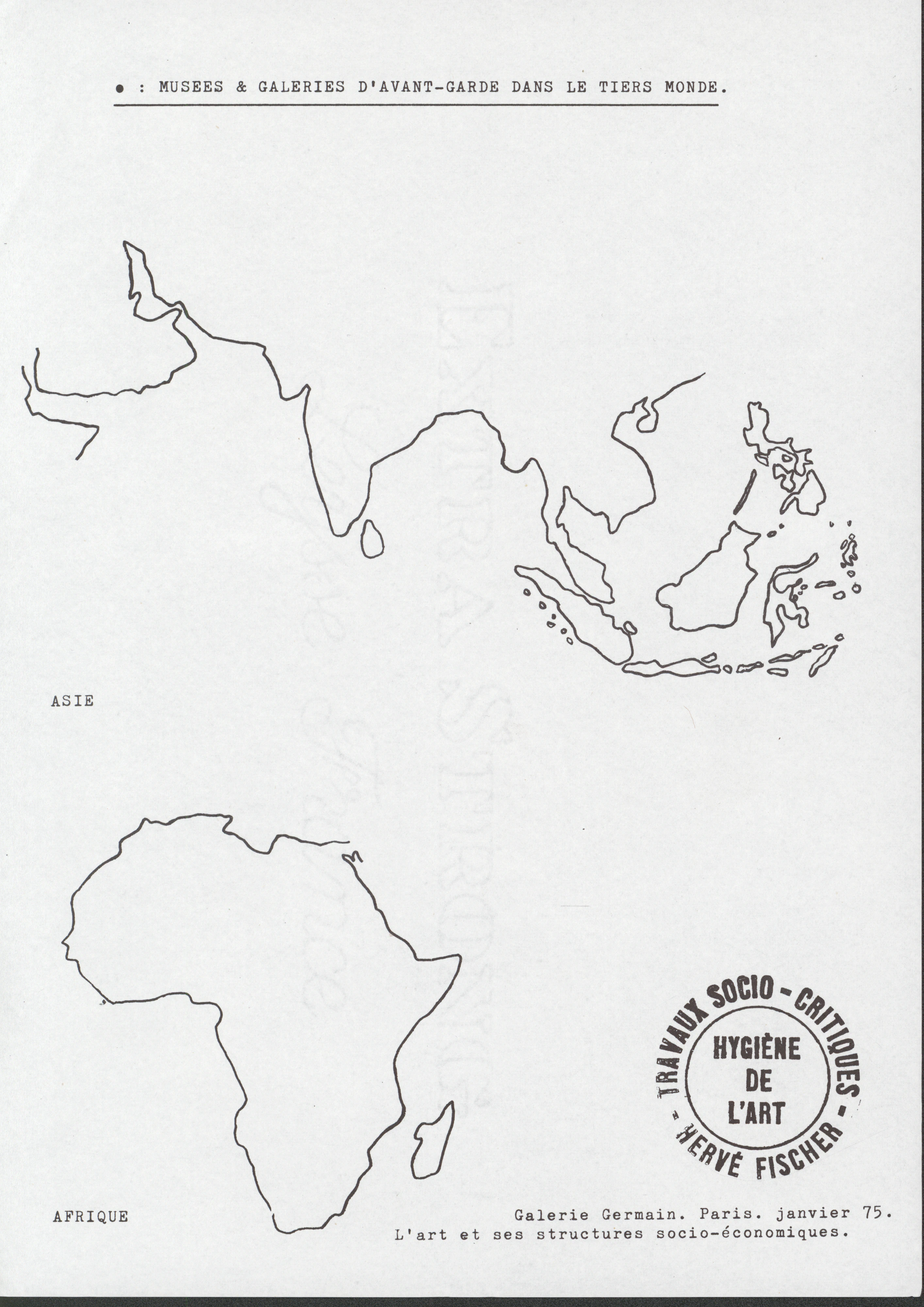
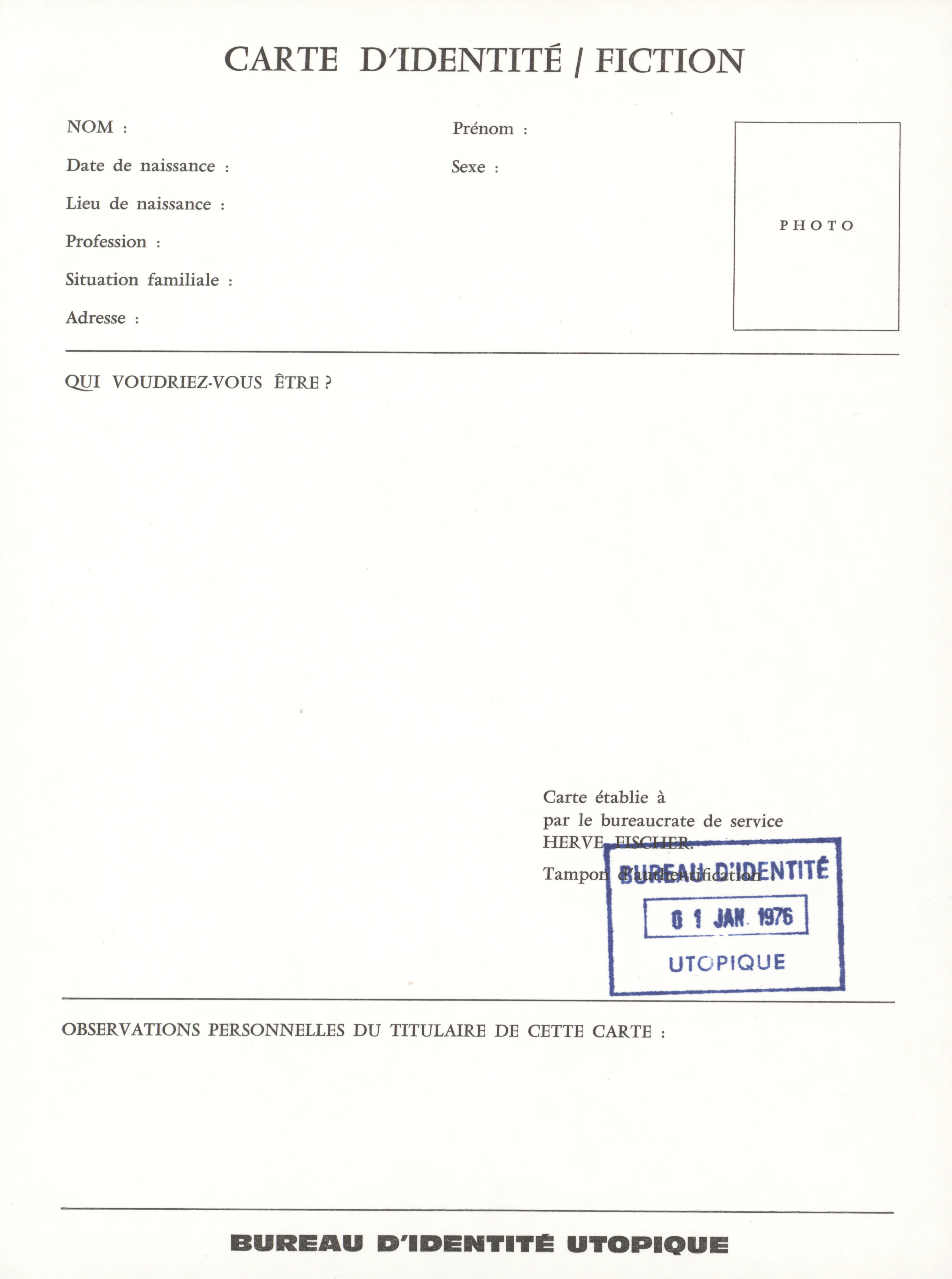
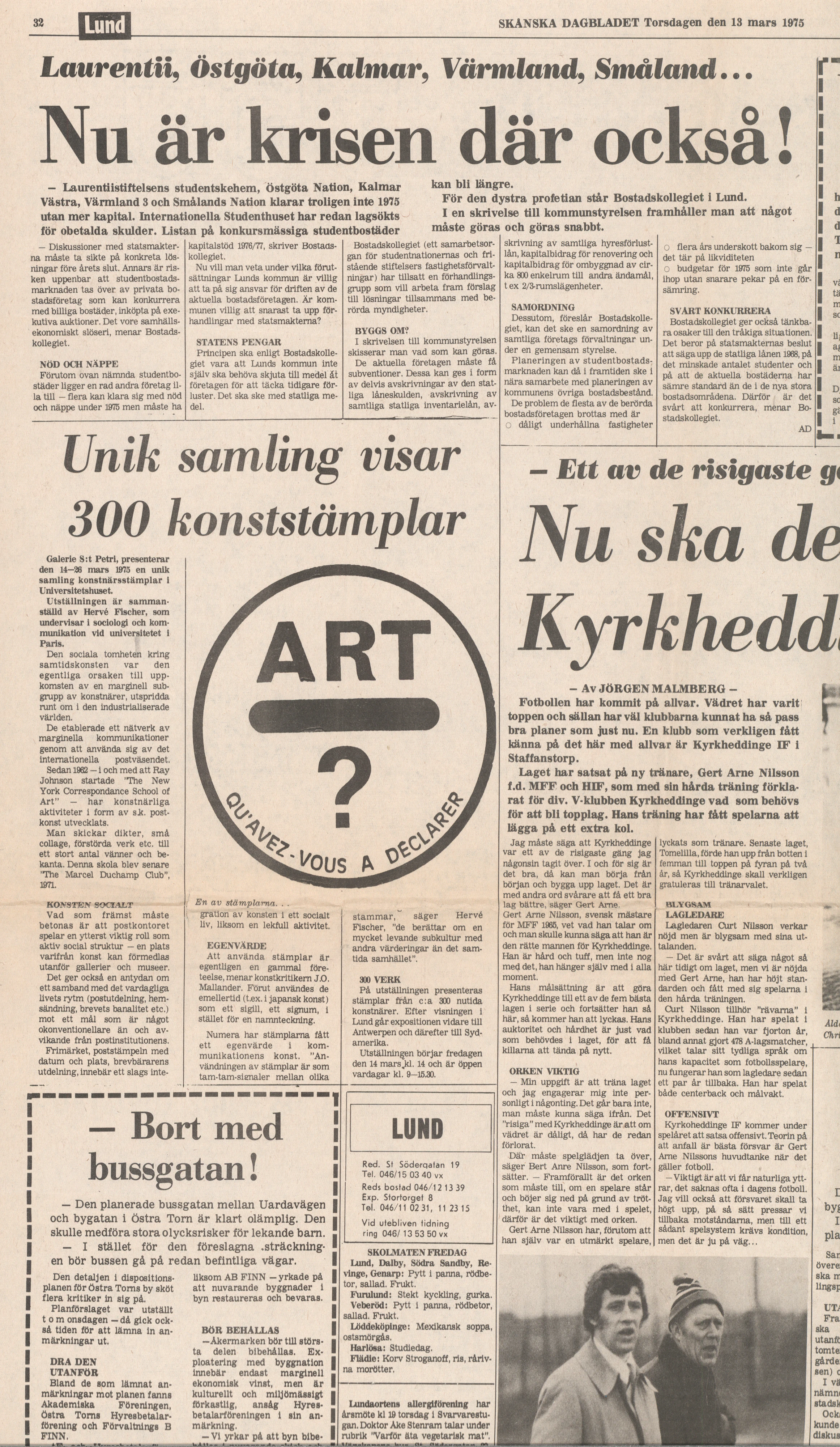
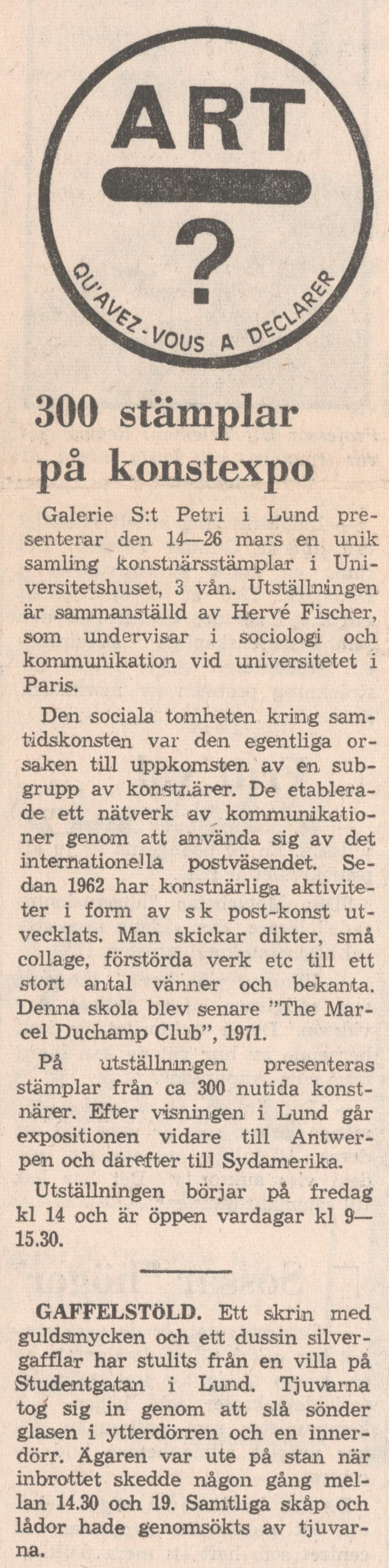
[JEANSELLEM VIEWER] — HERVE FISCHER ART ET COMMUNICATION MARGINALE TAMPONS D'ARTISTES 14-26.03.1975 — Categories: letters, docs, press — Keywords: Galerie S:t Petri, Jean Sellem, archive — Category: letters — Paris, 5 May 1974Dear friend,I am pleased to announce the publication of “ART ET COMMUNICATION MARGINALE – TAMPONS D’ARTISTES”.In this book I have brought together the stamps of more than 140 artists from every country, generally taken from significant documents and postal mailings.This is the first time that such an artistic subject has been treated systematically.The book is not distributed in the usual way: you will not find it in bookshops (only a few specialised bookshops will sell it).Produced through correspondence, it must be distributed in the same way and by ourselves. This parallel, or underground, distribution — the only one possible for a book of this kind, unsaleable in station kiosks and on the conventional market — is very difficult.It is therefore necessary for us to organise ourselves in order to make the publication possible (and the distribution it entails) for other books of the same kind, too often excluded from publishing today.For this reason, everyone receives a certain number of prospectuses to distribute themselves around them.I hope you will approve of this method and that you will agree to take part in it. If you have any suggestions or proposals, please write to me.Beyond the distribution of this book, it is a much broader project from which we will all benefit.Thank you in advance.With friendly greetings,Hervé Fischer59, rue Brillat Savarin, Paris 13thtel. 588.32.62 — — — Category: letters — <p>8.3.75</p> — Dear Jean Sellem,J. O. Mallander wrote to me that you should receive the original materials from Tampere ART ET COMM. MARGINALE.I am very pleased that you are considering presenting this exhibition. I have known about your activities for a long time.This exhibition is due to begin on 5 April at the Centro Cultural International in Antwerp, before leaving for South America. Please be kind enough to send the documents back to Antwerp in good time, so that I have time to hang them before the opening of the exhibition. And I am always sceptical about postal delays. Allow plenty of time! (By registered express mail.)Forgive me for these worries. Keep me informed, and if you need anything, a few copies of the book to put on sale, etc., write to me.Thank you for your interest in this exhibition. Looking forward to hearing from you, I send you my warm regards.Hervé Fischer — — — Category: letters — PHARMACIE FISCHER & Ciepills for votingpills for deathpills for lovepills for having childrenpills for not having childrenhygienic pillspills for thinkingpills for being calmpills for being cheerfulpills for watching TVpills for reading the newspaperpills for taking your mind off thingspills for getting some oxygenpills for curing mad peoplepills for being originalnew pillsfamily pillspills for artistspills for criticspills for collectorspills for coldspills against nuisancespills for sleepingpills for getting excitedpills for conversationpills for the headpills for the lungspills for the heartpills for the hairpills for the eyespills for catspills for plantspills for arthritisideological pillspills for dandruffpills for workingpills for holidayspills for listening to the violinpills for reading poemspills for taking the metropills for the carpills for walkingpills for feverpine-pillswine-pillswater-pillsvitamin pillsmeat-pillsbutter-pillspills for beautypills for memorypills for intelligencepills for reasoningpills for believing100% excipientreimbursed by social insurancePHARMACIE FISCHER INC.PILLSrenewableThe Pills, that's life!Paris, 8.3.75Prescription for Jean Sellem,A - one pill each dayB - one box each weekC - one pill each eveningD - one pill each morningE - one pill each hourF - one pill each week-endG - one pill each morning, when you get up.Henri FischerPHARMACIE FISCHER INC.pills and vitamins59, Rue Brillat-Savarin, 75013 ParisTo feel well, take Pills!(International Campaign for Pills)Pills are life!(International Campaign for Pills) — — — Category: letters — <p><span style="color: rgb(17, 17, 17);">14 April 1975</span></p> — Dear Jean Sellem,A moment ago, I learned that the package of stamps has (finally) arrived at the I.C.C. in Antwerp! Phew! I am relieved.In the meantime, I went to Belgrade, where I had been invited to give a lecture on sociological art. Despite the doctors’ orders (I was not supposed to leave my bed because of the pneumonia I caught — nothing serious), I went there anyway.And on Thursday I will go again (secretly!) to Brussels, where I am transforming the Galerie Hervé Alexandre into the Pharmacie Fischer et Cie.I passed on your plan of Galerie S Petri to J. F. Bory. As for the rest, I am waiting for news from Canada and for a decision in Paris from the bureaucracy concerning the Stamps exhibition. — I hope you will like the Bory exhibition. Discuss the dates with him. I am very happy that you are considering doing it, because he is an excellent friend and I like his work very much.Warm regards to you, dear Jean Sellem, hoping that one of these days we will see each other!Hervé Fischer — — — Category: letters — — — Category: letters — <p><span style="color: rgb(17, 17, 17);">Paris, 22 November 1980</span></p> — Dear Jean Sellem,I am currently seeking a grant from the Ministry of Labour to develop E.S.I.’s publishing activities. Could you write me a nice letter, on proper letterhead, attesting to the international importance of E.S.I. and expressing the hope that I might further develop its activities in continued collaboration with you, as far as Sweden is concerned.Thank you in advance.Hervé Fischer — — — Category: letters — <p>Paris, 19 Dec. 80</p> — Dear Jean,Would there have been any doubt that you might propose an event to me with Fred Forest and Jean-Paul Thibaut. I understand as well that the malicious actions of my two former friends against me do not alter our friendship. I would like that to be so.Having no desire to add to this petty, shabby avant-garde game, which is absolutely contrary to the idea of sociological art, I did not wish to reply with a leaflet in order to re-establish the truth of the facts; I have had my own version distributed in 3,000 copies.In the same spirit, and in the name of the friendship we have for one another, I am telling you of my wish: that you do not allow Forest and Thibaut to… — I must inform you that I have resigned from the Collectif d’art sociologique and from the École Sociologique Interrogative. It is paradoxical that I should be the one to leave, but we no longer had anything in common except (illegible) and the determination to harm me systematically, which I (feel).Consequently, while Forest and Thénot are of course free to do and say whatever they wish together, they no longer have any right to do so in the name of the collective or of the École Sociologique Interrogative, whose dissolution I have requested. I am also discontinuing the publication of the Cahiers ES.May I add, Jean, that this letter is private and must remain so, as I have no intention of contributing to their campaign. I ask you not to communicate it to anyone. I trust you, and send you my warmest regards and best wishes for Christmas and the New Year.P.S. There is no need for you to reply, if you prefer not to.Hervé — — — Category: docs — — — Category: docs — — — Category: docs — — — Category: docs — — — Category: docs — — — Category: docs — — — Category: docs — — — Category: docs — IDENTITY / FICTIONCIRCULAR No. 292I IS AN ANONYMOUS COLLECTIVE. I IS THE OTHER, EACH PERSON IS PARTIALLY ALL THE OTHERS. ALL SUBJECTIVITIES ARE COLLECTIVE. I AM THOUGHT.ERNST FISCHER: — MAN ASPIRES TO UNITE IN ART HIS SELF WITH A COMMUNAL EXISTENCE... HE FEELS THAT HE CAN ATTAIN TOTALITY ONLY IF HE TAKES POSSESSION OF THE EXPERIENCE OF OTHERS, WHICH IS VIRTUALLY HIS OWN.KARL MARX: — SOCIETY IS NOT COMPOSED OF INDIVIDUALS.LOUIS ALTHUSSER: — WHAT CONSTITUTES SOCIETY IS THE SYSTEM OF ITS SOCIAL RELATIONS. MAN IS A MYTH OF BOURGEOIS IDEOLOGY.LUCIEN GOLDMANN: — LIBERAL CAPITALISM WAS A PERIOD OF INDIVIDUALISM AND OF THE DEVELOPMENT OF PERSONALITY. IN ORGANIZED CAPITALISM, ON THE CONTRARY, IT IS THE AWARENESS OF TOTALITY THAT APPEARS AS THE FUNDAMENTAL PHENOMENON.ALAIN ROBBE-GRILLET: — THE WORLD AROUND US BECOMES ONCE AGAIN A SMOOTH SURFACE, WITHOUT MEANING, WITHOUT SOUL, WITHOUT VALUE, OVER WHICH WE NO LONGER HAVE ANY HOLD.NORBERT WIENER: — THROUGHOUT THIS BOOK, THERE HAS BEEN NO MENTION OF CONSCIOUSNESS AND THE SUBJECTIVE ELEMENTS APPARENT TO IT, FOR THE GOOD REASON THAT I HAVE AT NO TIME HAD TO INTRODUCE THEM... HOWEVER VIVID CONSCIOUSNESS MAY APPEAR TO THE PERSON WHO POSSESSES IT, THERE IS UP TO THE PRESENT NO KNOWN METHOD BY WHICH HE CAN DEMONSTRATE HIS EXPERIENCE TO ANOTHER.I REGISTER: -2988699 / 14.10.41 / 965.41230 / 5883262 / O.N.D. 4255 / 230.224.A / M.29800 / 75.692866 / 61338.A / C.L. 0869 / 5881241 / F.I.41.10.75.014.23.506 / 8016.VR.75 / 206207583372 / 32634250 / 230736.B ETC.THERE ARE A MULTITUDE OF FISCHERS, WITH DIFFERENT NUMBERINGS, MARTINS, DURANDS, SMITHS, OR STATISTICALLY RARE NAMES, ALL OF WHICH ARE AS MUCH FISCHER... I AM COUNTED.ROLAND BARTHES: — THEN PERHAPS THE SUBJECT RETURNS, NOT AS ILLUSION, BUT AS FICTION. A CERTAIN PLEASURE IS DRAWN FROM IMAGINING ONESELF AS AN INDIVIDUAL, FROM INVENTING A FINAL FICTION, ONE OF THE RAREST: THE FICTION OF IDENTITY. THIS FICTION IS NO LONGER THE ILLUSION OF UNITY; ON THE CONTRARY, IT IS THE THEATRE OF SOCIETY IN WHICH WE MAKE OUR PLURAL APPEAR. OUR PLEASURE IS INDIVIDUAL — BUT NOT PERSONAL.Hervé Fischer — Circular “Identity / Fiction” — hygiene of art 1973 — — — — — Category: docs — — — — — Category: docs — — — Category: docs — — — Category: press — Unique collection presents 300 artists’ stampsGalerie S:t Petri is presenting, from 14–26 March 1975, a unique collection of artists’ stamps at the University Building.The exhibition has been assembled by Hervé Fischer, who teaches sociology and communication at the University of Paris.The social void surrounding contemporary art was the actual reason for the emergence of a marginal subgroup of artists scattered throughout the industrialised world.They established a network of marginal communications by making use of the international postal system.Since 1962 — when Ray Johnson founded “The New York Correspondance School of Art” — artistic activities in the form of so-called mail art have developed.Poems, small collages, enlarged works, etc. are sent to a large number of friends and acquaintances. This school later became “The Marcel Duchamp Club” in 1971.ART AS A SOCIAL ACTIVITYWhat must above all be emphasised is that the post office plays an extremely important role as an active social structure — a place from which art can be communicated outside galleries and museums.It also suggests a connection with the rhythm of everyday life (mail delivery, home delivery, the banality of the letter, etc.), directed towards a goal somewhat more unconventional and divergent from the postal institution itself.The postage stamp, the postmark with date and place, and the postman’s delivery imply a kind of integration of art into social life, as well as a playful activity.INTRINSIC VALUEThe use of stamps is actually an old phenomenon, says art critic J. O. Mallander. In the past, however, they were used (for example in Japanese art) as a seal, a sign, instead of a signature.Nowadays stamps have acquired an intrinsic value in the art of communication. “The use of stamps is like tam-tam signals between different tribes,” says Hervé Fischer. “They tell of a very lively subculture with values different from those of contemporary society.”300 WORKSThe exhibition presents stamps by approximately 300 contemporary artists. After its presentation in Lund, the exhibition will travel to Antwerp and then to South America.The exhibition opens on Friday 14 March at 2 p.m. and is open on weekdays from 9 a.m. to 3.30 p.m.Caption: One of the stamps. — — — Category: press — 300 stamps at art exhibitionGalerie S:t Petri in Lund is presenting, from 14–26 March, a unique collection of artists’ stamps at Universitetshuset, third floor. The exhibition has been assembled by Hervé Fischer, who teaches sociology and communication at the university in Paris.The social vacuum surrounding contemporary art was the real reason for the emergence of a subgroup of artists. They established a network of communication by making use of the international postal system. Since 1962, artistic activities in the form of so-called postal art have developed. Poems, small collages, altered works, etc. are sent to a large number of friends and acquaintances. This school later became “The Marcel Duchamp Club”, 1971.The exhibition presents stamps by approximately 300 contemporary artists. After being shown in Lund, the exhibition will travel on to Antwerp and then to South America.The exhibition opens on Friday at 2 p.m. and is open weekdays from 9 a.m. to 3.30 p.m.
CLICK TO VIEW PRESS RELEASE
HERVE FISCHER
ART ET COMMUNICATION MARGINALE
TAMPONS D'ARTISTES
14-26.03.1975
14-26.03.1975HERVE FISCHERART ET COMMUNICATION MARGINALETAMPONS D'ARTISTES
SOCIOLOGICAL ART group
Hervé FISCHER, Fred FOREST, Jean-Paul THENOT have decided to set up a SOCIOLOGICAL ART group which will be able to serve as a liaison and working structure for all whose research and practical work in the field of art has the sociological phenomena and the link between art and society as its fundamental theme.
The SOCIOLOGICAL ART group notes the manifestation of a new awareness of the sociological facts, linked to the process of massification. The domain of this awareness is now no longer the relationship between man as an individual and the world, but the relationship between man and society which produces him.
By its artistic activity, the group expects to subject art to reexamination, to reveal the sociological facts and to enable visualisation of a sociological theory of art. Though it will resort primarily to the theories and methodology of the social sciences, it also hopes that this artistic activity will provide opportunities for research and experiment.
The group is aware of the diverse ideological views of the publics. It will use intercommunication, surveys and interrogative teaching.
At the same time it relates art to its sociological context, and draws attention to the new channels of communication, which appear to be radically new features in the evolution of art, and demand new ways of working.