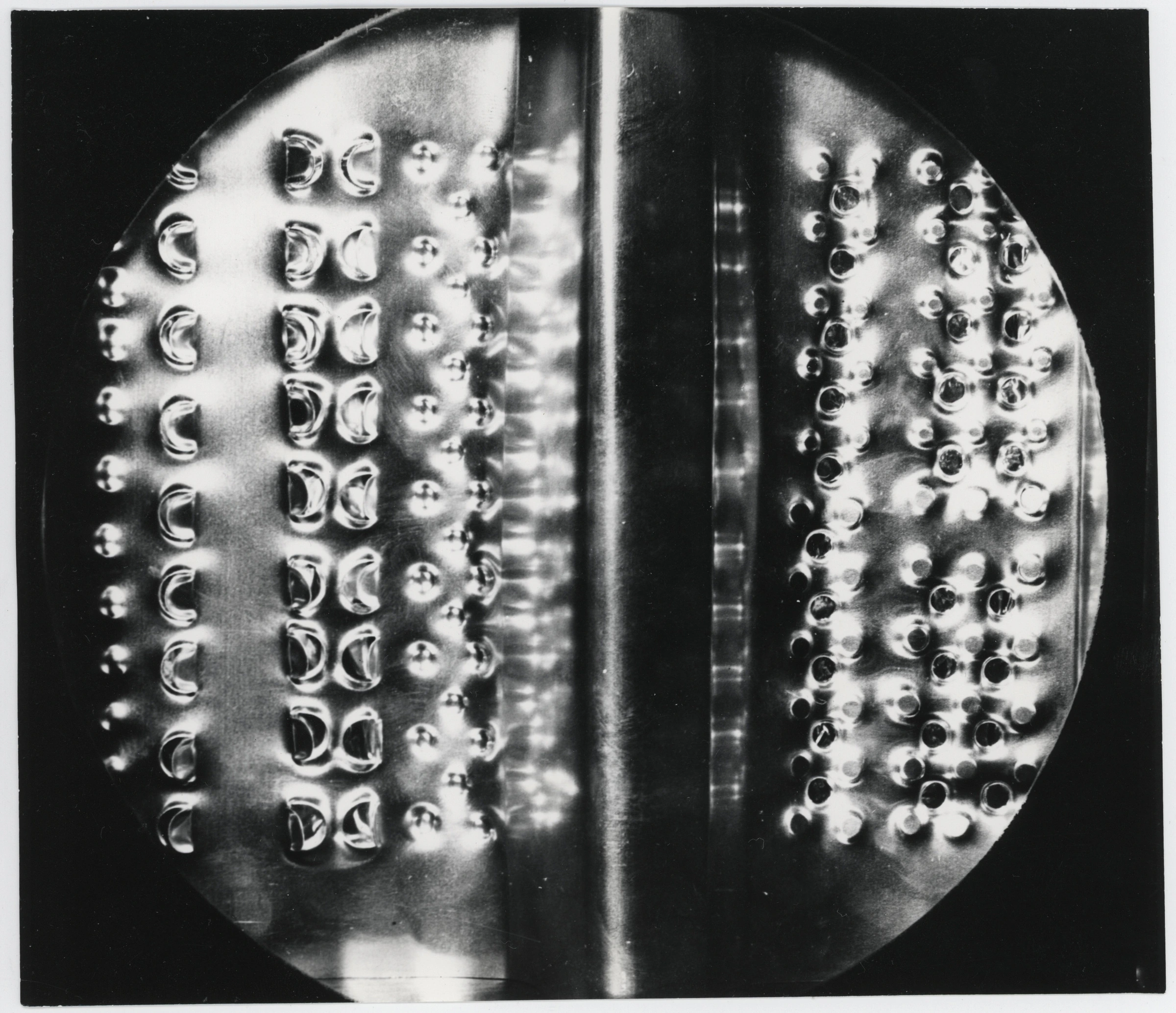
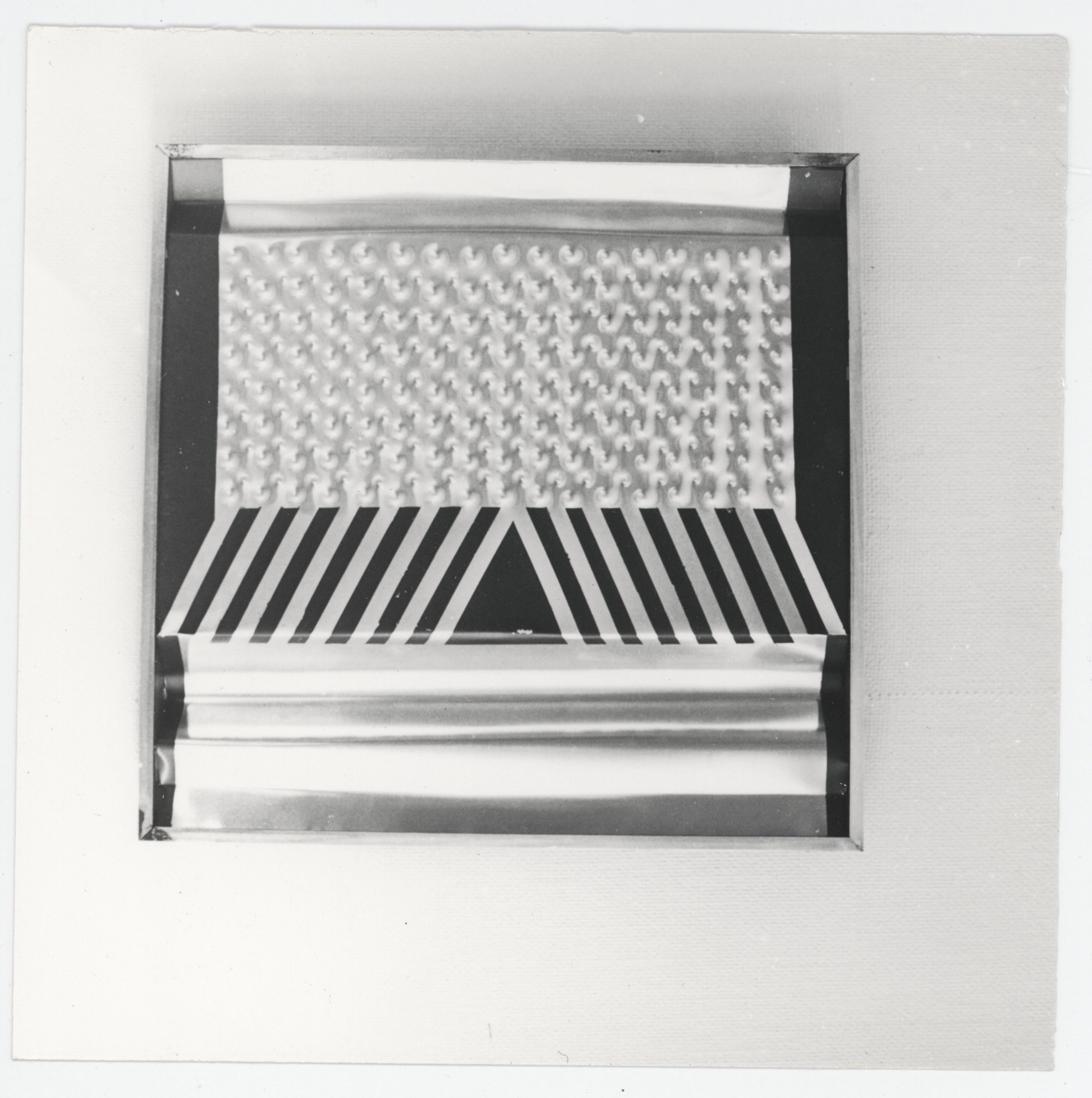
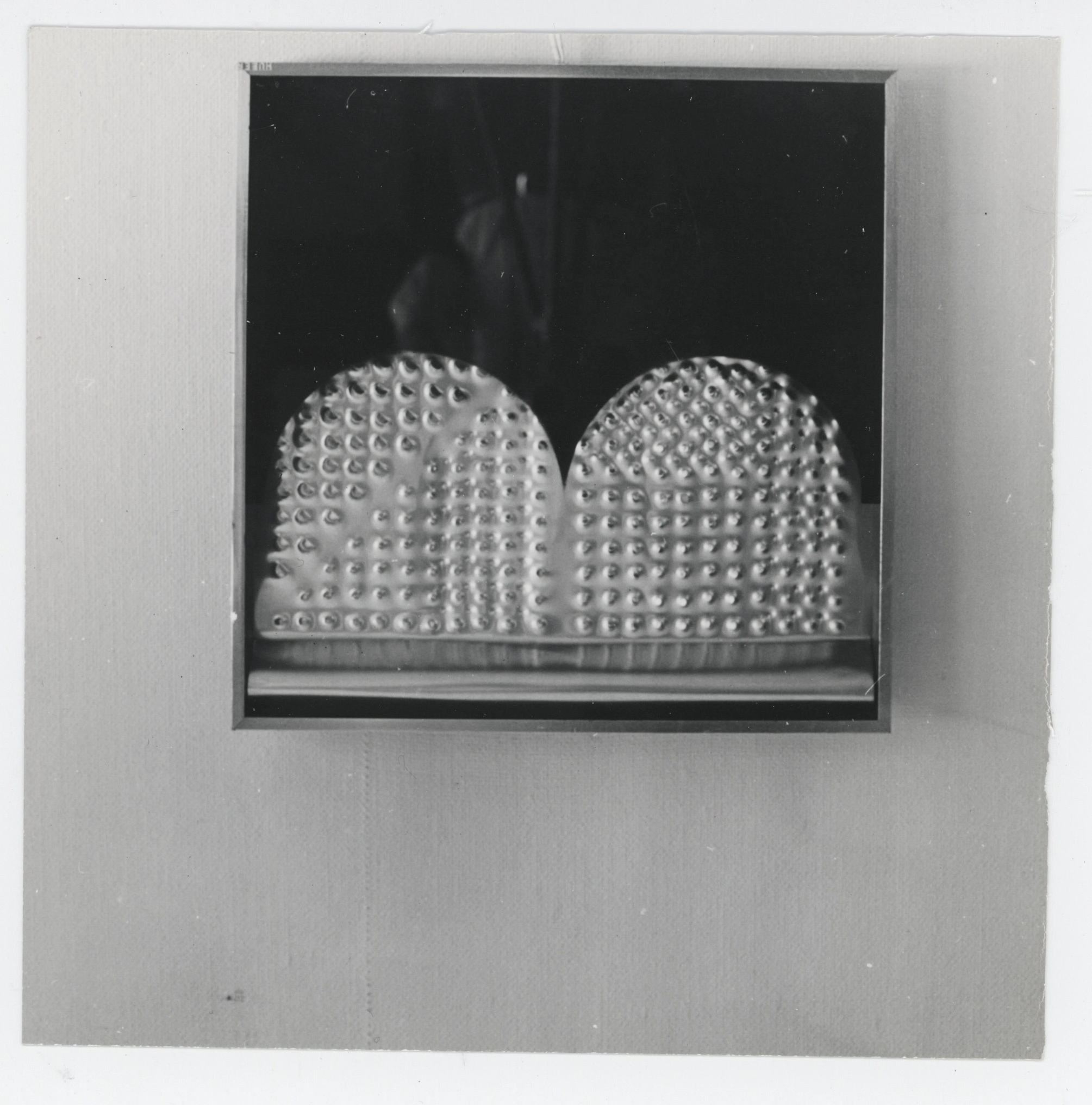
Flashing light. Reflections of people seeking one another. Machines. The chrome of car bumpers. Optical phenomena. Disturbances in broken communication transmission. Shadows of loneliness.
You beautiful metallic world, where the yellow blinking searchlight draws patterns on the screen of the picture tube, the same patterns as on the shoreline of the childhood lake. Do we remember correctly? Childhood? Sun? Light? Untainted water?
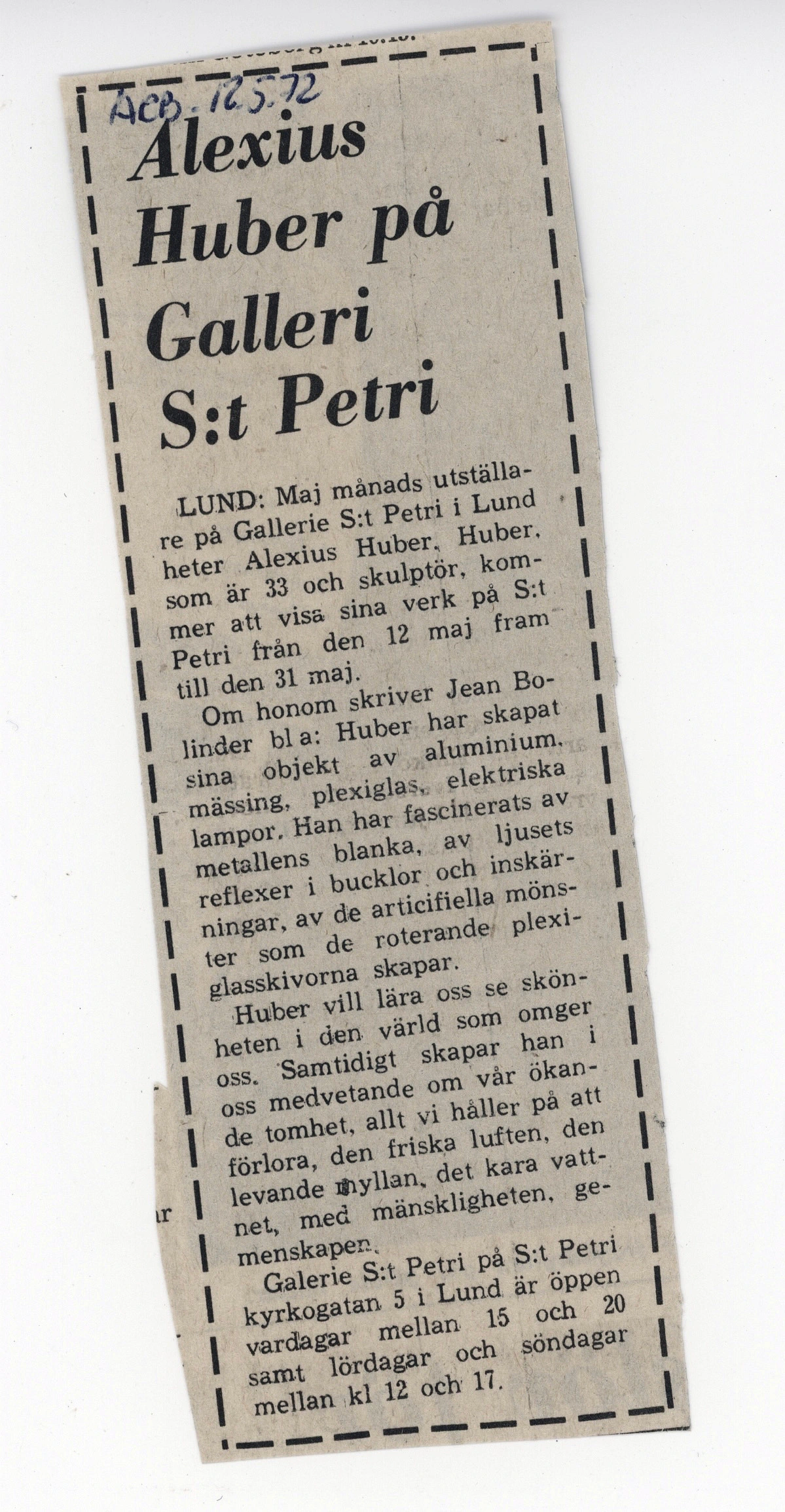
Huber has created his objects out of aluminum, brass, plexiglass, electric lamps. He has been fascinated by the gloss of metal, by light’s reflections in dents and incisions, by the artificial patterns produced by rotating plexiglass plates. Huber wants to teach us the beauty of the world that surrounds us. At the same time, he makes us aware of our growing emptiness, of all that we are on the verge of losing: the fresh air, the living soil, the clear water, human solidarity, community.
Jean Bolinder
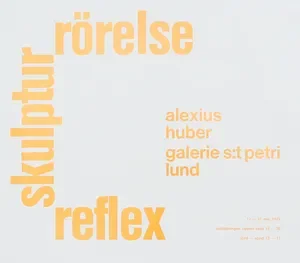
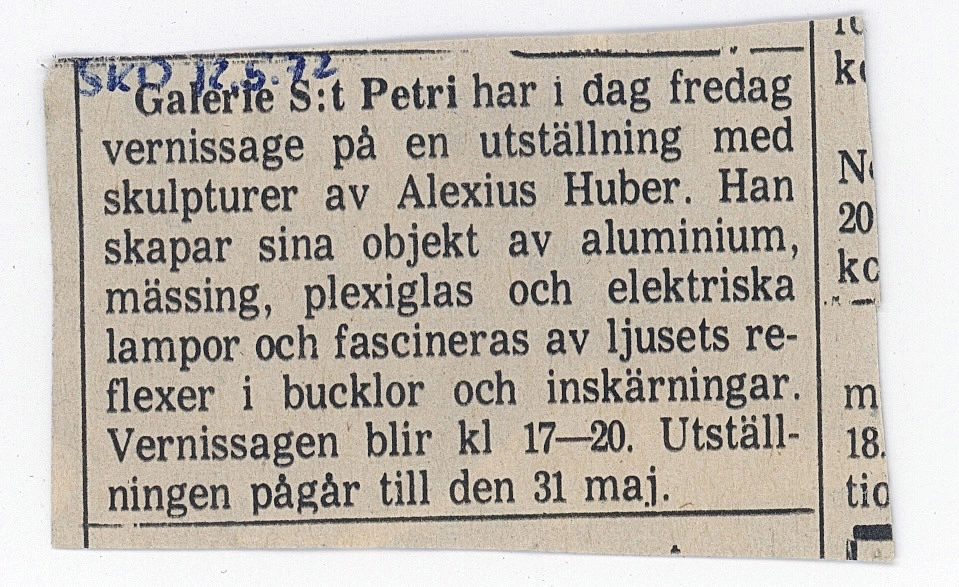
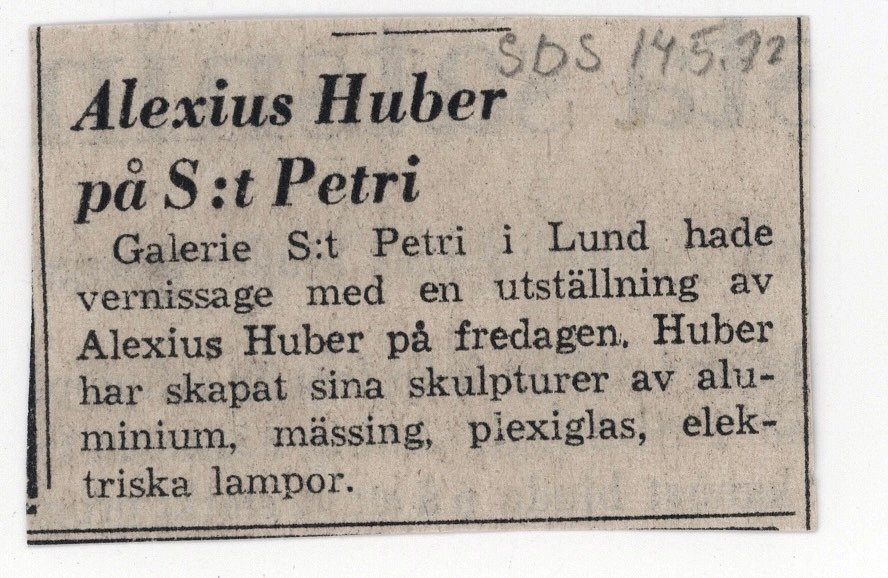
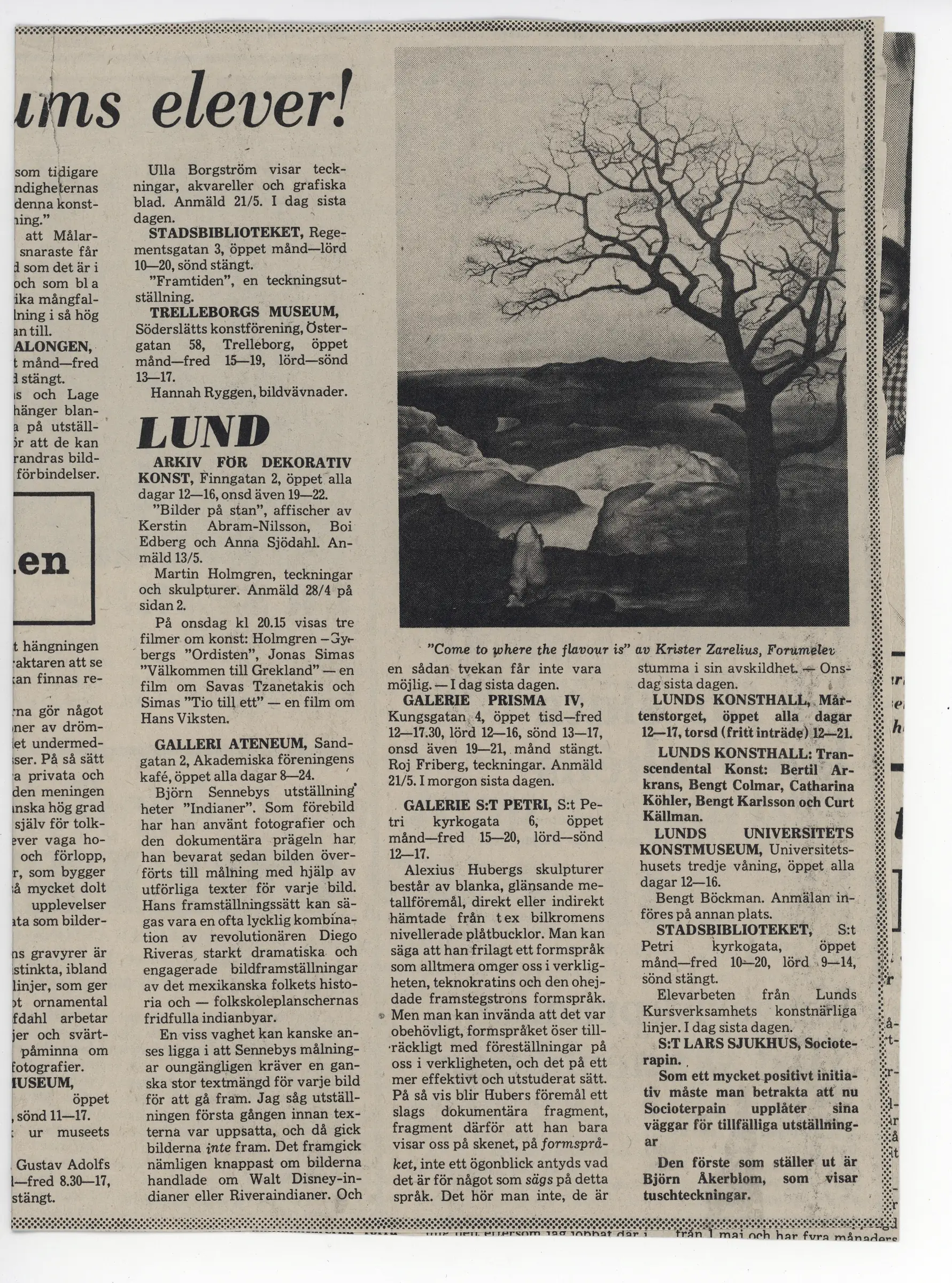
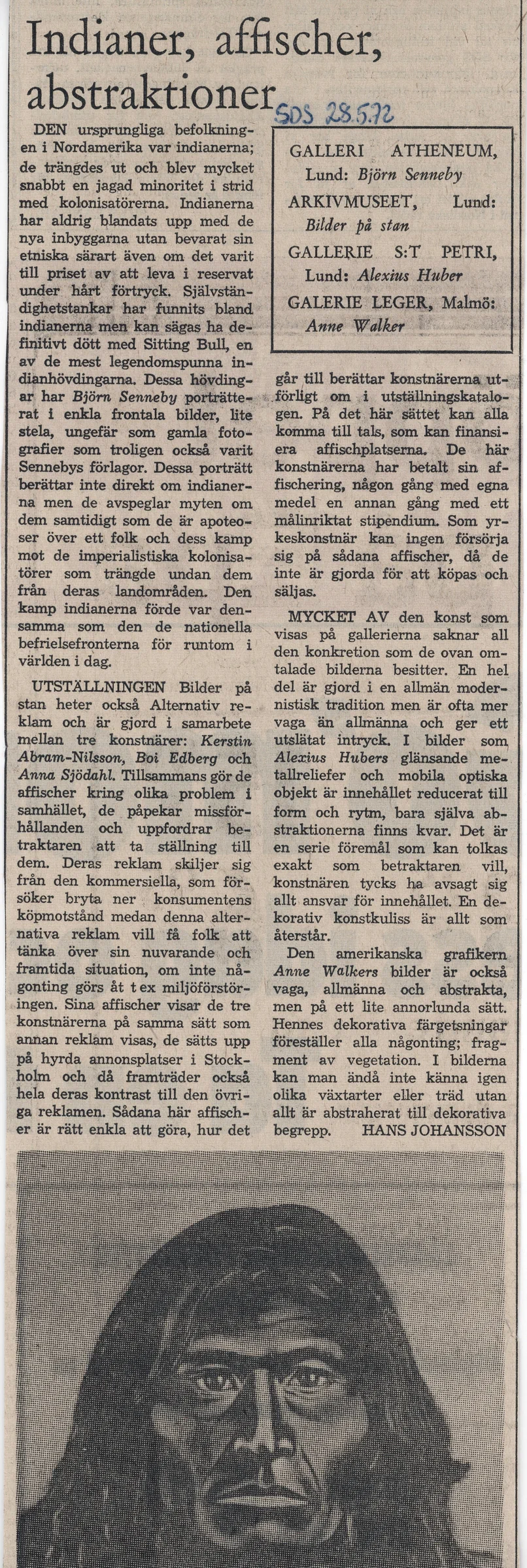
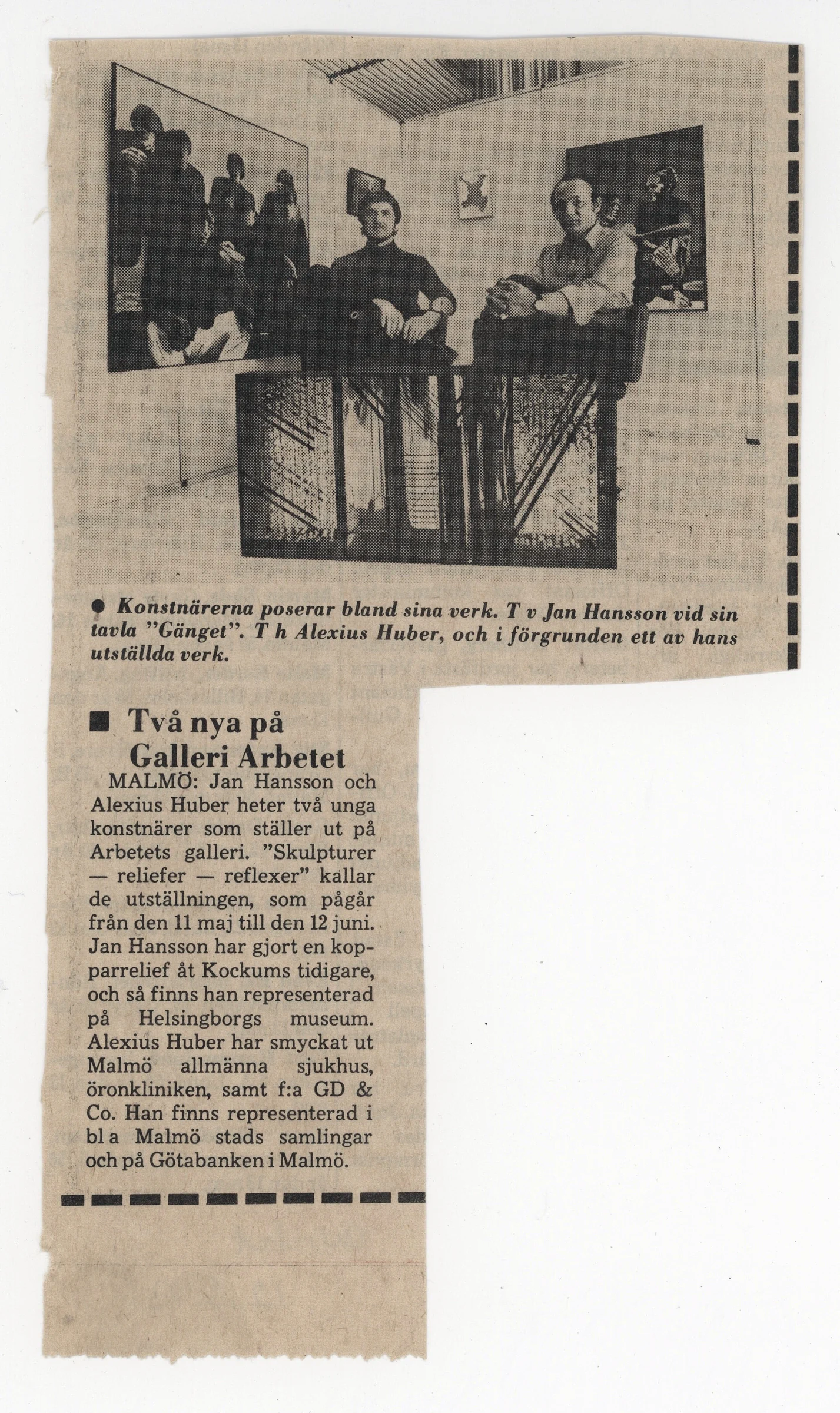
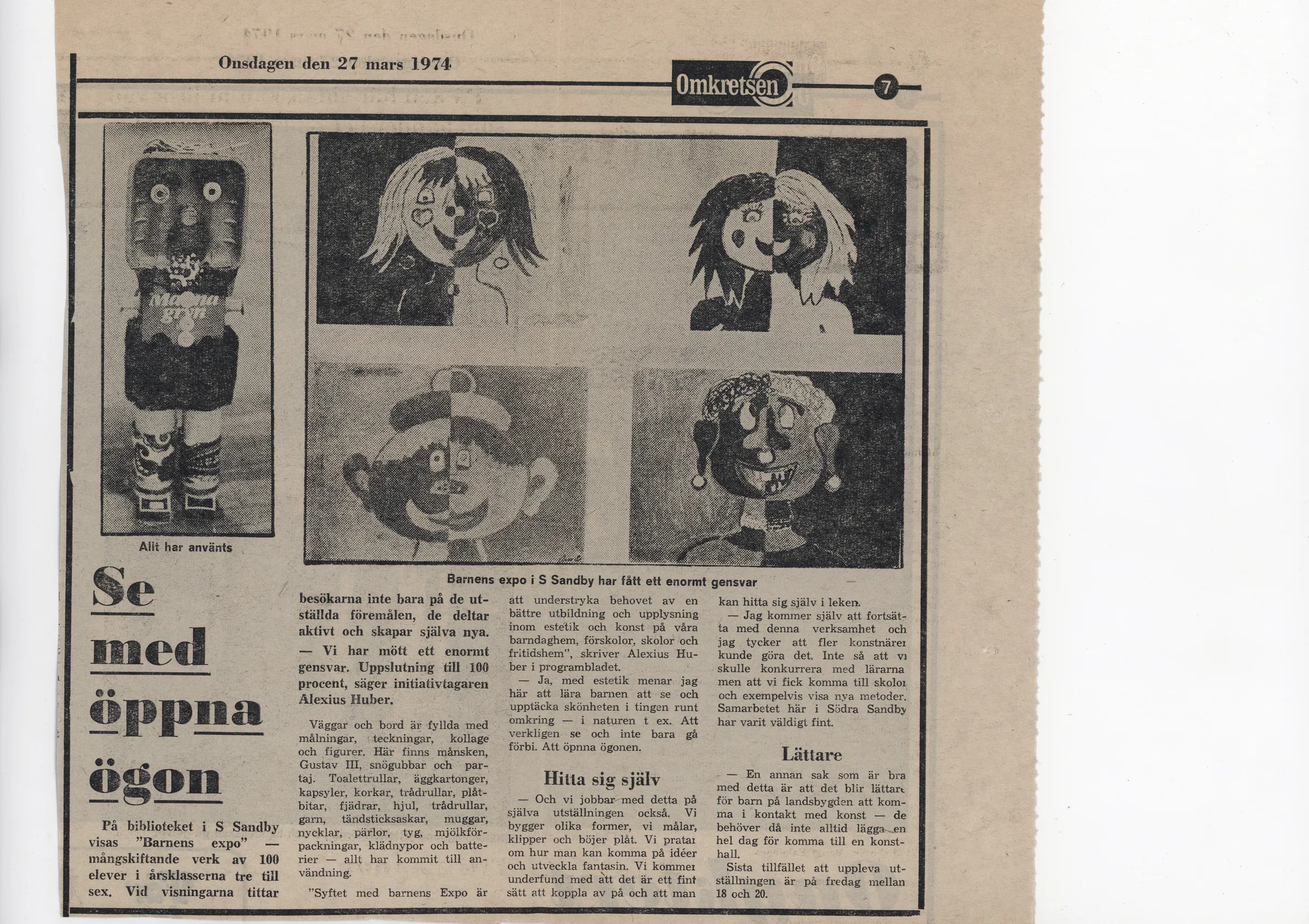
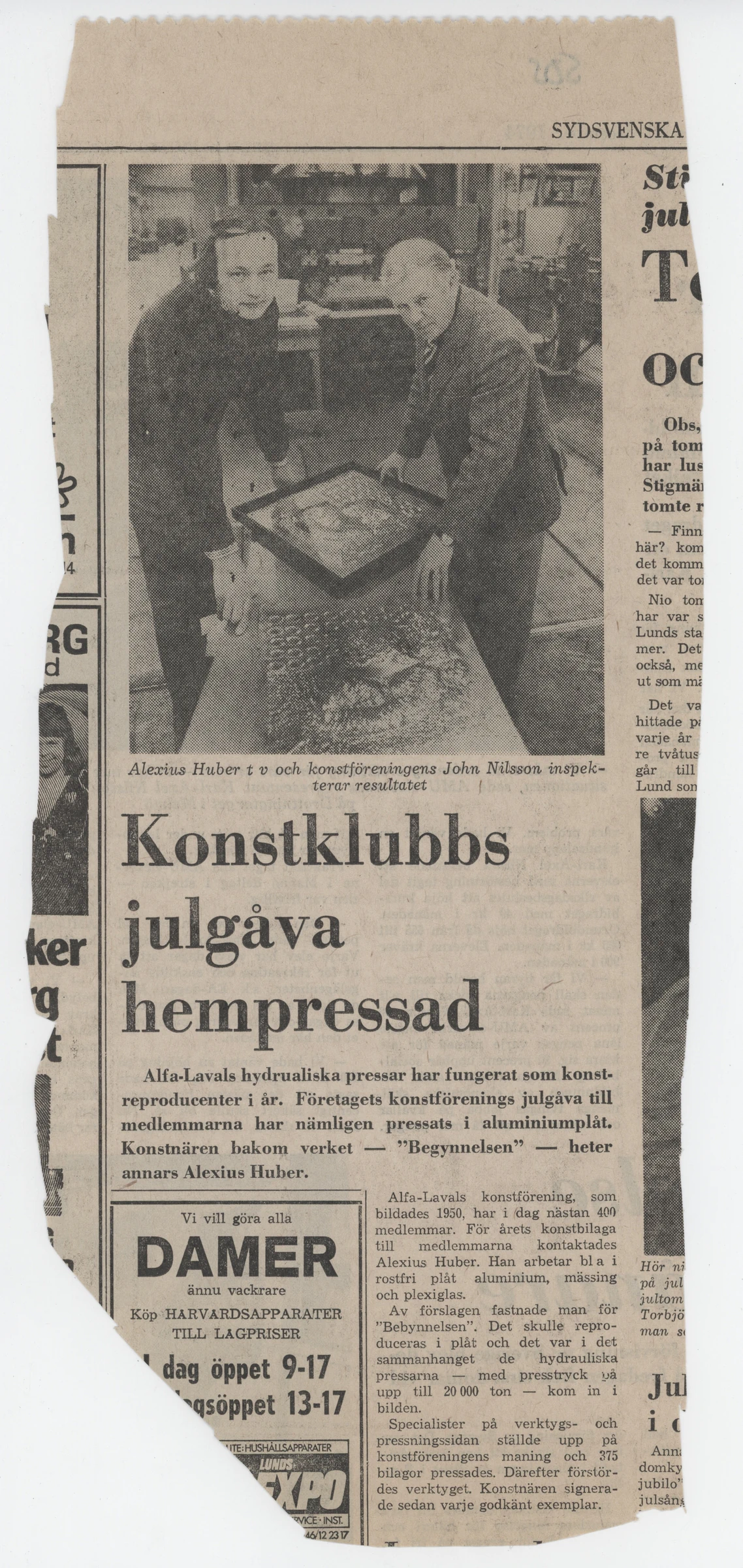
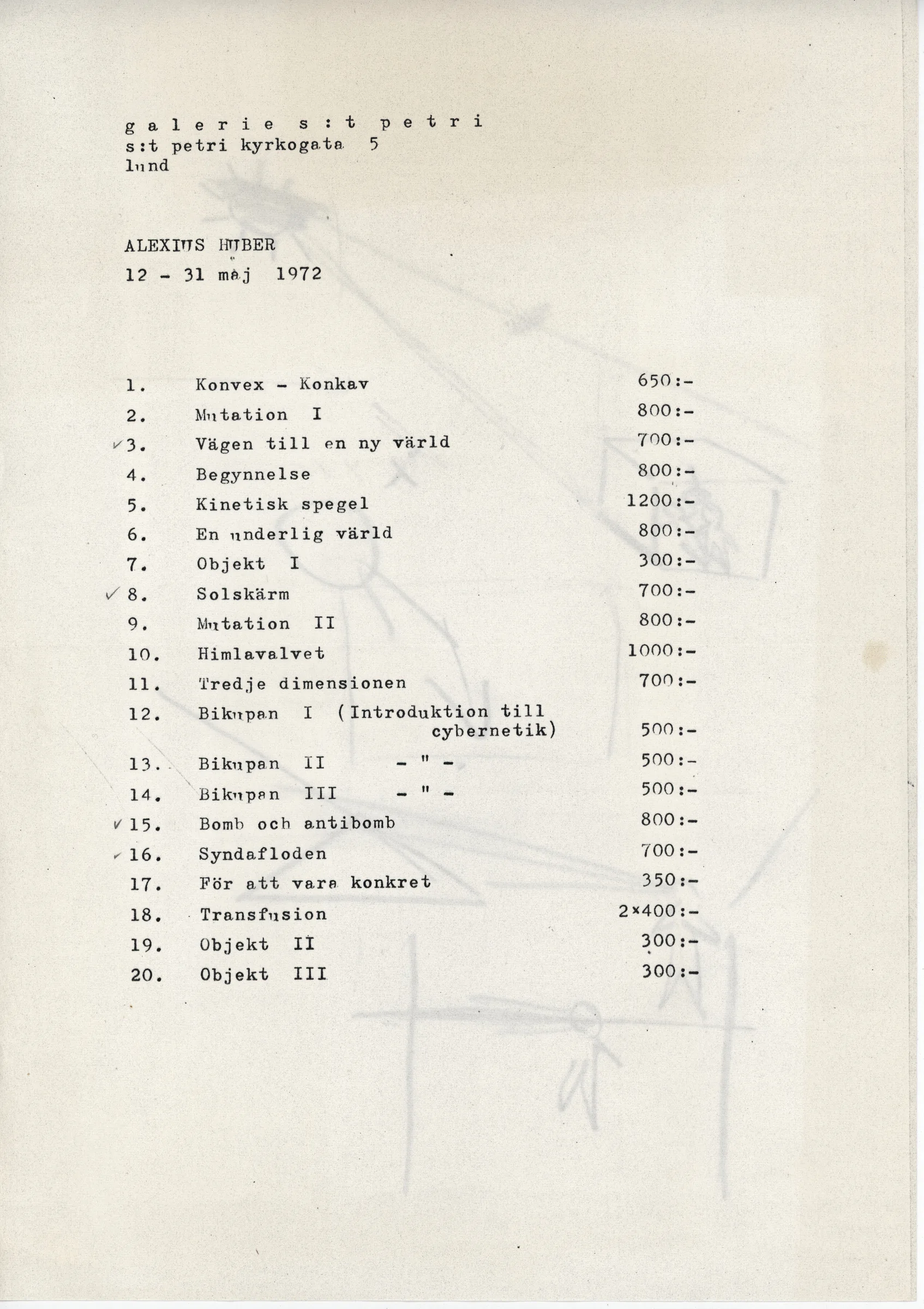
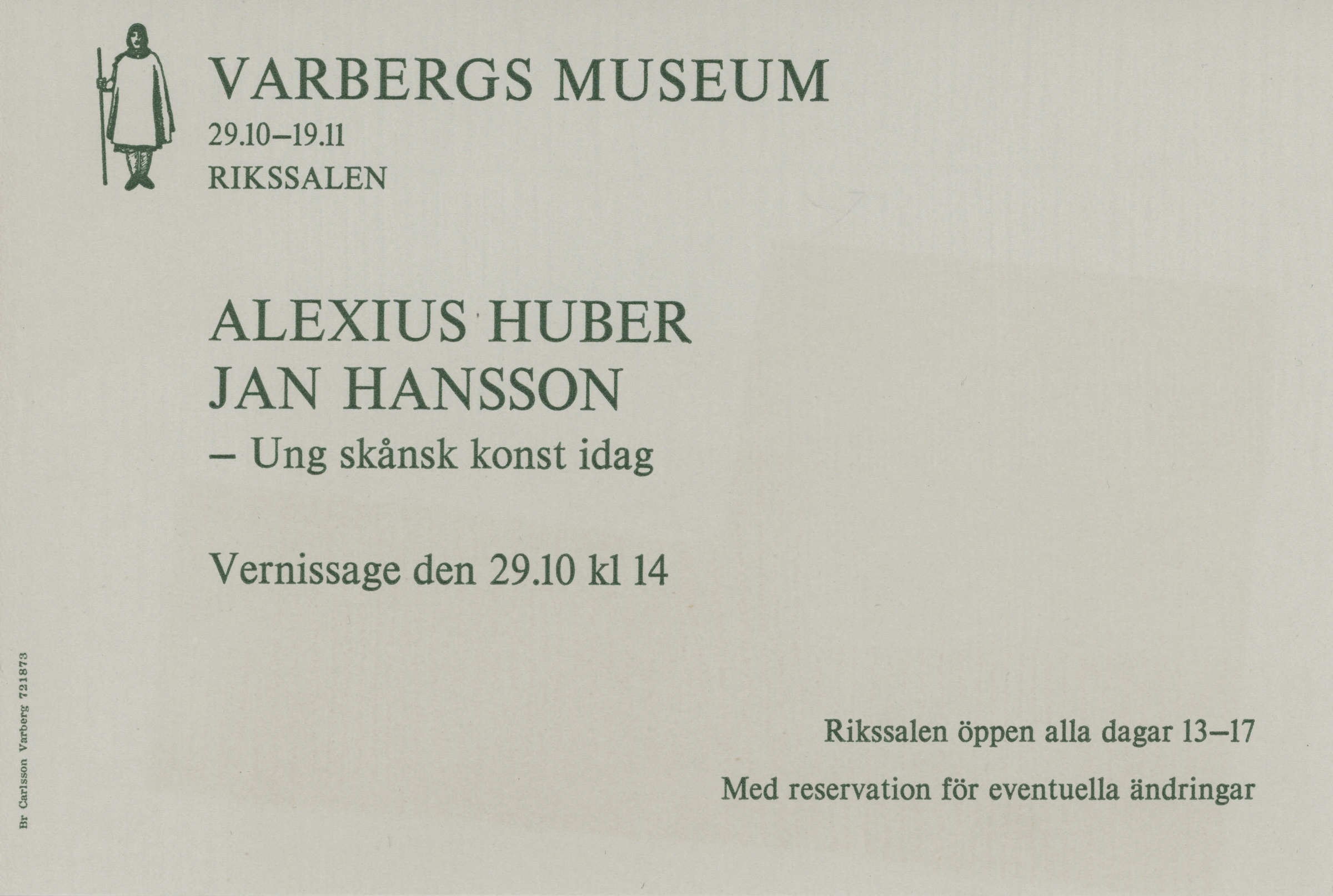
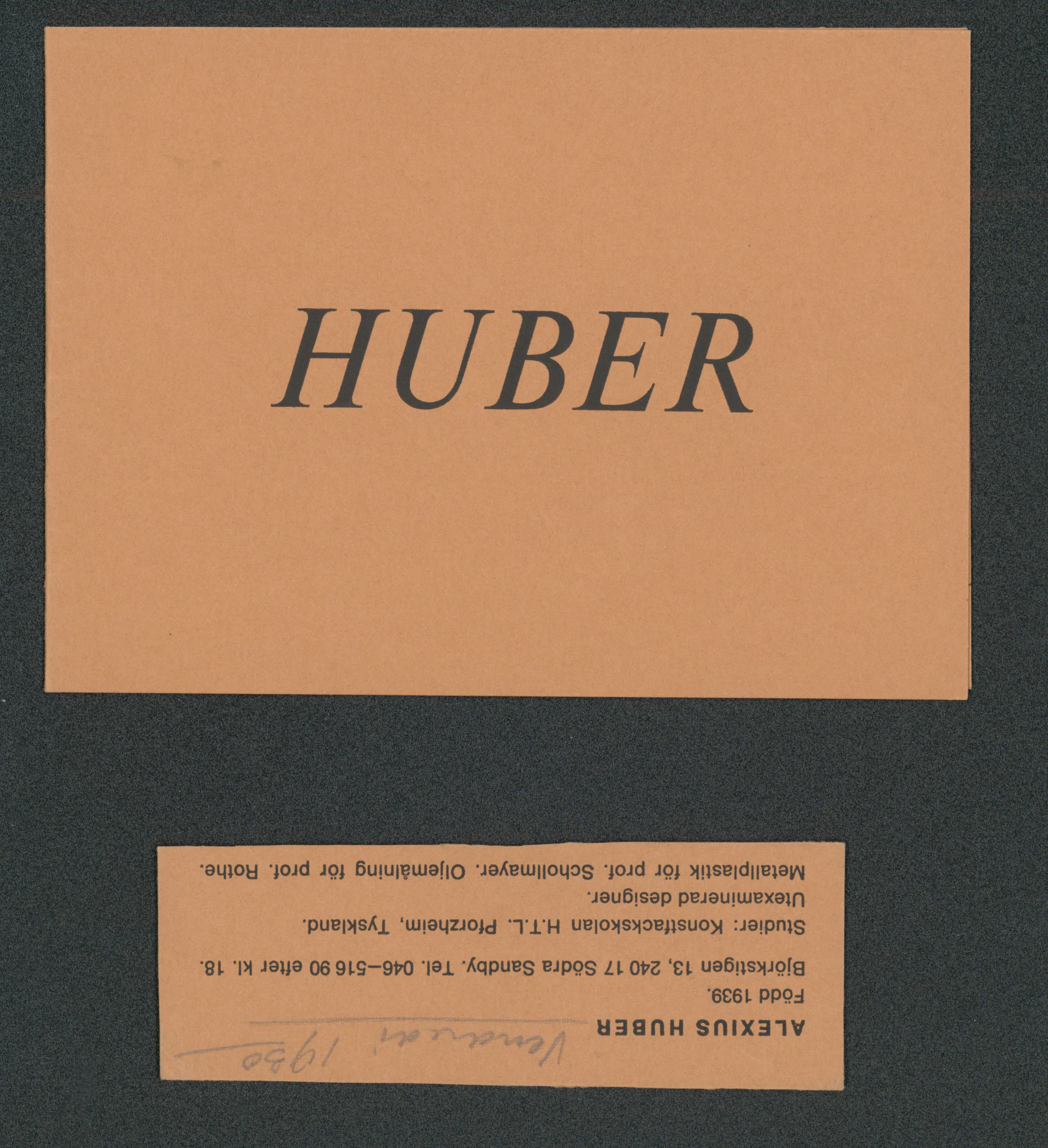
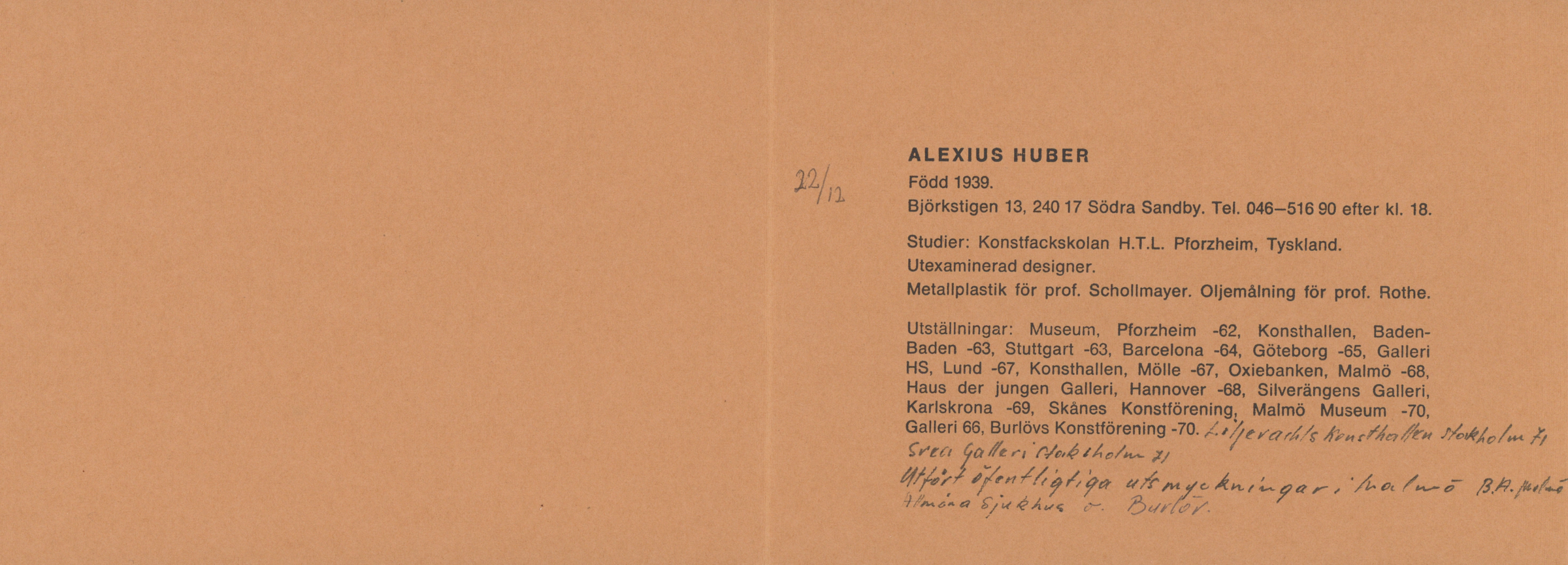
[JEANSELLEM VIEWER] — 21.04 - 10.05.1972 ALEXIUS HUBER — Categories: invitation, press — Keywords: Galerie S:t Petri, Jean Sellem, archive — Category: invitation — Galerie S:t Petri is holding an opening today, Friday, for an exhibition of sculptures by Alexius Huber. He creates his objects from aluminum, brass, plexiglass and electric lamps, and is fascinated by the reflections of light in dents and indentations. The opening runs from 5–8 pm. The exhibition continues until 31 May. — — — Alexius Huber at Galerie S:t PetriLUND: The exhibiting artist for the month of May at Galerie S:t Petri in Lund is Alexius Huber. Huber, who is 33 and a sculptor, will show his works at S:t Petri from 12 May until 31 May.About him, Jean Bolinder writes, among other things: Huber has created his objects from aluminium, brass, plexiglass and electric lamps. He has been fascinated by the sheen of metal, by light’s reflections in dents and incisions, and by the artificial patterns created by rotating plexiglass discs.Huber wants to teach us to see the beauty in the world around us. At the same time, he awakens in us an awareness of our growing emptiness—everything we are in the process of losing: fresh air, living soil, clear water, humanity, community.Galerie S:t Petri, S:t Petri Kyrkogatan 5, Lund, is open weekdays from 15:00 to 20:00, and Saturdays and Sundays from 12:00 to 17:00. — — — Category: invitation — Alexius Huber at S:t PetriGalerie S:t Petri in Lund held an opening on Friday for an exhibition by Alexius Huber. Huber has created his sculptures from aluminium, brass, plexiglass and electric lamps. — — — Caption: “Come to where the flavour is”, by Krister Zarelius (Formuleter). — LUND — GALERIE S:T PETRI (S:t Petri kyrkogata 6)Open Mon–Fri 3–8 pm, Sat–Sun 12–5 pm.Alexius Huber’s sculptures consist of smooth, gleaming metal objects, directly or indirectly drawn, for example, from the levelled sheet-metal dents of car chrome. One might say he has uncovered a formal language that increasingly surrounds us in reality: the language of technocracy and unrestrained faith in progress.But one might object that this is unnecessary: in real life that formal language already pours enough notions over us—and in a more effective, more calculated way. In that sense Huber’s objects become a kind of documentary fragments; fragments because he shows us only the sheen, the formal language—without for a moment suggesting what it is that is being “said” in that language. You don’t hear it; they are mute in their seclusion. — Wednesday is the last day. — — — Category: press — “Portrait of a Native American Chief,” by Björn Senneby. — Indians, posters, abstractionsThe original population of North America was the Indians; they were pushed out and very quickly became a hunted minority in conflict with the colonizers. The Indians never mixed with the new inhabitants but preserved their ethnic distinctiveness, even though this came at the price of living in reservations under harsh oppression. Ideas of independence existed among the Indians but can be said to have died definitively with Sitting Bull, one of the most legendary Native American chiefs. These chiefs have been portrayed by Björn Senneby in simple frontal images, somewhat stiff, resembling the old photographs that likely served as his models. These portraits do not speak directly about Indians, but they reflect their myth while serving as apotheoses of a people and its struggle against the imperialist colonizers who drove them from their lands. The struggle of the Indians was the same as that of the national liberation fronts around the world today.THE EXHIBITION *Bilder på stan* (“Pictures in the City”) is also called *Alternative Advertising* and was created in collaboration between three artists: Kerstin Abram-Nilsson, Boj Edberg and Anna Sjödahl. Together they make posters addressing various social problems, pointing out abuses and urging the viewer to take a stand. Their advertising differs from commercial advertising, which tries to overcome the consumer’s resistance to buying, whereas this alternative advertising wants to make people reflect on their present and future situations, about issues such as environmental destruction. Their posters are displayed in the same way as commercial ones: they are posted on rented billboards in Stockholm, and in that setting their contrast with regular advertising becomes evident. Such posters are fairly easy to make, as the artists explain in detail in the exhibition catalogue. In this way everyone who can finance a billboard slot can have a voice. Sometimes the artists have paid for the posters themselves, other times with the help of grants. As professional artists, none of them can make a living from such posters, since they are not intended to be bought or sold.MUCH of the art shown in galleries lacks the concreteness that the images mentioned above possess. Huber works in a general modernist tradition but is often vaguer than general and leaves a rather flat impression. In Alexius Huber’s gleaming metallic works and mobile optical objects, the content is reduced to form and rhythm, with abstraction itself remaining. It is a series of objects that can be interpreted entirely according to the viewer’s will, as the artist seems to have renounced all responsibility for content. What remains is a kind of decorative craft.The American graphic artist Anne Walker is also vague and general, but in a somewhat different way. Her decorative posters depict various things — fragments of vegetation. Yet one cannot recognize specific species of plants or trees: everything is abstracted into decorative concepts.HANS JOHANSSONGALLERI ATHENEUM, Lund: Björn Senneby ARKIVMUSEET, Lund: *Bilder på stan* GALLERIE S:T PETRI, Lund: Alexius Huber GALERIE LEGER, Malmö: Anne Walker — — — “The artists among their works: Jan Hansson on the left with ‘Gänget’, and Alexius Huber on the right.” — Two new artists at Galleri ArbetetMALMÖ: Jan Hansson and Alexius Huber are two young artists exhibiting at the Arbetet gallery. “Sculptures — reliefs — reflections” is the title of the exhibition, which runs from 11 May to 12 June.Jan Hansson has previously made a copper relief for Kockums and is represented at the Helsingborg Museum.Alexius Huber has decorated Malmö General Hospital, the ENT clinic, as well as the company GD & Co. He is also represented in, among others, the Malmö City collections and at Götabanken in Malmö. — — — Category: press — “Everything has been used” — works created by the pupils for the Children’s Expo in Södra Sandby. — Wednesday, 27 March 1974See with open eyesAt the library in Södra Sandby, “Children’s Expo” is on display, showing the versatility of 100 pupils from grades 3 to 6. During the visits, the visitors do not merely look at the exhibited items — they participate actively and create new works themselves.“We have received an enormous response. Appreciation at 100 percent,” says the initiator Alexius Huber.Walls and tables are filled with paintings and drawings in various styles, from amusing fantasy figures to more everyday motifs. Pupils have also built figures from household items, toys, newspaper clippings, sticks, scraps of fabric, etc. Several teachers — art teachers, classroom teachers and special educators — have followed the work with great interest.“The purpose of the Children’s Expo is to emphasize the need for better education and awareness in aesthetics and art in our nurseries, preschools, schools and after-school centers,” explains Alexius Huber in the program.“In modern society, I believe that from childhood through the end of upper secondary school we push children into one and the same direction, into a routine reality — rather than letting them play. One must learn to act.”Finding oneself“We work with this in my study circles and courses, through symbolism and images that help people. We talk about children and about development aimed at helping them unwind and find themselves through play.”“I personally feel that this activity must continue, and I think more artists should engage in it. Here we have been very concrete in our effort to be invited into schools and show our involvement. The cooperation here in Södra Sandby has been very positive.”Easier“Another positive aspect is that it becomes easier for children in rural areas to encounter art. In the cities, they can always easily slip into an exhibition. For rural children, it is easier to experience art when art comes to them. The exhibition will be shown to most pupils in Södra Sandby and will continue until Friday between 6 and 8 p.m.” — — — Category: press — “Alexius Huber (left) and John Nilsson inspecting a test impression of the work ‘The Beginning’.” — Art club’s Christmas gift, home-pressedAlfa-Laval’s hydraulic presses have served as art reproducers this year. The company art association’s Christmas gift to its members has been pressed in aluminium sheet. The artist behind the work — “The Beginning” — is Alexius Huber.The Alfa-Laval Art Association, founded in 1950, today has nearly 400 members. For this year’s art edition for the members, Alexius Huber was contacted. He works, among other materials, with stainless sheet metal, aluminium, brass and plexiglass.Among the proposals, “The Beginning” was chosen. It was to be reproduced in sheet metal, and for that purpose the hydraulic presses — capable of exerting pressures up to 20,000 tons — came into play.Tooling and pressing specialists assisted the art association, and 375 copies were pressed. The tool was then enlarged, and the artist signed each approved copy. — — — — — — — — — Category: invitation — Biographical card of Alexius Huber (exhibition presentation). — HUBERALEXIUS HUBERBorn 1939.Björkstigen 13, 240 17 Södra Sandby. Tel. 046–516 90 after 6 p.m.Studies: Art School H.T.L., Pforzheim, Germany.Graduated designer.Metal sculpture under Prof. Schollmayer.Oil painting under Prof. Rothe.[handwritten: Vernissage 1970] — — — Artist biography / CV of Alexius Huber. — ALEXIUS HUBERBorn 1939.Björkstigen 13, 240 17 Södra Sandby. Tel. 046–516 90 after 6 p.m.Studies: College of Applied Arts H.T.L., Pforzheim, Germany.Graduated designer.Metal sculpture under Prof. Schollmayer.Oil painting under Prof. Rothe.Exhibitions: Museum, Pforzheim (1962), Konsthallen Baden-Baden (1963),Stuttgart (1963), Barcelona (1964), Gothenburg (1965),Gallery HS, Lund (1967), Konsthallen Mölle (1967),Ottebakken, Malmö (1968), Haus der jungen Kunst, Hanover (1968),Silverangens Gallery, Karlskrona (1969),Skåne Art Association, Malmö Museum (1970),Gallery 68, Burlöv Art Association (1970).Represented in: Konsthallen Stockholm,Swedish National Arts Council (Statens Konstråd),Malmö General Hospital, the Bishop’s Residence,Butler Medical Center. — — — Front — — — Back — — — — — — — Category: press — Children’s Exhibition Project — Play as a Basis for Art Education (24 Feb 1974)” — At my art exhibition in Södra Sandby in 1973, and at an art lecture on the possibilities of artistic expression—drawing, printmaking/graphics, oil painting and sculpture—I, as the initiator, decided in consultation with the following teachers—Mats Kullenberg, Anders Fredriksson, Lars Christensson, Ulla-Britt Nilsson and Gulli Olsson—to arrange an exhibition of about 100 pupils’ works. In consultation with the pupils it was decided that they would create with complete freedom in their choice of theme and material.Within the art-theoretical understanding of the concept of play, play is presented as the human being’s (the artist’s) free, unbound manifestation of the self, a liberation of one’s own ego. Play is here to have its own form, to be the highest form of human activity: without goal, without intention, motivated in itself, and in its highest perfection precisely artistic activity.The conditions and prerequisites of play are thus found within play itself, outside the sphere of real life. And in play one finds the only medium through which one can attain the realm of freedom, where the human being frees himself from the oppression and deformation implied by everyday reality and, released from its bonds, subject only to the laws of aesthetics, realizes his true existence as a human being. The human being—originally a playful creature—according to this view finds his way back to himself in play and thus does not stand as a stranger to himself. This view of play as artistic activity is expressed particularly clearly in Schiller. There is no other way to make the sensuous human being rational than first to make him aesthetic.The purpose of the children’s Expo is to emphasize the need for better education and awareness in aesthetics and art in our day-care centres, preschools, schools and after-school centres. Artists can and want to help convey this knowledge to our young fellow human beings.Södra Sandby, 24.2.1974 Alexius Huber