He began his artistic career in 1955 at the Skåne Painting School in Malmö under the guidance of artist Tage Hansson, after which Lindgren continued his studies with Mogens Andersen in Copenhagen in 1958. Study trips abroad followed, and in 1962 Lindgren entered the Staatliche Kunstschule in Bremen, while also participating in the Summer Exhibition of Young Art, Städtische Galerie, Munich in 1962.
In 1963 he debuted with his first solo exhibition at Galerie Richter in Bremen. In 1964 Lindgren had his Swedish debut in Malmö at the Theatre Gallery with about thirty paintings. Marianne Nanne-Bråhammar then wrote about the exhibition: “The interest in light is reminiscent of a painter like Turner, today a current name. The mood in the pictures can acquire a surrealist overtone, and one understands when the artist in the catalogue speaks of a macabre world of Matta.”
The following years were marked by exhibitions abroad as well as in Lund at the now existing Galerie HS and Galerie Loftet in Malmö.
In 1970 Lindgren participated in the exhibition “Art for Children” at Malmö Museum. In 1970–71 he was represented in the Lunds Konsthall Artotek.
In 1970 Lindgren distanced himself from official art life and began experimenting with fluorescent and phosphorescent image compositions in the long-wave ultraviolet spectrum, especially at the wavelength of 3655 Å. This led to what he called “transcendental light painting”, using means deliberately chosen to evoke a third dimensional space of light, without comparison in current visual art. His light paintings can be experienced as windows in the wall leading to an inaccessible inner paradise; the paintings are static and harmonious counterparts to the acrobatic-kinetic art of the theater, created by his modern color techniques.
Lindgren’s light paintings are centered on Tibetan mandalas; glowing from within, they are Dionysian night visions, dawning galaxies, light landscapes with a mystical astral character. In terms of color, they are ascetically conceived, directly dematerialized figures radiating a meditative atmosphere. These light paintings can also be likened to iconostases of “light icons” from the 19th century, captivating the viewer beyond the boundaries of language and discursive thought, into the neglected and forgotten inner-perceptual space; into the contemplative, ordered, and sacred existence of perception. These light paintings possess the lost third dimension, and here an unmistakably spiritual perspective emerges, one that cannot be confused with a merely material visual content.
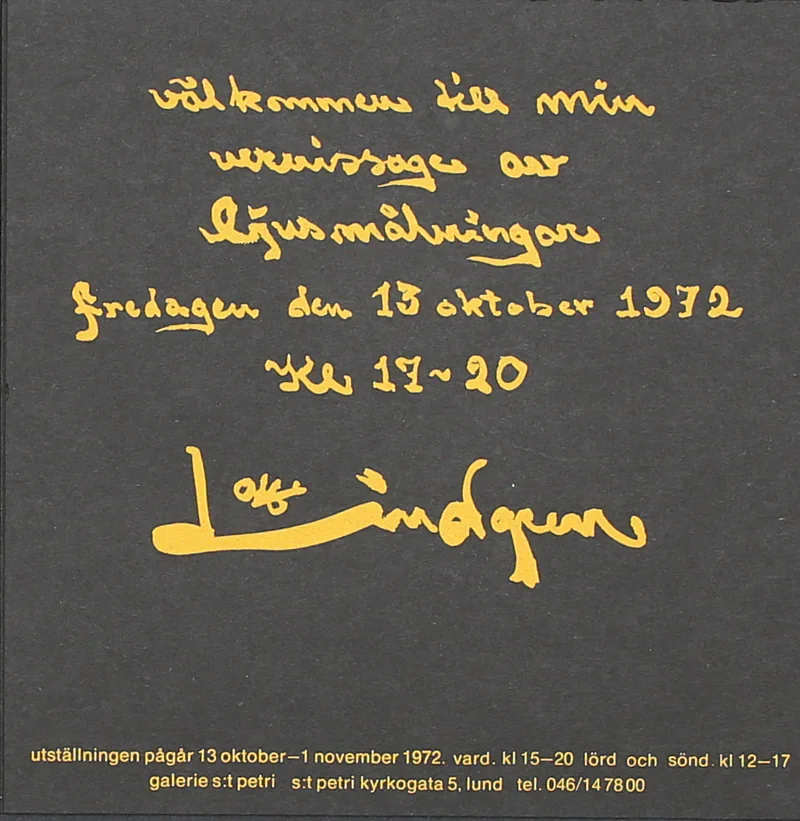
ALF FRITZ LINDGREN exhibits his light paintings for the first time at GALERIE S:T PETRI, LUND, from Friday 13 October – 1 November 1972.
[JEANSELLEM VIEWER] — 13.10 -1.11.1972 ALF LINDGREN — Categories: press, letters, visual — Keywords: Galerie S:t Petri, Jean Sellem, archive — Category: press — Newspaper and date unidentified (press clipping). — Light paintings that lead us into the mysticism of the East. At Gallery S:t Petri in Lund, Alf Lindgren exhibits light paintings that introduce us to the world of Eastern mysticism. He has worked with fluorescent and phosphorescent paints that require a dark room with ultraviolet light, which makes the images self-luminous and produces a strong three-dimensional effect. The stillness of the composition and the concentration of the experience toward the center direct the mind toward another world beyond reality. An Indian mandala is a meditation image enclosed within a circle. One sits in front of it, enters oneself, enters the image, and suggests oneself into a meditative state. Alf Lindgren’s mandala is a Japanese landscape. The message of Eastern philosophy concerning what art should be — an object for meditation — he has made his own. The suggestion is enhanced by the scent of incense and Indian raga music. Gallery S:t Petri, which was founded a year ago, is a different and ambitious gallery. The activity is carried out on an idealistic basis. The exhibitions are often interesting but display a somewhat uneven quality. In connection with the exhibitions, programs are organized every Saturday evening on subjects such as music, poetry, philosophy, and religion. Alf Lindgren’s “Mandala,” one of the light paintings exhibited at Gallery S:t Petri. Box: Kristina Carmer at the opening. — — — Category: press — Sydsvenska Dagbladet, 28 November 1972 (handwritten pencil annotation: “SDS 28.11.72”). Critical press article presenting the exhibitions of Carl Magnus and Gert Sparr at Gallery Prisma IV in Lund, and of Alf Fritz Lindgren at Gallery S:t Petri in Lund, — Ambiguous contours, added fragmentsGallery Prisma IV, Lund: Carl Magnus and Gert SparrGallery S:t Petri, Lund: Alf Fritz LindgrenAmbiguous contours, added fragments. Carl Magnus’s images have often been based on certain elementary insights into human visual perception. He has worked with a contour that is ambiguous in that it can give rise to a form oriented in either of two directions, but since the contour, for our perception, describes the form only for one of the two areas it delimits, we will, on the basis of the same image, the same visual stimulus, alternately see one of the two possible images. In his most recent series of images, dealing with staircases that, depending on the viewpoint, may appear to lead both upward and downward, to have neither beginning nor end, etc., Carl Magnus continues to work with variables of perception. The results strikingly resemble the type of images that usually illustrate books on Gestalt psychology. Carl Magnus is perhaps somewhat more interesting to look at than the illustrations in psychology textbooks, but they nevertheless remain at a rather superficial wit that becomes tiresome and monotonous when repeated image after image. There is something heart-pounding in Gert Sparr’s prints and collages. He works with clear and well-defined forms and fragments that easily catch the eye. But the gaze merely wanders from fragment to fragment. Sparr has not managed to synthesize his images into coherent wholes. The long and strange titles do not provide any more tangible clues to the content either. To me, Sparr’s images are merely added fragments without any inner connection. Certain fluorescent and phosphorescent colors appear only in particular light. Alf Fritz Lindgren works with such colors, which enhances the mystical character of his paintings. In a catalogue text, the images are described as “transcendental light painting,” and reference is made to a “finite perspective that cannot be confused with temporal content.” Lindgren’s striving has a clearly religious character, and the images bear the mark of meditation objects; the path Lindgren indicates to reach what he calls “nothingness,” and which seems to be a form of salvation, is that of meditation. The paintings he shows seem merely to be results he has achieved on his path toward “nothingness,” with artistic activity appearing to be only part of the struggle for salvation. What frightens me in images such as these is the escapism, the flight from reality they express, that is, the very attitude that lies behind their creation — — — Category: press — Skånska Dagbladet, 13 October 1972 (handwritten pencil annotation: “SKD 13.X.72”) — Light paintings at Gallery S:t PetriAlf Lindgren’s light paintings produce a three-dimensional effect. They have been compared to William Turner’s experiments with light. Alf Fritz Lindgren, born in Malmö in 1941, is exhibiting his light paintings for the first time. The opening takes place at Galerie S:t Petri in Lund. In 1970 the artist began his artistic experiments with fluorescent and phosphorescent image compositions in the long-wave ultraviolet field. This leads to a “transcendental light painting” using stylistic means that evoke a third spatial dimension. The light paintings can be experienced as windows in the wall to an inaccessible inner paradise. The paintings measure 1 x 1 m and six are shown at Galerie S:t Petri. Alf Fritz Lindgren began his artistic career in 1955 at the Scanian painting school in Malmö and subsequently studied under Mogens Andersen in Copenhagen. In 1962 he was admitted to the Staatliche Kunstschule in Bremen. In 1963 he made his debut with his first solo exhibition at Galerie Richter in Bremen. He made his Swedish debut in Malmö at the theatre gallery. His paintings have been compared with Turner’s works for their light atmospheres. The exhibition at Galerie S:t Petri runs until 1 November — — — Category: press — Arbetet, 21 octobre 1972. Article « Konstronden » — GALERIE S:T PETRI, S:t Petri kyrkogata 5, open Monday–Friday 3–8 p.m., Saturday–Sunday 12–5 p.m. Alf Fritz Lindgren presents light paintings.In 1970, the artist began experiments with fluorescent and phosphorescent pictorial compositions in the long-wave ultraviolet range. This leads to a “transcendental light painting,” employing stylistic means that invoke a third spatial dimension. The light paintings can be experienced as windows in the wall opening onto an inaccessible inner paradise. The paintings measure 1 × 1 m, and six works are shown at Galerie S:t Petri. The exhibition runs until 1 November. — — — Category: press — Arbetet, 15 October 1972 (handwritten pencil note: “ARB 15.10.72”) — Transcendental light painting – a new art form at S:t PetriLUND: A completely new art form was introduced on Friday at Galerie S:t Petri in Lund.It concerns “transcendental light painting.”The artist is Alf Fritz Lindgren, born in Malmö in 1941. He describes his art as follows:— The light paintings possess the lost third dimension. He believes that the paintings can be compared to “light icons,” which draw the viewer beyond the boundaries of language into the neglected, forgotten inner perceptual space. According to other interpreters, his light paintings can be experienced as windows in the wall leading to an inaccessible inner paradise. It was in 1970 that Lindgren withdrew from the official art world and began experimenting with fluorescent and phosphorescent pictorial compositions.Above all, he used ultraviolet colors. — — — Category: press — Sydsvenska Dagbladet, 13 October 1972. — Siberia and Lund in the same painting!Ola Billgren, an artist from Lund, opens his exhibition at Krognoshuset tomorrow. It has been nearly five years since his last exhibition. What he presents this time are paintings that have already been shown at the Moderna Museet in Stockholm, in Paris, and in Japan. He now wants to show them one final time before they completely lose their relevance for him personally, he says. Most of the works were made two years ago. The painting shown in the picture is titled Diptych and draws its motifs from Siberia (left) and from the cloister garden in Lund.Alf Lindgren, a painter from Malmö, opens his exhibition today at Galerie S:t Petri. This time he presents so-called “light paintings”. In 1970 he began experimenting with fluorescent and phosphorescent pictorial compositions within the long-wave ultraviolet spectrum. In this way he has developed stylistic means intended to evoke a third spatial dimension. — — — Category: letters — Invitation card for the exhibition LJUSMÅLNINGAR 1973–74 by Alf Lindgren, held at Galerie Gustav. Printed recto, verso featuring a handwritten text signed by the artist — Light paintings, 1973–1974. — Welcome to the vernissage at Galerie Gustav on Saturday, 2 February, from 2 p.m. to 6 p.m. Alf Lindgren. The exhibition runs from 2 February to 24 February, open from 12 noon to 7 p.m., closed on Mondays. Galerie Gustav, Regementsgatan 94, Malmö. Tel. +46 40 626 86 — — — Category: visual — Black-and-white photographic reproduction of a work by Alf Lindgren. — Black-and-white photographic reproduction of a work by Alf Lindgren.No title is indicated on the print and no handwritten annotation is present. — — — Category: visual — Archival envelope bearing a handwritten felt-tip annotation: “No. II Mandala (svartvita foton)”. — — — Category: visual — Black-and-white photographic reproduction of a work by Alf Lindgren, entitled Mandala, no. II. — Black-and-white photographic reproduction of a work by Alf Lindgren, entitled Mandala, no. II.Print preserved in a transparent plastic sleeve bearing a handwritten felt-tip annotation: “no. II Mandala (3 st.)”, — — — Category: visual — Folded invitation card (booklet format) for the exhibition “Ljusmålningar” by Alf Lindgren, Galerie S:t Petri, Lund, October–November 1972. The front features a die-cut window containing a colour photographic reproduction (positive/negative-like) of an artwork. — Printed text:ALF FRITZ LINDGRENSödra Rörsjögatan 5, 211 37 MalmöTelephone +46 40 129208No words, nor explanation.A fundamental component of art.Stillness and silence are in themselvesthe path to knowledge. Meditation createsa sovereign state of the present gaze,in which all ideas mergeand flow together in an inner vision.The ages of wisdom, with their thousandsof experiences and astonishing factual knowledgein modern science and technology;sounding music, rich in emotional and variable meaning;renowned works of art – all point awayand fade before the depth and strength of nothingness.In order not to return from these realms into the world of spirit,yet without deviating, to grasp oneselfwithout contradiction; to preserve and elevatethe purity of spirit and body; to unitetruth and reality in harmony,to experience them thus – this is the ultimate meaningof artistic activity.Alf LindgrenHandwritten text:Welcome to my opening reception of light paintings on Friday, 13 October 1972 from 5 pm to 8 pm. Alf Lindgren — I Beyond Here and Now II Mandala III “This is not it, nor is that…” IV Divine Nemesis V The Holy Sacrament of Mata VI Integrated Cosmos