

CLICK TO VIEW PRESS RELEASE
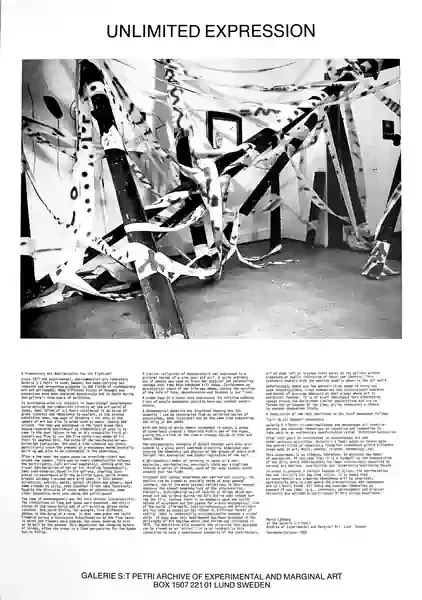
UNLIMITED EXPRESSIONSEPTEMBER - OCTOBER 1980
Call for Innovators!
Galerie S:t Petri in Lund invites all creative individuals—those who see themselves as innovators and trailblazers—to participate in an exploratory manifestation titled “Unlimited Expression.”
After nine years of experimental artistic and cultural activity, S:t Petri wishes to explore the possibilities of creating a forum for innovators in various fields such as art, music, poetry, science, and technology.
The experiment is therefore an attempt to discover new forms of expression. At the same time, it marks a farewell to the avant-gardism of the 1970s in art, which has unfortunately been increasingly exploited by certain art dealers, institutions, and so-called alternative publishers.
To maintain a certain freedom of action, the manifestation is not limited by time. The hope is to create an experimental and creative environment in a city that offers both favorable conditions and expertise. All who consider themselves carriers of new ideas—such as inventors, philosophers, and independent thinkers—are welcome to participate in this unique manifestation.
Galerie S:t Petri is open weekdays 3–8 p.m., Saturdays 1–5 p.m.
Text extracted from the poster:
UNLIMITED EXPRESSION — A Promontory Art Manifestation for the Eighties
Since 1971 the experimental, non-commercial art laboratory Galerie S:t Petri in Lund, Sweden, has been carrying out research and project work in the fields of contemporary art and philosophy. Many different facets of thought and expression have been explored extensively and in depth during the gallery’s nine years of existence.
In accordance with its interest in experimental developments outside the more commercial circuits of the art world, Jean Sellem of S:t Petri considered the beginning of the eighties as an opportune time for a brief analysis of contemporary art, mass culture, poetry and science through the means of a “manifestation of art” that once again regarded humanism as priority over what is becoming the new metaphysics or psychology. Pressed by a growing crisis in Western art and thought, this attempt was aimed to dissolve the norms the sixties began gradually building up to become the dogmas of the seventies.
Participants in the manifestation came from Sweden and abroad to express both their own ideas about form itself and the participants’. Each had separate, working divisions within the gallery, and they were given total freedom to express their thoughts and ideas through painting, construction, sculpture, installations, music, video, philosophy, metaphysics, and science. No restrictions, deadlines, or censorship were applied; nor was any control exercised over aesthetic form, language, or concept. The experiment was open-ended.
Each participant developed his or her own characteristic approach. Some worked with language structures, others with scientific symbolism. Among the visual contributors were artists such as Andrzej Płoski, Erik Dietman, and Rudolf Steiner’s spiritual successors, whose works reflected the metaphysical dimensions of light and transformation. Others, working in physics or mathematics, provided models expressing energy fields or philosophical systems too broad in a time perspective for the human eye to follow.
A similar reflection of metamorphosis was expressed in a pictorial review using new digital grids. A subtle ordinary change of phases could bridge the physical and personality aspects over time and transform body and thought as an ontological chart of new life and death. Furthermore, an astrological frame of reference was drawn for the question of the role of chaos, determination, and freedom in our lives.
A wide range of human expression found its infinite correlation to muscle movements possible here as another contribution.
A mathematical equation was displayed showing how one quantity can be constructed but at the same time conserving the energy of the individual.
With the help of white sheets suspended in space, a group of schoolboys created a labyrinth in which one of them, giving the vibration to the hanging motor of a fan, gave life.
The anthroposophic thoughts of Rudolf Steiner were also presented as pieces combined of scientific knowledge emphasizing ideology and creativity. Metaphysics was understood through the relationship of form, light, and philosophy; a model of thinking in terms of non-logical, non-symbolic constructs that was visually abstract.
A large series of drawings, each of the same height, which meant that more forms of expression could easily relate to each other, was made possible by horizontal walls, flat surfaces, and easy contact between contributors.
Each of these expressions reflected not merely rational attitudes, but also spontaneity and inner necessity. The project thus became a laboratory for intuition and transcendence—a platform where art could again redefine its philosophical and moral role in a humanistic context.
All of the participants presented their works anonymously—none signed their contributions. This anonymity was crucial, ensuring that no hierarchy of artistic value or name recognition was established. Each participant, through their contribution, expressed their own insight into the unity of art and life.
A translation of the text published in the local newspaper follows:
“Galerie S:t Petri in Lund challenges and encourages all creative persons to consider themselves as innovators and ‘innovative thinkers’ and to take part in an experimental manifestation called Unlimited Expression.”
“After nine years of experimental artistic and cultural activity, S:t Petri wishes to investigate the possibilities of creating a forum for innovators in various fields such as art, music, poetry, science, and technology.”
“The experiment is therefore an attempt to discover new forms of expression. At the same time, it marks a farewell to the avant-gardism of the 1970s, which has unfortunately been increasingly exploited by certain art dealers, institutions, and alternative publishing houses.”
“The aim is to create a platform for intellectual and spiritual freedom that transcends both political and commercial constraints.”
“Everyone who believes themselves to be a bearer of new ideas—particularly inventors, philosophers, and independent thinkers—is welcome to participate in this unique experiment.”
Marie Sjöberg, S:t Petri
Archive of Experimental and Marginal Art, Lund, Sweden
September/October 1980
