ZERO -TEXTS
Graz (Austria): Studentenhaus Leechgasse 24 der katholischen Hochschulgemeinde, publisher, 1974.
24 unnumbered pages, 290 x 206 mm, staple binding, black and white offset printing.
English.
Edition of 600 copies.
Catalogue published for the exhibition "Endre Tót – Zero-texts", January/February 1974, in Graz (Austria).
(See the mention in the Impressum: "Katalog zur Ausstellung, Endre Tót – Zero-texts, Jänner/Februar 1974, Studentenhaus Leechgasse 24 der katholischen Hochschulgemeinde Graz.")
On the back cover of our copy, there is a handwritten dedication in blue ballpoint pen by Endre Tót to Jean Sellem (founder of Galerie St. Petri in Lund, Sweden), signed and dated September 8, 1975, reading: "For Jean."
ZERO -TEXTS
Graz (Austria): Studentenhaus Leechgasse 24 der katholischen Hochschulgemeinde, publisher, 1974.
24 unnummerierte Seiten, 290 × 206 mm, Klammerheftung, Schwarz-Weiss-Offsetdruck.
Englisch.
Auflage: 600 Exemplare.
Katalog zur Ausstellung «Endre Tót – Zero-texts», Januar/Februar 1974, in Graz (Österreich).
(Siehe den Hinweis im Impressum: «Katalog zur Ausstellung, Endre Tót – Zero-texts, Jänner/Februar 1974, Studentenhaus Leechgasse 24 der katholischen Hochschulgemeinde Graz.»)
Auf der Rückseite des Umschlags unseres Exemplars befindet sich eine handschriftliche Widmung von Endre Tót an Jean Sellem (Gründer der Galerie St. Petri in Lund, Schweden), mit blauem Kugelschreiber geschrieben, signiert und auf den 8. September 1975 datiert. Die Widmung lautet: «For Jean.»
ZEROPOST
Es ist wunderschön gemacht! (It is beautifully made!)
Geneva: Edition Howeg & Ecart. Sheet of postage stamps.
Sheet dimensions: 298 × 213 mm
Edition of 1,000 copies + 50 signed and numbered copies.
In 1976, a second edition was printed in green, also in 1,000 copies, of which 50 were signed and numbered.
There is also a third version in light green (see ALMANACH ECART, page 141), printed in 50 signed and numbered copies.
Wunderschön! (Beautiful!)
ZEROPOST
Es ist wunderschön gemacht!
Genf: Edition Howeg & Ecart. Briefmarkenbogen.
Bogenformat: 298 × 213 mm.
Auflage von 1.000 Exemplaren plus 50 signierten und nummerierten Exemplaren.
1976 erschien eine zweite Auflage in Grün, ebenfalls in 1.000 Exemplaren, davon 50 signiert und nummeriert.
Es existiert außerdem eine dritte Version in Hellgrün (siehe ALMANACH ECART, S. 141), gedruckt in 50 signierten und nummerierten Exemplaren.
Wunderschön!
LOOK! HERE'S A GIANT ZERO FOR YOO!
● In a letter from John Armleder to Endre Tót, we read that the edition of "Giant Zero" was printed in 50 numbered copies (001–050), signed by Tót, and 450 numbered copies (051–500), unsigned. This information is not mentioned on the postcard.
● In the same correspondence, the layout of this Giant Zero is included, at the time still titled "Great Zero." A few days later, in a follow-up letter, Endre Tót asked John Armleder to change "Great" to "Giant."
* Excerpt from a letter sent on July 3, 1974, published in the booklet ENDRE TÓT. CORRESPONDENCE WITH JOHN ARMLEDER. ECART GENEVA.
LOOK! HERE'S A GIANT ZERO FOR YOO!
● In einem Brief von John Armleder an Endre Tót lesen wir, dass die Auflage von „Giant Zero“ in 50 nummerierten Exemplaren (001–050), von Tót signiert, sowie in 450 nummerierten Exemplaren (051–500) ohne Signatur gedruckt wurde. Diese Information ist auf der Postkarte nicht vermerkt.
● In derselben Korrespondenz ist auch das Layout dieses Giant Zero enthalten, das zu diesem Zeitpunkt noch den Titel „Great Zero“ trug. Wenige Tage später bat Endre Tót John Armleder in einem weiteren Brief, „Great“ in „Giant“ zu ändern.
* Auszug aus einem am 3. Juli 1974 versandten Brief, veröffentlicht im Heft ENDRE TÓT. CORRESPONDENCE WITH JOHN ARMLEDER. ECART GENEVA.
CORRESPONDANCE AVEC JOHN ARMLEDER
Geneva: Ecart, John Armleder, publisher, August 1974.
82 unnumbered pages, semi-rigid cover, perfect binding with reinforced tape, 292 x 206 mm; facsimile-printed booklet, black and white offset printing, with some illustrations in color.
Printers: Patrick Lucchini and David Macintosh.
Edition of 500 numbered copies, including 50 copies numbered and signed by Tót and Armleder on the title page, featuring several original stamp imprints from both artists.*
Our copy is dedicated to the publisher Thomas Howeg.
Languages: English, French, German.
* See additional information.
This booklet contains the correspondence exchanged between Endre Tót and John Armleder during the preparation of Endre Tót’s exhibition at Ecart in June–July 1974. It serves as the exhibition catalog.
On the title page, the inscription reads:
"THIS BOOKLET WAS PRINTED IN 500 NUMBERED COPIES FROM 1 TO 500, OF WHICH THE FIRST 50 WERE SIGNED AND STAMPED BY ENDRE TÓT & JOHN ARMLEDER. THIS COPY IS No. 031."
On page 2, the inscription states:
"THIS BOOKLET WAS OFFSET PRINTED BY PATRICK LUCCHINI AND DAVID MACINTOSH AT THE ECART WORKSHOPS FOR THE EXHIBITION ENDRE TÓT IN JUNE AND JULY 1974 AT ECART, 6 PLANTAMOUR, GENEVA."
Regarding the stamps, they are mentioned in the last letter published at the end of the book, dated August 1974:
"I would like the first 50 copies to be signed by us both & stamped by us both as well."
(Excerpt from a letter by John Armleder sent on July 3, 1974, to Tót, reproduced in the booklet CORRESPONDENCE WITH JOHN ARMLEDER).
Page 3 of our copy, numbered 031/50, contains on the left side:
- 10 original stamp imprints by Endre Tót (9 in black ink, 1 in green ink).
- His signature in blue ballpoint pen.
On the right side:
- 10 original stamp imprints by John Armleder (9 in blue ink, 1 in red ink).
- His signature in blue ballpoint pen.
At the top of the page, there is a dedication dated 1976, addressed to Thomas Howeg, written in blue ballpoint pen:
"Für Thomas, Happy New Year 1976."
Stamps by Endre Tót in this edition:
- READ IT STANDING AND ALOUD
- DOCUMENTS MAKE ME CALM
- WHY DO I STAMP?
- I AM GLAD IF I CAN STAMP – Endre Tót – (portrait in the center)
- IFYOUREADTHISIWILLLOVEYOU
- hey! Look! 0’m here again
- EVERGREEN STAMP BY ENDRE TÓT (green ink)
- zer0kay
- ZERO-STAMP by ENDRE TÓT (with a 0 in the center of the stamp)
- TÓTalMAIL
CORRESPONDANCE AVEC JOHN ARMLEDER
Genf: Ecart, John Armleder, Verleger, August 1974.
82 unnummerierte Seiten, halbstarrer Umschlag, Klebebindung mit Verstärkungsband, 292 × 206 mm; als Faksimile gedrucktes Heft, Schwarzweiß-Offsetdruck, mit einigen farbigen Abbildungen.
Druck: Patrick Lucchini und David Macintosh.
Auflage von 500 nummerierten Exemplaren, darunter 50 Exemplare, die auf der Titelseite von Tót und Armleder nummeriert und signiert sind und mehrere originale Stempelabdrucke beider Künstler enthalten.*
Unser Exemplar ist dem Verleger Thomas Howeg gewidmet.
Sprachen: Englisch, Französisch, Deutsch.
* Siehe zusätzliche Informationen.
Dieses Heft enthält die Korrespondenz zwischen Endre Tót und John Armleder während der Vorbereitung von Endre Tóts Ausstellung bei Ecart im Juni–Juli 1974. Es fungiert zugleich als Ausstellungskatalog.
Auf der Titelseite lautet die Inschrift:
„THIS BOOKLET WAS PRINTED IN 500 NUMBERED COPIES FROM 1 TO 500, OF WHICH THE FIRST 50 WERE SIGNED AND STAMPED BY ENDRE TÓT & JOHN ARMLEDER. THIS COPY IS No. 031.“
Auf Seite 2 heißt es:
„THIS BOOKLET WAS OFFSET PRINTED BY PATRICK LUCCHINI AND DAVID MACINTOSH AT THE ECART WORKSHOPS FOR THE EXHIBITION ENDRE TÓT IN JUNE AND JULY 1974 AT ECART, 6 PLANTAMOUR, GENEVA.“
Bezüglich der Stempel werden diese im letzten Brief erwähnt, der am Ende des Buches abgedruckt ist und auf August 1974 datiert ist:
„I would like the first 50 copies to be signed by us both & stamped by us both as well.“
(Auszug aus einem Brief von John Armleder vom 3. Juli 1974 an Tót, wiedergegeben im Heft CORRESPONDENCE WITH JOHN ARMLEDER.)
Seite 3 unseres Exemplars, nummeriert 031/50, enthält auf der linken Seite:
• 10 originale Stempelabdrucke von Endre Tót (9 in schwarzer Tinte, 1 in grüner Tinte).
• Seine Signatur in blauem Kugelschreiber.
Auf der rechten Seite:
• 10 originale Stempelabdrucke von John Armleder (9 in blauer Tinte, 1 in roter Tinte).
• Seine Signatur in blauem Kugelschreiber.
Am oberen Rand der Seite befindet sich eine Widmung, datiert 1976, an Thomas Howeg, handschriftlich in blauem Kugelschreiber:
„Für Thomas, Happy New Year 1976.“
Stempel von Endre Tót in dieser Ausgabe:
- READ IT STANDING AND ALOUD
- DOCUMENTS MAKE ME CALM
- WHY DO I STAMP?
- I AM GLAD IF I CAN STAMP – Endre Tót – (portrait in the center)
- IFYOUREADTHISIWILLLOVEYOU
- hey! Look! 0’m here again
- EVERGREEN STAMP BY ENDRE TÓT (green ink)
- zer0kay
- ZERO-STAMP by ENDRE TÓT (with a 0 in the center of the stamp)
- TÓTalMAIL
Night Visit to the National Gallery
20 unnumbered pages, semi-rigid cover, staple binding, 106 x 180 mm; color offset printing.
Printed in Devon on Nimrod Cartridge, autumn 1974, by Takako Saito.
Edition of 500 copies.
The booklet is a subversion of the National Gallery of London's brochure "A Brief Visit to the National Gallery" (1971). Endre Tót faithfully replicated the layout of the original brochure but replaced the artwork reproductions with solid color fields.
To achieve this result, Endre Tót likely used at least two copies of the original brochure in order to manipulate the title.
He also altered the placement of the spine, thereby changing the reading direction of the booklet. Originally, it was meant to be flipped from left to right, but after Tót's intervention, it is flipped from bottom to top, like a tear-off calendar.
A BRIEF VISIT TO THE NATIONAL GALLERY
In the beautiful book by Alice Motard dedicated to Beau Geste Press (Éditions Les Presses du Réel, 2020), a text by Polly Gregson, titled "Beau Geste Press: Printers and Printed Works", describes the summer of 1974:
"The summer passed without much activity at the Press. In the autumn, Takako printed Night Visit to the National Gallery, a book by the Hungarian conceptual artist Endre Tót.
Few people have had the chance to sneak into one of the world's most popular museums in the middle of the night. Endre Tót probably wasn’t one of them, but in this guide, he evokes the atmosphere of a night visit with credibility and humor, aided by the expertise of Takako Saito, whose prints perfectly capture the flickering light of the streetlamps and passing shadows."
Night Visit to the National Gallery
20 unnummerierte Seiten, halbstarrer Umschlag, Klammerheftung, 106 × 180 mm; Farb-Offsetdruck.
Gedruckt in Devon auf Nimrod Cartridge, Herbst 1974, von Takako Saito.
Auflage von 500 Exemplaren.
Das Heft ist eine Subversion der Broschüre der National Gallery London „A Brief Visit to the National Gallery“ (1971). Endre Tót hat das Layout der Originalbroschüre getreu reproduziert, jedoch die Reproduktionen der Kunstwerke durch einfarbige Flächen ersetzt.
Um dieses Ergebnis zu erzielen, verwendete Endre Tót vermutlich mindestens zwei Exemplare der Originalbroschüre, um den Titel zu manipulieren.
Zudem veränderte er die Position des Rückens und damit die Leserichtung des Heftes. Ursprünglich war es zum Umblättern von links nach rechts gedacht; nach Tóts Eingriff wird es jedoch von unten nach oben geblättert – wie ein Abreißkalender.
A BRIEF VISIT TO THE NATIONAL GALLERY
In dem schönen Buch von Alice Motard, das Beau Geste Press gewidmet ist (Éditions Les Presses du Réel, 2020), beschreibt ein Text von Polly Gregson mit dem Titel „Beau Geste Press: Printers and Printed Works“ den Sommer 1974:
„Der Sommer verging ohne größere Aktivitäten bei der Press. Im Herbst druckte Takako Night Visit to the National Gallery, ein Buch des ungarischen Konzeptkünstlers Endre Tót.
Nur wenige Menschen hatten die Gelegenheit, sich mitten in der Nacht in eines der meistbesuchten Museen der Welt zu schleichen. Endre Tót gehörte vermutlich nicht dazu, doch in diesem Führer evoziert er mit Glaubwürdigkeit und Humor die Atmosphäre eines nächtlichen Besuchs – unterstützt durch die Expertise von Takako Saito, deren Drucke das flackernde Licht der Straßenlampen und die vorbeiziehenden Schatten perfekt einfangen.“
TÓTal Questions by TÓT
16 unnumbered pages, semi-rigid cover, staple binding, 210 x 148 mm; black and white offset printing.
Edition of 300 signed copies.
A second edition (1981) of 600 copies also published by Hundertmark exists.
Our copy contains a handwritten dedication in blue ballpoint pen by the artist in English:
"GLADLY DEDICATED TO Jörn", signed Endre.
* We do not yet have information on his identity.
This book is the first volume in a series of five booklets published by Hundertmark between 1974 and 1980. It was followed by:
- JIRI VALOCH (1976)
- GEORGE MACIUNAS (1976)
- BERNHARD JOHANNES BLUME (1978)
- CLAUS BÖHMLER (1979)
The book is a facsimile edition of a selection of questionnaires that had been filled out and returned to Endre Tót. In 1974, from Budapest, he sent these forms to the following people:
- Marina Abramović
- Anonymous c/o Marilyn Monroe (most likely Endre Tót himself)
- George Brecht
- Jacques Charlier
- Hervé Fischer
- Ken Friedman
- Dick Higgins
- Pierre Restany
- Takako Saito
- Mieko Shiomi
- Wolf Vostell
There was no response from Marcel Duchamp (who had passed away in 1968).
* Description found on page 181 of the catalog:
"10 Jahre EDITION HUNDERTMARK 1970 - 1980 BERLIN - KÖLN"
Exhibition at the DAAD-Galerie, Berlin, from March 12 to April 13, 1980.
Publisher: Berliner Künstlerprogramm des Deutschen Akademischen Austauschdienstes (DAAD).
TÓTal Questions by TÓT
16 unnummerierte Seiten, halbstarrer Umschlag, Klammerheftung, 210 × 148 mm; Schwarzweiß-Offsetdruck.
Auflage von 300 signierten Exemplaren.
Eine zweite Auflage (1981) von 600 Exemplaren, ebenfalls bei Hundertmark erschienen, existiert.
Unser Exemplar enthält eine handschriftliche Widmung des Künstlers in blauem Kugelschreiber auf Englisch:
„GLADLY DEDICATED TO Jörn“, signiert Endre.
* Über seine Identität liegen uns bislang keine Informationen vor.
Dieses Buch ist der erste Band einer Reihe von fünf Heften, die zwischen 1974 und 1980 bei Hundertmark erschienen. Es folgten:
- JIRI VALOCH (1976)
- GEORGE MACIUNAS (1976)
- BERNHARD JOHANNES BLUME (1978)
- CLAUS BÖHMLER (1979)
Das Buch ist eine Faksimile-Ausgabe einer Auswahl von Fragebögen, die ausgefüllt und an Endre Tót zurückgesandt wurden. 1974 versandte er diese Formulare von Budapest aus an folgende Personen:
- Marina Abramović
- Anonym c/o Marilyn Monroe (höchstwahrscheinlich Endre Tót selbst)
- George Brecht
- Jacques Charlier
- Hervé Fischer
- Ken Friedman
- Dick Higgins
- Pierre Restany
- Takako Saito
- Mieko Shiomi
- Wolf Vostell
Von Marcel Duchamp gab es keine Antwort (er war 1968 verstorben).
* Beschreibung nach Seite 181 des Katalogs:
„10 Jahre EDITION HUNDERTMARK 1970–1980 BERLIN – KÖLN“,
Ausstellung in der DAAD-Galerie, Berlin, vom 12. März bis 13. April 1980.
Verlag: Berliner Künstlerprogramm des Deutschen Akademischen Austauschdienstes (DAAD).
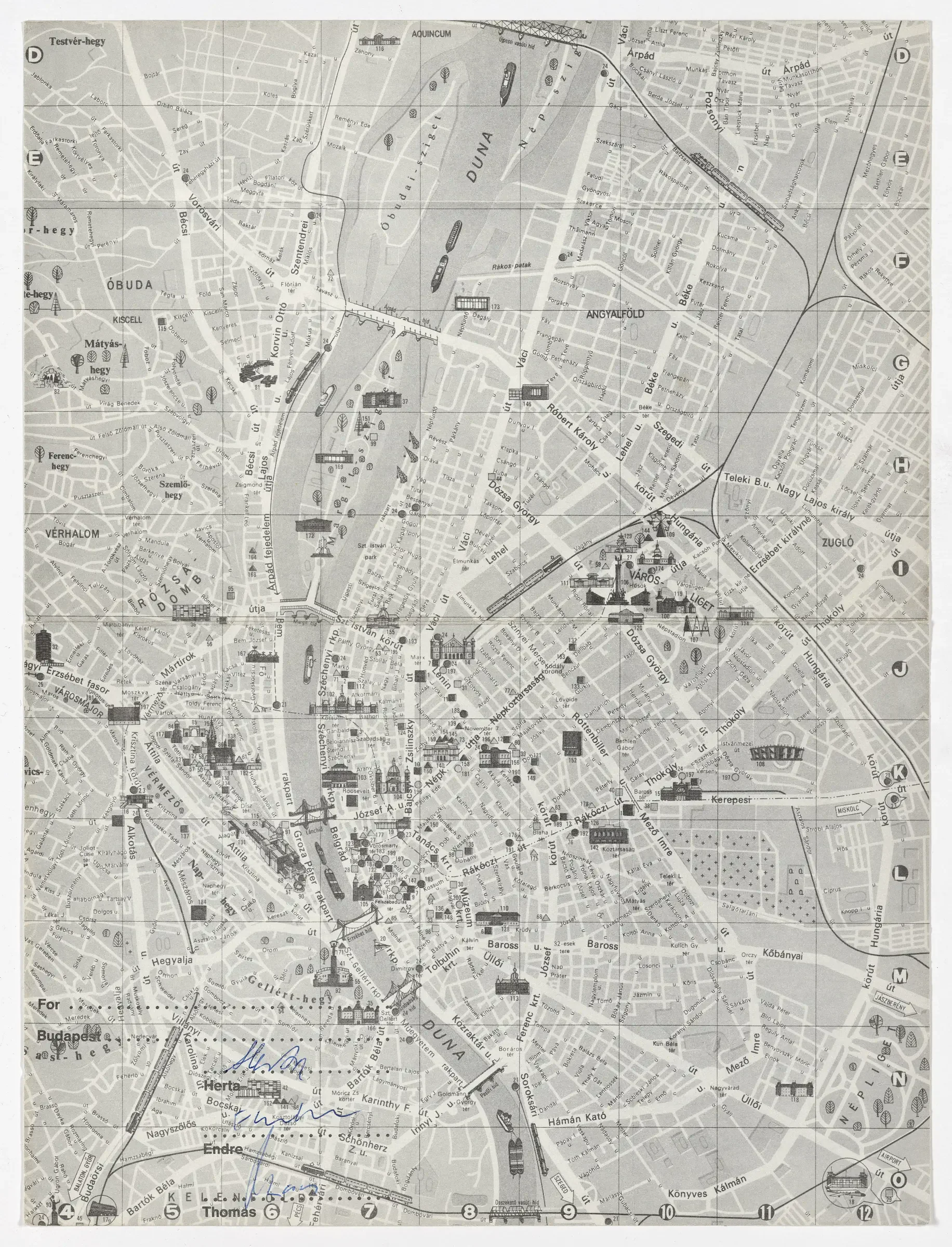
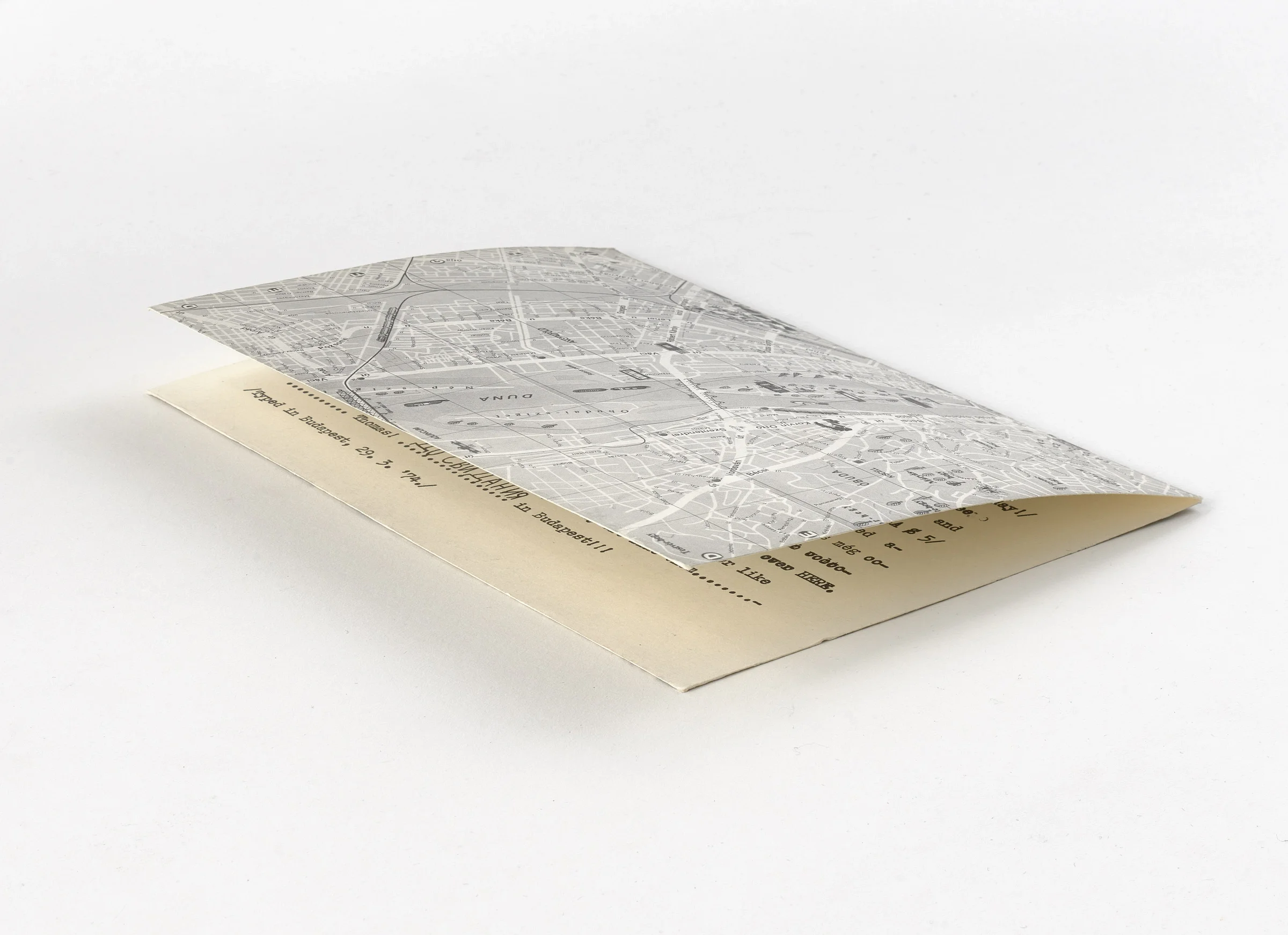
COLOURED DAYS
Hinwil (Switzerland): Howeg publisher.
Din A5, 4 pages, closed 240 × 159 mm, open 240 × 318 mm. Cardboard paper folded in the middle.
Black-and-white silkscreen. No indication of the number of copies.
The first time Tót mentions this edition is on an undated postcard, most likely dating from March 1974. The front shows a black-and-white photograph of the Chain Bridge (Széchenyi Lánchíd) and its surroundings, on which Tót has drawn a line in blue pen across the bridge that then branches off to the right.
For COLOURED DAYS, an edition of 1,000 signed copies is stated. Thomas Howeg, however, informed us that only a small number of prototypes were actually printed. We hold three copies, as well as the original typescript that the artist sent to Thomas Howeg.
COLOURED DAYS
Hinwil (Schweiz): Edition Howeg.
Din A5, 4 Seiten, geschlossen 240 × 159 mm, geöffnet 240 × 318 mm. In der Mitte gefaltetes Kartonpapier.
2-Farben-Siebdruck schwarzweiß. Keine Angaben zur Anzahl der Exemplare.
Das erste Mal erwähnt Tót diese Ausgabe auf einer undatierten Postkarte, die jedoch sehr wahrscheinlich aus dem März 1974 stammt. Auf der Vorderseite ist ein Schwarzweißfoto der Kettenbrücke (Széchenyi Lánchíd) und ihrer Umgebung zu sehen, auf dem Tót mit einem blauen Stift eine Linie über die Brücke gezogen hat, die anschließend nach rechts abzweigt.
Für COLOURED DAYS wird eine Auflage von 1.000 signierten Exemplaren angegeben. Thomas Howeg teilte uns jedoch mit, dass lediglich einige Prototypen gedruckt wurden. Wir besitzen drei Exemplare sowie das Original-Typoskript, das der Künstler an Thomas Howeg geschickt hat.
one dozen rain pOstCarDs (1971–73)
12 postcards (105 x 148 mm) and a loose note on light blue thin paper (94 x 147 mm) in an envelope (114 x 162 mm); single-color (violet) offset printing.
The number of copies produced is unknown. According to Endre Tót (visit on September 25, 2023), the edition likely exceeded 100 copies.
The title is stamped in green ink on the back of the envelope.
The loose sheet provides information about the publisher, the edition title, and a numbered list of the postcards along with their respective titles:
- your rain - my rain
- old rain - new rain
- left rain - right rain
- normal rain - tót rain
- inside-rain
- corner-rain
- isolated-rain
- rival-rain
- horizon-rain
- zero-rain
- sex-rain by Endre Tót
- I am glad when I can type rains
There are copies where the color of the envelope varies, some featuring multiple stamp imprints by Tót, some signed, others unsigned.
In our copy, the postcards your rain - my rain, normal rain, and horizon rain are signed on the back by Endre Tót.
one dozen rain pOstCarDs (1971–73)
12 Postkarten (105 × 148 mm) sowie ein loses Blatt aus hellblauem, dünnem Papier (94 × 147 mm) in einem Umschlag (114 × 162 mm); einfarbiger (violetter) Offsetdruck.
Die Auflagenhöhe ist unbekannt. Nach Angaben von Endre Tót (Besuch am 25. September 2023) dürfte die Auflage mehr als 100 Exemplare umfasst haben.
Der Titel ist in grüner Tinte auf die Rückseite des Umschlags gestempelt.
Das lose Blatt enthält Angaben zum Verlag, zum Titel der Edition sowie eine nummerierte Liste der Postkarten mit ihren jeweiligen Titeln:
- your rain – my rain
- old rain – new rain
- left rain – right rain
- normal rain – tót rain
- inside-rain
- corner-rain
- isolated-rain
- rival-rain
- horizon-rain
- zero-rain
- sex-rain by Endre Tót
- I am glad when I can type rains
Es existieren Exemplare, bei denen die Farbe des Umschlags variiert; einige weisen mehrere Stempelabdrucke von Tót auf, einige sind signiert, andere nicht.
In unserem Exemplar sind die Postkarten your rain – my rain, normal rain und horizon rain auf der Rückseite von Endre Tót signiert.
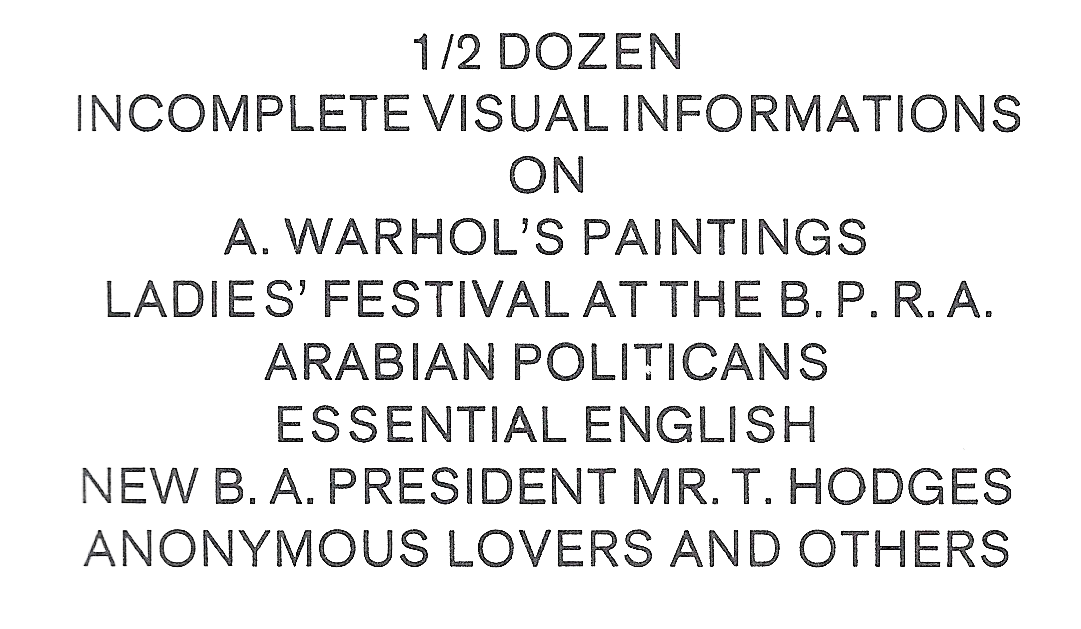
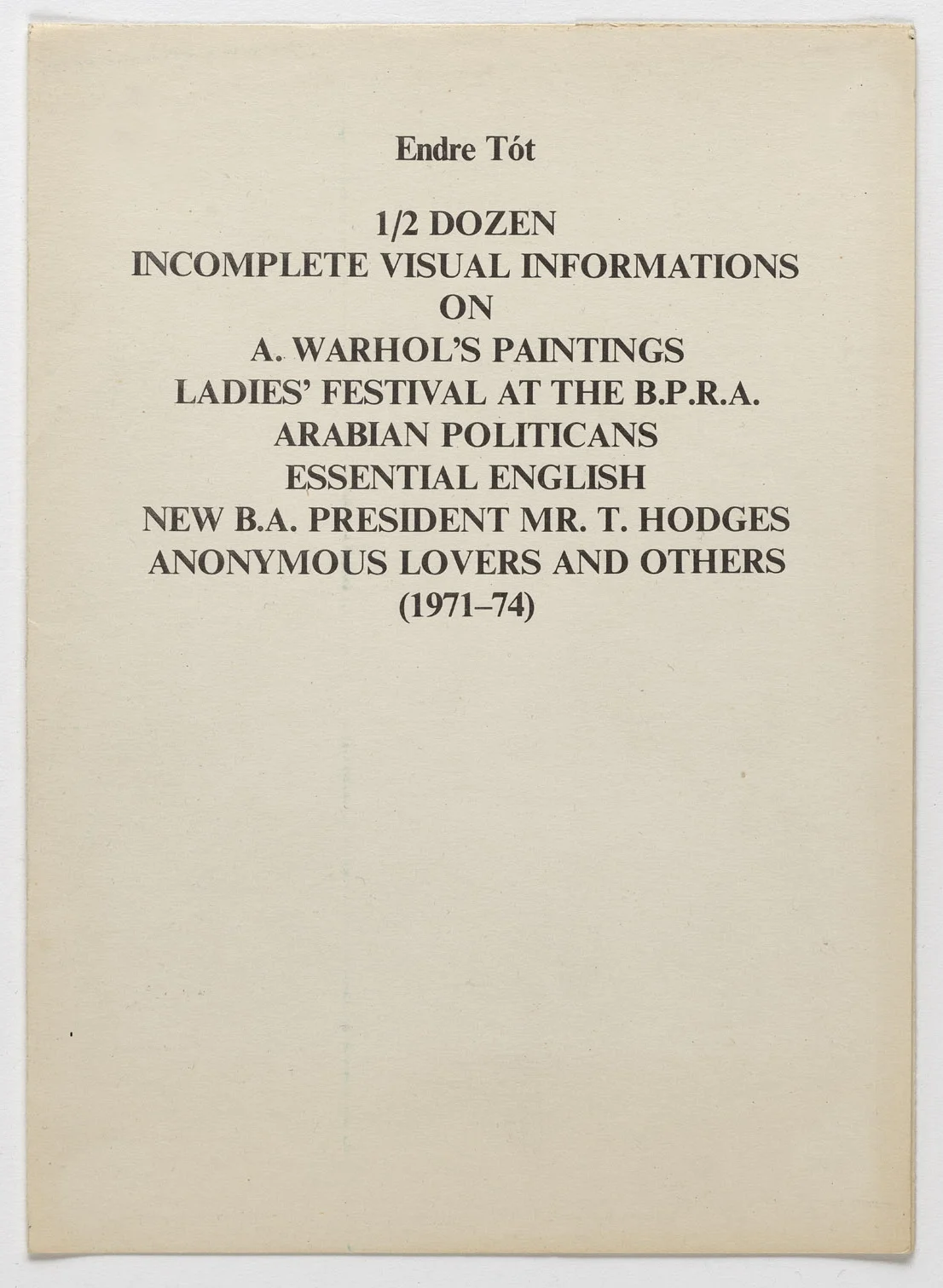
We have selected two images from this book. They are very similar: each is framed by a black-bordered rectangle accompanied by a caption. The content of these two captions caught our attention; indeed, when placed alongside the empty frame, they appear enigmatic. The writing style used, as well as the thematic content, creates a meaning that remains elusive.
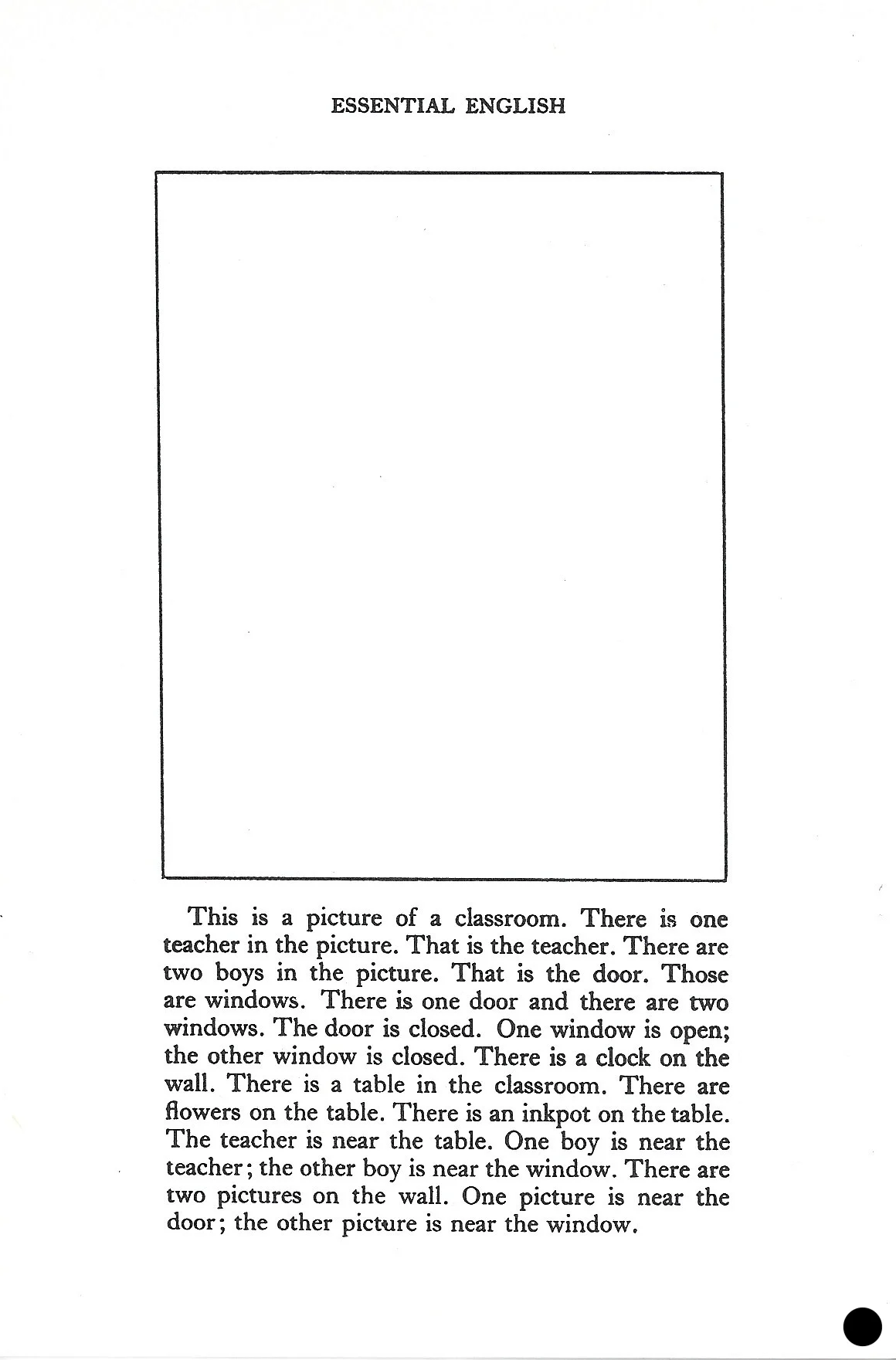
The first image, titled "ESSENTIAL ENGLISH", along with its caption, which we transcribe below:
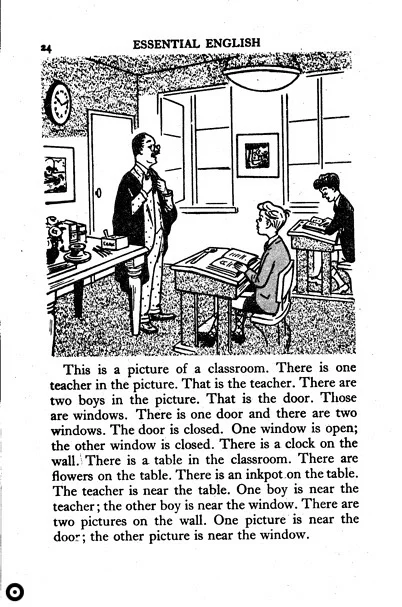
This is a picture of a classroom. There is one teacher in the picture. That is the teacher. There are two boys in the picture. That is the door. Those are windows. There is one door and there are two windows. The door is closed. One window is open; the other window is closed. There is a clock on the wall. There is a table in the classroom. There are flowers on the table. There is an inkpot on the table. The teacher is near the table. One boy is near the teacher; the other boy is near the window. There are two pictures on the wall. One picture is near the door; the other picture is near the window.
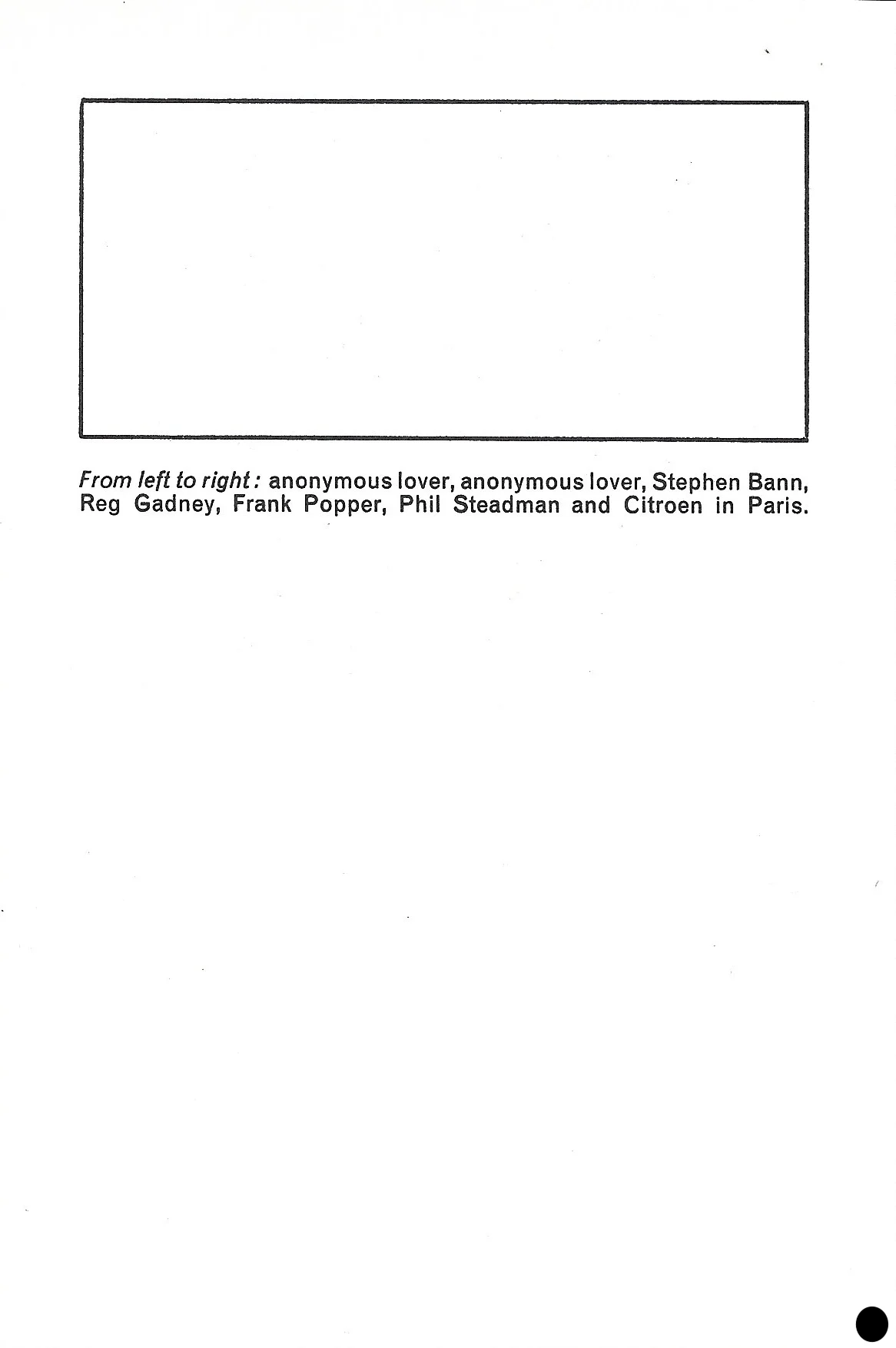
The second image contains the following caption:
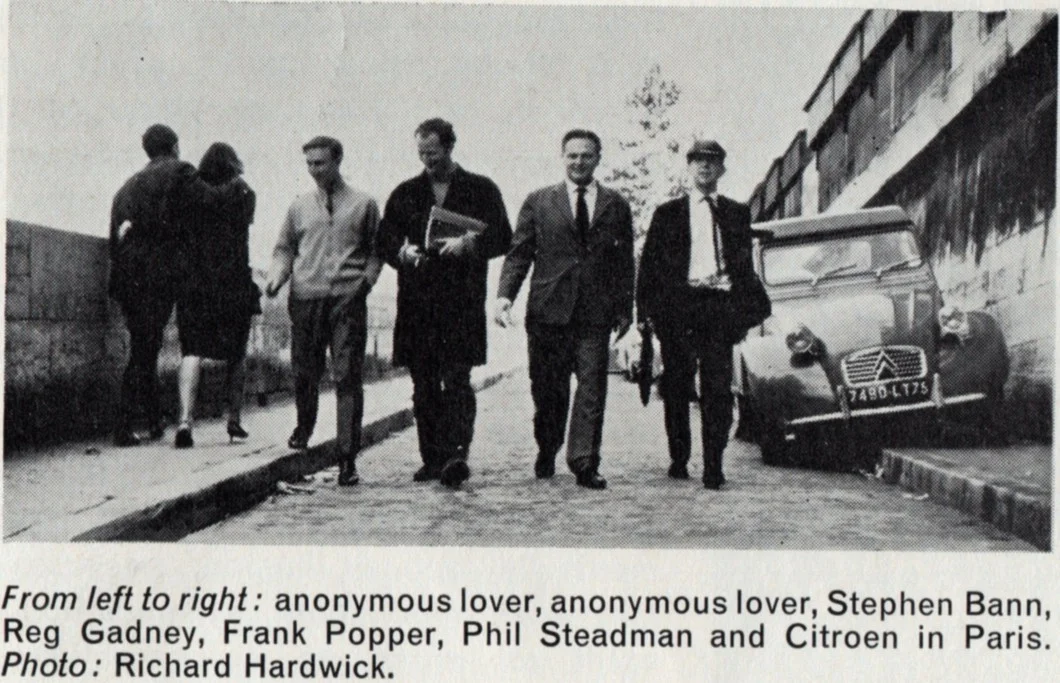
From left to right: anonymous lover, anonymous lover, Stephen Bann, Reg Gadney, Frank Popper, Phil Steadman and Citroen in Paris.
The first text is a descriptive passage composed of short, clear sentences, methodically structured through repetition of terms, reminiscent of the style of Samuel Beckett. The second text is a heterogeneous assemblage of words that do not form a complete sentence. It is structured like a rebus or a writing game based on free associations. It includes the phrase "anonymous lover" twice, followed by the names of three people, and then the brand name "Citroen". The overall effect is highly distinctive.
As we progressed in our research, we first discovered that Essential English is a textbook for learning English, with the full title: Essential English for Foreign Students. It was originally written by C. E. Eckersley in 1953. A revised and expanded edition was published in the 1960s. We found a copy online, and it contains one of the images (fig.1) that Endre Tót appropriated, removing the visual content from the frames.
When associated once again with its original visual reference, the meaning of the caption is reframed. In its altered state, the caption loses its rich associative power.
Regarding the second caption, we found the original image that Endre Tót erased in the publication (British Art Studies, Issue 12, published 31 May 2019, page 74, Figure 56.):