

PRESS RELEASE
ENDRE TÓTDRAWINGS AND WRITINGS OF JOY15 - 25.11.1979
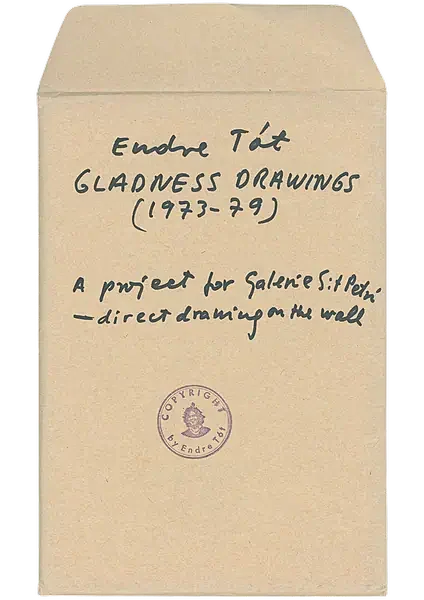
Endre Tót from Hungary visits Galerie S:t Petri in Lund between November 17 and 25, 1979. He makes use of the gallery’s special architecture, drawing lines and writing sentences directly on the walls and windows. The exhibition is called “Gladness Drawings and Writings”, and it truly reflects Endre Tót’s life-affirming philosophical attitude.
Almost ten years ago, Tót taught apprentices in printing in Budapest and got the idea to start working with sentences and what could be a more reasonable starting point than to feel and express gladness in such printed meaning. Since, for example, in Hungary one generally cannot print just anything without the censorship’s approval, this seemingly harmless experiment became quite controversial and risky for both himself and his students. The artwork read something like: “I am glad I could print this meaning.”
The joy of being able to express oneself has since come to shape Endre Tót’s artistic approach. Image and word follow each other in his work. The text is perhaps the most important — it is the one that clarifies the idea. The text need not only be written on paper; it manifests visually in various ways: on banners, on buildings, or — as in Galerie S:t Petri — directly on walls and windows.
In his small room in Budapest, Endre Tót began to express his “gladness” sentences in the simplest way. He wrote zero-texts, such as “I am glad if I can type zeros,” and sent his “gladness” letters, cards, and posters to friends all over the world. These various postal events later came to be shown at the Paris Biennial in 1971. That was the beginning of an art movement called Mail Art, in which experimental artists worldwide began to engage from then on.
Endre Tót’s “gladness” sentences also have a philosophical background. The circumstances under which he has lived have created a kind of pessimism, yet they have not been able to suppress his joy of life. The sentences are filled with irony and humor, yet at the same time carry an undertone of profound seriousness. His message is clear and distinct, but expressed in a subtly ironic way. The playfulness is evident: one may even laugh at his seemingly naïve expressions of joy, yet at the same time grasp their depth.
At present, Endre Tót holds a working grant in West Berlin, where he will remain for another six months. He is regarded as one of the most important experimental artists of the 1970s in Eastern Europe. This is his first personal visit to Sweden, although he had already exhibited at Galerie S:t Petri in 1975.
On Saturday at 6 p.m., Endre Tót will present his exhibition.
Galerie S:t Petri is open weekdays 3–8 p.m., Saturdays and Sundays 1–5 p.m.
