CLICK TO VIEW PRESS RELEASE
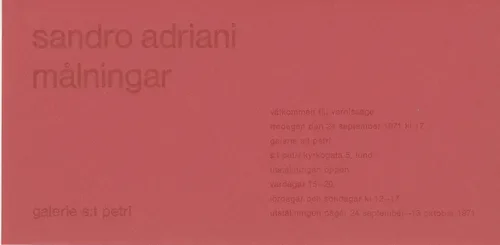
SANDRO ADRIANI
MÅLNINGAR
24.09 - 13.10.1971
SANDRO ADRIANIMÅLNINGAR24.09 - 13.10.1971
galerie s:t petri
s:t petri kyrkogata 5
lund
SANDRO ADRIANI - (1941 Rome Italy)
24 september - 13 october 1971
" In this society of mechanical things
in which I love living
I find the need for a naturalistic beauty .
Using medieval modes and techniques
I wish to reproduce on my canvas
exhibitions of colour and lines
for a public
with no time to stop by
for the exciting experience
of a moving sea
or
the sun and wind in the trees and flowers ."
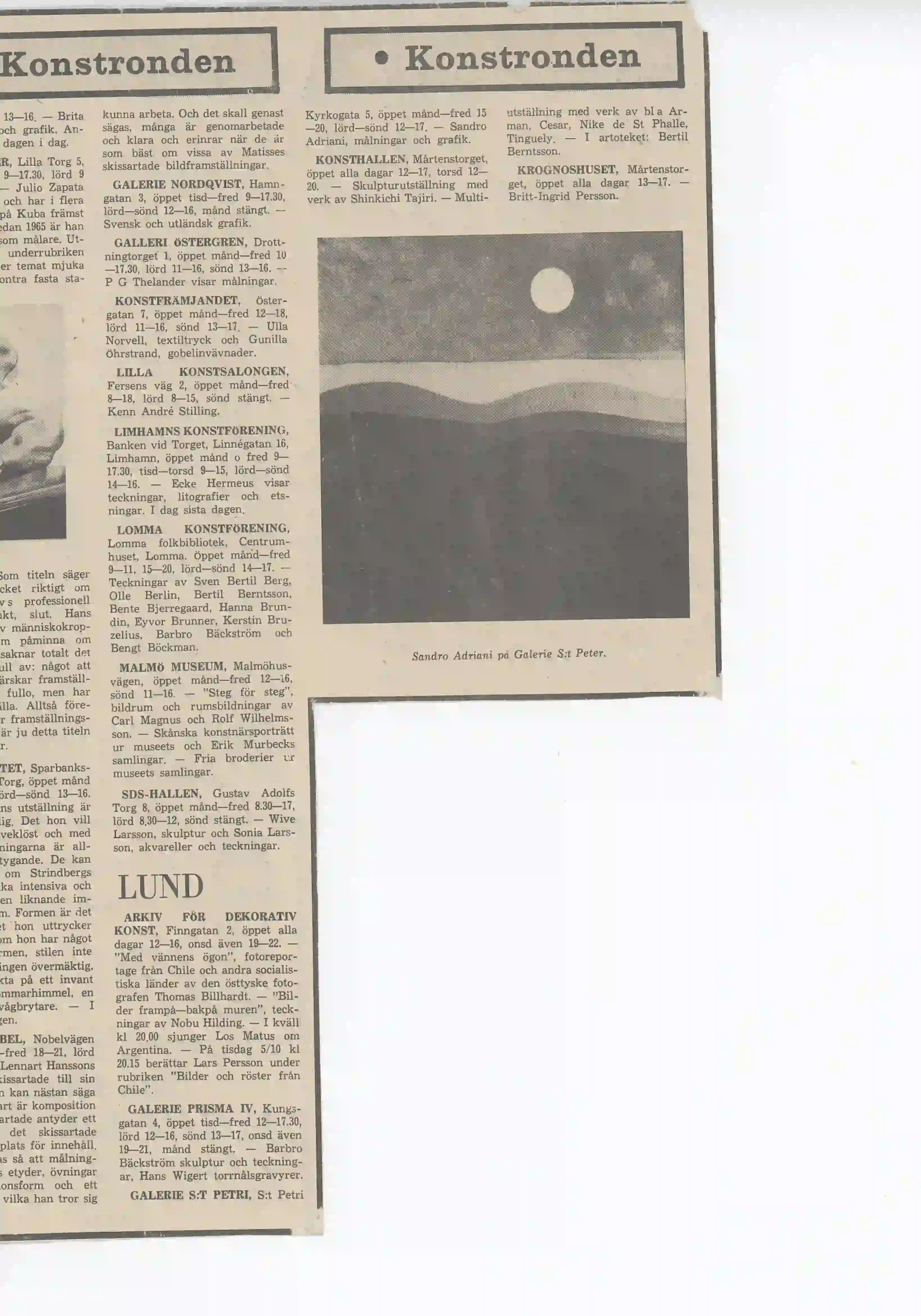
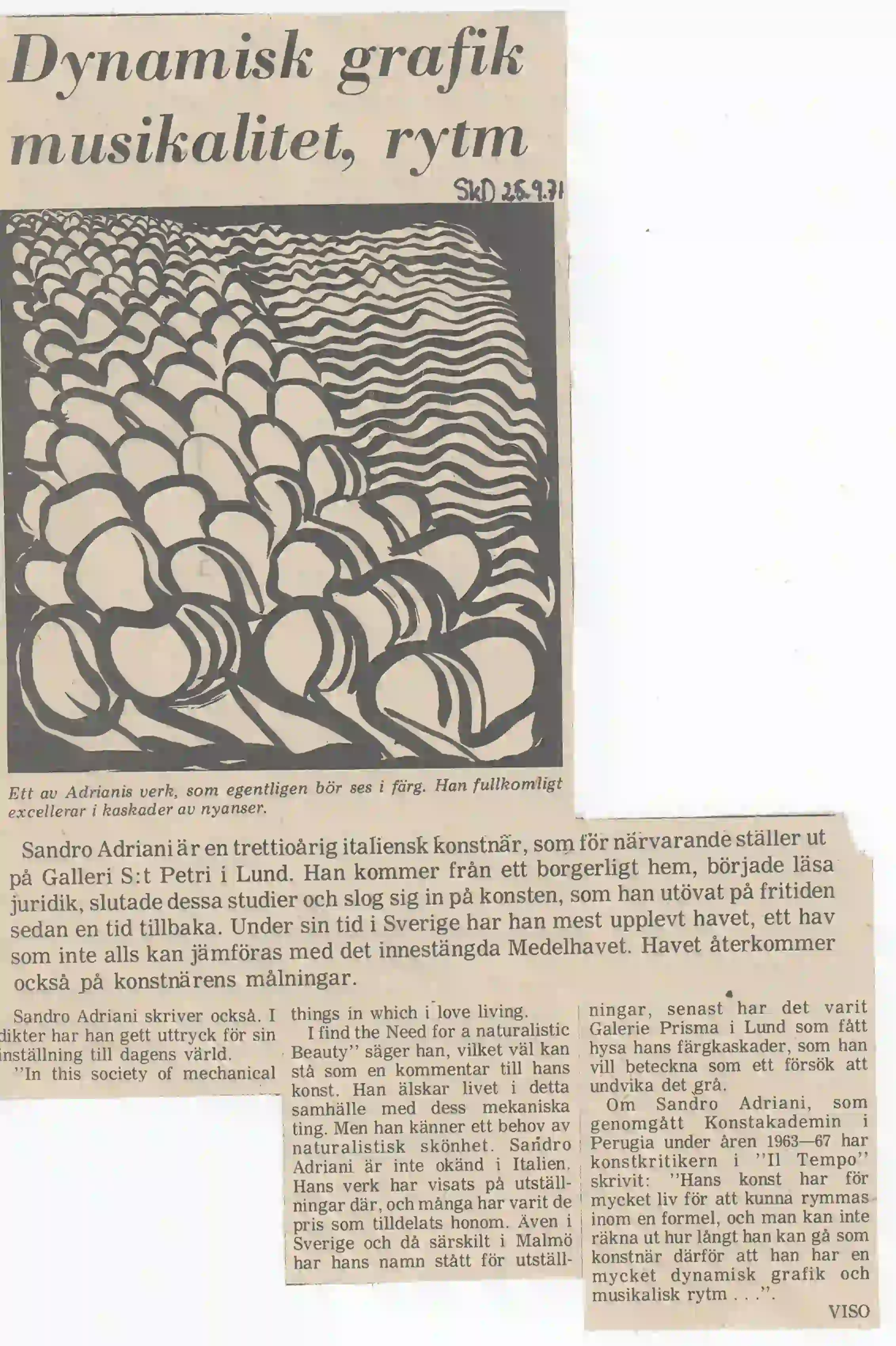
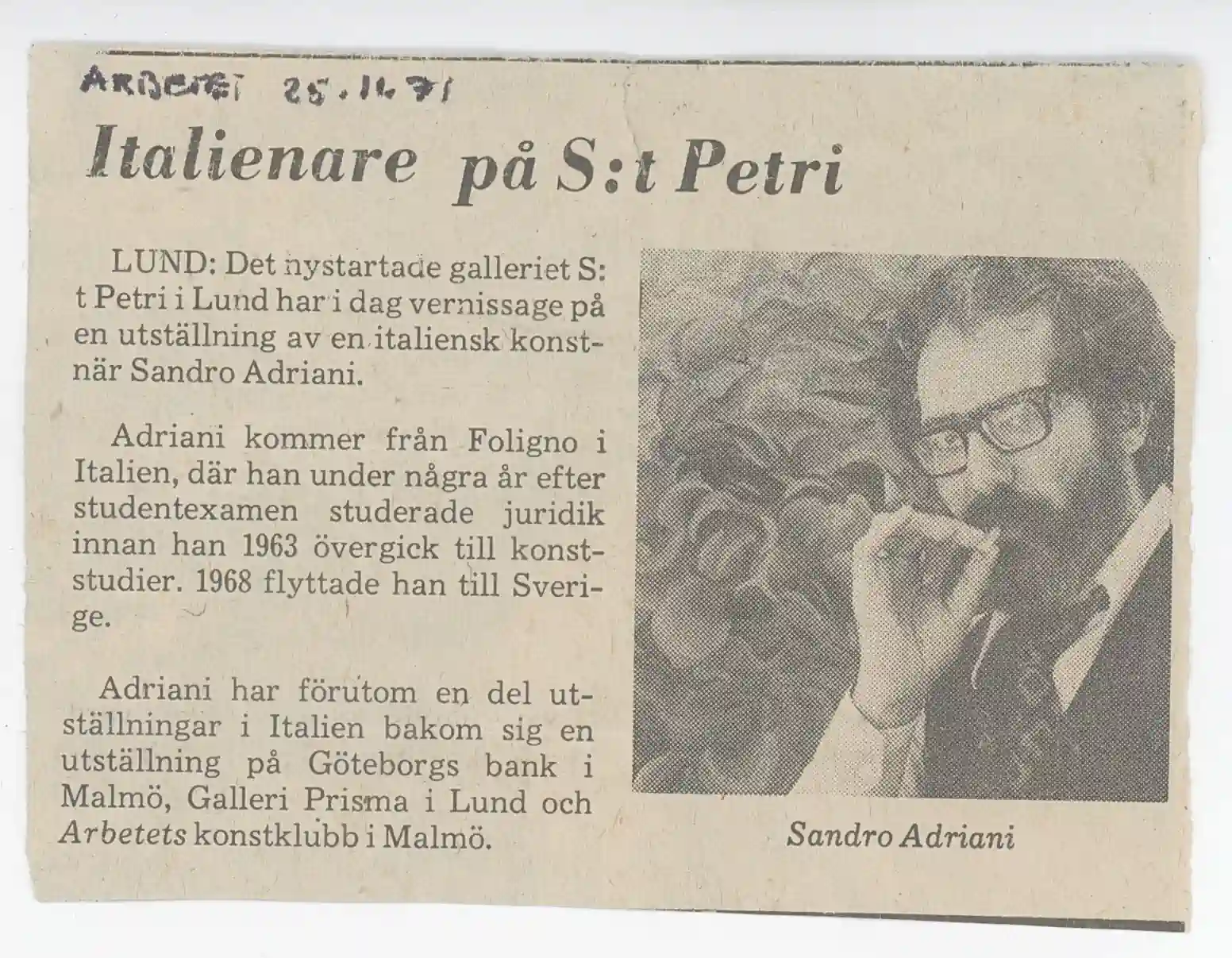
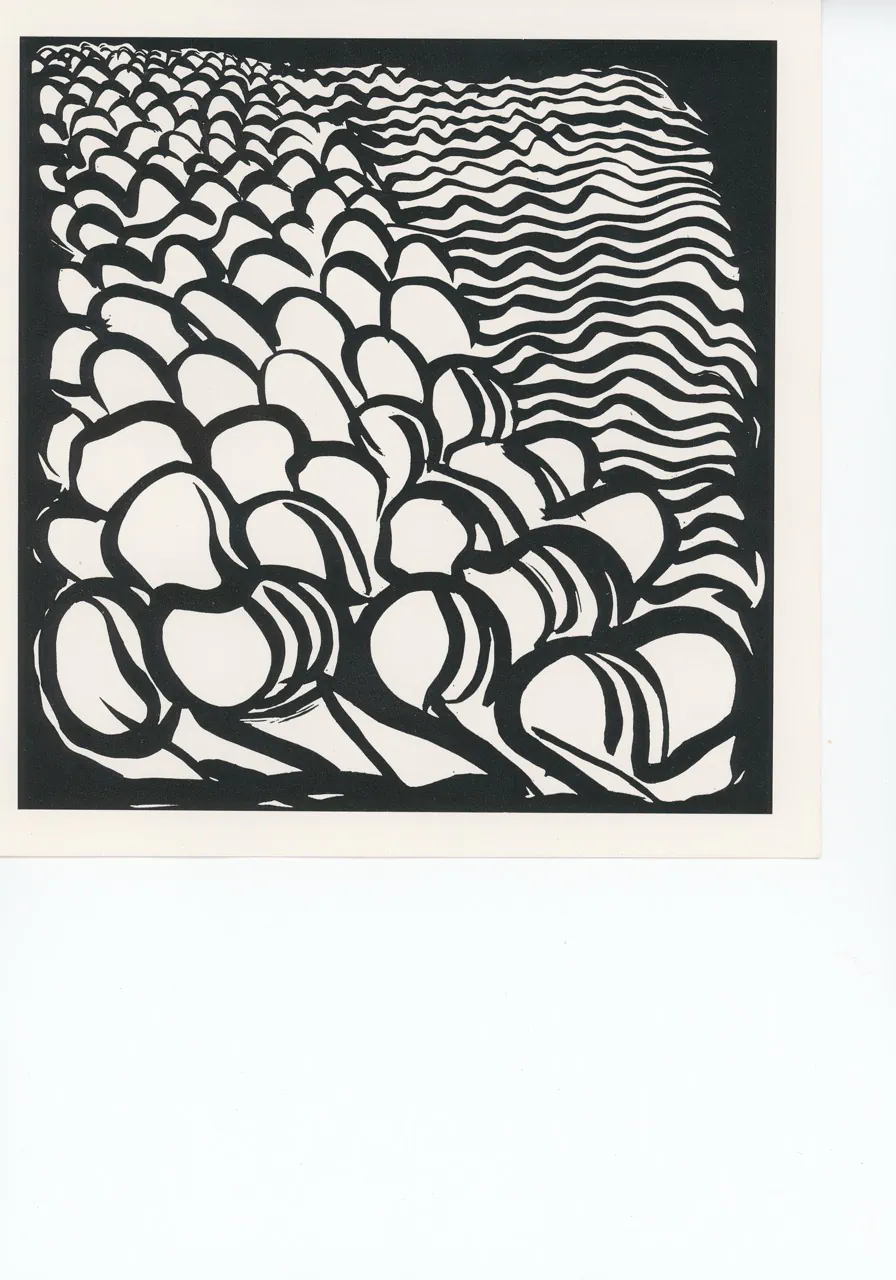
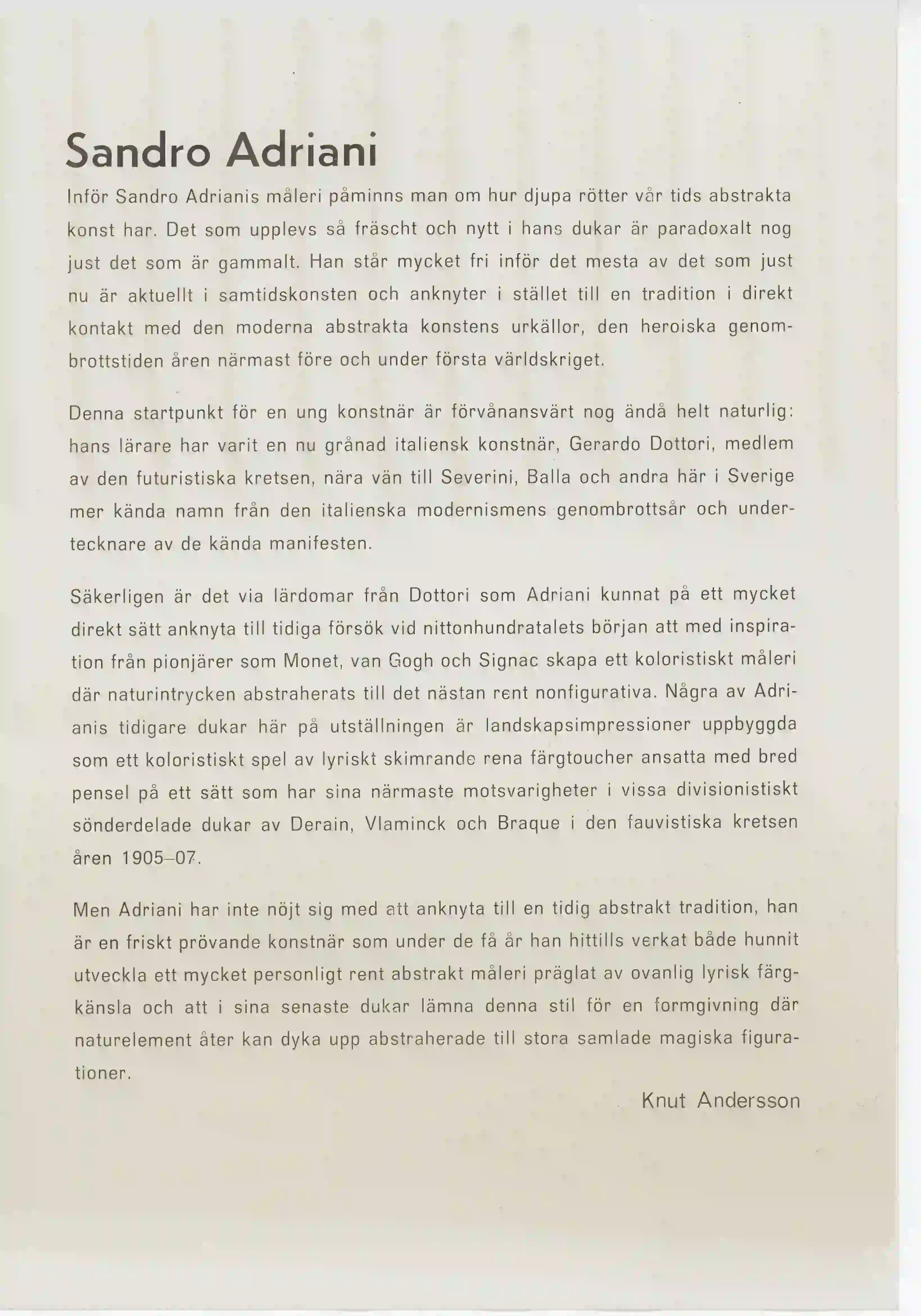
[JEANSELLEM VIEWER] — 24.09 - 13.10.1971 SANDRO ADRIANI — Categories: press, visual, docs — Keywords: Galerie S:t Petri, Jean Sellem, archive — Category: press — — — Category: press — SANDRO ADRIANI, exhibiting at Galerie S:t Petri, likes to paint a schematic landscape with a similarly schematic sky above it. The waves have frozen in their motion and resemble corrugated metal sheets. The coloration is also simple: unmixed blue, yellow, green, and red. The effect can be strong enough for the retina to react. — — — Category: press — GALLERY S:T PETRI, S:t Petri Kyrkogata 5, open Monday–Friday 3 PM–8 PM, Saturday–Sunday 12 PM–5 PM. Adriani’s paintings and drawings also belong to a geometric and abstract idiom. Decorative motifs with precise forms, in strong colors, built from pure, vivid color fields — LAST DAY ON WEDNESDAY. — — — Category: press — GALLERY S:T PETRI, S:t Petri Kyrkogata 5, open Monday–Friday 3 PM–8 PM, Saturday–Sunday 12 PM–5 PM. — Sandro Adriani, paintings and graphic works. — — — Category: press — Dynamic Graphics – Musicality, RhythmOne of Adriani’s works, which really ought to be seen in color. He excels completely in cascades of nuances.Sandro Adriani is a thirty-year-old Italian artist, currently exhibiting at Galleri S:t Petri in Lund. He comes from a middle-class family, began studying law, then abandoned those studies to pursue art, which he had been practicing in his spare time for some years. During his stay in Sweden, he has experienced the sea more than anything else — a sea that cannot be compared to the enclosed Mediterranean. The sea also reappears in the artist’s paintings.Sandro Adriani also writes. In his poems, he expresses his attitude toward today’s world. “In this society of mechanical things in which I love living, I find the Need for a naturalistic Beauty,” he says — a line that may well serve as a commentary on his art. He loves life in this society with its mechanical things. Yet he feels a need for naturalistic beauty.Sandro Adriani is not unknown in Italy. His works have been shown in exhibitions there, and he has received many prizes. In Sweden too — especially in Malmö — his name has been associated with exhibitions. Most recently, Galerie Prisma in Lund hosted his cascades of color, which he describes as an attempt to avoid the gray.About Sandro Adriani, who studied at the Art Academy in Perugia between 1963 and 1967, an art critic for Tempo wrote: “His art has too much life to be confined within a formal structure, and it is impossible to predict how far he may go as an artist, for his work is marked by a very dynamic, graphic and musical rhythm…” — — — Category: press — Italian Artist at S:t PetriLUND: The newly founded S:t Petri Gallery in Lund is holding the opening today for an exhibition by the Italian artist Sandro Adriani.Adriani comes from Foligno in Italy, where he studied law for several years after graduating, before switching to art studies in 1963. He moved to Sweden in 1968.In addition to several exhibitions in Italy, Adriani has shown his work at Göteborgs Bank in Malmö, Galleri Prisma in Lund, and the Arbetet art club in Malmö. — — — Category: visual — — — Category: docs — Sandro AdrianiIn the presence of Sandro Adriani’s painting, one is reminded of how deep the roots of modern abstract art truly are. What feels fresh and new in his canvases is, paradoxically, precisely what is old. He remains largely untouched by what currently dominates contemporary art, instead linking himself to a tradition directly connected to the origins of modern abstract art — the heroic breakthrough years just before and during the First World War.This starting point for a young artist is surprising, yet entirely natural: his teacher was the now grey-haired Italian artist Gerardo Dottori, a member of the Futurist circle and close friend of Severini, Balla, and other figures well known in Sweden for their role in the emergence of Italian modernism and their signatures on the famous manifestos.It is surely through Dottori’s teachings that Adriani has been able to reconnect, in such a direct way, with the early 20th-century efforts — inspired by pioneers such as Monet, van Gogh, and Signac — to create a colourist painting in which impressions of nature were abstracted to the point of near non-figuration. Some of Adriani’s earlier canvases in this exhibition are landscape impressions built as colourist compositions of lyrically shimmering pure colour touches, applied with a broad brush, with close affinities to certain divisionist, fragmented works by Derain, Vlaminck, and Braque from the Fauvist years 1905–07.But Adriani has not been content merely to reconnect with an early abstract tradition: he is a boldly exploratory artist who, in the few years he has been active, has developed a highly personal abstract style, marked by an unusually lyrical sense of colour. In his most recent canvases, he moves beyond this manner toward a visual language in which elements of nature reappear — abstracted into large, unified magical figures.Knut Andersson