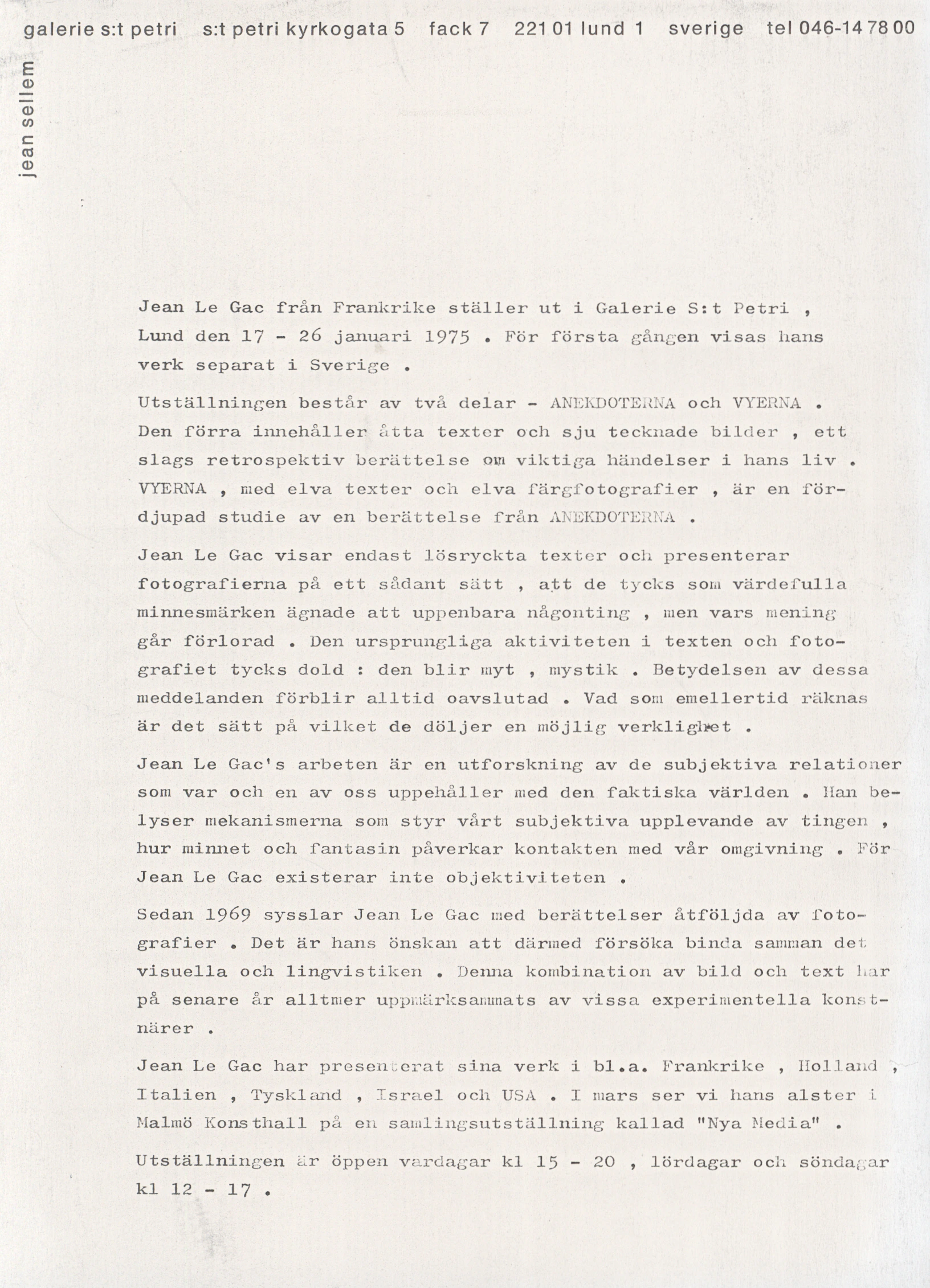
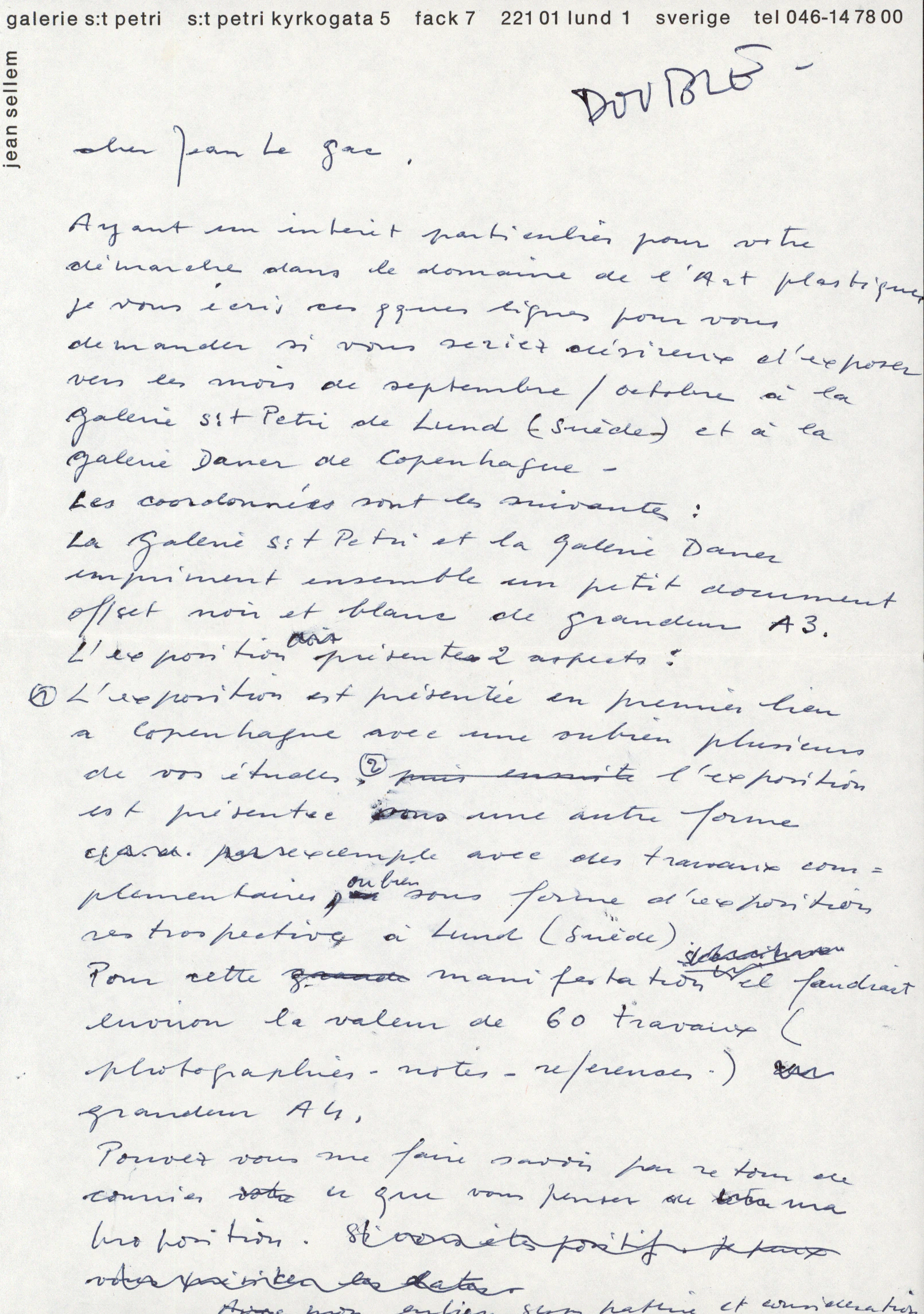
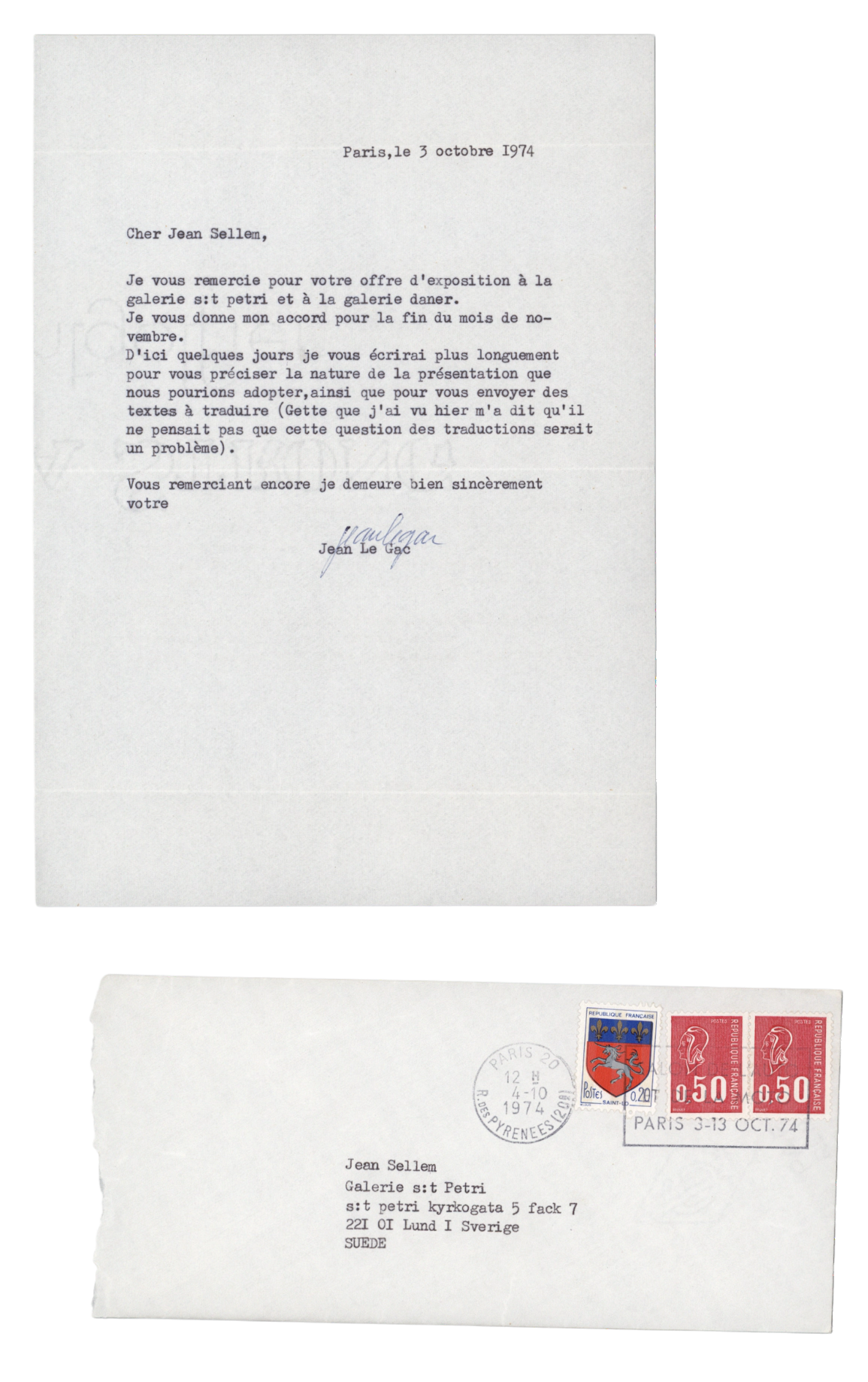
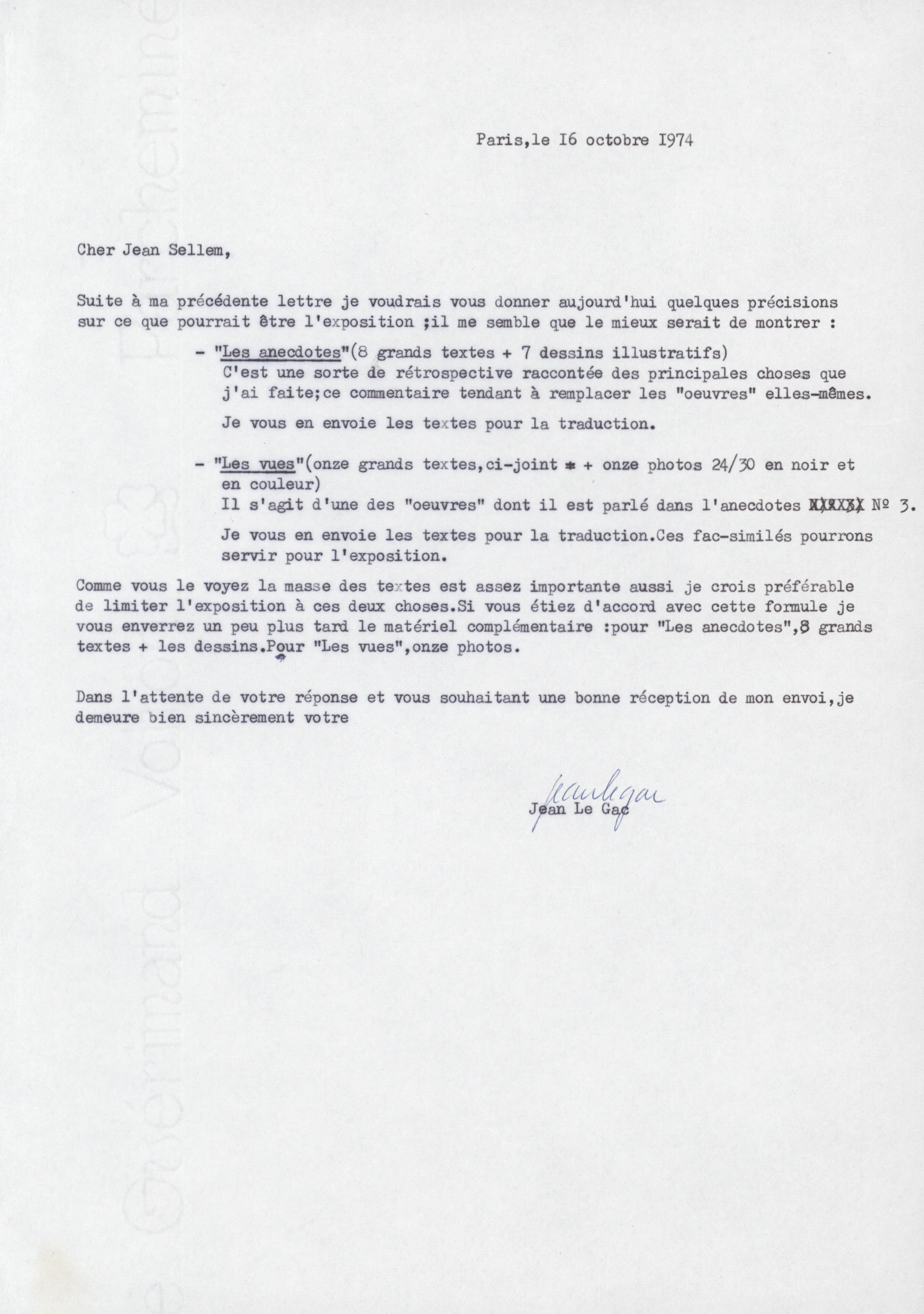
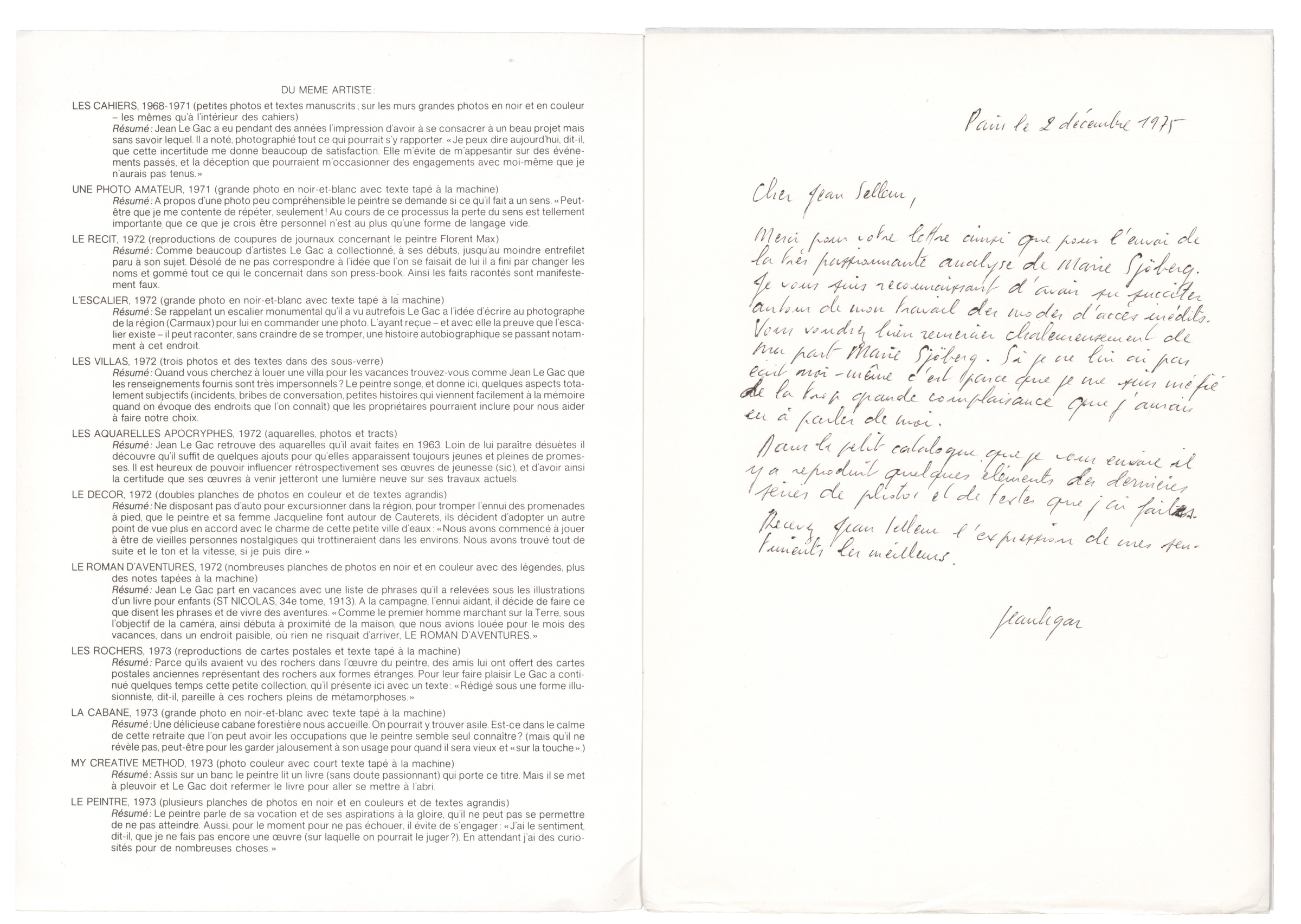
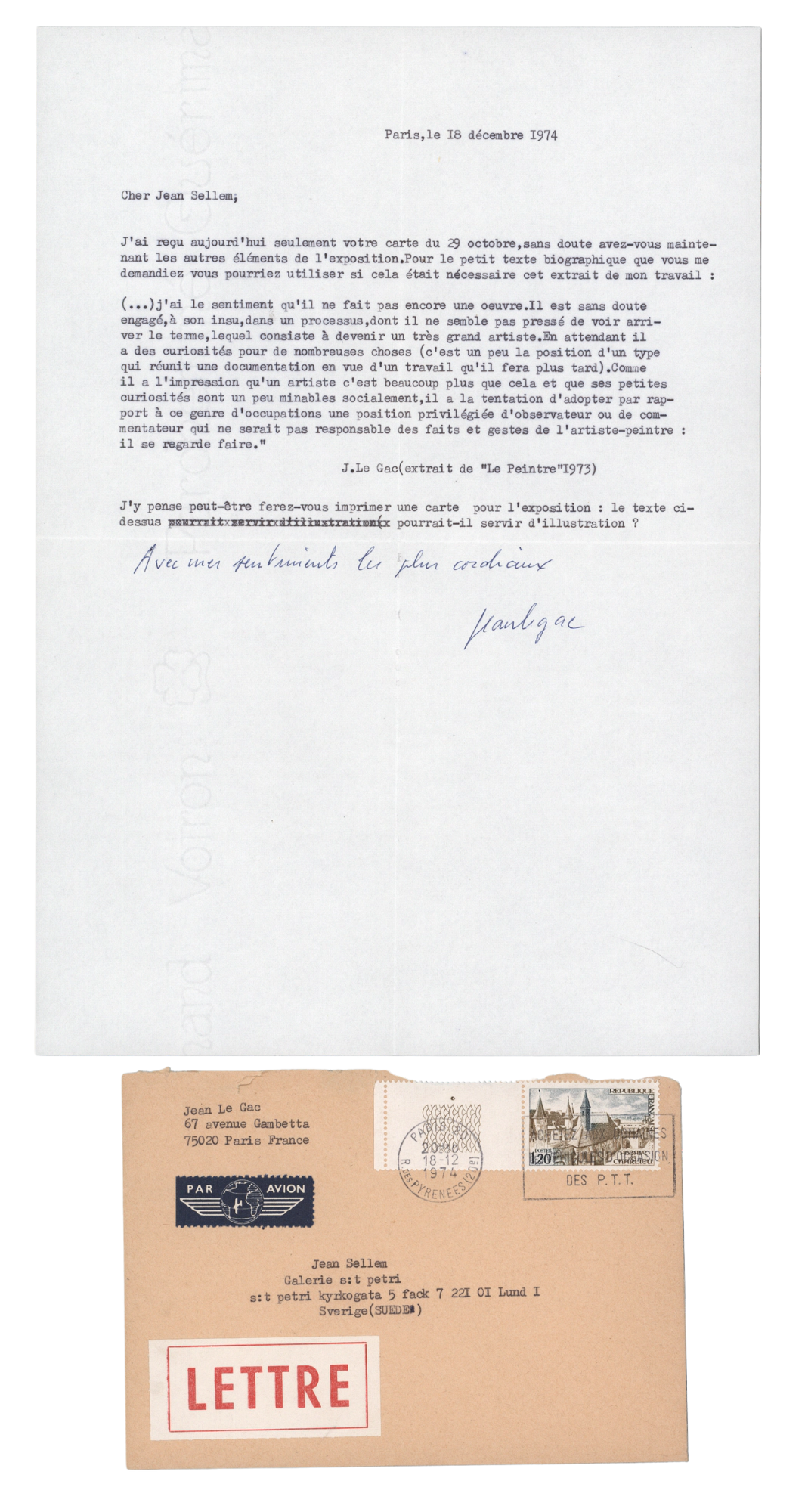
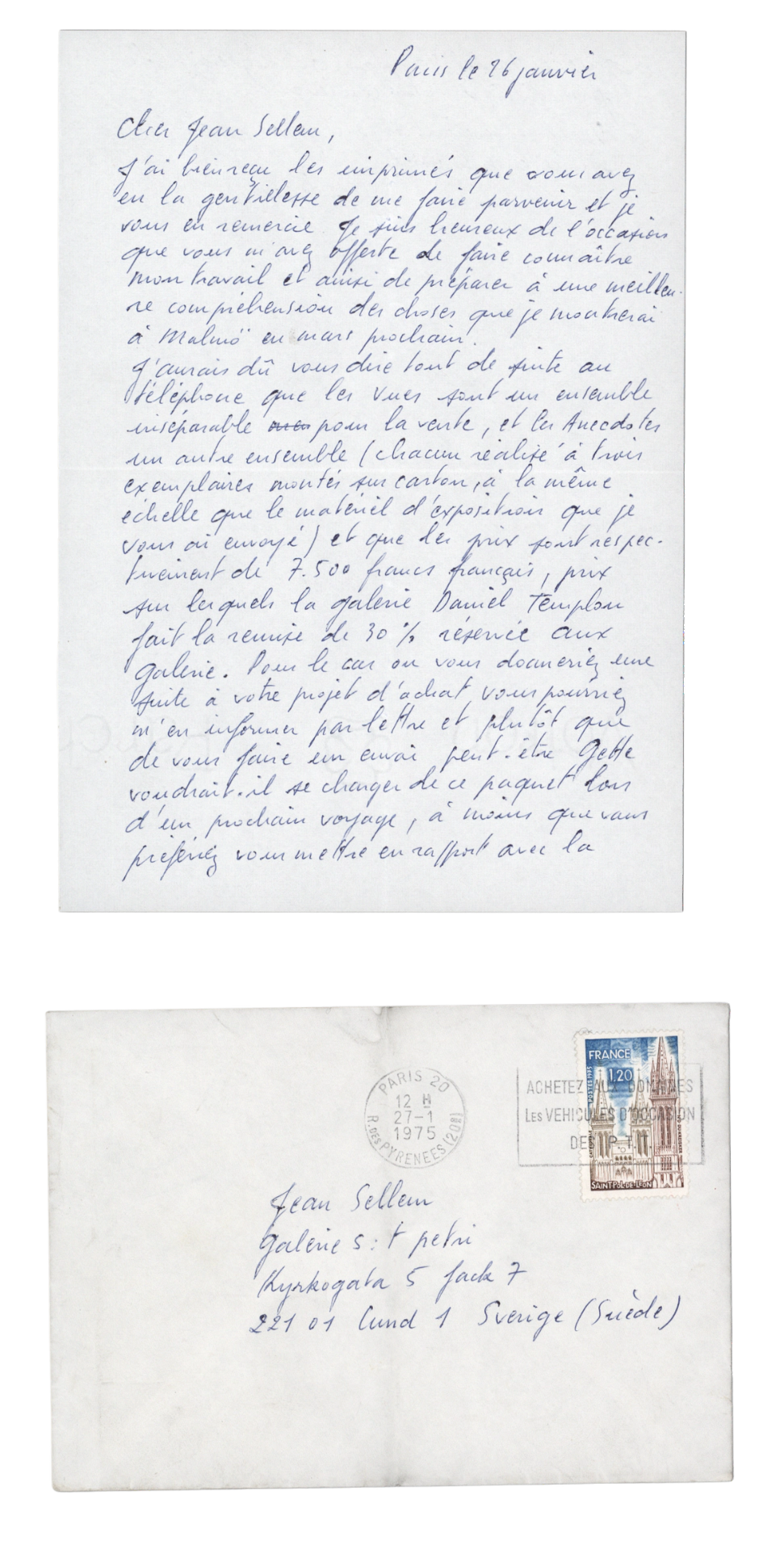
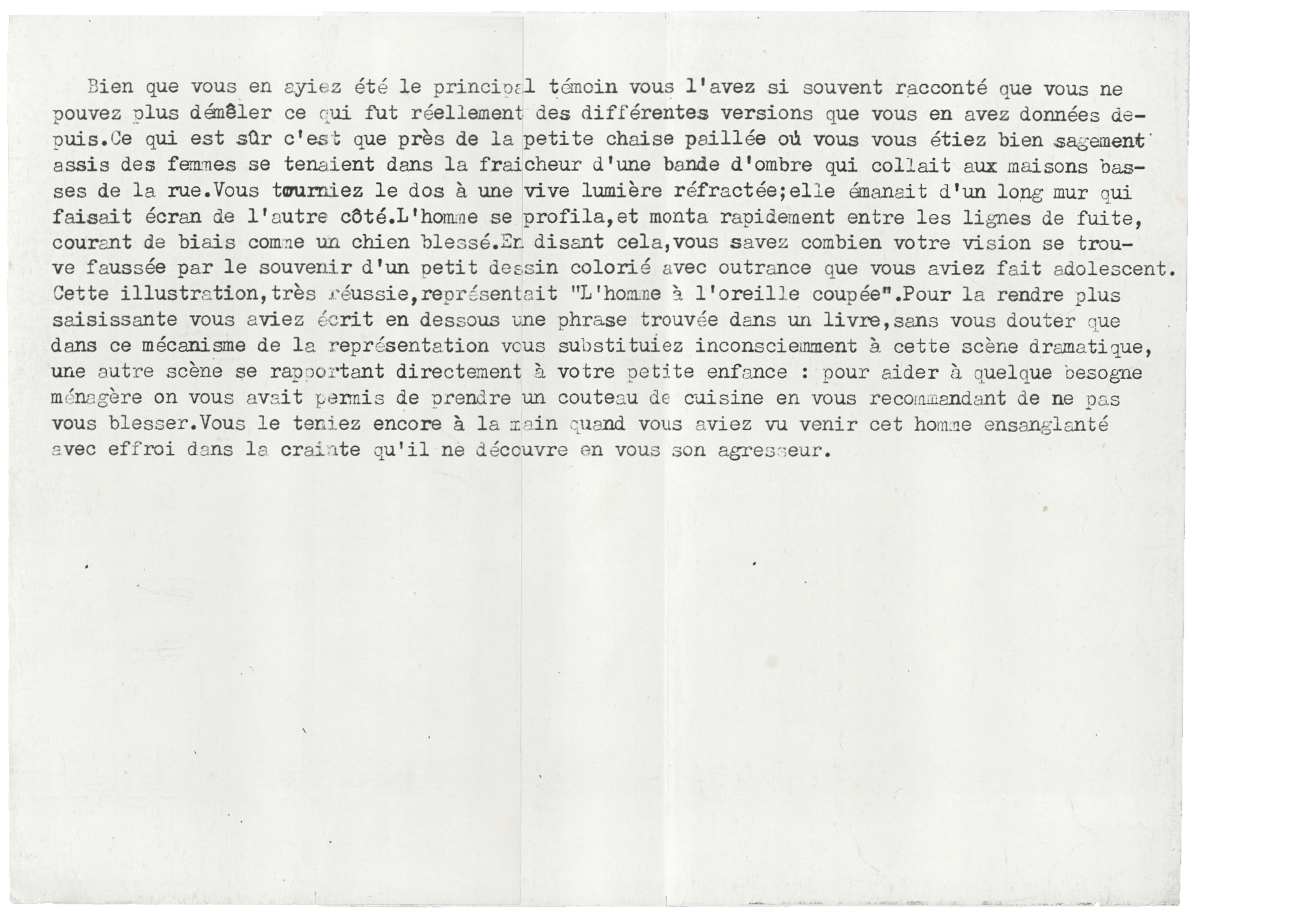
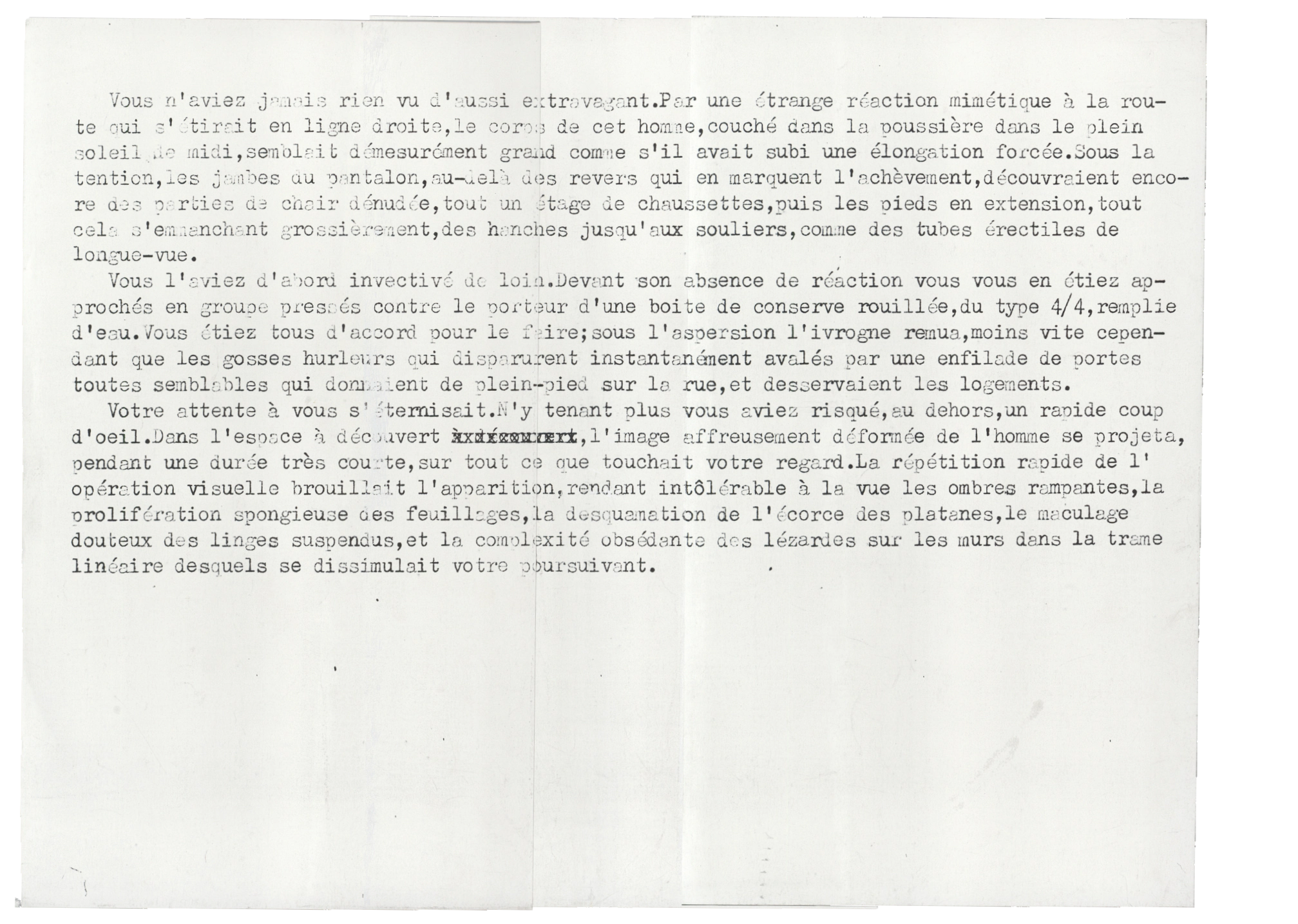
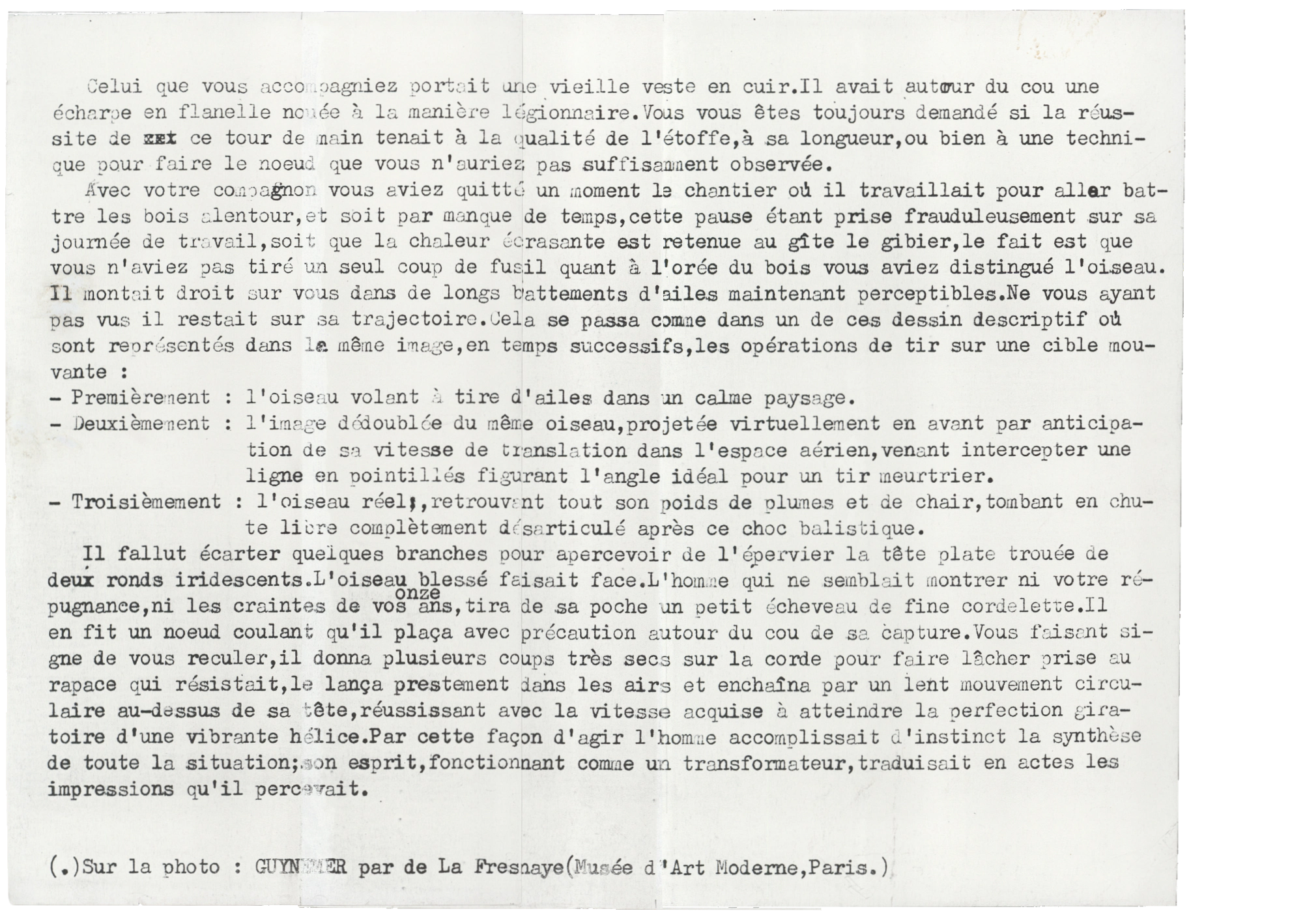
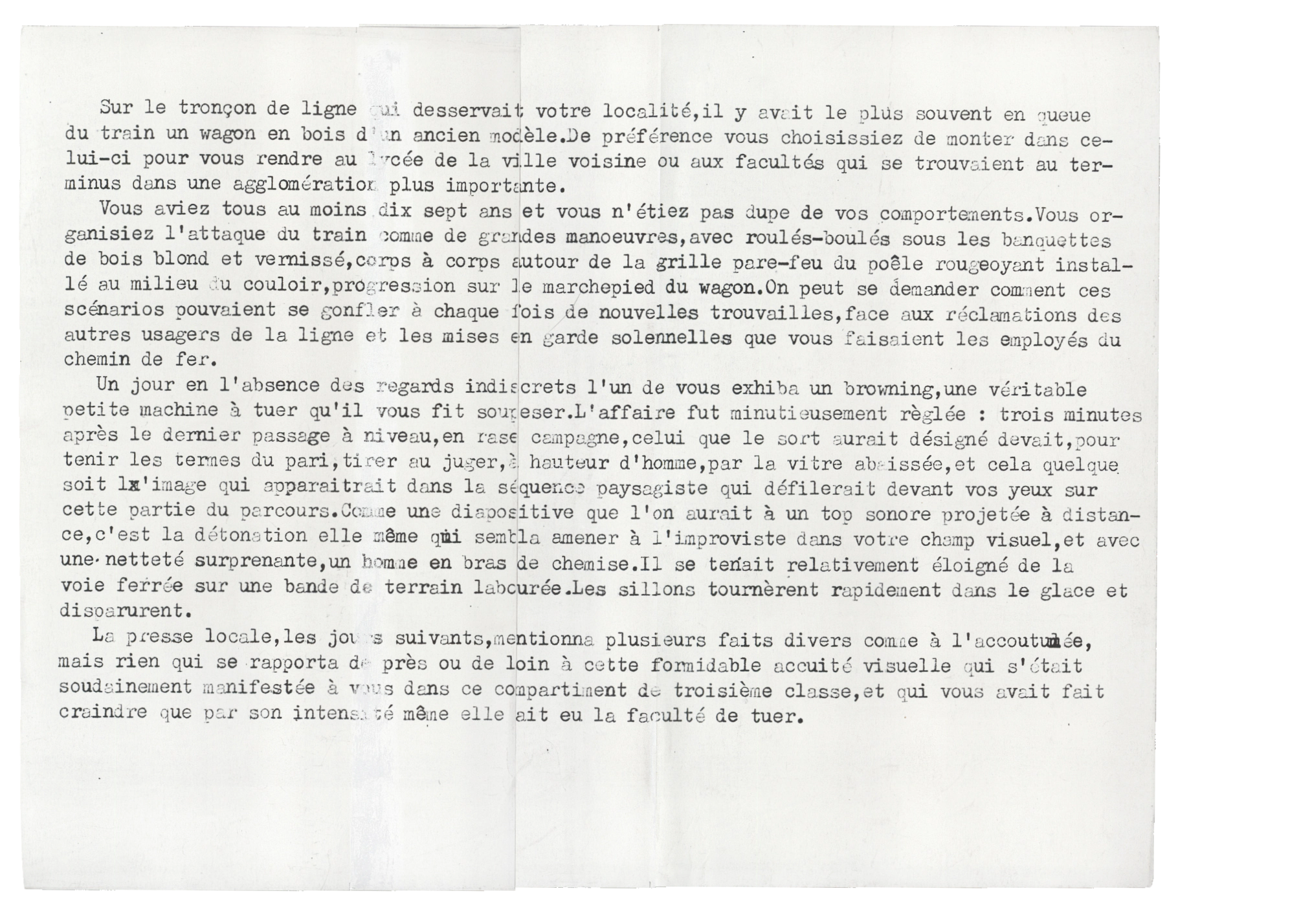
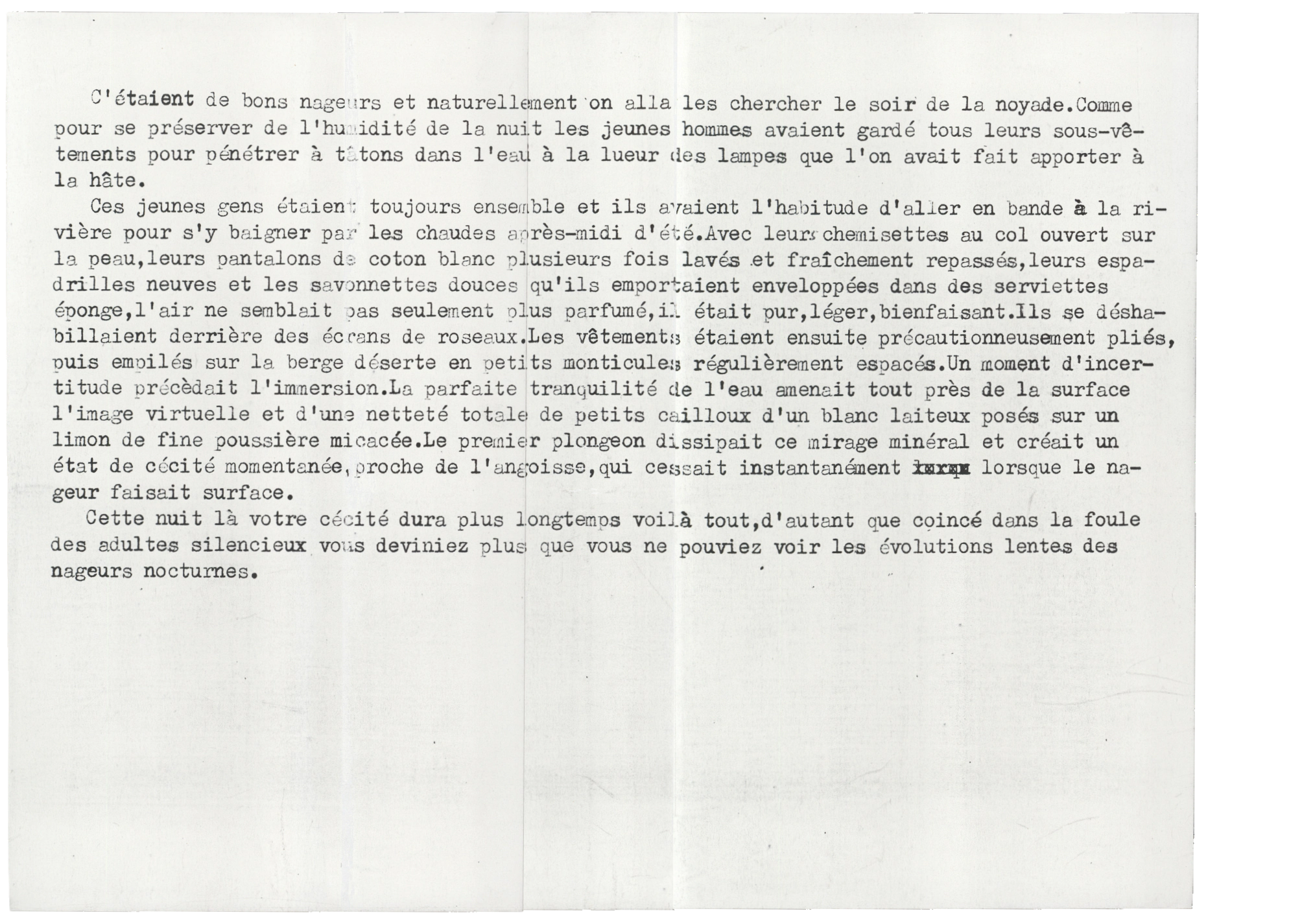
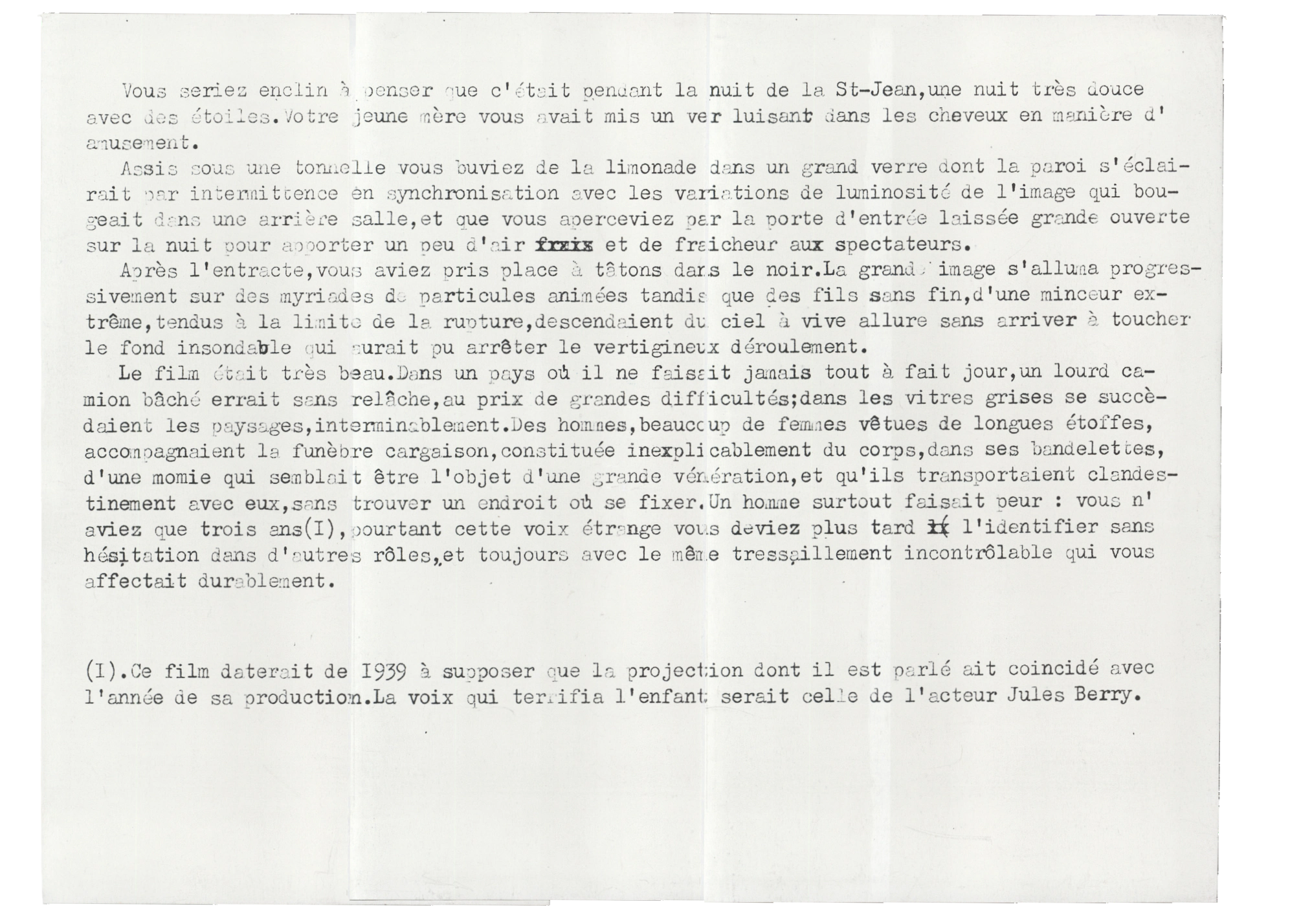
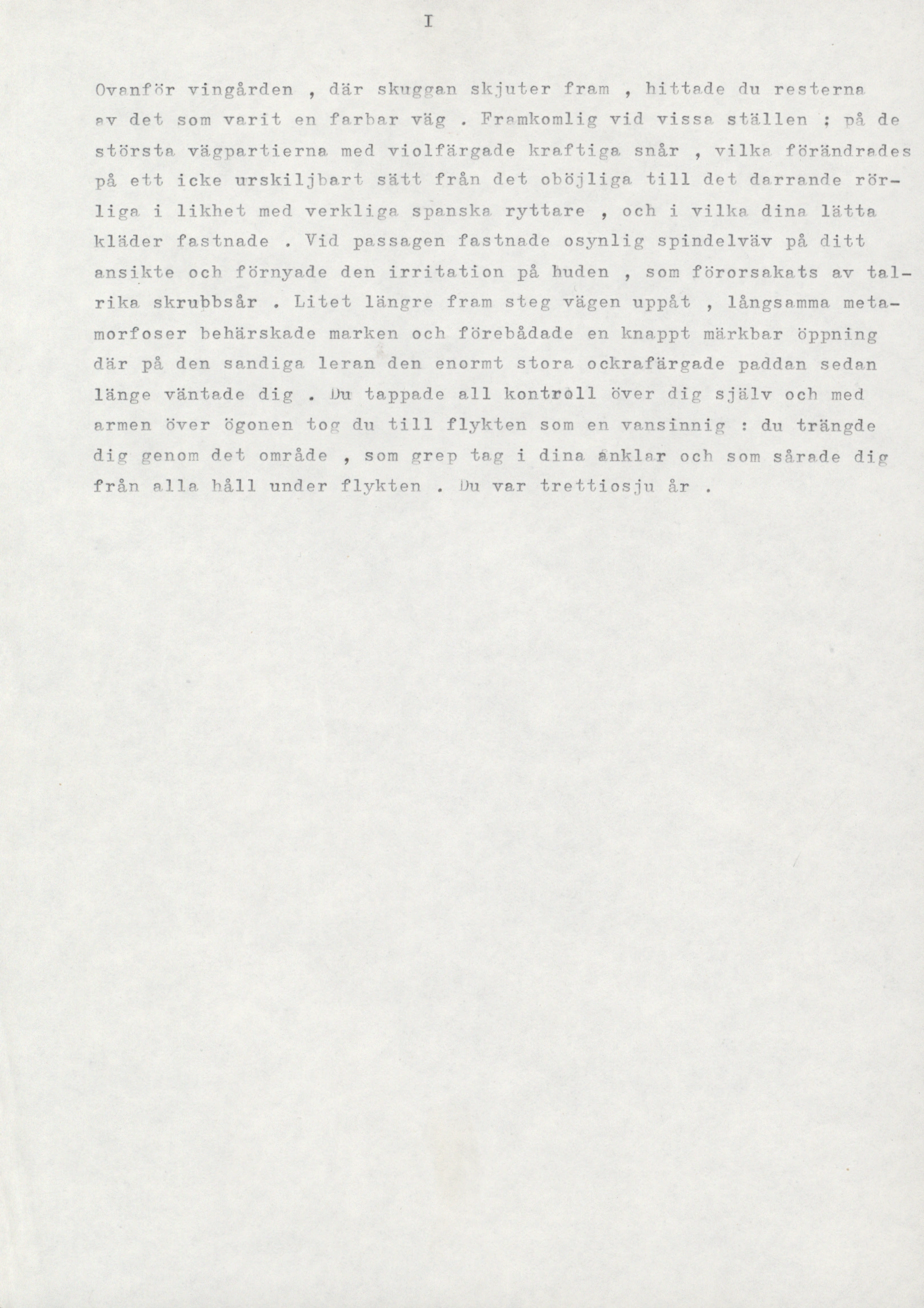
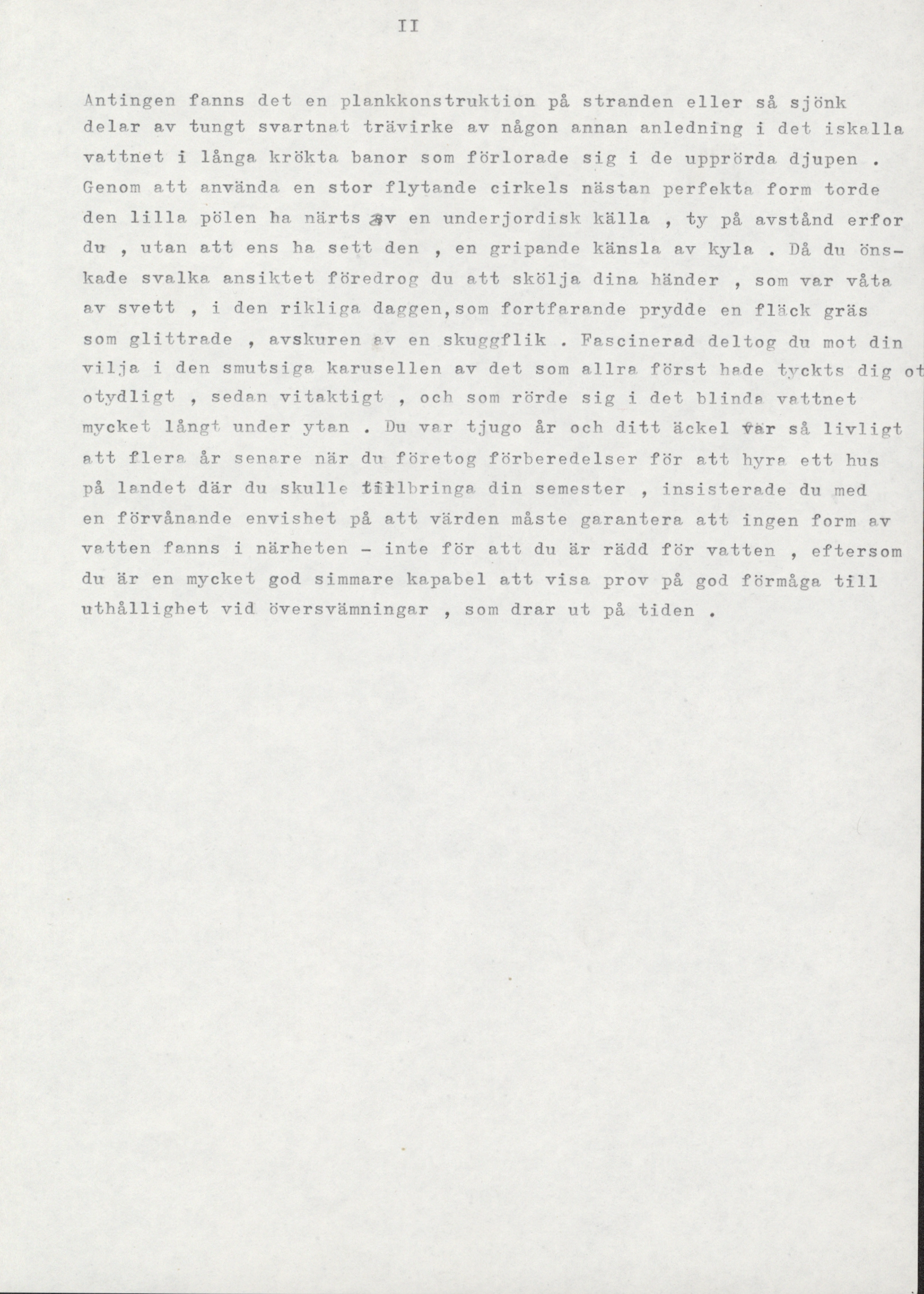
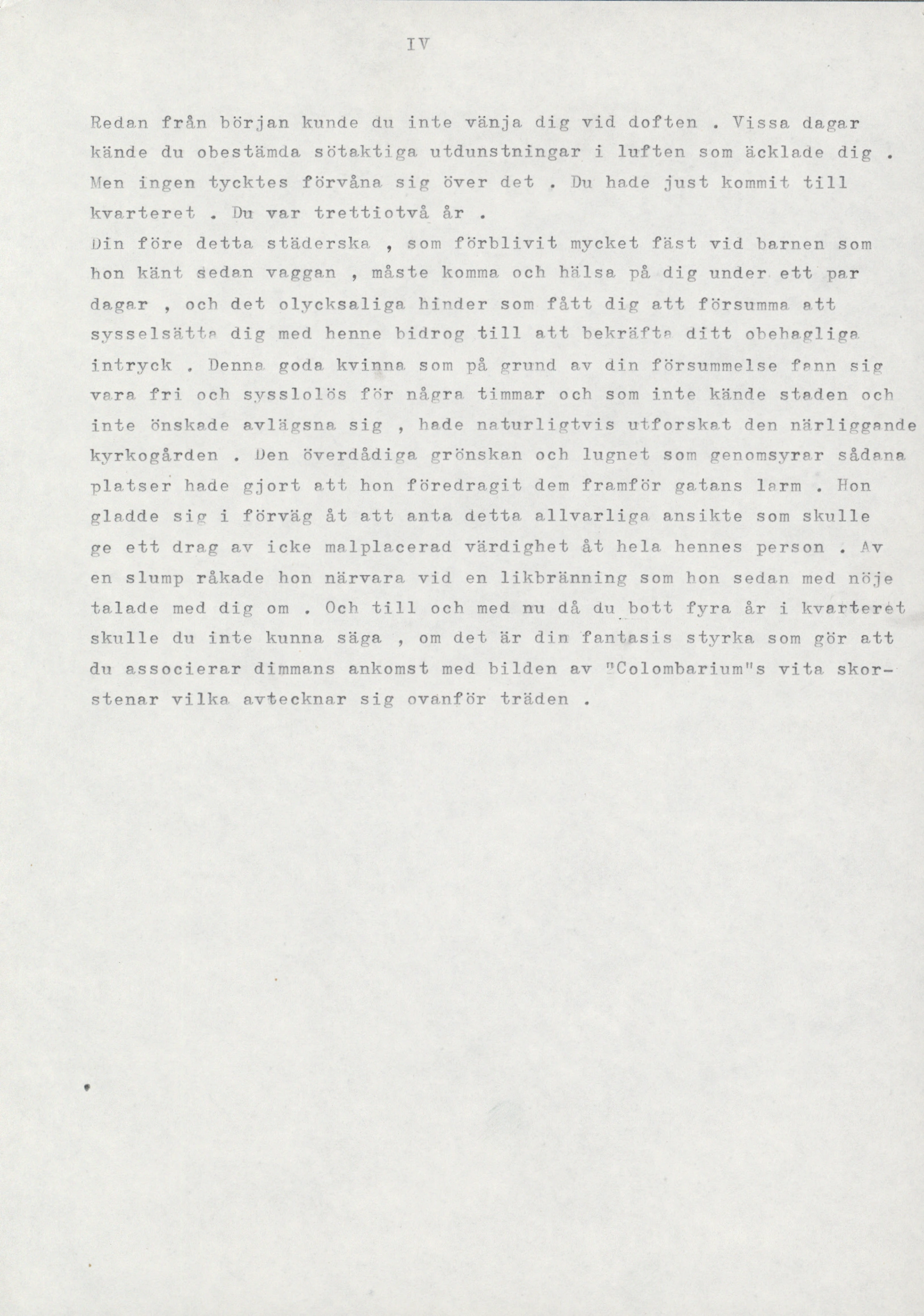
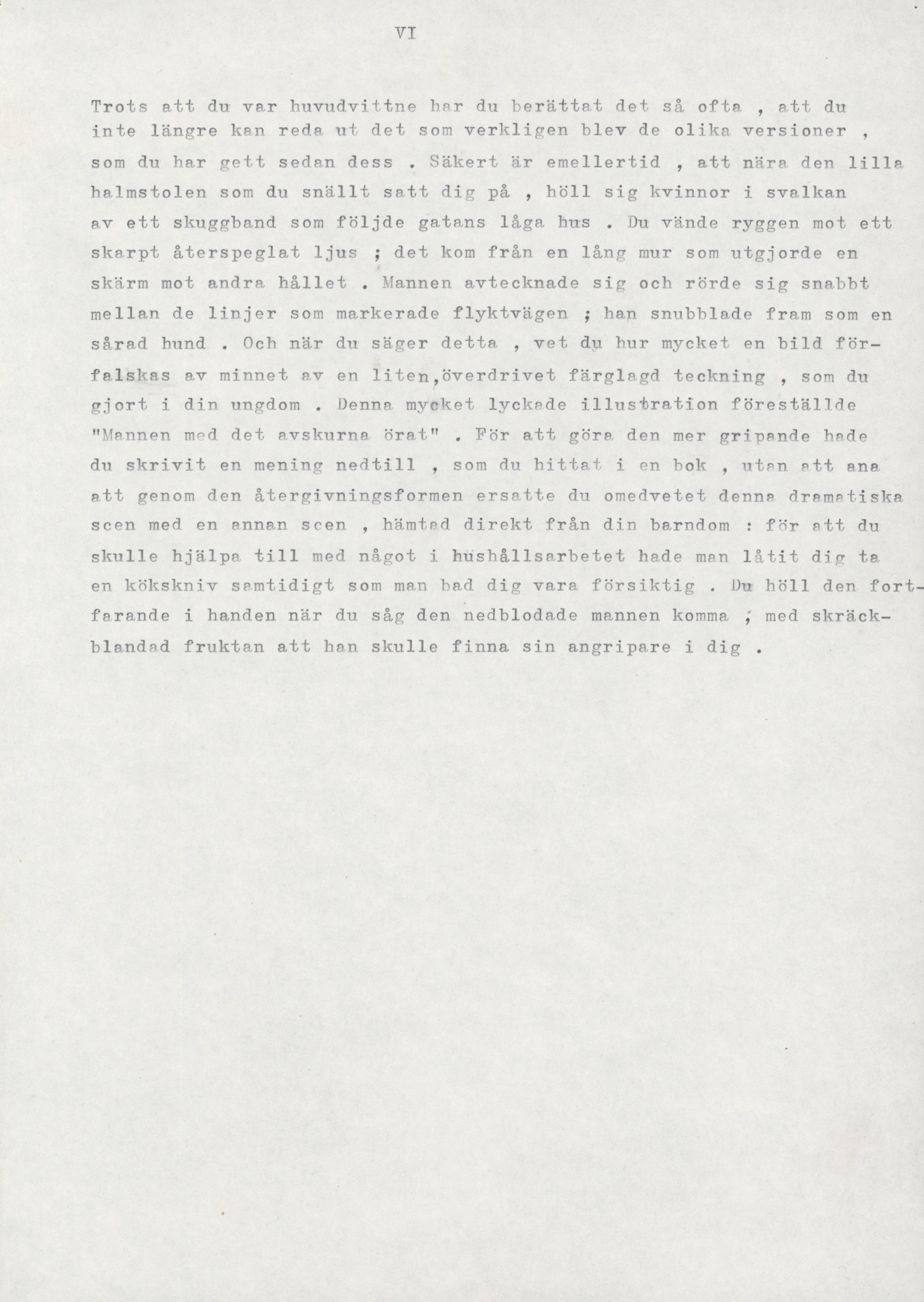
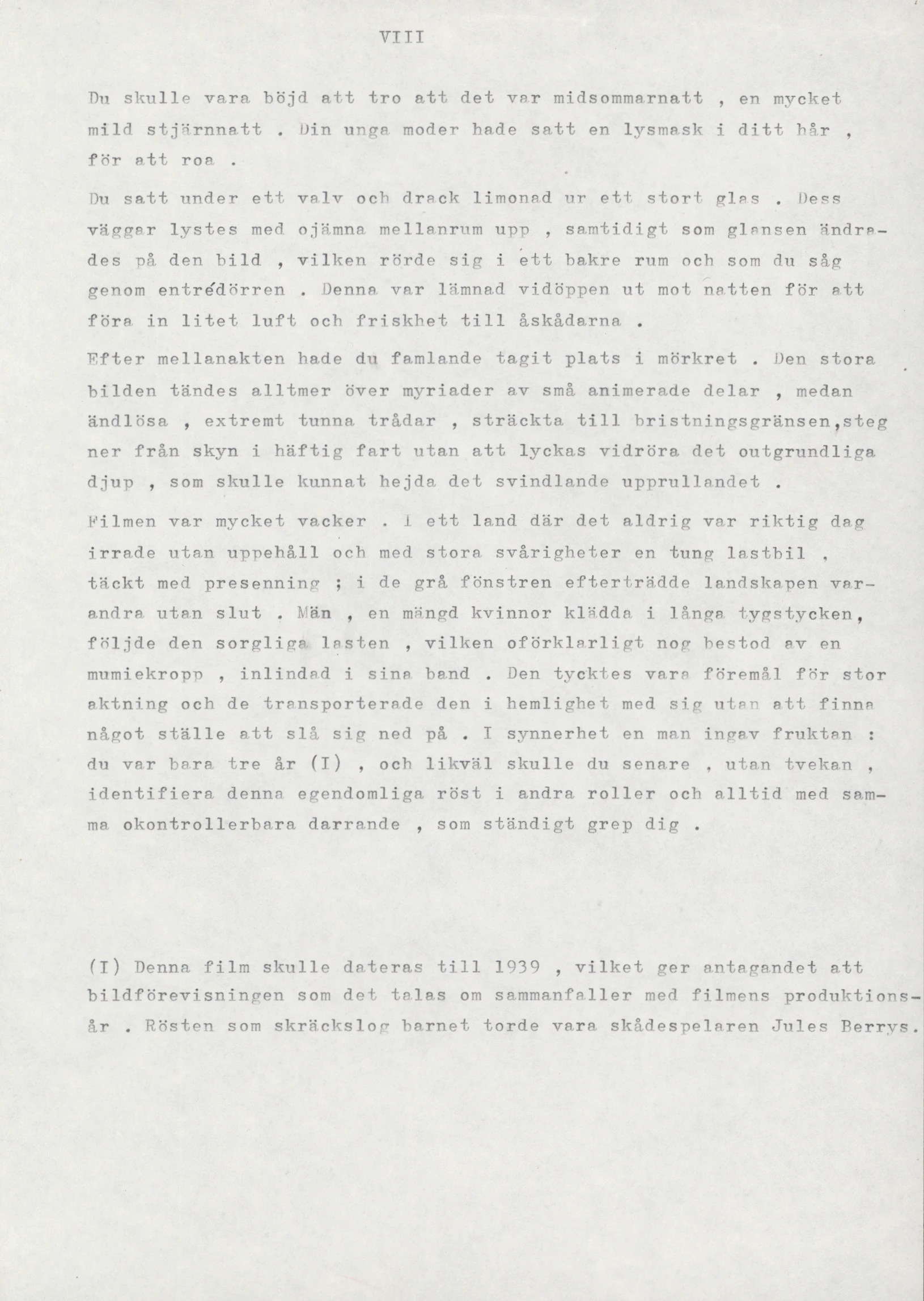
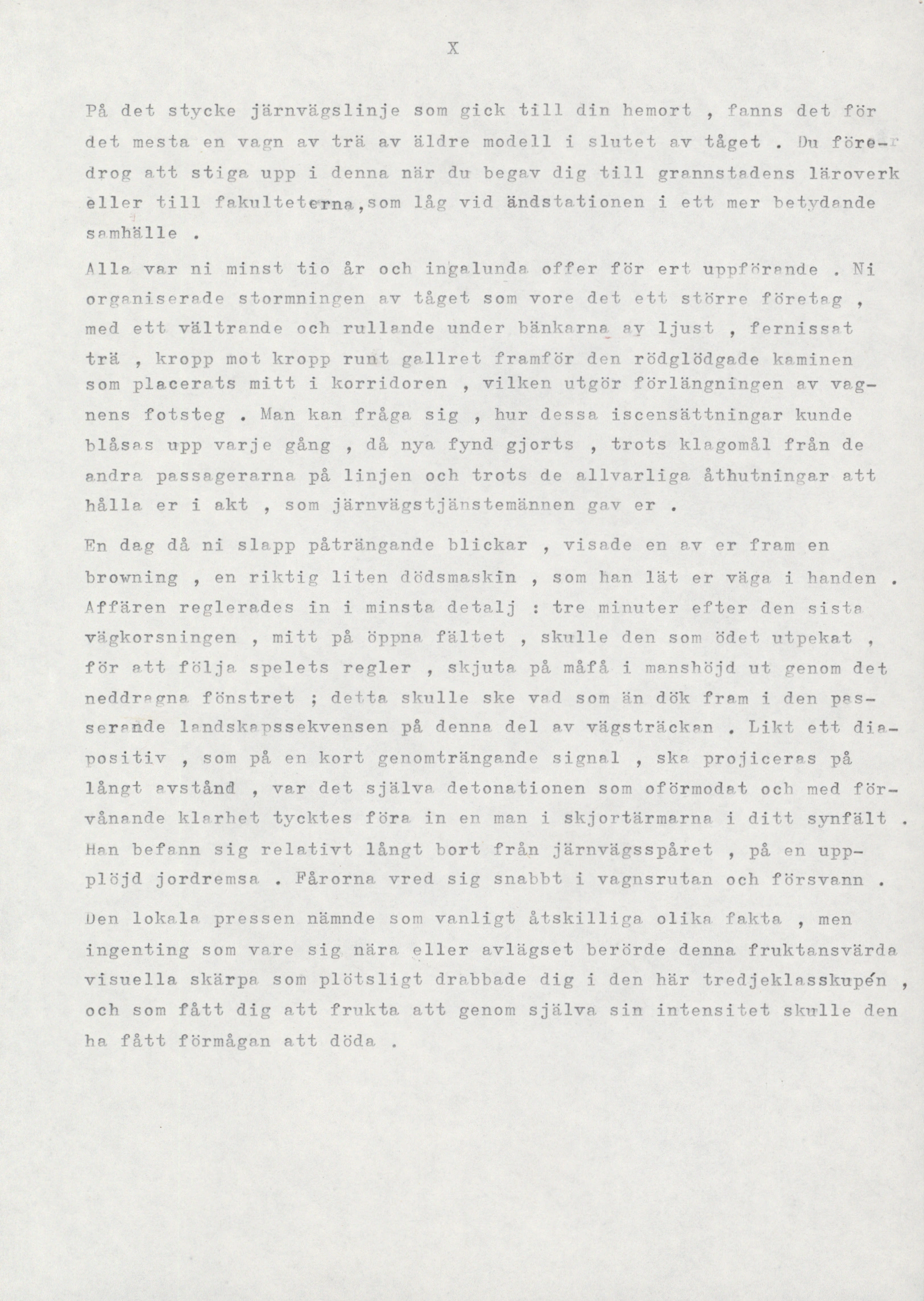
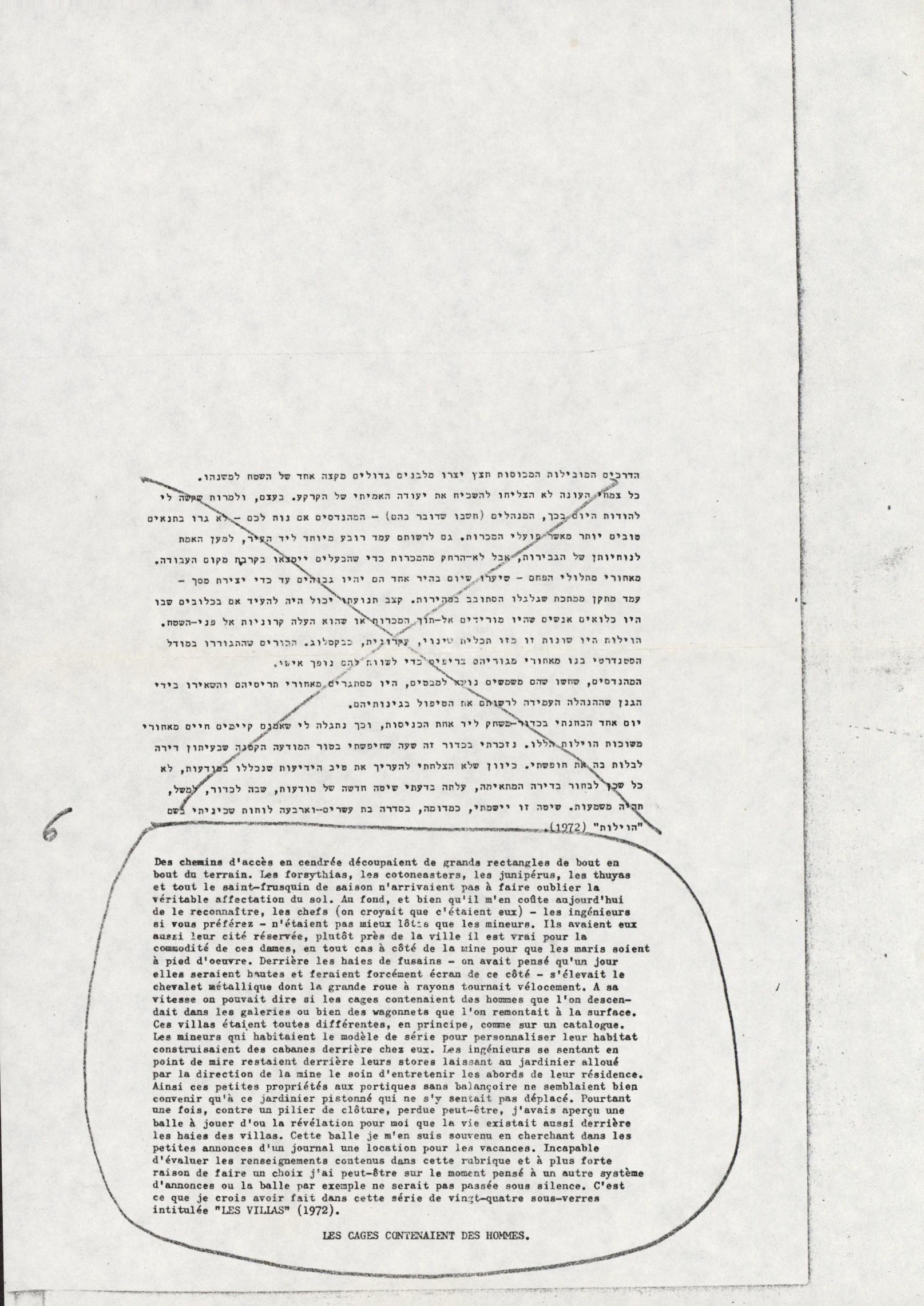
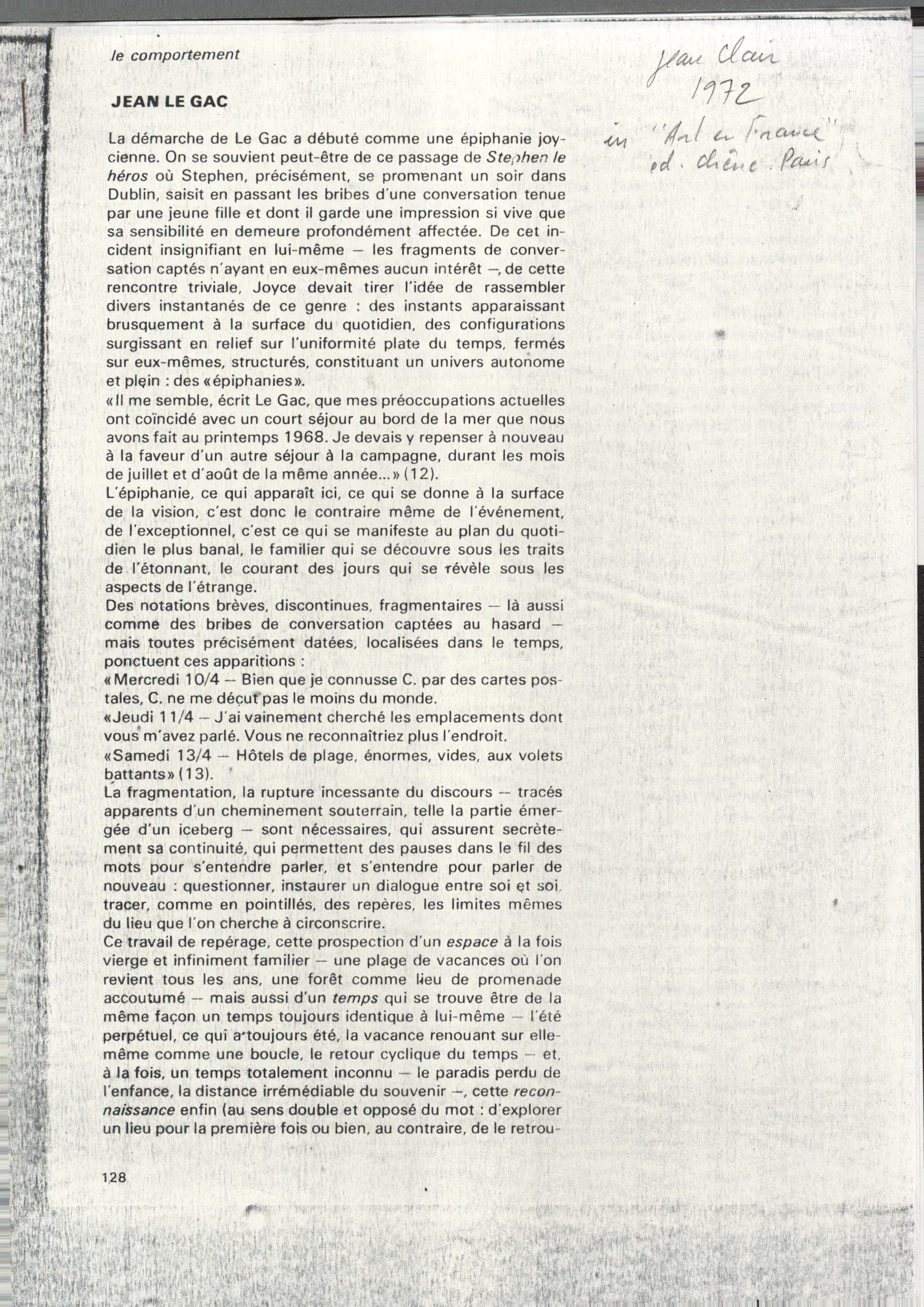
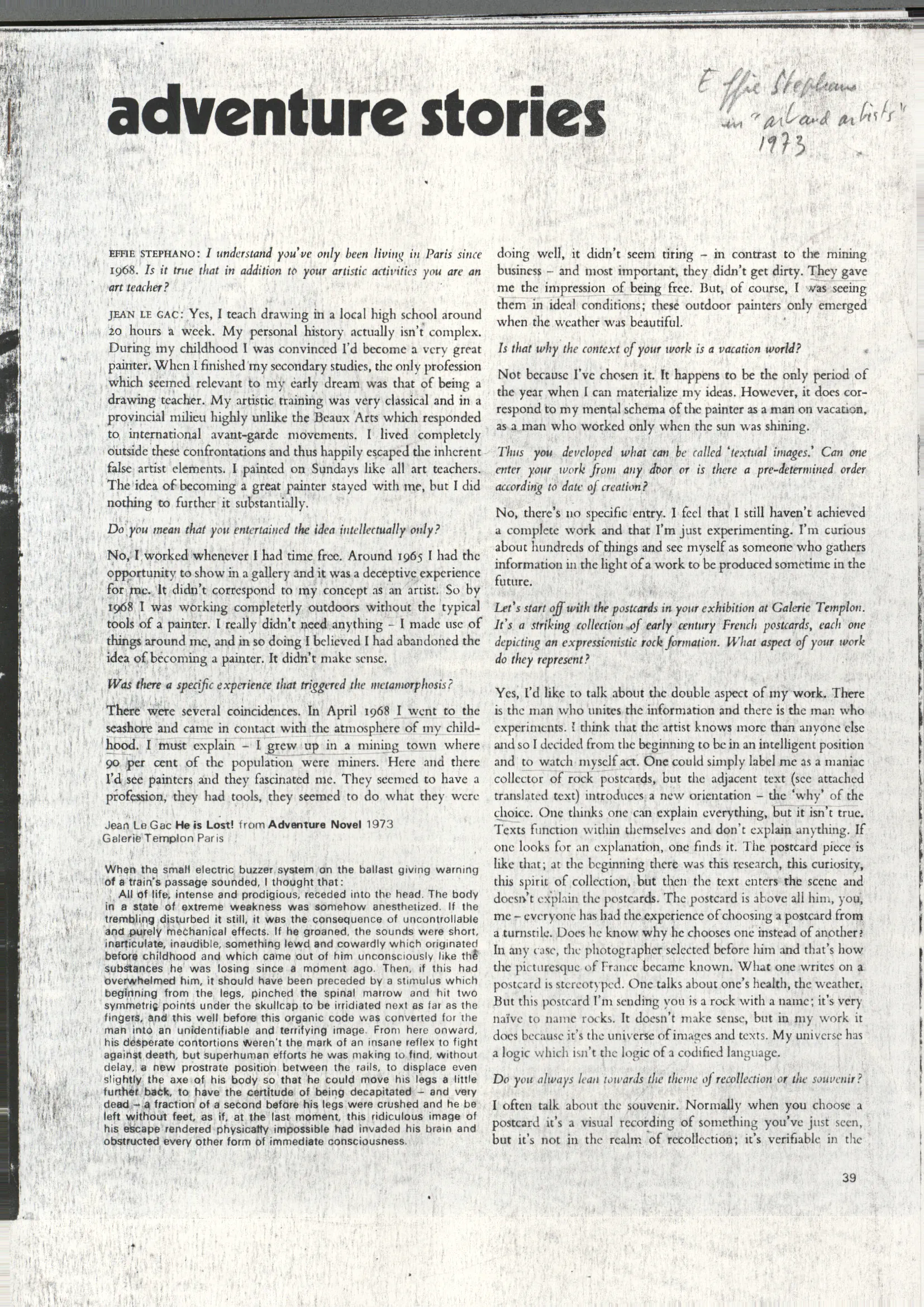
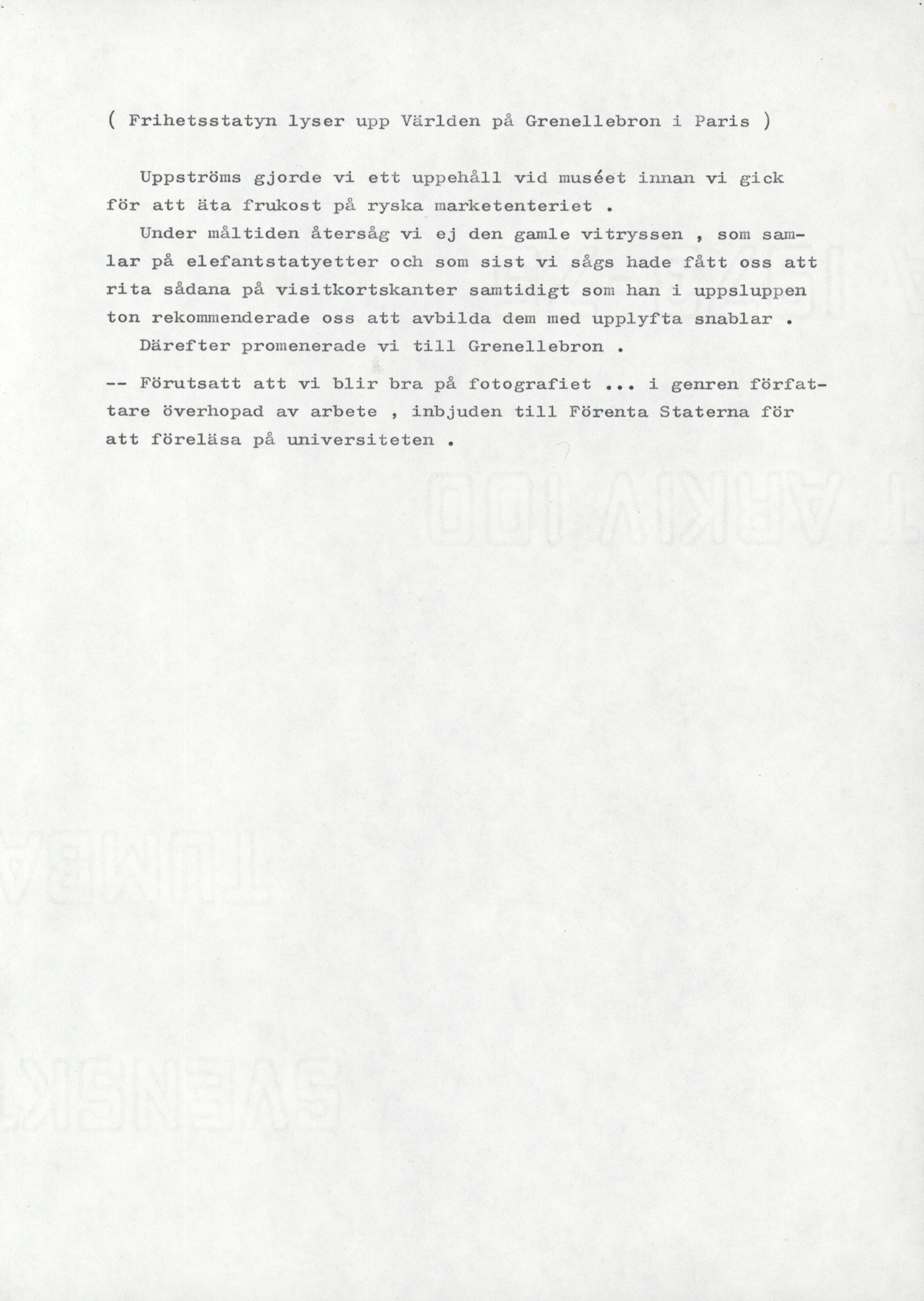
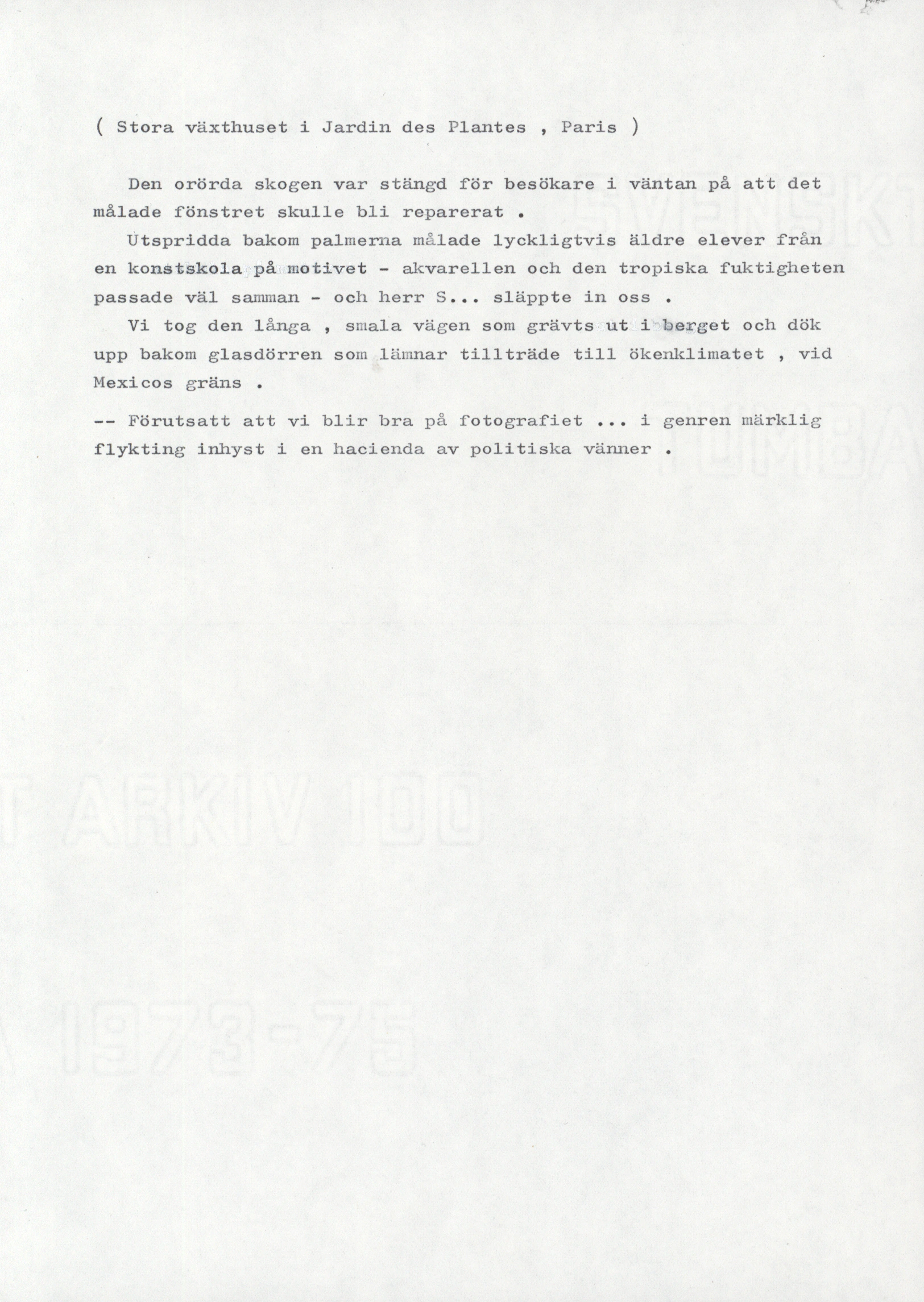
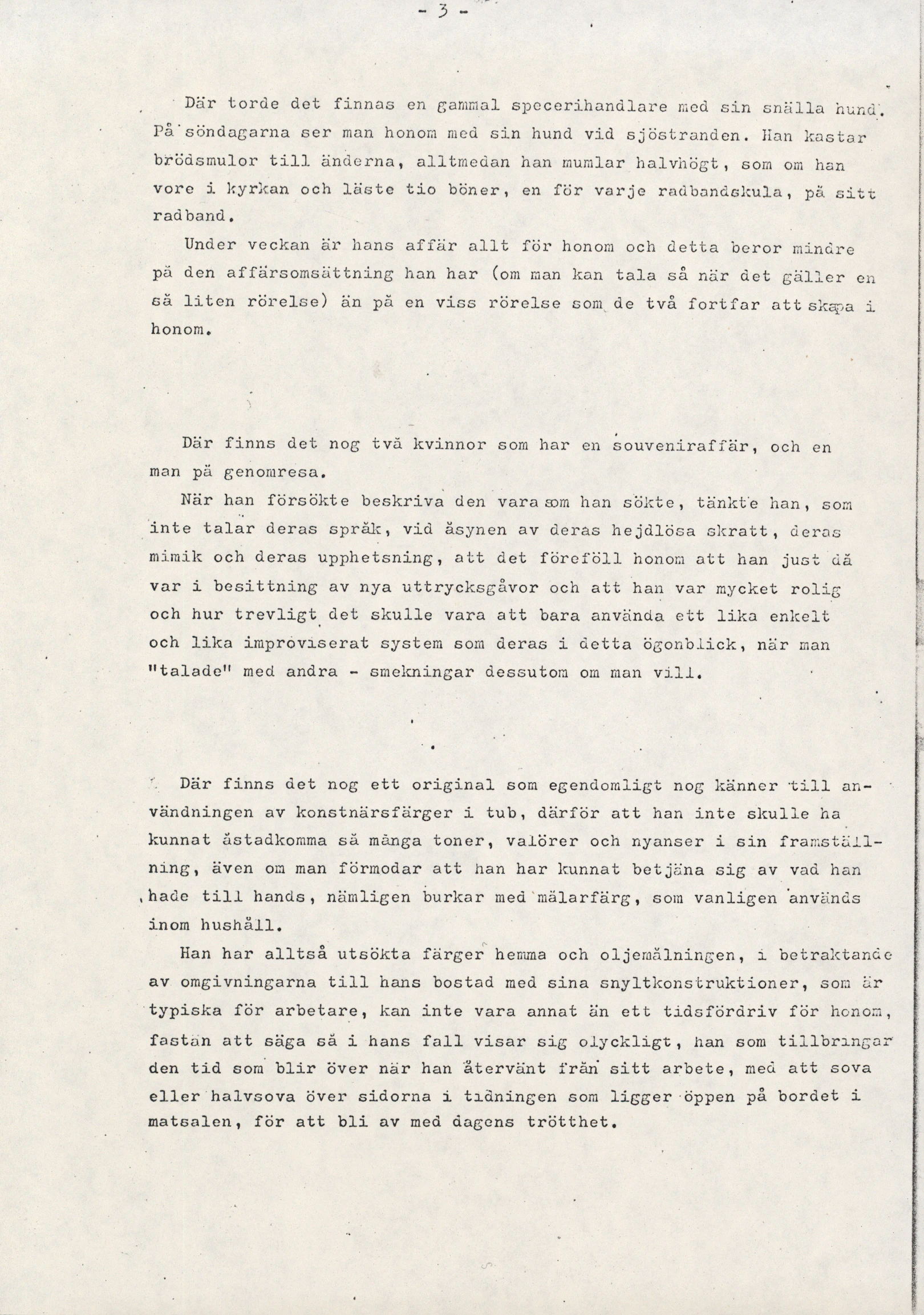
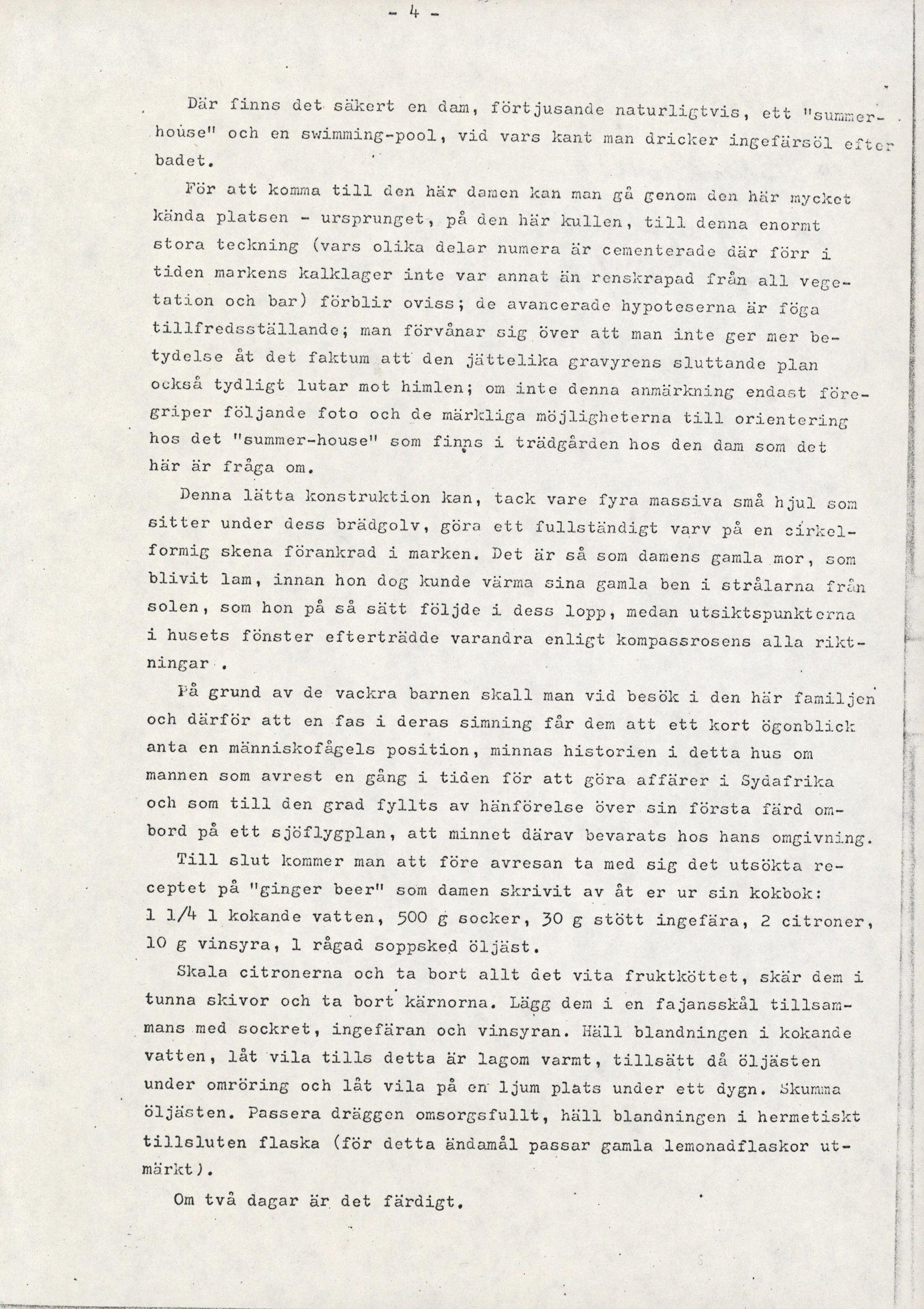
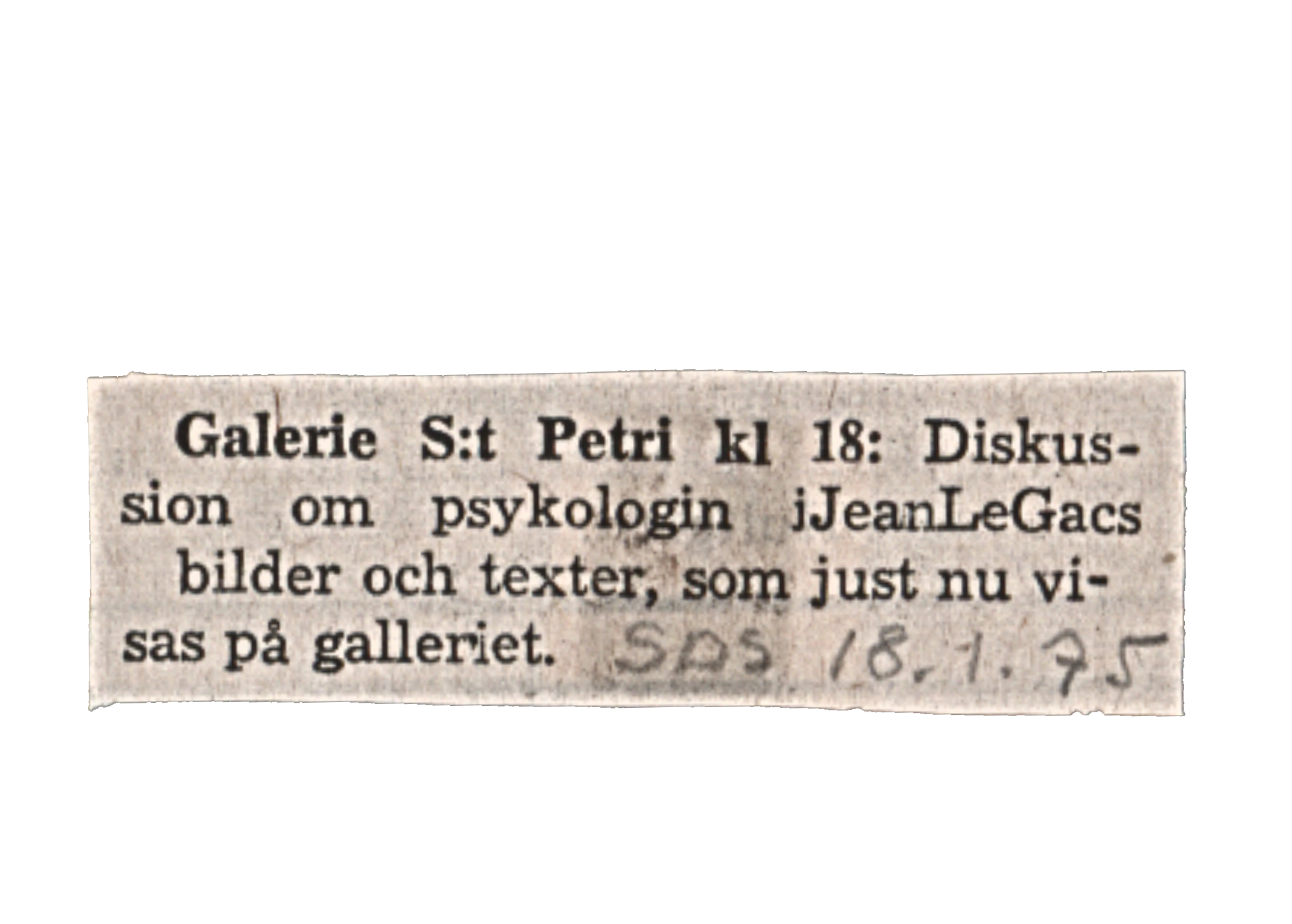
[JEANSELLEM VIEWER] — JEAN LE GAC ANEKDOTERNA och VYERNA 17.01-25.01.1975 — Categories: press, letters, docs, visual — Keywords: Galerie S:t Petri, Jean Sellem, archive — Category: press — Jean Le Gac from France is exhibiting at Galerie S:t Petri, Lund, from 17–26 January 1975. For the first time, his work is being shown separately in Sweden.The exhibition consists of two parts — ANEKDOTERNA and VYERNA. The former contains eight texts and seven drawn images, a kind of retrospective account of important events in his life. VYERNA, with eleven texts and eleven colour photographs, is an in-depth study of an account taken from ANEKDOTERNA.Jean Le Gac shows only loosely detached texts and presents the photographs in such a way that they appear as valuable memorial objects intended to reveal something, but whose meaning is lost. The original activity in the text and the photograph seems dead; it becomes myth, mystery. The meaning of these means of communication remains unresolved. What is indirectly revealed is the way in which they conceal a possible reality.Jean Le Gac’s work is an exploration of the subjective relations that each one of us maintains with the factual world. He sheds light on the mechanisms that govern our subjective experience of things, how memory and imagination affect our contact with our surroundings. For Jean Le Gac, objectivity does not exist.Since 1969 Jean Le Gac has worked with narratives accompanied by photographs. His aim is thereby to try to connect the visual with linguistics. This combination of image and text has in recent years increasingly attracted the attention of certain experimental artists.Jean Le Gac has presented his works in, among other places, France, the Netherlands, Italy, Germany, Israel and the USA. In March we will see his work at Malmö Konsthall in a group exhibition entitled “Nya Media”.The exhibition is open weekdays 15:00–20:00, Saturdays and Sundays 12:00–17:00. — — — Category: letters — Dear Jean Le Gac,Having a particular interest in your approach in the field of visual art, I am writing these few lines to ask whether you would be interested in exhibiting around September/October at Galerie S:t Petri in Lund (Sweden) and at Galerie Daner in Copenhagen.The arrangements are as follows:Galerie S:t Petri and Galerie Daner will jointly print a small black-and-white offset document in A3 format.The exhibition should have two aspects:1) The exhibition will first be presented in Copenhagen with a selection of several of your studies.2) Then the exhibition will be presented in another form, for example with complementary works, or in the form of a retrospective exhibition in Lund (Sweden).For this presentation, approximately 60 works would be required (photographs, notes, references), in A4 format.Could you let me know by return mail what you think of my proposal? If you are in favour, I can [continuation cut off in the image]. — — — Category: letters — <p><span style="color: rgb(17, 17, 17);">Paris, 3 October 1974</span></p> — Dear Jean Sellem,Thank you for your offer of an exhibition at Galerie S:t Petri and Galerie Daner.I agree to the end of November.Within the next few days I will write to you at greater length to clarify the nature of the presentation we might adopt, and also to send you texts to be translated (Gette, whom I saw yesterday, told me that he did not think this question of translations would be a problem).Thanking you once again, I remain very sincerely yours,Jean Le Gac — — — Category: letters — <p><span style="color: rgb(17, 17, 17);">Paris, 16 October 1974</span></p> — Dear Jean Sellem,Following my previous letter, I would like to give you today a few further details about what the exhibition might consist of; it seems to me that the best solution would be to show:— “The Anecdotes” (8 large texts + 7 illustrative drawings)It is a kind of narrated retrospective of the principal things I have done; this commentary is intended to replace the “works” themselves.I am sending you the texts for translation.— “The Views” (eleven large texts, enclosed + eleven 24 × 30 photographs in black and white and in colour)This is one of the “works” referred to in Anecdote No. 3.I am sending you the texts for translation. These facsimiles may be used for the exhibition.As you can see, the quantity of text is fairly considerable, so I think it would be preferable to limit the exhibition to these two things. If you agree with this arrangement, I will send you a little later the supplementary material for “The Anecdotes”: 8 large texts + the drawings. For “The Views”: eleven photographs.Awaiting your reply, and hoping that my shipment reaches you safely, I remain sincerely yours,Jean Le Gac — — — Category: letters — <p><span style="color: rgb(17, 17, 17);">Paris, 2 December 1975</span></p> — Dear Jean Sellem,Thank you for your letter, as well as for sending me Marie Sjöberg’s very fascinating analysis.I am grateful to you for having succeeded in bringing about new ways of approaching my work.Please convey my warmest thanks to Marie Sjöberg. If I have not written to her myself, it is because I was wary of the excessive self-indulgence I might have found in speaking about myself.In the small catalogue I am sending you, several elements from the latest series of photographs and texts I have made are reproduced.Please accept, Jean Sellem, the expression of my very best regards.Jean Le Gac — — — Category: letters — <p><span style="color: rgb(17, 17, 17);">Paris, 18 December 1974</span></p> — Dear Jean Sellem,I only received your card of 29 October today. No doubt you now have the other elements for the exhibition. For the short biographical text you asked me for, you could use, if necessary, this excerpt from my work:“(...) I have the feeling that he has not yet produced an oeuvre. He is undoubtedly engaged, without realizing it, in a process whose conclusion he does not seem in any hurry to reach, and which consists in becoming a very great artist. In the meantime, he is curious about many things (it is somewhat the position of someone gathering documentation for work that he will do later). Since he has the impression that being an artist amounts to much more than this, and that his little curiosities are somewhat socially insignificant, he is tempted to adopt, in relation to this kind of activity, the privileged position of an observer or commentator who would not be responsible for the actions and behaviour of the artist-painter: he watches himself at work.”J. Le Gac (excerpt from “Le Peintre”, 1973)Come to think of it, perhaps you will have a card printed for the exhibition: could the text above [crossed-out text, illegible] serve as an illustration?With my warmest regards,Jean Le Gac — — — Category: letters — <p><span style="color: rgb(17, 17, 17);">Paris, 26 January</span></p> — Dear Jean Sellem,I have received the printed material that you were kind enough to send me, and I thank you for it. I am pleased with the opportunity you have given me to make my work known and thus to prepare for a better understanding of the things I will show in Malmö next March.I should have told you immediately on the telephone that the Views form an inseparable group for sale, and the Anecdotes another group (each produced in three copies mounted on cardboard, at the same scale as the exhibition material I sent you), and that the prices are respectively 7,500 French francs, a price on which Galerie Daniel Templon grants the 30% discount reserved for galleries.Should you decide to proceed with your proposed purchase, you could let me know by letter and, rather than having me send you the material, perhaps [unclear] could take charge of the package on a forthcoming trip, unless you would prefer to contact — Galerie Daniel Templon, which would take care of the formalities according to your wishes.Thanking you once again, I remain,Yours sincerely,Jean Le Gac — — — Category: letters — — — Category: letters — — — Category: letters — — — Category: letters — I really think I have had what you call a “mad laugh”. It was “9 h 50’ 39” G.M.T.”. I was “strolling” — I love that word in your language — along the harbour quay of Plaisance, when I had the idea of slipping my fists into the pockets of my trousers, as you so amusingly do. It was at that moment that the words from your great writer Gertrude Stein came to mind: “(he) liked being there, (he) found himself better and better there, which amounts to saying that he (he) found reasons to feel comfortable with the fact of being there” (1).Of all your languages, that is the one I prefer, but at the Centre des Centres I was advised against using it in public. They have programmed for me a succession of your nineteenth-century literature, which they have renovated with one thousand and seventeen brand-new expressions and words. They think I should be able to sustain a conversation without drawing too much attention to myself. They merely warned me that if I say “car” for “automobile”, that will pass at worst for a pleasant nod to your eyes. Besides, this morning at the KARRACK, the café where I went “to throw one down” to get into the mood, it worked just as they had planned. My way of speaking is just a little more refined than average. It created a slight distance between me and the other consumers and undoubtedly spared me the embarrassing questions to which too much familiarity with them would have exposed me. This first contact was a success. “(We) liked being together there... (we) liked the union” (1). I paid for my “round” and put two very danceable arrangements of opera arias on the jukebox, excerpts from NABUCCO and from L’ELIXIR D’AMOUR... You know, I am beginning to know you quite well. I must say that I am now on my thirteenth “journey” to Earth.In 1611 of your Christian era they had already sent me to Toledo, and no later than last year I was in New York to “study your post-modern art”. We are trying to understand this thing that you call “painting”. Honfleur was chosen as the place where I would complete my mission because it is the ideal setting for a post-artistic situation and for the degeneration of “painting”. I think they chose well: witness the little lighthouse and the pretty pavilion, both unaltered, which I immediately identified as those appearing in a famous painting by Seurat; witness also the numerous plaques affixed here and there, commemorating painters, writers, art critics. I will not conceal from you that the name of Adolphe Marais gave me, for a moment, a problem. I had to “turn over in my head” everything we know in order to identify this artist.It was in a secluded little lane in the popular district of Honfleur that I finally had the revelation of “painting”. Words fail me to describe the many gaps in the surface and the lacunae in the colour on the wooden trellis of this garden gate, decorated with patches of pastel and cut-out cardboard painted in such a way that “this makes the thing we consider very different, and this makes what is different at bottom, it makes a composition, it blurs, it shows, that’s what it has, it likes it as it is, and this makes what one sees as one sees it” (2). I think — I value the painting of painters, the one all your writings on art have been announcing to us for a hundred years, this holy painting which has always been just about to be, never quite there, which makes you so voluble about it. Your “Polichinelle secret” is in truth that “painting” can be just as good for you, à la new-yorkaise, caviar with gritted teeth à la française, a simple barrel with its splattered paint and the chords played on it during the first paid holidays of the month of your summer 1936, that for you “painting” can just as well be a little painted harbour cabin at an angle à la Edward Hopper as a freshly repainted boat which openly displays the desire of its owner to conceal his own deteriorated instincts, but which above all, in the name of transcendence, must not say so. What we cannot understand is why you are so delicate, while extraordinary phenomena of retroversion take place before your very eyes, and the hull of the boat, to take only this case, succeeds by this layer of paint in appreciably regenerating its organism.A doubt comes over me before I “send” my conclusions to the Centre des Centres: you do not notice any of this!(1) Miss Furr and Miss Skeene — G. Stein.(2) Composition and Explication — G. Stein.(Excerpt from Space-Honfleur, an introduction..., 9 photographs and text, 105 × 238 cm, 1980.) — — — Category: docs — — — Category: docs — IAbove the vineyard, where the shadow projected forward, you found the remains of what had once been a passable road. It was still practicable in certain places; on the largest stretches of the road there were dense violet-coloured thickets, imperceptibly changing from rigid immobility to trembling movement, like real chevaux-de-frise, and in which your light clothes became caught. As you passed, invisible spiderwebs clung to your face and renewed the irritation of your skin caused by numerous scratches.A little farther on the road began to rise; slow metamorphoses dominated the ground and heralded a barely perceptible clearing where, on the sandy clay, an enormous ochre-coloured toad had long been waiting for you. You completely lost control of yourself and, with your arm across your eyes, fled like a madman: you forced your way through the area that seized your ankles and wounded you from every side as you ran.You were thirty-seven years old. — IIEither there had been a plank construction on the shore, or pieces of heavy, blackened timber had for some other reason sunk into the ice-cold water in long curved courses that disappeared into the agitated depths. Judging from the almost perfect form of a large floating circle, the small pool must have been fed by an underground spring, for even from a distance, without having seen it, you experienced a gripping sensation of cold.When you wanted to cool your face, you preferred to rinse your sweat-wet hands in the abundant dew that still covered a glittering patch of grass cut off by a tongue of shadow. Fascinated, and against your will, you took part in the filthy carousel of something that at first had seemed indistinct, then whitish, and which moved in the blind water far beneath the surface.You were twenty years old, and your disgust was so intense that several years later, when you were making arrangements to rent a house in the country where you intended to spend your holiday, you insisted with astonishing obstinacy that the landlord guarantee that there was no form of water anywhere nearby — not because you are afraid of water, since you are an excellent swimmer capable of displaying considerable endurance during prolonged floods. — IIIOn the southeastern side of a thick oak trunk there was a large circular opening penetrating deeply into the wood. A person of your size should have been able to insert half an arm into it by standing on tiptoe. You experienced the existence of this hole as a threat. Your reluctance to investigate its bottom blindly held you back, for fear that there might be some cold, sticky thing withdrawing into the blind opening, or a few small abandoned bodies, naked and featherless — still-warm fledglings desperately trembling beneath a dense, engulfing froth of red ants — or perhaps some heavy, seething swarm of bees that, under external provocation, would vomit forth a grey, buzzing cloud of poisonous arrows.And even if you had been slightly more attentive and had refused to establish a connection between the existence of this hole and what remained of a scattered network of porcelain insulators arranged in spiralling rings around the thick branches of the tree, despite your thirty-three years your common sense would not have helped you discover the truth any better than the anxious fantasies in which your soul took pleasure. — IVFrom the very beginning you were unable to get used to the smell. On certain days you noticed vague, sweetish exhalations in the air that disgusted you. But no one seemed surprised by them. You had only just arrived in the neighbourhood. You were thirty-two years old.Your former housekeeper, who had remained very attached to the children she had known since they were in the cradle, was due to come and visit you for a couple of days, and the unfortunate obstacle that had caused you to neglect taking care of her contributed to confirming your unpleasant impression. This good woman, finding herself free and unoccupied for a few hours because of your neglect, and neither knowing the town nor wishing to venture far away, had naturally explored the nearby cemetery. The luxuriant vegetation and the calm that permeates such places had made her prefer it to the noise of the street. She took pleasure in advance in assuming that grave expression which would lend her whole person a not inappropriate air of dignity.By chance she happened to witness a cremation, which she subsequently spoke to you about with pleasure. And even now, after living in the neighbourhood for four years, you would not be able to say whether it is the power of your imagination that causes you to associate the arrival of mist with the image of the white chimneys of the “Columbarium” outlined above the trees. — VThe best thing the architect had created in the mining town was a small construction rising behind each semi-detached house and consisting, in addition to toilets, of twelve rabbit hutches, two henhouses and two dovecotes. Each family shared this building annex with its neighbours according to a strictly symmetrical plan reminiscent of the abstraction of an industrial drawing. One could nevertheless imagine all the picturesque details that the draughtsman must have taken from the small masonry projections and from the fine pen strokes used to emphasize the rustic wood. Against the whiteness of the paper, the details would lend this marginal structure a certain aura of Rousseau-like dreams. The graphic success undoubtedly allowed the architect to win the sympathy of the commission entrusted with examining the projects and to obtain the order for the construction of the new town.He had nevertheless not thought of everything; the proof was that when the miners, influenced by this bucolic style, decided to breed a few pigeons and turtle doves, they had to stretch surprisingly large volumes of fine-meshed wire netting over homemade wooden frames in order to keep the birds in the nest, since they were no longer recognised by their respective foster parents.You did not like the new acquisition your father had made in order to distinguish himself. The new pair of pigeons was abnormally fat. Your aversion to these large beige birds was rooted in their submissiveness, which made them endure the worst torments inflicted by two metallic-feathered pigeons; you preferred the latter. During the savage pecking they mechanically drew their heads in and thus avoided looking at their attackers, like indifferent creatures with their eyes stupidly fixed on a single point in space. With their deformity and strong smell, they seemed to be the product of some monstrously inbred creation from a taxidermist’s imagination. They had a little one.One day when you were alone at home, you noticed an unusual sound coming from the henhouse. Your favourite pigeon hurled itself with all its strength against the edge of a semicircular platform and pulled from a hole in the dovecote the naked white skeleton of a small bird, whose bony head it frantically hammered with its beak so that the sound echoed against the wood. It did not stop until, with dizzyingly powerful wingbeats, it had torn at the loose skin of the neck and thrown the soft matter to the ground. After that your silence was complete, and you never explained why. — VIAlthough you were the principal witness, you have told the story so often that you can no longer disentangle what really happened from the different versions you have given since then. What is certain, however, is that near the little straw chair on which you had obediently seated yourself, women remained in the coolness of a strip of shade running along the low houses of the street. You had your back to a sharply reflected light; it came from a long wall forming a screen on the opposite side.The man stood out against it and moved rapidly between the lines marking his escape route; he stumbled forward like a wounded dog. And as you say this, you know how much an image can be falsified by the memory of a small, excessively coloured drawing that you made in your youth. This very successful illustration represented “The Man with the Severed Ear”. To make it more affecting, you had written beneath it a sentence found in a book, without realising that through this mode of representation you were unconsciously replacing that dramatic scene with another one drawn directly from your childhood: in order for you to help with some household task, you had been allowed to take a kitchen knife while being told to be careful. You were still holding it in your hand when you saw the blood-covered man approaching, with the terror-stricken fear that he might recognise his attacker in you. — VIIYou had never seen anything so strange before. The road, stretching in a straight line, underwent a peculiar mimetic reaction through which the man’s body, crouched in the dust beneath the full midday sun, appeared immeasurably large, as though an extension had been imposed upon it. This extension caused the trouser legs, even above the turn-ups that marked their ends, to expose areas of bare flesh, then a section of socks and finally the lengthened feet; everything was carelessly joined together, from hip to shoe, like the successive tubes of a telescope.At first you shouted insults at him from a distance. When he did not react, you approached him as a group, pressed closely around the one who carried a roasted 4/4-size tin can filled with water. You had all agreed to do it; the drunken man moved when the water was thrown over him, although not as quickly as the screaming children, who immediately vanished, swallowed up by a row of completely identical doors facing the street that served as their refuges.Your own expectation faded. Now that you no longer clung to it, you risked a quick glance out there where you stood. In this unprotected space, for a brief instant, the man’s terribly disfigured image intruded upon everything your eyes brushed against. The rapid repetition within the visual event disturbed the apparition and made it unbearable to look at the crawling shadows, the fungus-like cell division of the foliage, the peeling bark of the maples, the ambiguous staining of the laundry hung outside and the obsessive complexity of the cracks in the walls, within whose linear course your pursuer concealed himself. — VIIIYou would be inclined to believe that it was Midsummer night, a very mild starry night. Your young mother had placed a glow-worm in your hair to amuse you.You were sitting beneath an arch and drinking lemonade from a large glass. At irregular intervals its walls lit up, while the brightness changed on the image moving in a room farther back, which you saw through the entrance door. The door had been left wide open to the night in order to bring a little air and freshness to the spectators.After the interval, you had groped your way to your place in the darkness. The large image became increasingly illuminated above myriads of small animated parts, while endless, extremely thin threads, stretched to breaking point, descended violently from the sky without succeeding in touching the unfathomable depth that might have halted their dizzying unrolling.The film was very beautiful. In a country where it was never properly daylight, a heavy truck covered with a tarpaulin wandered without pause and with great difficulty; in its grey windows the landscapes succeeded one another without end. Men and a multitude of women dressed in long lengths of cloth followed the mournful load, which inexplicably consisted of a mummified body wrapped in its bandages. It seemed to be an object of great reverence, and they secretly transported it with them without finding anywhere to settle. One man in particular inspired fear: you were only three years old (I), and yet later you would undoubtedly recognise this strange voice in other roles, always with the same uncontrollable trembling that continually seized you.(I) This film would appear to date from 1939, which suggests that the screening described here coincided with the year in which the film was produced. The voice that terrified the child was probably that of the actor Jules Berry. — IXThe man accompanying you wore an old leather jacket. Around his neck he had a flannel scarf tied in the manner of the legionnaires. You have always wondered whether this successful device was due to the quality of the material, to its length, or to a method of tying the knot to which you had not paid sufficient attention.Together with your companion, you had for a moment left the timber yard where he worked in order to wander through the surrounding forest. Whether because there was little time and this pause was deceptively eating into his working day, or because the crushing heat had kept the game away, you did not fire a single shot when you caught sight of the bird at the edge of the forest. It flew directly toward you with long wingbeats, now clearly visible. As it had not noticed you, it continued along its course. It happened exactly as in one of those descriptive drawings in which the successive procedures for shooting at a moving target are shown within the same picture:— First: the bird flying with outstretched wings in a peaceful landscape.— Second: the image doubled, with the same bird virtually projected forward to anticipate its rapid movement through the air and intersect a dotted line symbolising the ideal angle for a fatal shot.— Third: the real bird regaining the full weight of its feathers and flesh and, completely disarticulated, falling freely after the ballistic shock.A few branches had to be pushed aside to see the sparrowhawk’s flat head pierced by two round, iris-reflecting holes. The wounded bird held its ground. The man, who appeared to notice neither your reluctance nor the fear of your eleven years, drew a small bundle of cord from his pocket. He made a slipknot and carefully placed it around the neck of his prey. While signalling you to move backwards, he struck the rope a few times to make the bird of prey release its grip, flung it rapidly into the air, chained it above his head in a slow circular movement and, with the speed thus gained, succeeded in reaching the perfect rotation of a vibrating propeller. By acting in this way, the man instinctively completed the synthesis of the entire situation; his mind, functioning like a transformer, translated the impressions he received into actions.(.) In the photograph: GUYNEMER by de La Fresnaye (Musée d’Art Moderne, Paris). — XOn the stretch of railway line leading to your home town, there was usually an old wooden carriage at the end of the train. You preferred to get into this one when travelling to the secondary school in the neighbouring town or to the faculties situated at the terminus in a larger community.All of you were at least ten years old and by no means victims of your own behaviour. You organised the storming of the train as though it were a major enterprise, tumbling and rolling beneath the benches of light varnished wood, body against body around the grille in front of the red-hot stove placed in the middle of the corridor, which extended the carriage steps. One may wonder how these performances could be revived each time some new discovery was made, despite the complaints of the other passengers on the line and despite the severe warnings to behave yourselves issued by the railway employees.One day when you were free from intrusive looks, one of you produced a Browning, a genuine little killing machine, which he allowed you to weigh in your hand. The affair was organised down to the smallest detail: three minutes after the final level crossing, in the middle of open country, the one chosen by fate, in order to follow the rules of the game, was to fire at random at the height of a man through the lowered window; this was to be done regardless of what appeared within the passing sequence of landscape along that stretch of track.Like a slide that, at a brief penetrating signal, is projected at a distance, it was the detonation itself that suddenly and with astonishing clarity seemed to introduce into your field of vision a man in shirtsleeves. He was relatively far from the railway line, on a strip of ploughed earth. The furrows twisted rapidly across the carriage window and disappeared.As usual, the local press reported various facts, but nothing that even remotely touched upon the terrifying visual sharpness that had suddenly struck you in that third-class compartment and made you fear that, by its very intensity, it might have acquired the power to kill. — XIThey were good swimmers, and naturally they were recovered in the evening when the drowning occurred. As though to protect themselves against the dampness of the night, the young men had kept all their underclothes on while groping their way down into the water by the light of lamps that had hastily been brought out.These young men were always together and were in the habit, during the hot afternoons of summer, of going in company to the river to bathe. With their shirts whose collars opened over the skin, their repeatedly washed and freshly ironed white cotton trousers, their new espadrilles and the small smooth cakes of soap they carried wrapped in terrycloth towels, the air seemed not merely more fragrant; it was clean, light, beneficial. They undressed behind screens of reeds. Their clothes were then carefully folded and stacked on the deserted shore in small, evenly measured piles.Before entering the water there was a moment of uncertainty. The total stillness of the water brought close to the surface the virtual and perfectly clear image of small milk-white stones lying on a bed of mud covered with fine glittering mica dust. The first dive dispersed this illusion of stones and created a condition of temporary blindness, close to anguish, that ceased immediately when the swimmer reached the surface.That night your blindness lasted longer; that is all, especially since, wedged into the crowd of silent adults, you could more easily guess than actually see the slow swaying movements of the nocturnal swimmers. — — — Category: docs — Cinder access paths divided the entire site into large rectangles. The forsythias, cotoneasters, junipers, thujas and all the other seasonal greenery could not make one forget the land’s true purpose. In the end, and although it pains me today to admit it, the bosses (we thought that was what they were) — the engineers, if you prefer — were no better off than the miners. They too had their own reserved housing estate, rather closer to the town, it is true, for the convenience of the ladies, but in any case beside the mine so that the husbands would be close to their workplace. Behind the spindle-tree hedges — which had been planted in the thought that one day they would grow tall and necessarily form a screen on that side — rose the metal headframe, its large spoked wheel turning rapidly. From its speed one could tell whether the cages contained men being lowered into the galleries or mine wagons being brought back up to the surface.These villas were all different, in principle, as if from a catalogue. The miners, who lived in the standard model, built sheds behind their houses to personalize their homes. The engineers, feeling that they were under scrutiny, remained behind their blinds, leaving the gardener assigned by the mine management to look after the surroundings of their residences.Thus these little properties, with their frames but no swings, seemed really to suit only this well-connected gardener, who did not feel out of place there. Yet once, against a fence post, perhaps lost, I had noticed a ball to play with, which revealed to me that life also existed behind the hedges of the villas. I remembered that ball while looking through the classified advertisements in a newspaper for a holiday rental. Unable to assess the information contained in that section, let alone make a choice, I may at that moment have thought of another system of advertisements in which, for example, the ball would not have been left unmentioned. I believe that is what I did in this series of twenty-four works under glass entitled “THE VILLAS” (1972).THE CAGES CONTAINED MEN. — When my luggage was ready, I had practically finished making a clean copy of the precious list. All that remained was to fold it into four and slip it into the inside pocket of my jacket so as to be sure not to lose it during the journey. In this way I had at my disposal a small stock of phrases, about a hundred in all, which I had taken care to put in order before going out into the field. I had to remember that I would be alone, and that consequently there could no longer be any question of keeping De Nansac with me, any more than the engineer James Wood or that old madman Guidford, and still less the unfortunate Edith. I crossed out their names wherever they appeared in order to obtain an indistinct textual material suitable for a single person. I also had to eliminate a few expressions peculiar to the period, such as “the Frenchman has only just enough time to throw himself aside”, together with a few minor modifications whose details I have forgotten and whose importance should not be exaggerated: in every sentence I retained the meaning it had beneath the illustrations in this thirty-fourth volume of “St. Nicolas, illustrated journal for boys and girls” from the year 1913 (at the time I had also wondered for what reasons the illustrator had chosen to illustrate one particular sentence rather than another that he could just as easily have taken from the text). During the first week of the holidays I had enough things to occupy me not to feel like undertaking the activities I had planned in advance with the phrases I had been carrying with me since our departure from Paris.However, the moment came when I found myself with my camera, out in the open countryside, not knowing what to do, waiting for an impossible event. On rereading them, the phrases no longer said anything to me; they had, as it were, crystallised into an absolute literal given. Bordering on the ridiculous, “I set off again”, as the text put it. Like the first man walking upon the Earth before the camera lens, this was how, near the house we had rented for our month’s holiday in a peaceful place where nothing was likely to happen, there began what was to become the series of twenty-four double plates in black-and-white and colour entitled “LE ROMAN D’AVENTURES” (1972).I COULD NOT KEEP DE NANSAC WITH ME... — — — Category: docs — — — Category: docs — nor who was responsible for this mixture of feathers and blood that was found spread all over the henhouse, and who blamed the neighbours’ ill will for the killing and the wild devastation of all your pigeons. You were rather a small, kind and timid boy, and neither the horror at the spectacle you had witnessed nor your wish that this nightmare should end immediately can justify the shameful barbarity of which you gave proof that day. — (The Statue of Liberty Enlightening the World on the Grenelle Bridge in Paris)Upstream we stopped at the museum before going to have breakfast at the Russian canteen.During the meal we did not see again the old White Russian, who collects elephant statuettes and who, the last time we met, had got us to draw such figures on the edges of visiting cards while jovially recommending that we depict them with raised trunks.Afterwards we walked to the Grenelle Bridge.-- Provided we turn out well in the photograph ... in the genre: writer overwhelmed with work, invited to the United States to lecture at a university. — (The Great Greenhouse at the Jardin des Plantes, Paris)The untouched forest was closed to visitors while the painted window was awaiting repair.Scattered behind the palm trees, older students from an art school were fortunately painting the motif — watercolour and tropical humidity went well together — and Mr. S... let us in.We took the long, narrow path cut into the rock and emerged behind the glass door that gives access to the desert climate, at the border of Mexico.-- Provided we turn out well in the photograph ... in the genre: strange refugee housed in a hacienda by political friends. — - 3 -There must be an old grocer there with his gentle dog.On Sundays one sees him with his dog on the lakeshore. He throws breadcrumbs to the ducks while muttering half aloud, as though he were in church saying ten prayers, one for each bead of his rosary.During the week his shop is everything to him, and this depends less on the business turnover he has (if one can speak that way in the case of such a small establishment) than on a certain movement that the two of them still continue to create in him.There are probably also two women there who keep a souvenir shop, and a man passing through.When he tried to describe the item he was looking for, he, who does not speak their language, thought, at the sight of their unrestrained laughter, their mimicry and their excitement, that at that very moment he possessed new expressive gifts and that he was very amusing, and how pleasant it would be to use only a system as simple and as improvised as theirs at that moment, when one “spoke” with others — caresses too, if one wishes.There is probably also an eccentric there who, strangely enough, knows how to use artists’ tube paints, because he could not otherwise have achieved so many tones, values and nuances in his rendering, even if one assumes that he may have made use of what he had at hand, namely tins of house paint, such as are usually used in the home.He therefore has exquisite colours at home, and the oil painting, considering the surroundings of his dwelling with its parasitic constructions, typical of workers, can be nothing other than a pastime for him, though to say so in his case proves unfortunate, he who spends the time left over after returning from work sleeping or half-sleeping over the pages of the newspaper lying open on the dining-room table, in order to rid himself of the day’s fatigue. — - 4 -There is certainly a lady there, charming of course, a “summer-house” and a swimming pool, beside which one drinks ginger beer after bathing.To reach this lady one may pass through this very famous place — the origin, on this hill, of this enormously large drawing (whose various parts are now cemented over where once the chalk layer of the ground had merely been scraped free of all vegetation and left bare) remains uncertain; the advanced hypotheses are scarcely satisfactory; one is surprised that greater importance is not attached to the fact that the sloping plane of the gigantic engraving also quite clearly inclines toward the sky; unless this remark merely anticipates the following photograph and the strange possibilities of orientation of the “summer-house” that stands in the garden of the lady in question.This light construction can, thanks to four massive little wheels under its wooden floor, make a complete revolution on a circular rail anchored in the ground. Thus the lady’s old mother, who had become lame, could, before she died, warm her old legs in the rays of the sun, which she thus followed in its course, while the points of view in the windows of the house succeeded one another according to all the directions of the compass.Because of the beautiful children, when one visits this family, and because one phase of their swimming makes them for a brief moment assume the posture of a bird-man, one should remember the story in this house of the man who once departed to do business in South Africa and who became so filled with rapture on his first trip aboard a seaplane that the memory of it has been preserved among those around him.Finally, before leaving, one will take away the exquisite recipe for “ginger beer” that the lady copied out for you from her cookbook:1 1/4 l boiling water, 500 g sugar, 30 g crushed ginger, 2 lemons, 10 g tartaric acid, 1 heaped tablespoon brewer’s yeast.Peel the lemons and remove all the white pith, cut them into thin slices and remove the seeds. Put them in an earthenware bowl together with the sugar, ginger and tartaric acid. Pour the mixture into boiling water, let it stand until it is pleasantly warm, then add the brewer’s yeast while stirring and leave it in a lukewarm place for one day. Skim off the yeast. Strain the sediment carefully, pour the mixture into a hermetically sealed bottle (old lemonade bottles are excellent for this purpose).In two days it is ready. — — — Category: visual — — — Category: visual — — — Category: press — <p><em style="color: rgb(17, 17, 17);">17.01.1975</em></p> — New openings at Lund galleriesToday, Friday, an exhibition by the French artist Jean Le Gac opens at Galerie S:t Petri. His exhibition consists of texts, drawings and colour photographs.Jean Le Gac’s exhibition consists of two parts — THE ANECDOTES and THE VIEWS. The former contains eight texts and seven drawings, a kind of retrospective account of important events in his life. THE VIEWS, comprising eleven texts and eleven colour photographs, is an in-depth study of one of the narratives from THE ANECDOTES.Jean Le Gac’s works explore the subjective relationships that each of us maintains with the actual world. He examines the mechanisms that govern our subjective experience of things, and how memory and imagination affect our contact with our surroundings. For Jean Le Gac, objectivity does not exist.Since 1969 he has worked with narratives accompanied by photographs. His aim is thereby to attempt to bring together the visual and the linguistic. In recent years, this combination of image and text has received increasing attention from certain experimental artists. — — — Category: press — <p><em style="color: rgb(17, 17, 17);">17.01.1975</em></p> — French art at a Lund galleryToday, Friday, an exhibition by the French artist Jean Le Gac opens at Galerie S:t Petri. It runs until 26 January and is open weekdays from 3–8 p.m., and Saturdays and Sundays from 12–5 p.m.The exhibition consists of two parts — “The Anecdotes” and “The Views” — a kind of retrospective account of important events in his life. Since 1969, Jean Le Gac has been working with narratives accompanied by photographs. His aim is to try to bring together the visual and the linguistic. In recent years, this combination of image and text has increasingly attracted the attention of certain experimental artists.Jean Le Gac has presented his work in, among other countries, France, the Netherlands, Italy, Germany, Israel and the USA. In March, his works will be shown at Malmö Konsthall in a group exhibition entitled “New Media”.[Handwritten note]SDS, 17 January 1975 — — — Category: press — <p><em style="color: rgb(17, 17, 17);">17.01.1975</em></p> — Frenchman holds premiere exhibitionShows “anecdotes” and “views”LUND: Jean Le Gac from France is exhibiting at Galerie S:t Petri in Lund from 17–26 January. This is the first time his work has been shown separately in Sweden. The exhibition consists of two parts: “The Anecdotes” and “The Views”.The Anecdotes contain eight texts and seven drawings, a kind of retroactive account of important events in his life.The Views, with eleven texts and colour photographs, are an in-depth study of a narrative from The Anecdotes.Jean Sellem at the gallery says:■ THE PERSON BEHIND IT— Jean Le Gac presents only fragmented texts and presents the photographs in such a way that they appear like valuable souvenir objects, while their meaning is lost.— The original activity in text and photograph is concealed: it becomes myth, mysticism. The significance of these messages always remains unresolved.■ NOT OBJECTIVE— Jean Le Gac’s works are an exploration of subjective relations that each one of us maintains with the physical world. He sheds light on the mechanisms that control our subjective experience of things, our memory and imagination affect our contacts with our surroundings. For Jean Le Gac there is no objectivity.— Since 1969 Jean Le Gac has worked on stories accompanied by photographs. It is his desire that this should attempt to bring together the visual and the linguistic.This combination of image and text has in recent years received increasing attention from certain experimental artists.■ TO MALMÖJean Le Gac presents his works, among other places, in France, Holland, Italy, West Germany, Israel and the USA. In March his works will be shown in Malmö Art Gallery at a group exhibition called “New Media”.The exhibition is open weekdays 15–20, Saturdays and Sundays 12–17. — — — Category: press
CLICK TO VIEW PRESS RELEASE
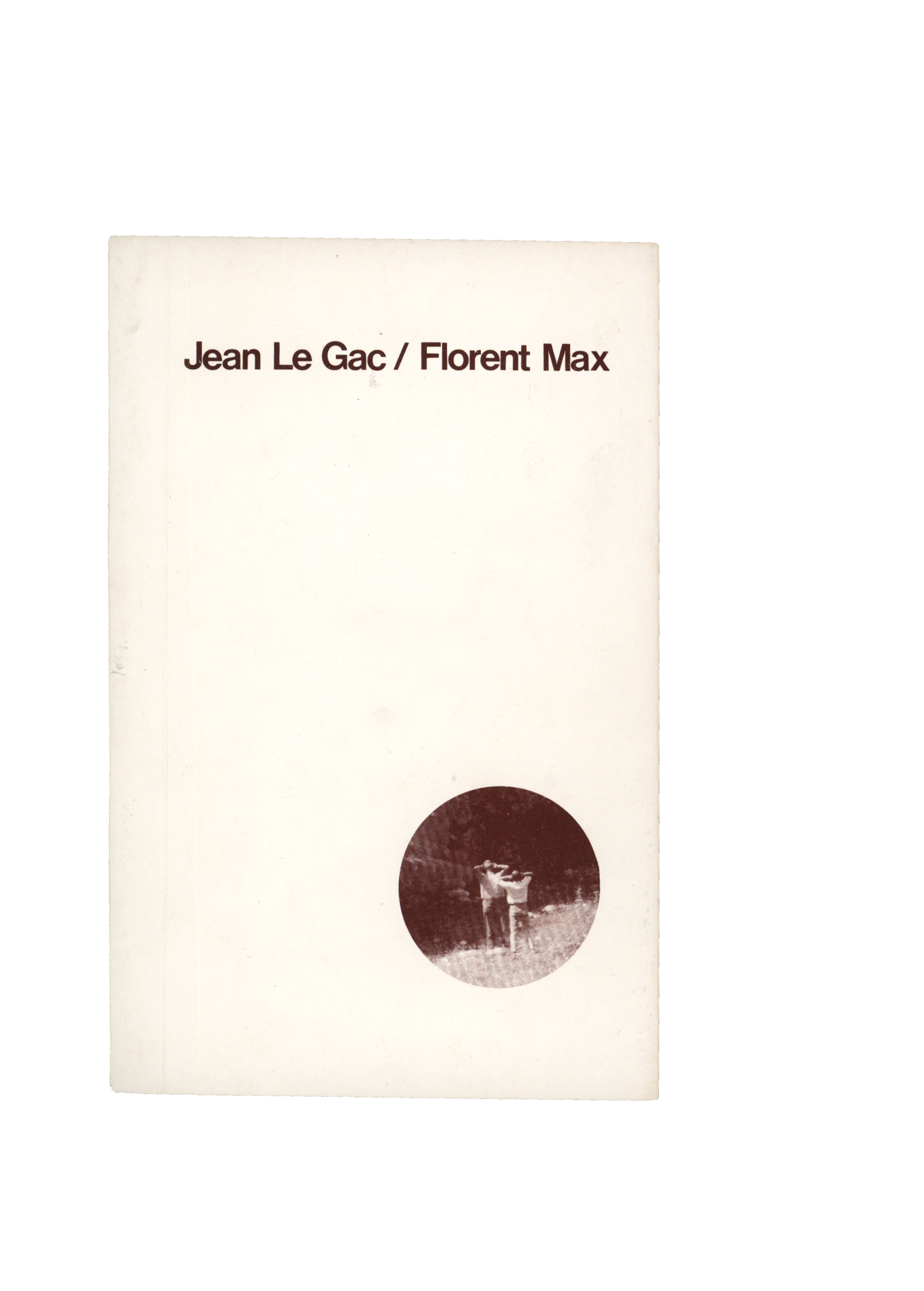
JEAN LE GAC
ANEKDOTERNA och VYERNA
17.01-26.01.1975
JEAN LE GACANEKDOTERNA och VYERNA17.01-26.01.1975
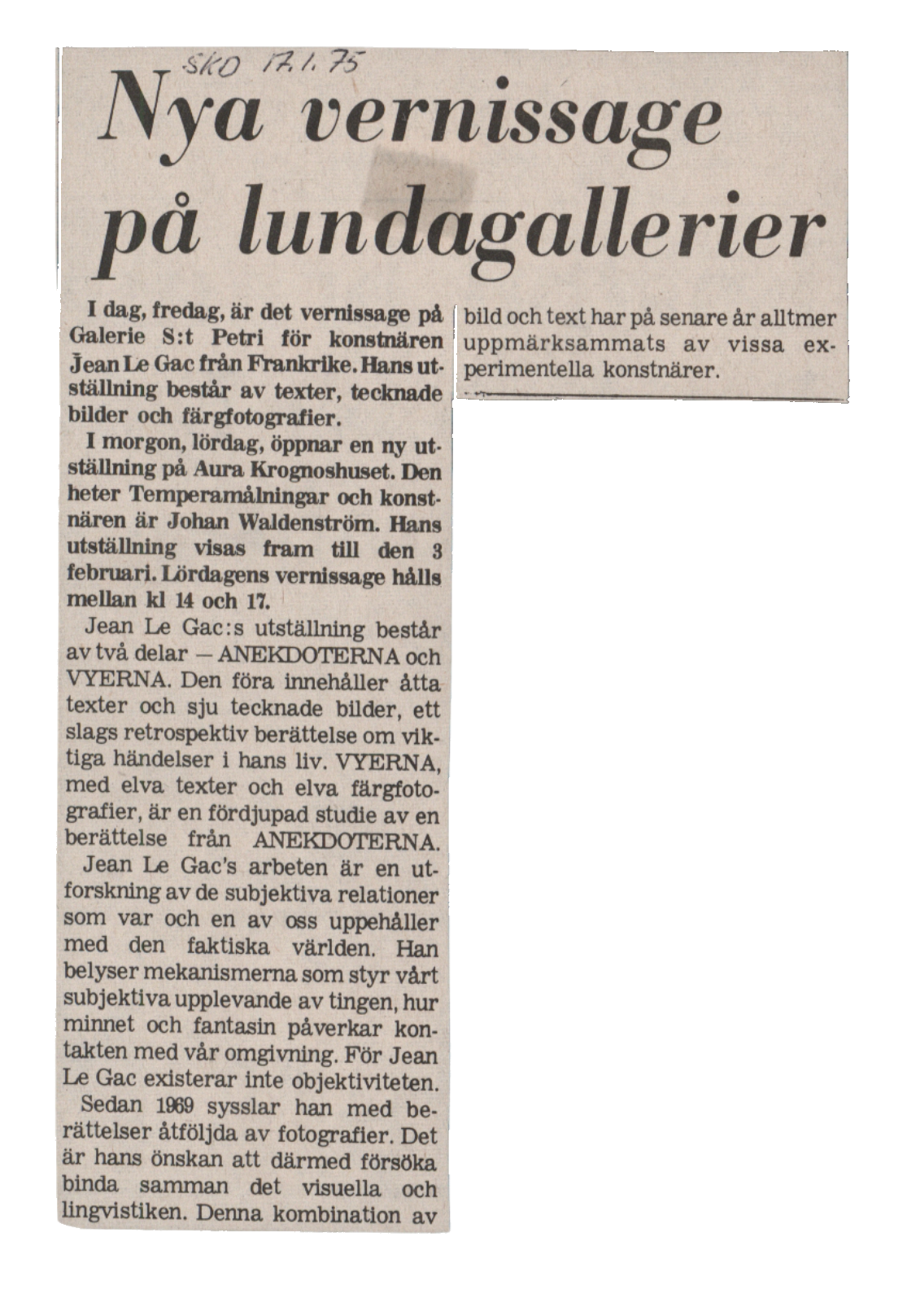
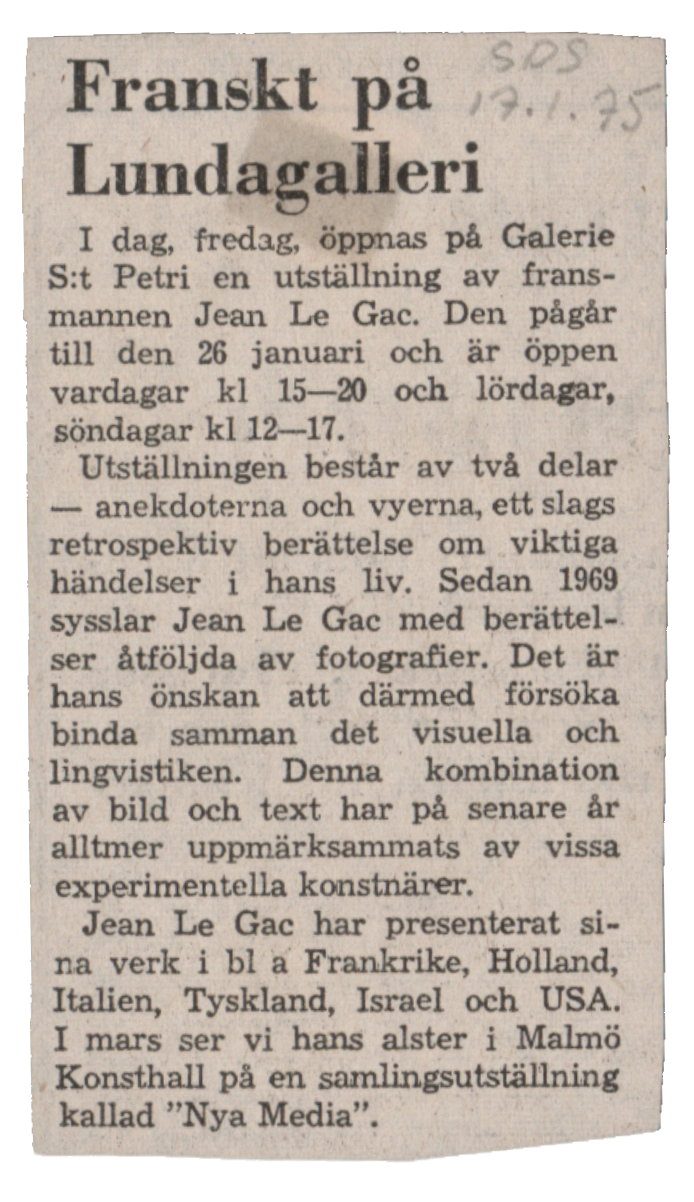
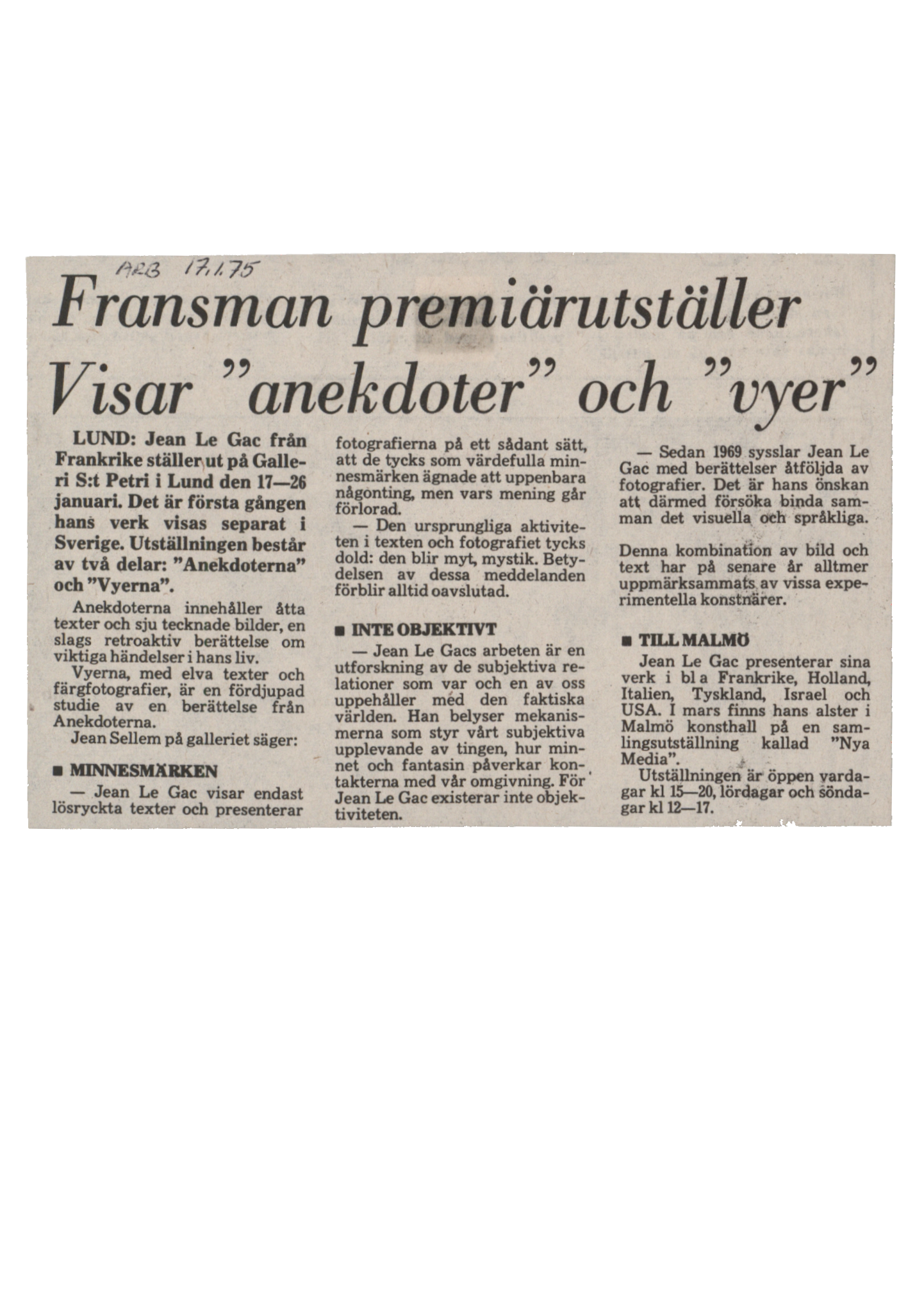
Jean Le Gac from France exhibits at Galerie S:t Petri, Lund, from January 17 to 26, 1975. For the first time, his work is being shown separately in Sweden.
The exhibition consists of two parts — THE ANECDOTES and THE VIEWS. The former includes eight texts and seven drawings, a kind of retrospective narrative about important events in his life. THE VIEWS, with eleven texts and eleven color photographs, is an in-depth study of one of the stories from THE ANECDOTES.
Jean Le Gac presents only isolated texts and displays the photographs in such a way that they seem like precious memorials devoted to revealing something whose meaning has been lost. The original activity within the text and photograph seems hidden: it becomes a myth, a mystery. The meaning of these messages always remains unfinished. What matters, however, is the way in which they conceal a possible reality.
Jean Le Gac’s work is an exploration of the subjective relations that each of us maintains with the real world. He illuminates the mechanisms that govern our subjective experience of things — how memory and imagination affect our contact with our surroundings. For Jean Le Gac, objectivity does not exist.
Since 1969, Jean Le Gac has been working with narratives accompanied by photographs. It is his intention to try to unite visual and linguistic mysticism. This combination of image and text has in recent years increasingly attracted the attention of certain experimental artists.
Jean Le Gac has presented his works in France, the Netherlands, Italy, Germany, Israel, and the USA. In March, his works will be seen at Malmö Konsthall in a group exhibition called “New Media.”
The exhibition is open on weekdays from 3 p.m. to 8 p.m., and on Saturdays and Sundays from 12 noon to 5 p.m.