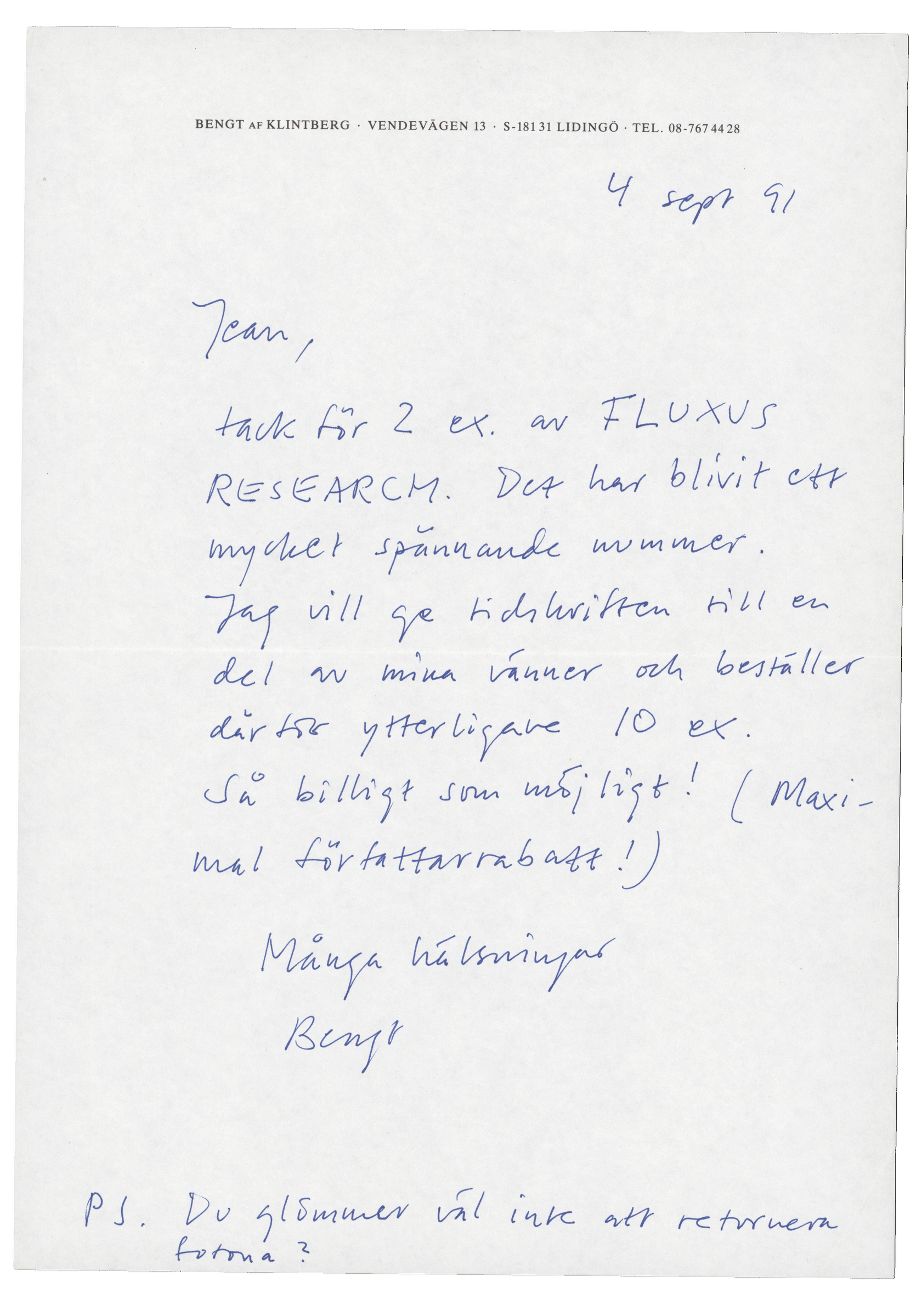
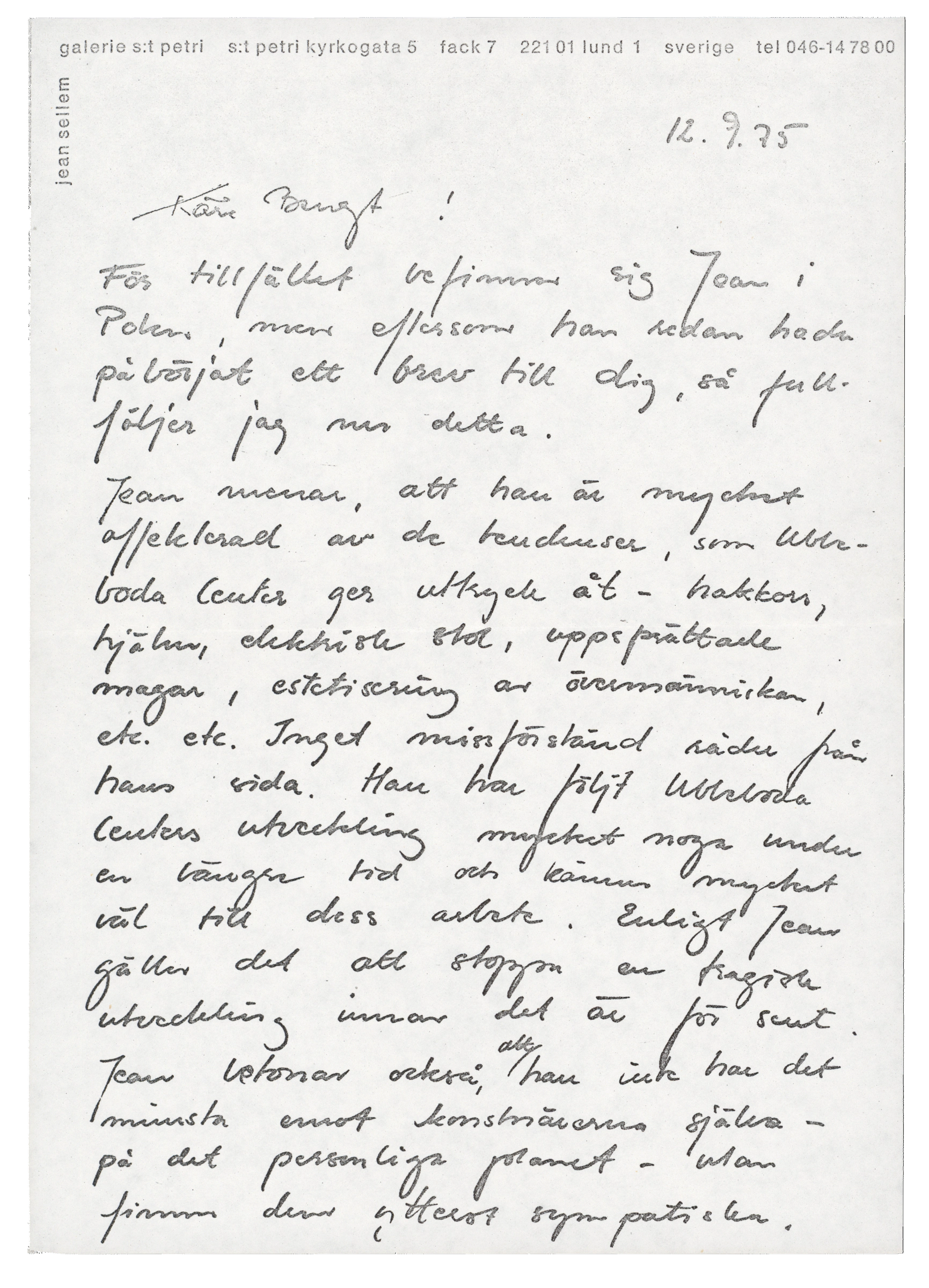
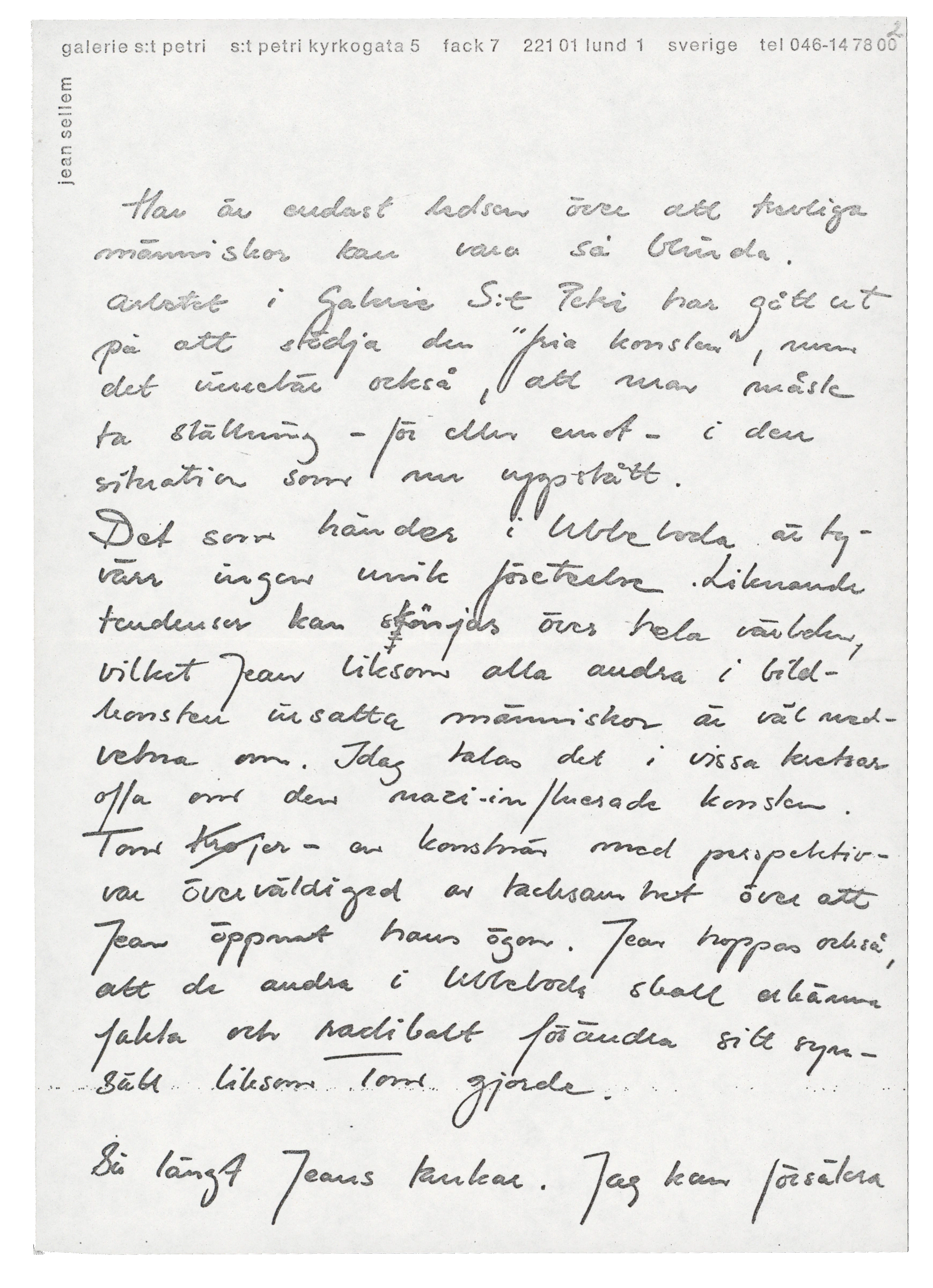
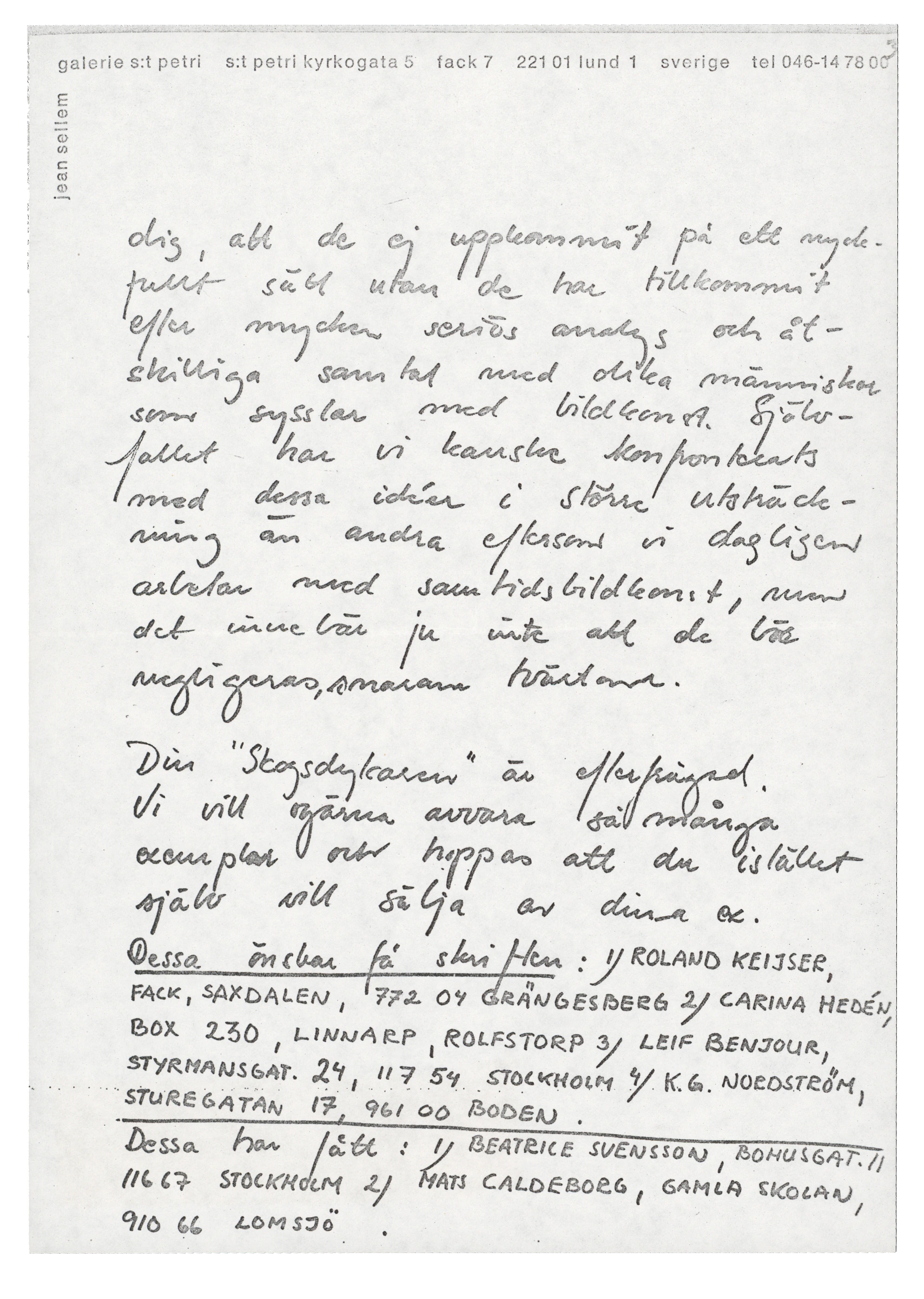
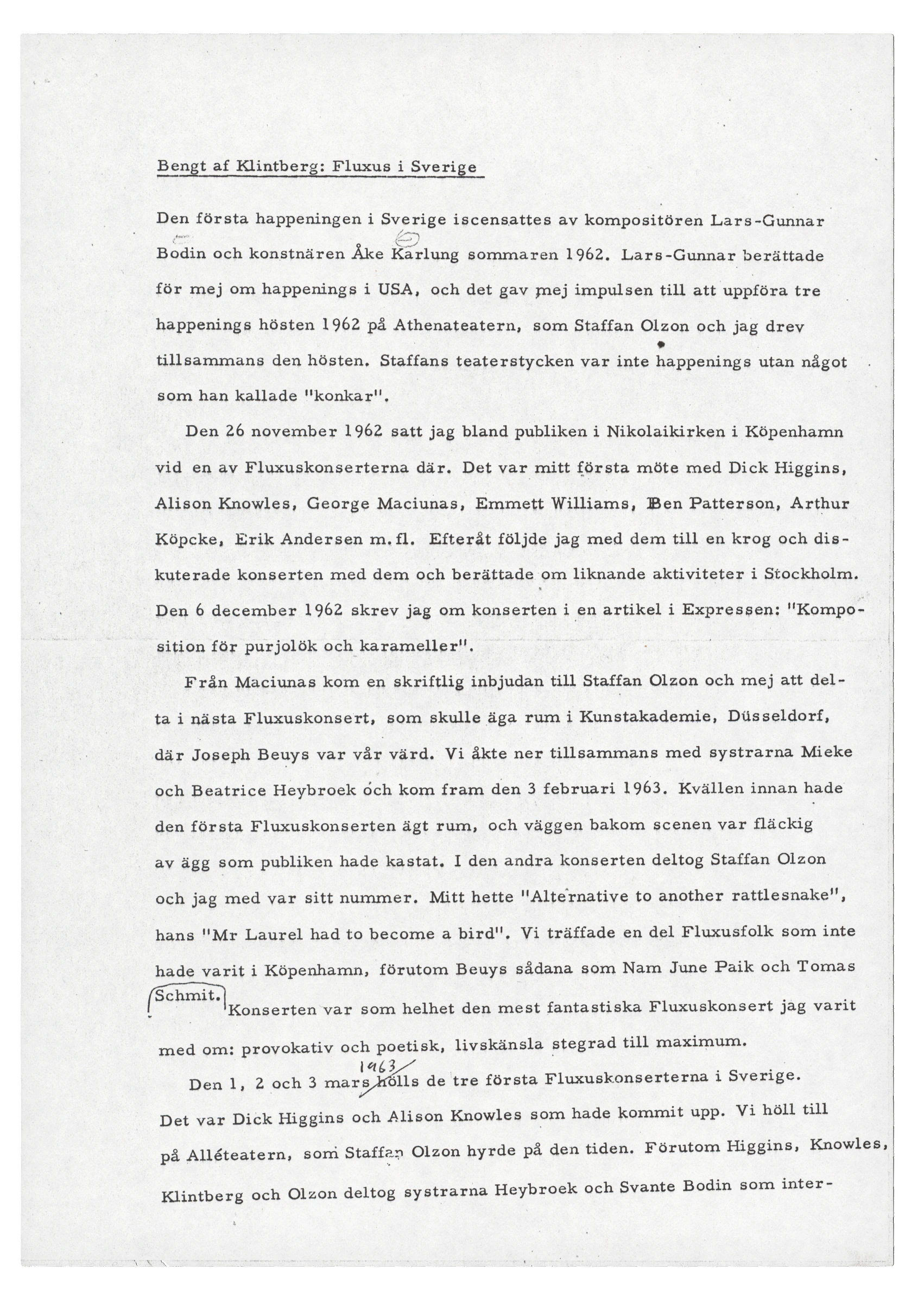
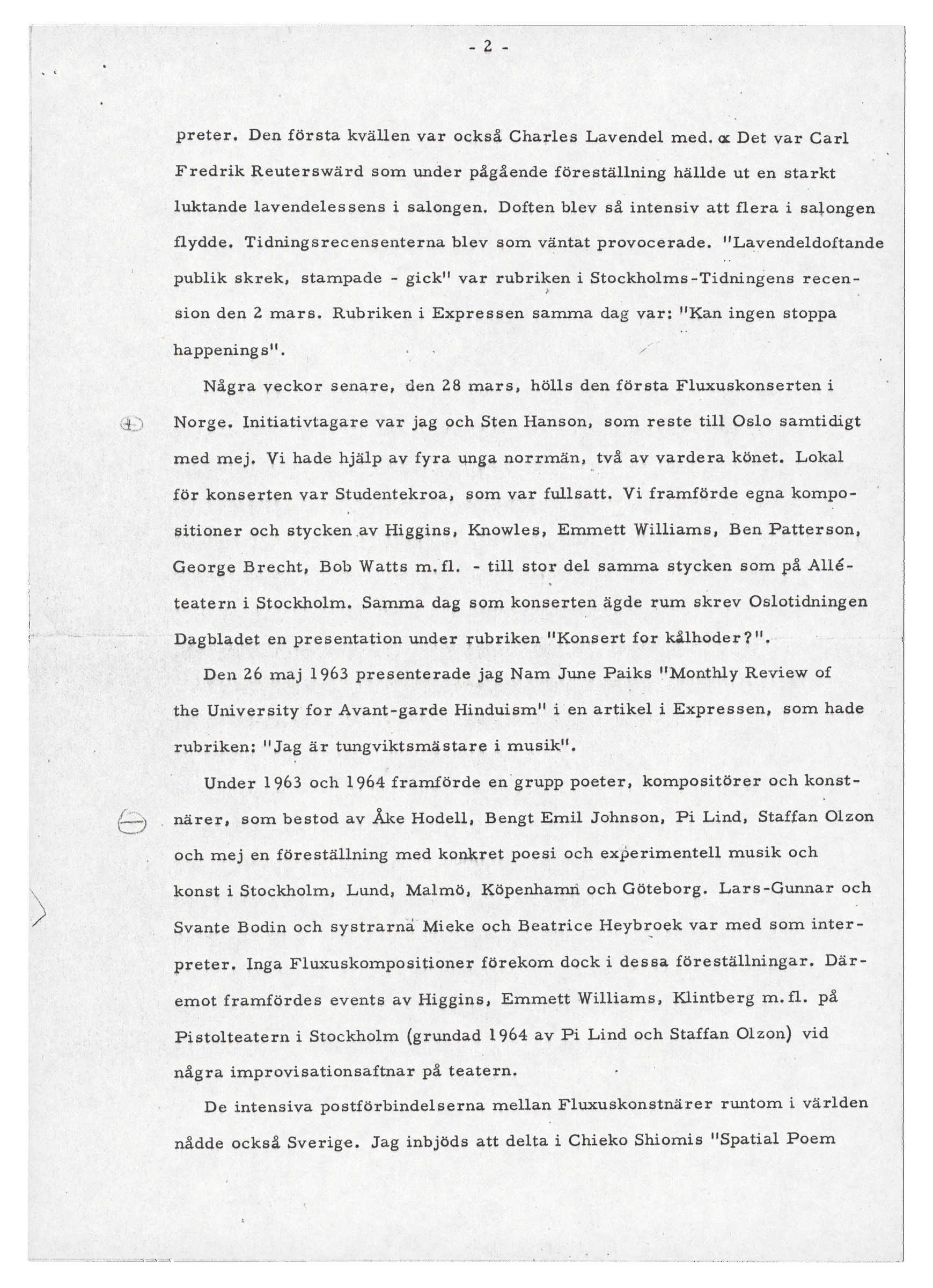
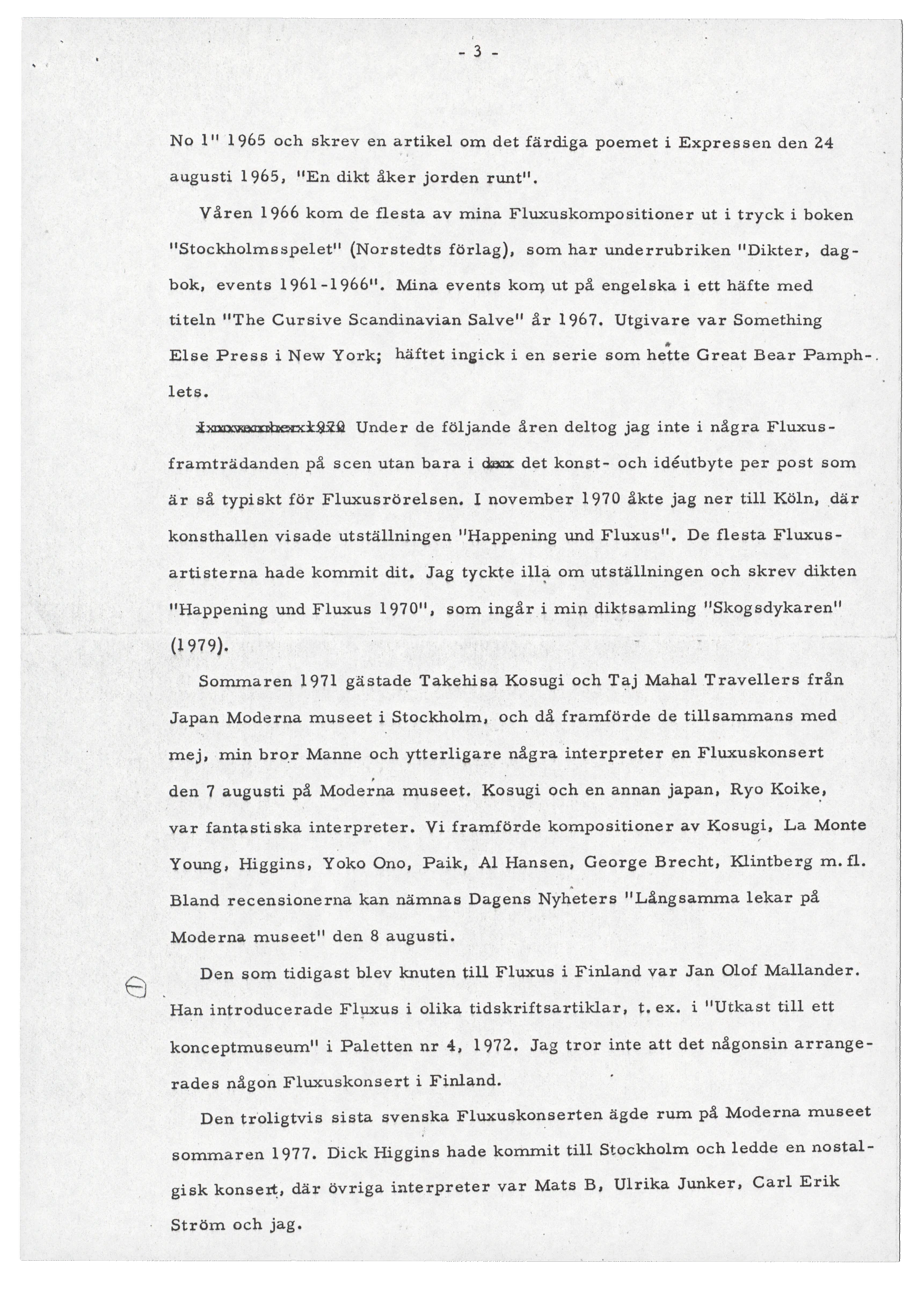
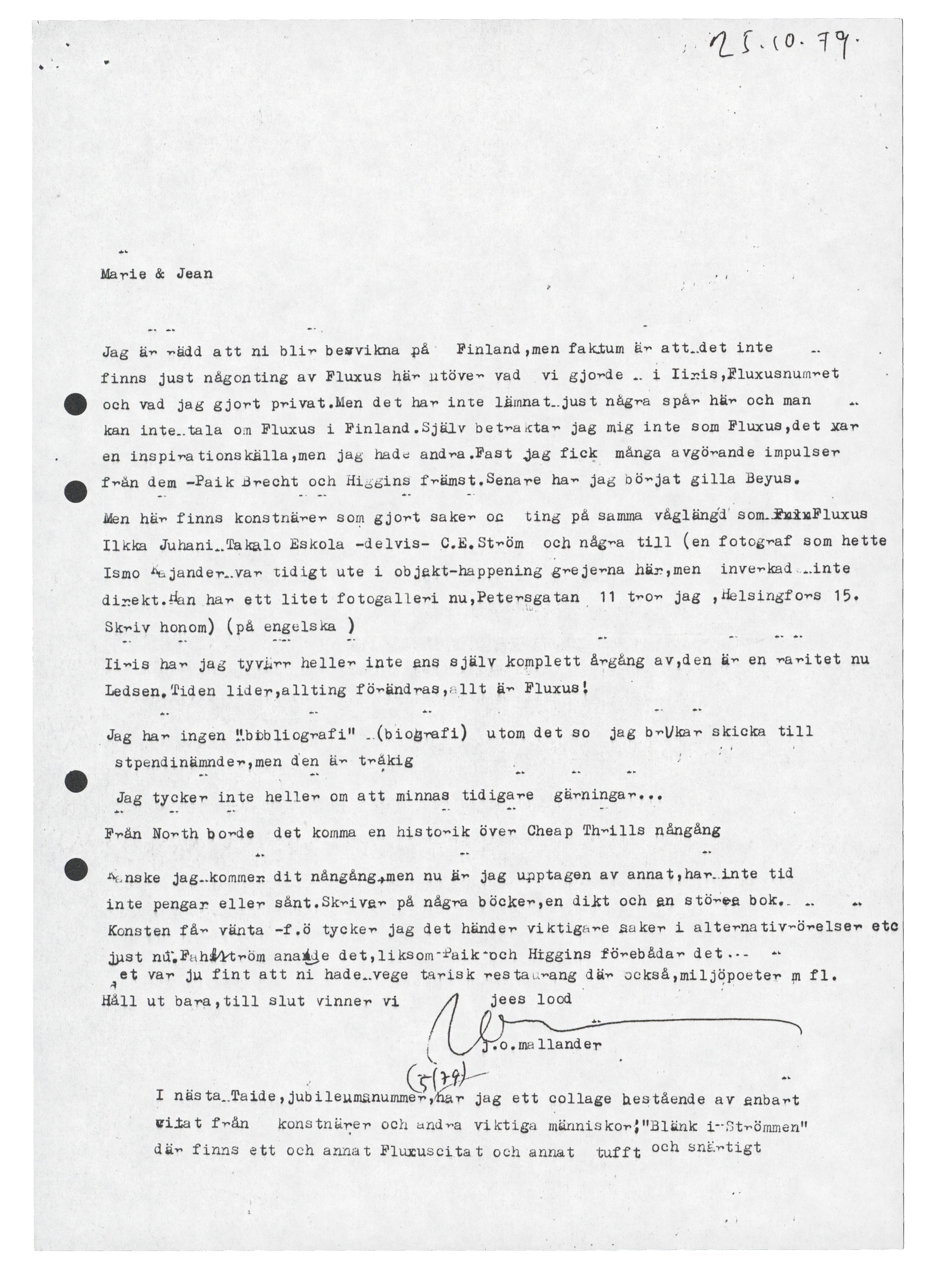
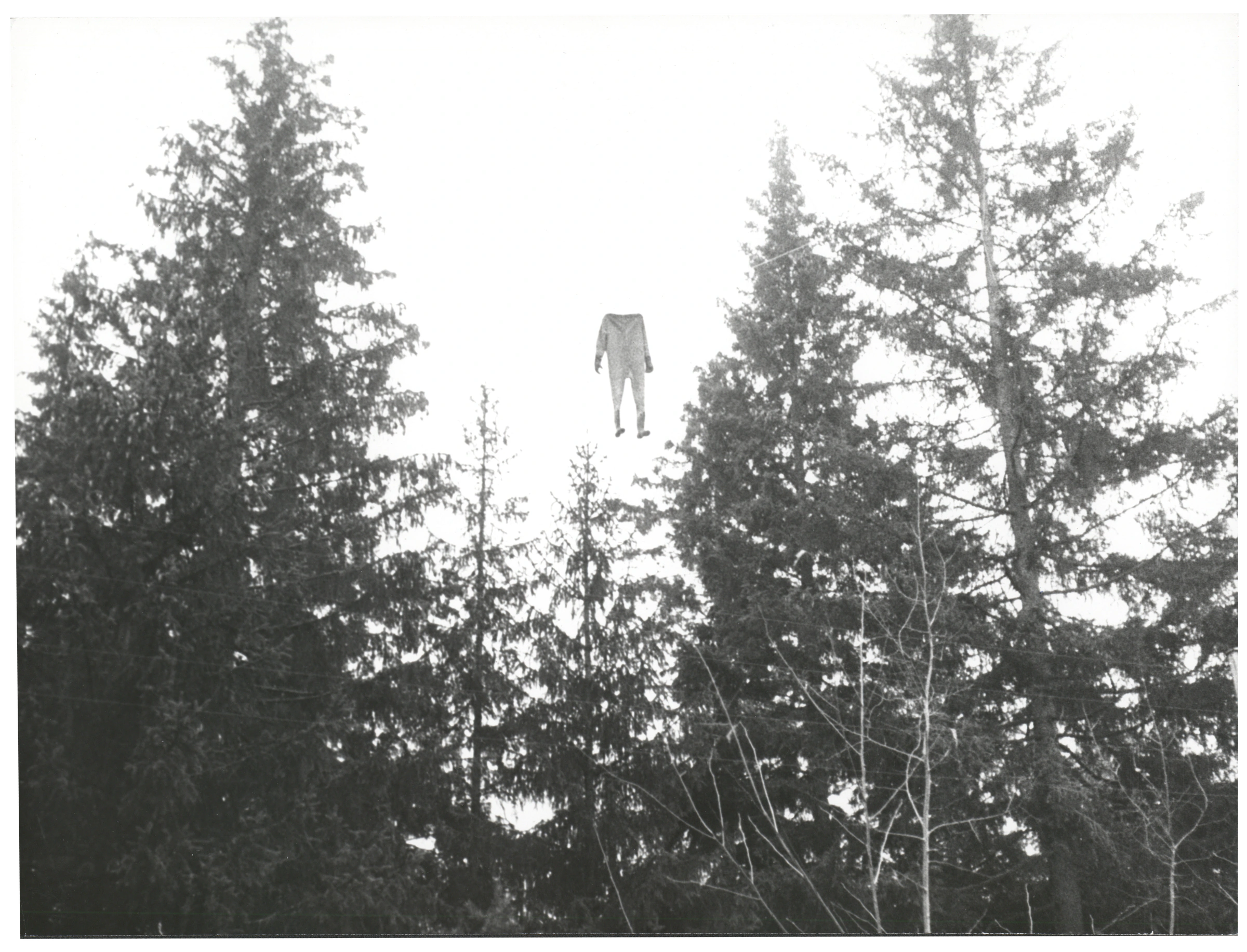
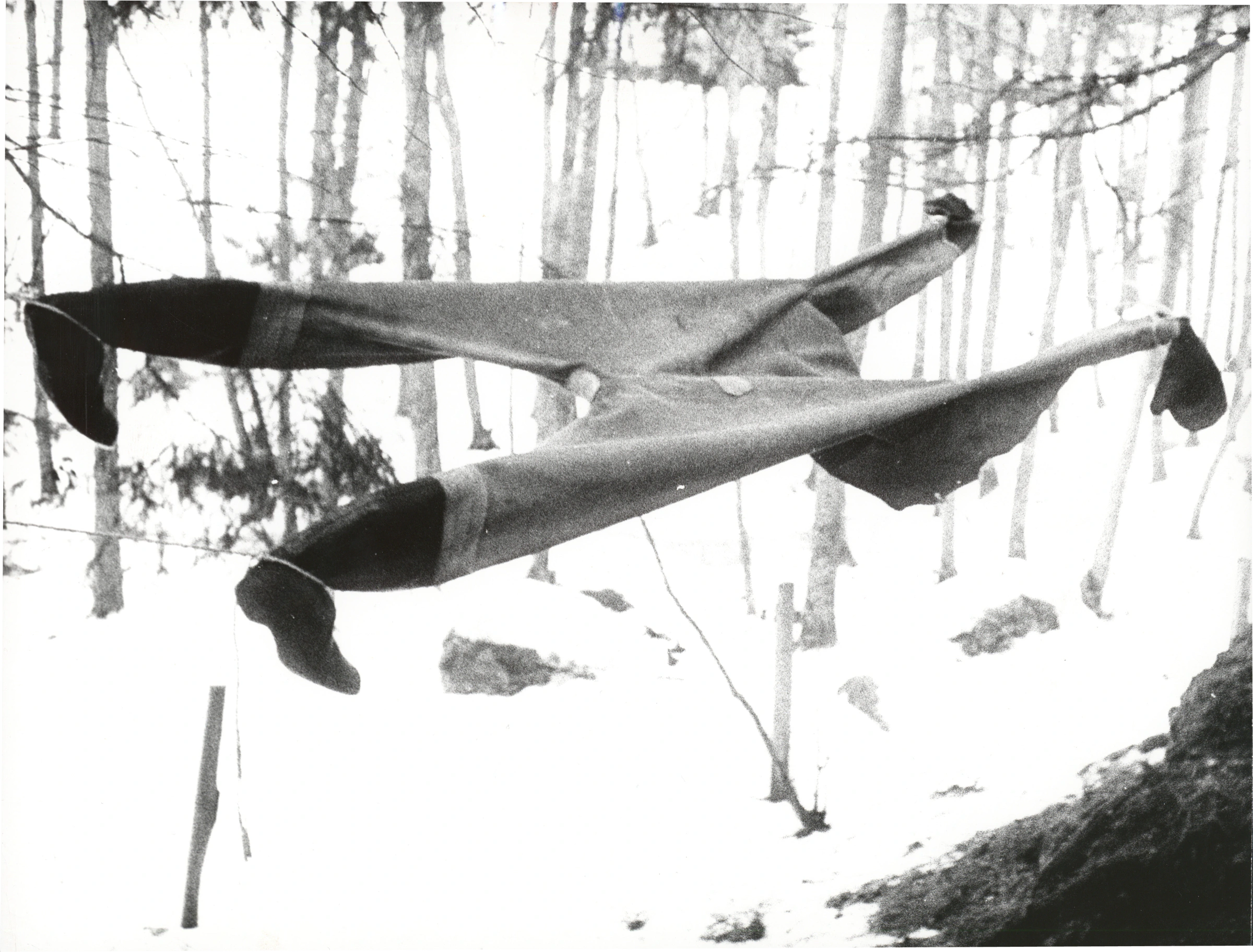
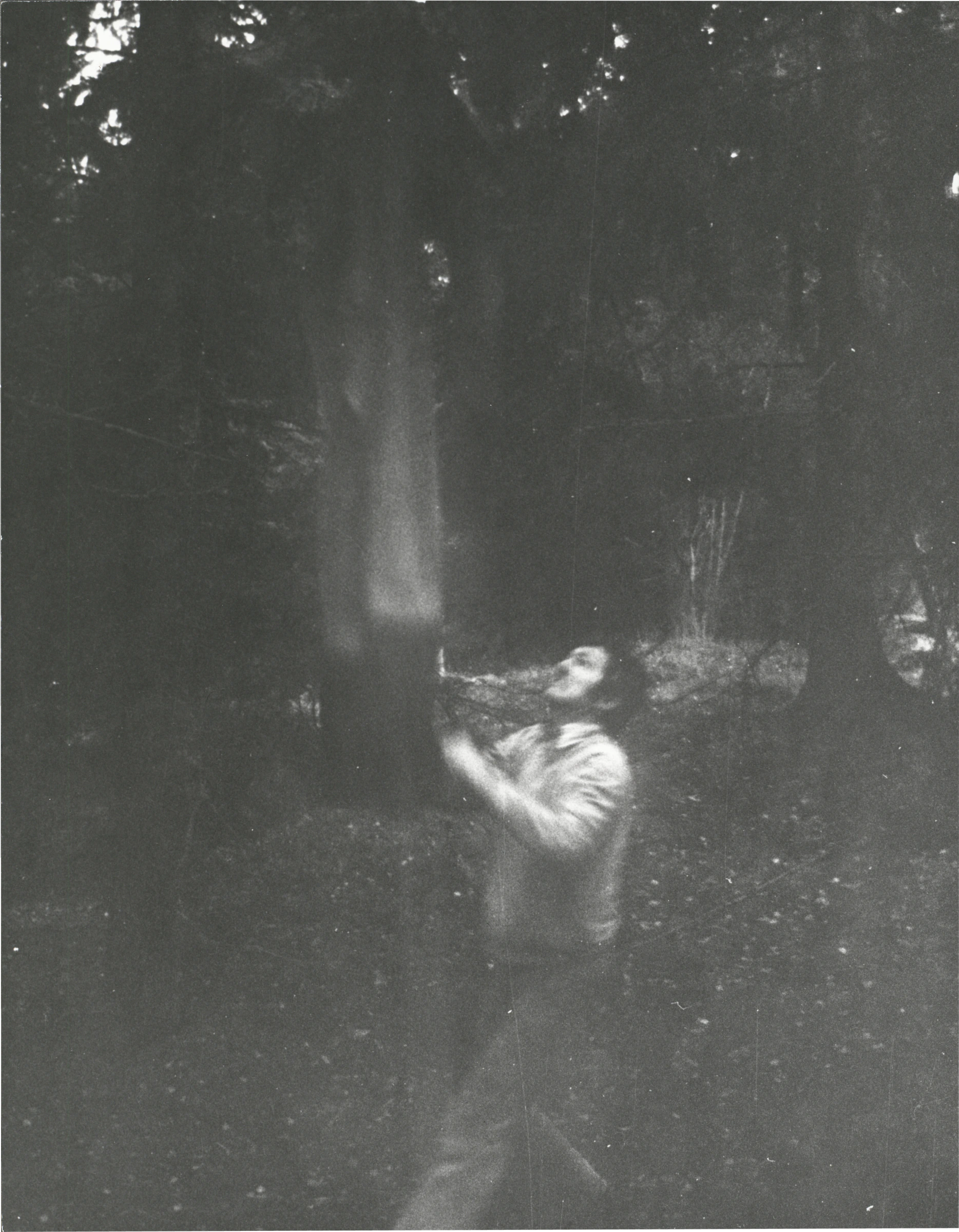
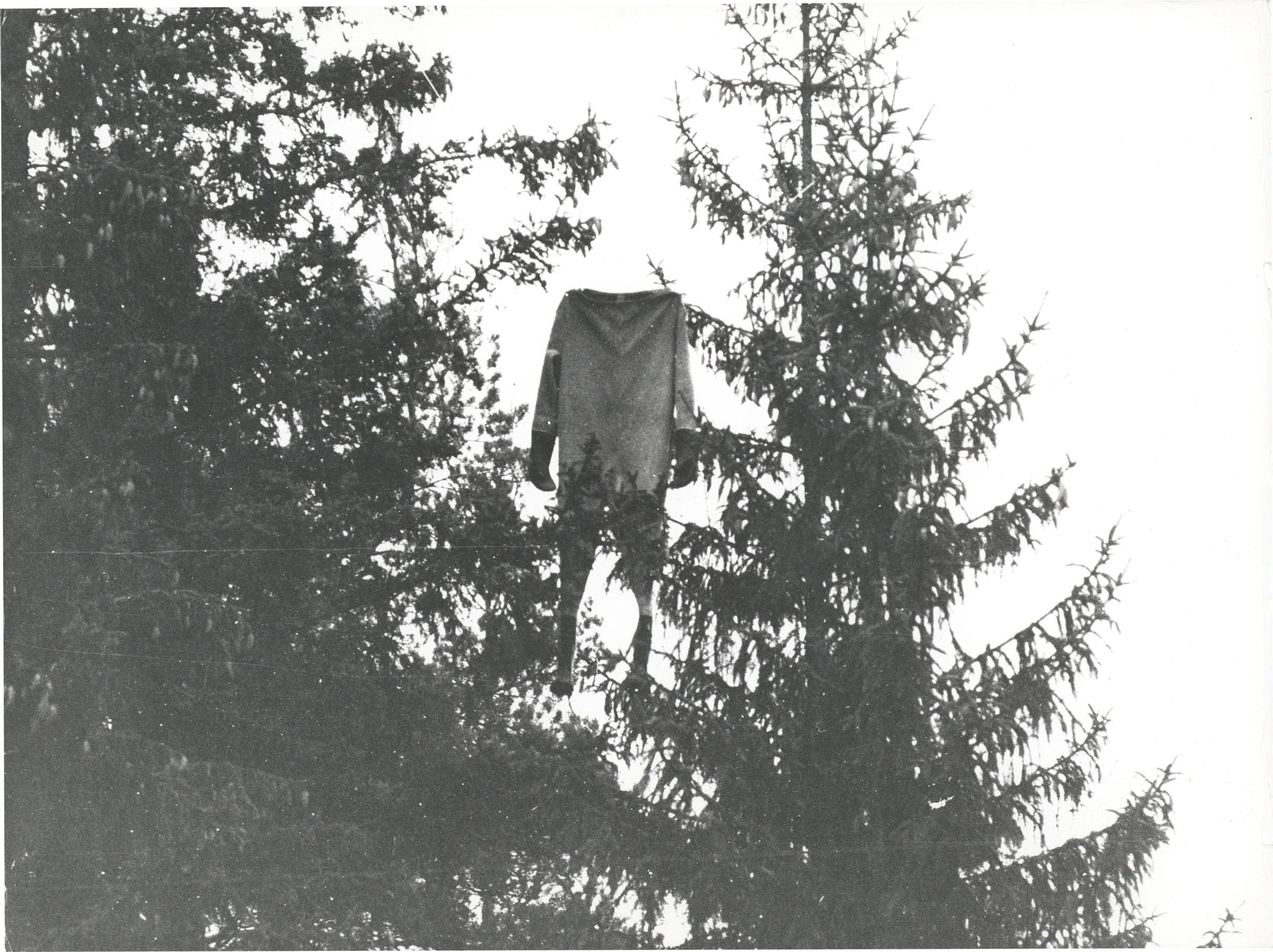
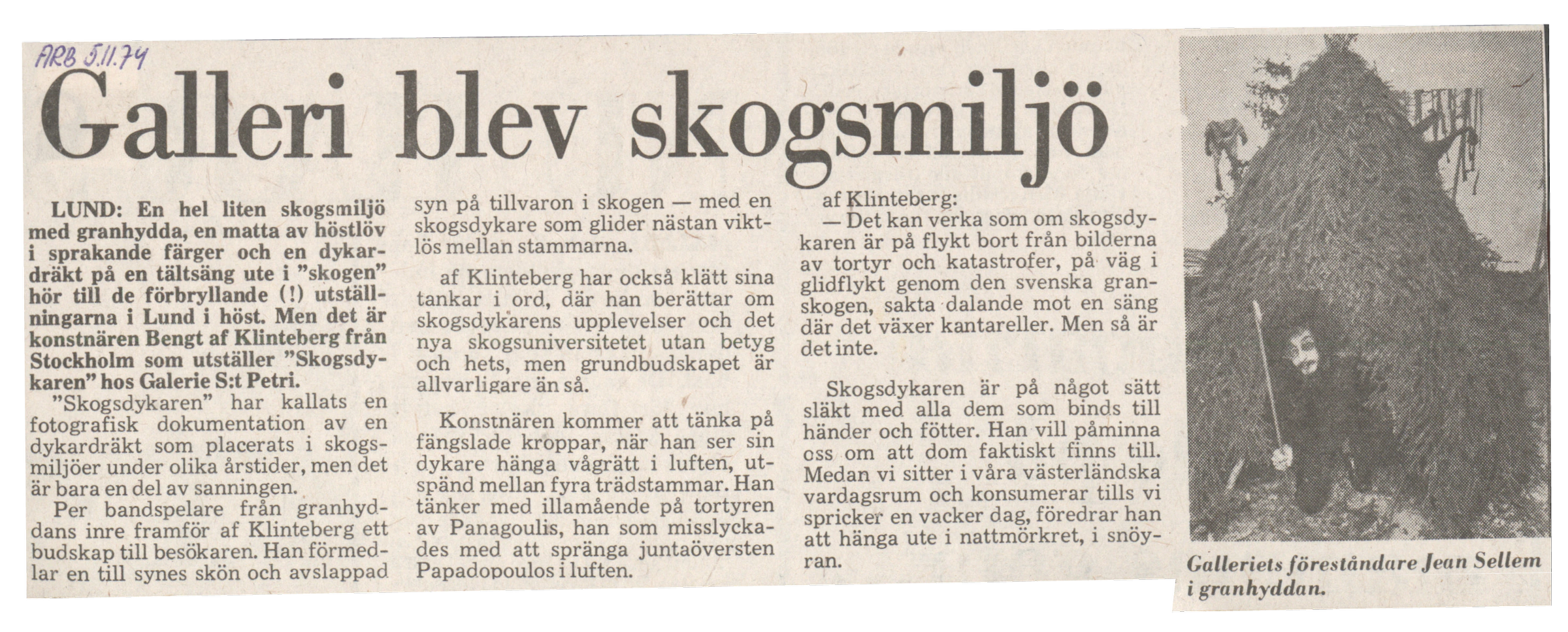
[JEANSELLEM VIEWER] — BENGT AF KLINTBERG Skogsdykaren (The Forest Diver) 26.10 -6.11.1974 — Categories: docs, letters, press, visual — Keywords: Galerie S:t Petri, Jean Sellem, archive — Category: docs — Dear Jean and Marie,Thank you for lending me the negatives. My radio programme about Ubbeboda will be broadcast on Sunday 19.10 at 9.15, with a repeat on 23.10 at 21.30. It has the title “Dragspel, japaner och svart granit”.Best wishesBengt — — — Category: docs — Bengt af Klintberg, who is exhibiting at Galerie S:t Petri from 26.10.–6.11., has in recent years worked primarily as a folklorist. Among other things, he has published the collections "Svenska trollformler" (1965), "Svensk folkpoesi" (1971, together with Finn Zetterholm) and "Svenska folksägner" (1972), and for several years he has taught folk literature at Stockholms Universitet.He began, however, as a poet and published two collections of nature poetry. In 1962 he was one of the first to introduce happenings in Sweden, and during the following years he wrote some drama, including "Lidner" for Pistolteatern in Stockholm. In 1966 the book "Stockholmspelet" appeared, which, in addition to poems and diary pages, contains a number of "events", that is, pieces that can be performed both on stage and in everyday life. The "event" as an art form was invented by the American George Brecht and has been developed mainly within an artists’ group with branches in the USA, Europe and Japan, called Fluxus. During 1963 and the years immediately following, Klintberg took part in Fluxus concerts in Düsseldorf, Köpenhamn, Stockholm and Oslo. Many of the Fluxus artists consistently refrained from producing permanent works of art and instead devoted themselves to creating actions that were art and that survived only as a memory among those present, or possibly in the form of photographs. In a couple of his own exhibitions, Klintberg applied Fluxus aesthetics in a Nordic environment. In April 1965, for example, he decorated a forest outside Stockholm with pieces of ice. The exhibition melted while the spectators walked around and viewed it. His exhibition at S:t Petri, SKOGSDYKAREN, which was shown earlier this autumn at Fylkingen in Stockholm, consists mainly of photographic documentation of a diving suit placed in forest environments during different seasons. — — — Category: letters — Hi Jean,I just wanted to write a few lines to tell you that Beatrice, whom you also got to know, is dead. We, her friends, are of course deeply affected today. — She was such a wonderful person in every way. Apparently she took sleeping pills. Many of us around her blame ourselves for the fact that this could happen.Bengt — — — Category: letters — galerie s:t petri s:t petri kyrkogata 5 fack 7 221 01 lund 1 sverige tel 046-14 78 00jean sellemYou may decide the price yourself. I would also like you to fill in the card from Bibliografiska Institutet and send it in.I hope the negatives will be useful to you. Send them back as soon as you have made the copies you want.I am also sending by post the 40:- that were to cover Jean’s travel expenses Malmö–Lund. Many thanks!Kind regardsMarie — — — Category: letters — Jean,Thank you for 2 copies of FLUXUS RESEARCH. It has turned out to be a very exciting issue.I would like to give the journal to some of my friends and therefore order another 10 copies. As cheaply as possible! (Maximum author’s discount!)Best wishes,BengtP.S. You won’t forget to return the photographs, will you?4 September 1991 — — — Category: letters — galerie s:t petri s:t petri kyrkogata 5 fack 7 221 01 lund 1 sverige tel 046-14 78 00jean sellem12.9.75Dear Bengt!At the moment Jean is in Poland, but since he had already begun a letter to you, I am now completing it.Jean feels that he is very affected by the tendencies expressed by Ultveda Center – swastikas, helmets, the electric chair, stuffed bellies, the aestheticization of the Übermensch, etc. etc. There is no misunderstanding on his part. He has followed the development of Ultveda Center very closely over a long period and knows its work very well. According to Jean, it is a matter of stopping a dangerous development before it is too late. Jean also stresses that he has nothing whatsoever against the artists themselves – on a personal level – but finds them extremely likeable. — He is only saddened that sensible people can be so blind.The work of Galerie S:t Petri has been aimed at supporting “free art”, but that also means that one must take a position – for or against – in the situation as one perceives it.What is happening at Ultveda is unfortunately not a unique phenomenon. Similar tendencies can be discerned throughout the world, something of which Jean, like everyone else well versed in visual art, is fully aware. Today, in certain circles, there is often talk of Nazi-influenced art.Tom Krøjer – an artist with perspective – was overwhelmed with gratitude that Jean had opened his eyes. Jean also hopes that the others at Ultveda will at least understand the facts and radically change their point of view, as Tom did.So much for Jean’s thoughts. I can assure you — that they did not arise on a whim, but came about after very serious analysis and numerous conversations with different people involved in visual art. Naturally, we may have been confronted with these ideas to a greater extent than others, since we work with contemporary visual art every day, but that certainly does not mean [unclear] – rather the opposite.Your “Skogsdykaren” is in demand. We would gladly spare the following copies and hope that you will instead sell some of your own copies yourself.The following would like to receive the publication:1/ ROLAND KEIJSER,FACK, SAXDALEN, 772 04 GRÄNGESBERG2/ CARINA HEDÉN,BOX 230, LINNARP, ROLFSTORP3/ LEIF BENJOUR,STYRMANSGAT. 24, 117 59 STOCKHOLM4/ K.G. NORDSTRÖM,STUREGATAN 17, 961 00 BODEN.The following have received it:1/ BEATRICE SVENSSON, BOMHUSGAT. 11116 67 STOCKHOLM2/ MATS CALDEBORG, GAMLA SKOLAN,910 66 LOMSJÖ — — — Category: press — Bengt af Klintberg: Fluxus in SwedenThe first happening in Sweden was staged by the composer Lars-Gunnar Bodin and the artist Åke Karlung in the summer of 1962. Lars-Gunnar told me about happenings in the USA, and that gave me the impulse to present three happenings in the autumn of 1962 at the Athena Theatre, which Staffan Olzon and I ran together that autumn. Staffan’s theatre pieces were not happenings but something he called "konkar".On 26 November 1962 I was sitting among the audience in St Nicholas Church in Copenhagen at one of the Fluxus concerts there. It was my first meeting with Dick Higgins, Alison Knowles, George Maciunas, Emmett Williams, Ben Patterson, Arthur Köpcke, Erik Andersen and others. Afterwards I went with them to a café and discussed the concert with them and told them about similar activities in Stockholm. On 6 December 1962 I wrote about the concert in an article in Expressen: "Composition for Leek and Sweets".From Maciunas came a written invitation to Staffan Olzon and me to take part in the next Fluxus concert, which was to take place at the Kunstakademie in Düsseldorf, where Joseph Beuys was our host. We travelled down together with the sisters Mieke and Beatrice Heybroek and arrived on 3 February 1963. The evening before, the first Fluxus concert had taken place, and the wall behind the stage was stained with eggs that the audience had thrown. In the second concert, Staffan Olzon and I each took part with one piece. Mine was called "Alternative to another rattlesnake", his "Mr Laurel had to become a bird". We met some Fluxus people who had not been in Copenhagen, besides Beuys, such as Nam June Paik and Tomas Schmit. Taken as a whole, the concert was the most fantastic Fluxus concert I have taken part in: provocative and poetic, with a sense of life intensified to the maximum.On 1, 2 and 3 March the first three Fluxus concerts in Sweden were held. Dick Higgins and Alison Knowles had come up. We were at the Allé Theatre, which Staffan Olzon was renting at the time. Besides Higgins, Knowles, Klintberg and Olzon, the sisters Heybroek and Svante Bodin took part as inter- — preters. On the first evening Charles Lavendel also took part. It was Carl Fredrik Reuterswärd who, during the performance, poured a strongly scented lavender essence into the auditorium. The smell became so intense that several people in the audience fled. As expected, the newspaper critics were provoked. "Lavender-scented audience screamed, stamped — left" was the headline of Stockholms-Tidningen’s review on 2 March. The headline in Expressen the same day was: "Can no one stop happenings?".A few weeks later, on 28 March, the first Fluxus concert in Norway was held. The initiators were Sten Hanson and I, and he travelled to Oslo at the same time as I did. We were helped by four young Norwegians, two of each sex. The venue for the concert was Studenterkroa, which was full. We performed our own compositions and pieces by Higgins, Knowles, Emmett Williams, Ben Patterson, George Brecht, Bob Watts and others — to a large extent the same pieces as at the Allé Theatre in Stockholm. On the same day that the concert took place, the Oslo newspaper Dagbladet published a presentation under the headline "(illisible)".On 26 May 1963 I presented Nam June Paik’s "Monthly Review of the University for Avant-garde Hinduism" in an article in Expressen, which bore the headline: "I am the heavyweight champion of music".During 1963 and 1964 a group of poets, composers and artists, consisting of Åke Hodell, Bengt Emil Johnson, Pi Lind, Staffan Olzon and myself, gave a performance with concrete poetry and experimental music and art in Stockholm, Lund, Malmö, Copenhagen and Gothenburg. Lars-Gunnar and Svante Bodin and the sisters Mieke and Beatrice Heybroek took part as interpreters. No Fluxus compositions occurred in these performances, however. Instead, events by Higgins, Emmett Williams, Klintberg and others were performed at Pistolteatern in Stockholm (founded in 1964 by Pi Lind and Staffan Olzon) during a few evenings of improvisation at the theatre.The intensive postal connections between Fluxus artists around the world also reached Sweden. I was invited to take part in Chieko Shiomi’s "Spatial Poem — No. 1" in 1965 and wrote an article about the finished poem in Expressen on 24 August 1965, "A Poem Travels Around the Earth".In the spring of 1966 most of my Fluxus compositions were published in the book "Stockholmsspelet" (Norstedts publishing house), which bears the subtitle "Poems, diary, events 1961–1966". My events were published in English in a booklet entitled "The Cursive Scandinavian Salve" in 1967. The publisher was Something Else Press in New York; the booklet formed part of a series called Great Bear Pamphlets.(illisible) During the following years I did not take part in any Fluxus performances on stage, but only in the exchange of art and ideas by post that is so typical of the Fluxus movement. In November 1970 I travelled down to Cologne, where the Kunsthalle was showing the exhibition "Happening und Fluxus". Most of the Fluxus artists had come there. I disliked the exhibition and wrote the poem "Happening und Fluxus 1970", which is included in my poetry collection "Skogsdykaren" (1979).In the summer of 1971 Takehisa Kosugi and the Taj Mahal Travellers from Japan visited the Moderna Museet in Stockholm, and there they, together with me, my brother Manne and several additional performers, gave a Fluxus concert on 7 August at the Moderna Museet. Kosugi and another Japanese artist, Ryo Koike, were fantastic performers. We performed compositions by Kosugi, La Monte Young, Higgins, Yoko Ono, Paik, Al Hansen, George Brecht, Klintberg and others. Among the reviews one may mention Dagens Nyheter’s "Slow Games at the Moderna Museet" of 8 August.The person who was earliest connected with Fluxus in Finland was Jan Olof Mallander. He introduced Fluxus in various journal articles, for example in "Draft for a Concept Museum" in Paletten no. 4, 1972. I do not believe that any Fluxus concert was ever arranged in Finland.The probably last Swedish Fluxus concert took place at the Moderna Museet in the summer of 1977. Dick Higgins had come to Stockholm and led a nostalgic concert, in which the other performers were Mats B, Ulrika Junker, Carl Erik Ström and myself. — 25.10.79Marie & Jean,I am afraid that you will be disappointed by Finland, but the fact is that there is really nothing of Fluxus here apart from what we did in Iris, the Fluxus issue, and what I have done privately. But it has left hardly any traces here, and one cannot speak of Fluxus in Finland. I myself do not regard myself as Fluxus; it was a source of inspiration, but I had others. Even so, I received many decisive impulses from them — above all from Paik, Brecht and Higgins. Later I have begun to like Beuys.But there are artists here who have done things on the same wavelength as Fluxus: Ilkka Juhani Takalo-Eskola — partly — C.E. Ström and a few others (a photographer named Ismo Kajander was early involved in object/happening things here, though not directly influenced. He now has a small photo gallery, at Petersgatan 11, I think, Helsinki 15. Write to him) (in English).Unfortunately I myself do not even have a complete run of Iris; it is a rarity now. Sorry. Time passes, everything changes, everything is Fluxus!I have no "bibliography" (biography) except the one I usually send to grant committees, but it is boring.Nor do I like remembering earlier deeds...A history of Cheap Thrills ought to be coming from North at some point.Perhaps I will come there sometime, but right now I am occupied with other things, have neither time nor money nor such things. I am writing a few books, a poem and a larger book... Art must wait — besides, I think more important things are happening in alternative movements, etc., right now. Fahlström sensed that, just as Paik and Higgins foreshadow it... It was nice that you also had a vegetarian restaurant there, environmental poets, etc.Just hold on — in the end we shall win.jees loodj.o. mallanderIn the next issue of Taide, the jubilee issue, I have a collage consisting solely of quotations from artists and other important people; "Blänk i Strömmen". There are one or two Fluxus quotations there, and other tough and snappy things. — — — Category: visual — — — Category: visual — — — Category: visual — — — Category: visual — — — Category: visual — — — Category: visual — — — Category: visual — — — Category: visual — — — Category: visual — — — Category: visual — — — Category: press — Gallery transformed into a forest environmentLUND: A whole little forest environment, with a spruce-branch hut, a carpet of autumn leaves in brilliant colours and a diving suit on a tent pole out in the “forest”, is among the bewildering (!) exhibitions in Lund this autumn. But it is the Stockholm artist Bengt af Klintberg who is exhibiting “The Forest Diver” at Galerie S:t Petri.“The Forest Diver” has been described as a photographic documentation of a diving suit placed in forest environments during different seasons, but that is only part of the truth.Through a tape recorder inside the spruce-branch hut, af Klintberg delivers a message to the visitor. He conveys an apparently beautiful and relaxed view of existence in the forest — with a forest diver gliding almost weightlessly between the tree trunks.Af Klintberg has also put his thoughts into words, telling of the forest diver’s experiences and of the new forest university without grades or pressure, but the underlying message is more serious than that.The artist thinks of imprisoned bodies when he sees his diver hanging horizontally in the air, stretched between four tree trunks. He thinks with nausea of the torture of Panagoulis, who failed in his attempt to blow up the junta colonel Papadopoulos.Af Klintberg:— It may seem as though the forest diver is fleeing from images of torture and catastrophes, gliding through the Swedish spruce forest, slowly descending towards a bed where chanterelles are growing. But that is not the case.The forest diver is in some way kindred to all those who are bound hand and foot. He wants to remind us that they really do exist. While we sit in our Western living rooms and consume until one fine day we burst, he prefers to hang outside in the darkness of night, in the driving snow.[Caption]The gallery’s director Jean Sellem in the spruce-branch hut.Arbetet, 5 November 1974 — — — Category: press — — — Category: press — <p><span style="color: rgb(17, 17, 17);">SKD, 25. Oktober 1974</span></p> — Diving suit as artBengt af Klintberg is exhibiting at Galerie S:t Petri from 26 October to 6 November. In recent years he has primarily been active as a folklorist. Among other things, he has published the collections “Svenska trollformler” (Swedish Magic Spells, 1965), “Svensk folkpoesi” (Swedish Folk Poetry, 1971, together with Finn Zetterholm) and “Svenska folksägner” (Swedish Folk Legends, 1972), and for several years he has taught folklore at Stockholm University.He began, however, as a poet and published two collections of nature poetry. In 1962 he was one of the first to introduce happenings in Sweden, and during the following years he wrote a number of dramatic works, including “Lidner” for the Pistolteatern in Stockholm. In 1966 the book “Stockholmsspelet” appeared, which, in addition to poems and diary pages, contains a series of “events”, that is, pieces that can be performed both on stage and in everyday life. The “event” as an art form was invented by the American George Brecht and has been cultivated above all within an artists’ group with branches in the USA, Europe and Japan, known as Fluxus. During 1963 and the following years, Klintberg took part in Fluxus concerts in Düsseldorf, Copenhagen, Stockholm and Oslo. Many Fluxus artists consistently refrained from producing permanent works of art and devoted themselves instead to creating actions that were art and survived only as a memory among those present, or possibly in the form of photographs. In a couple of his own exhibitions, Klintberg applied Fluxus aesthetics to a Nordic environment. In April 1965, for example, he decorated a forest outside Stockholm with pieces of ice. The exhibition melted while the spectators walked around looking at it. His exhibition at S:t Petri, THE FOREST DIVER (which was shown earlier this autumn at Fylkingen in Stockholm), consists mainly of photographic documentation of a diving suit placed in forest environments during different seasons. — — — Category: press — <p><span style="color: rgb(17, 17, 17);">SDS, 26. Oktober 1974</span></p> — Forest Diver at art exhibitionBengt af Klintberg, folklorist, poet, playwright and Fluxus artist, decorated a forest outside Stockholm in 1965 with pieces of ice, which melted away as the spectators walked around and viewed the exhibition.On Saturday he is opening an exhibition at Galerie S:t Petri in Lund. It is called "The Forest Diver" and consists primarily of photographic documentation of a diving suit placed in forest environments during different seasons.
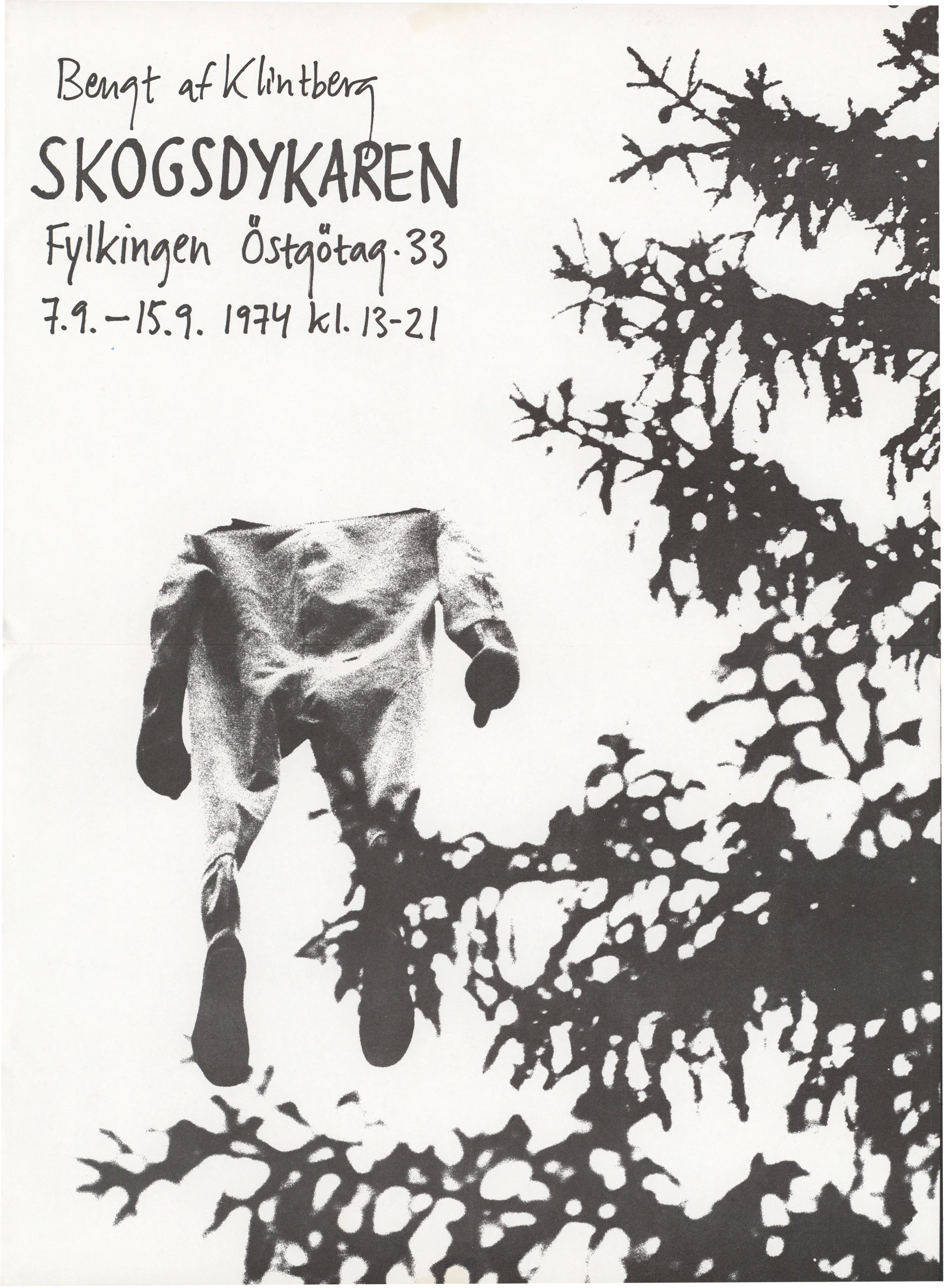
BENGT AF KLINTBERGSkogsdykaren (The Forest Diver)26.10 -6.11.1974
BENGT AF KLINTBERGSkogsdykaren (The Forest Diver)26.10 -6.11.1974
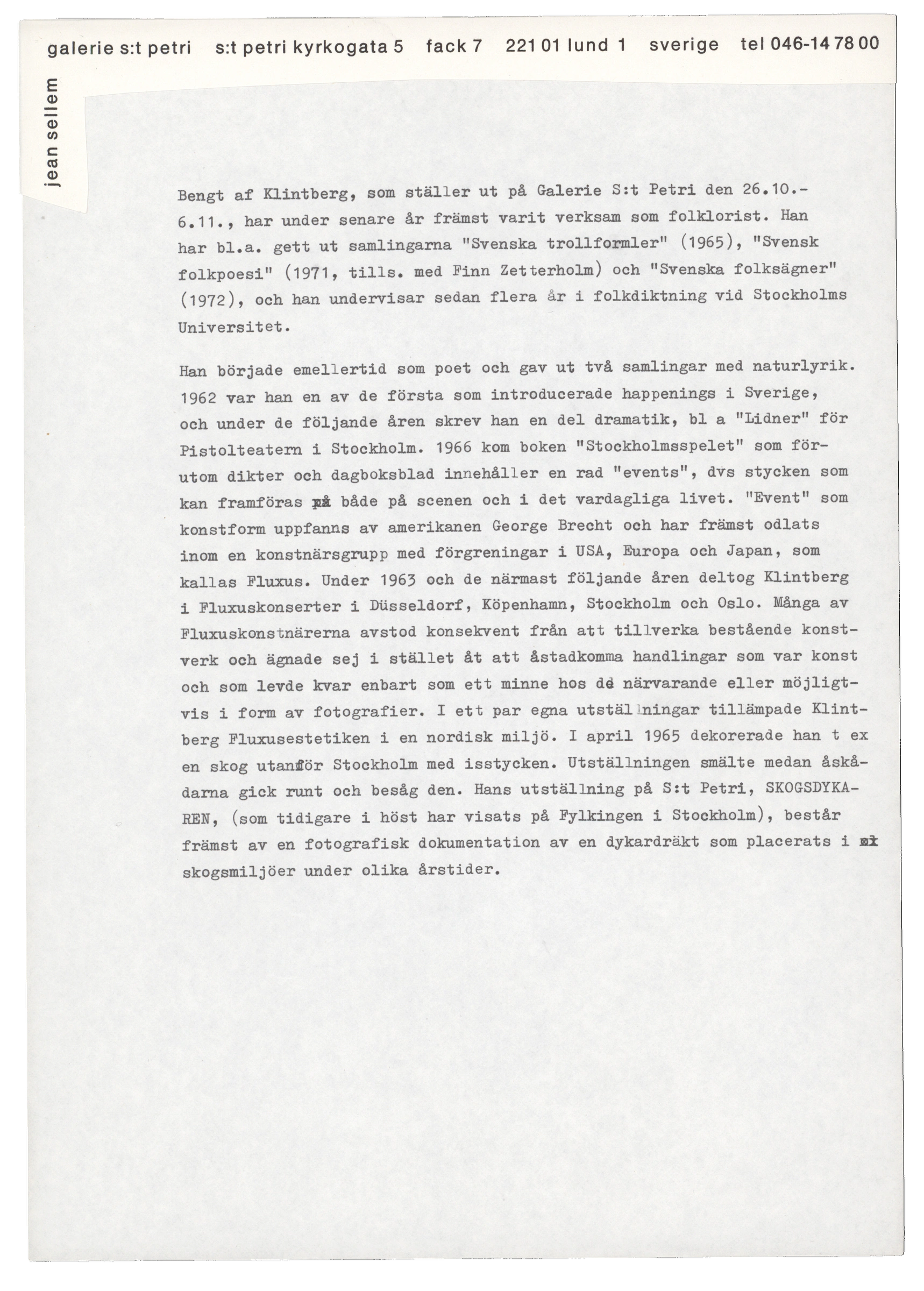
galerie s:t petri s:t petri kyrkogata 5 — fack 7 — 22101 lund 1 — sweden — tel 046-147800
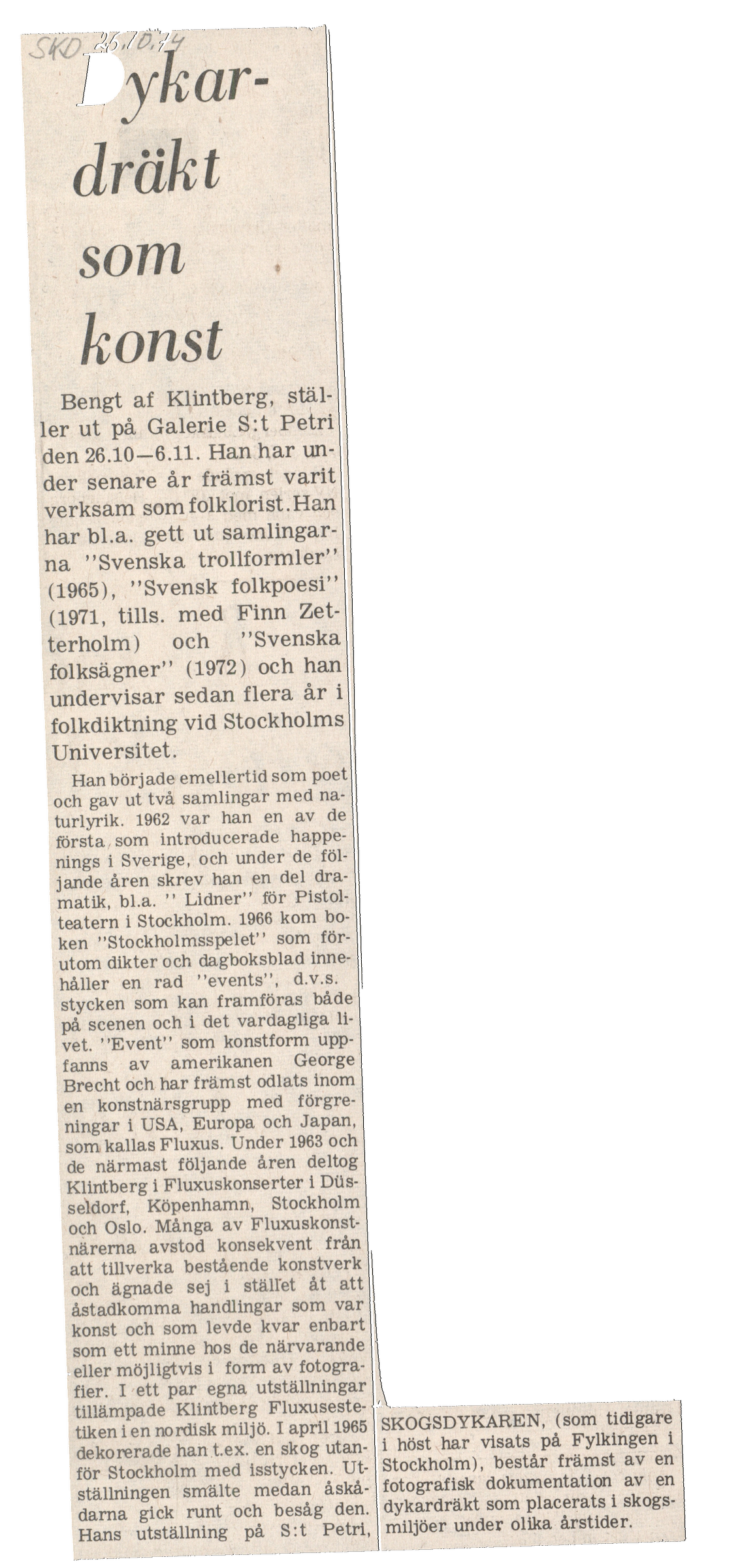
Bengt af Klintberg, who is exhibiting at Galerie S:t Petri from October 26 to November 6, has in recent years mainly been active as a folklorist. He has published the collections “Svenska trollformler” (Swedish Spells, 1965), “Svensk folkpoesi” (Swedish Folk Poetry, 1971, together with Finn Zetterholm), and “Svenska folksägner” (Swedish Folk Legends, 1972). For several years he has also taught folklore at Stockholm University.
However, he began as a poet, publishing two collections of nature poetry. In 1962, he was one of the first to introduce happenings in Sweden, and during the following years he wrote several plays, including “Lidner” for Pistolteatern in Stockholm.
In 1966 he published the book “Stockholmsspelet” (The Stockholm Game), which — besides poems and diary entries — contains a series of “events”, that is, pieces that can be performed both on stage and in everyday life. The concept of “event” was invented by the American George Brecht and developed mainly within an artists’ group and its branches in the USA, Europe, and Japan known as Fluxus.
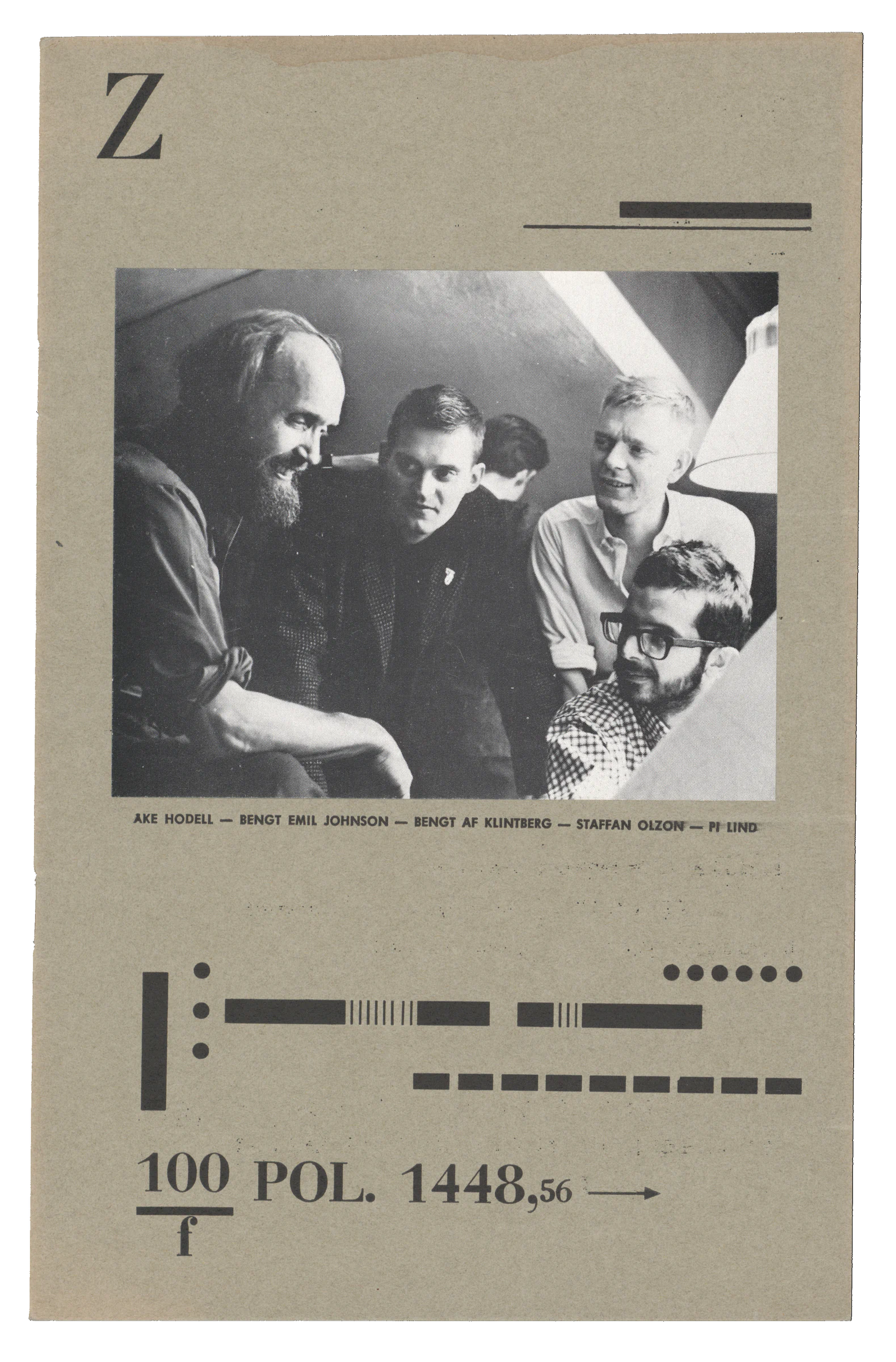
During 1963 and the following years, Klintberg participated in Fluxus concerts in Düsseldorf, Copenhagen, Stockholm, and Oslo. Many Fluxus artists consistently refrained from producing enduring art objects and instead devoted themselves to creating actions that were art and that survived only as memories among those present — or, at most, as photographs.
In a few of his own exhibitions, Klintberg transplanted Fluxus aesthetics into a Nordic environment. In April 1965, for example, he decorated a forest outside Stockholm with blocks of ice. The exhibition melted while the audience walked around and viewed it.
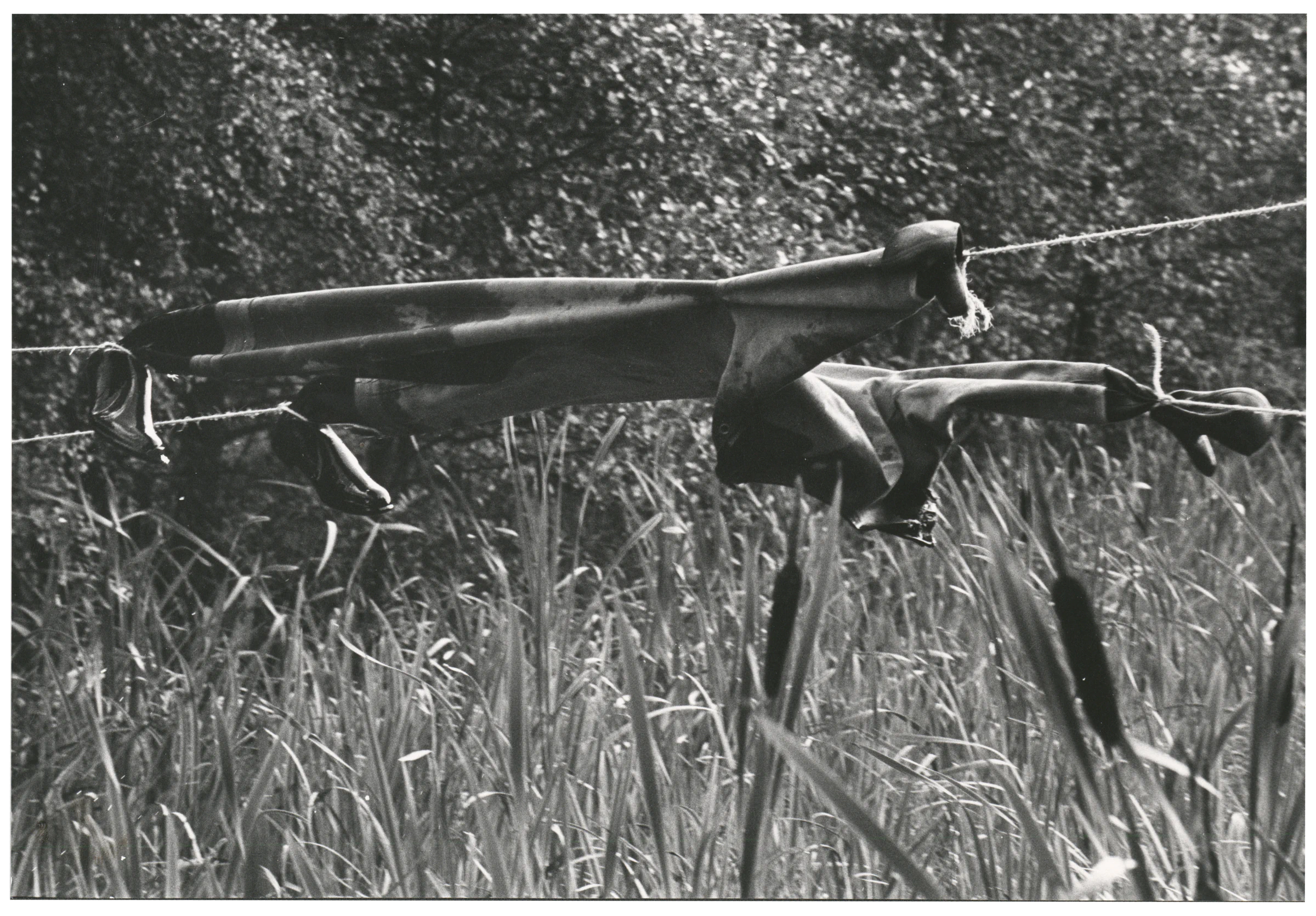
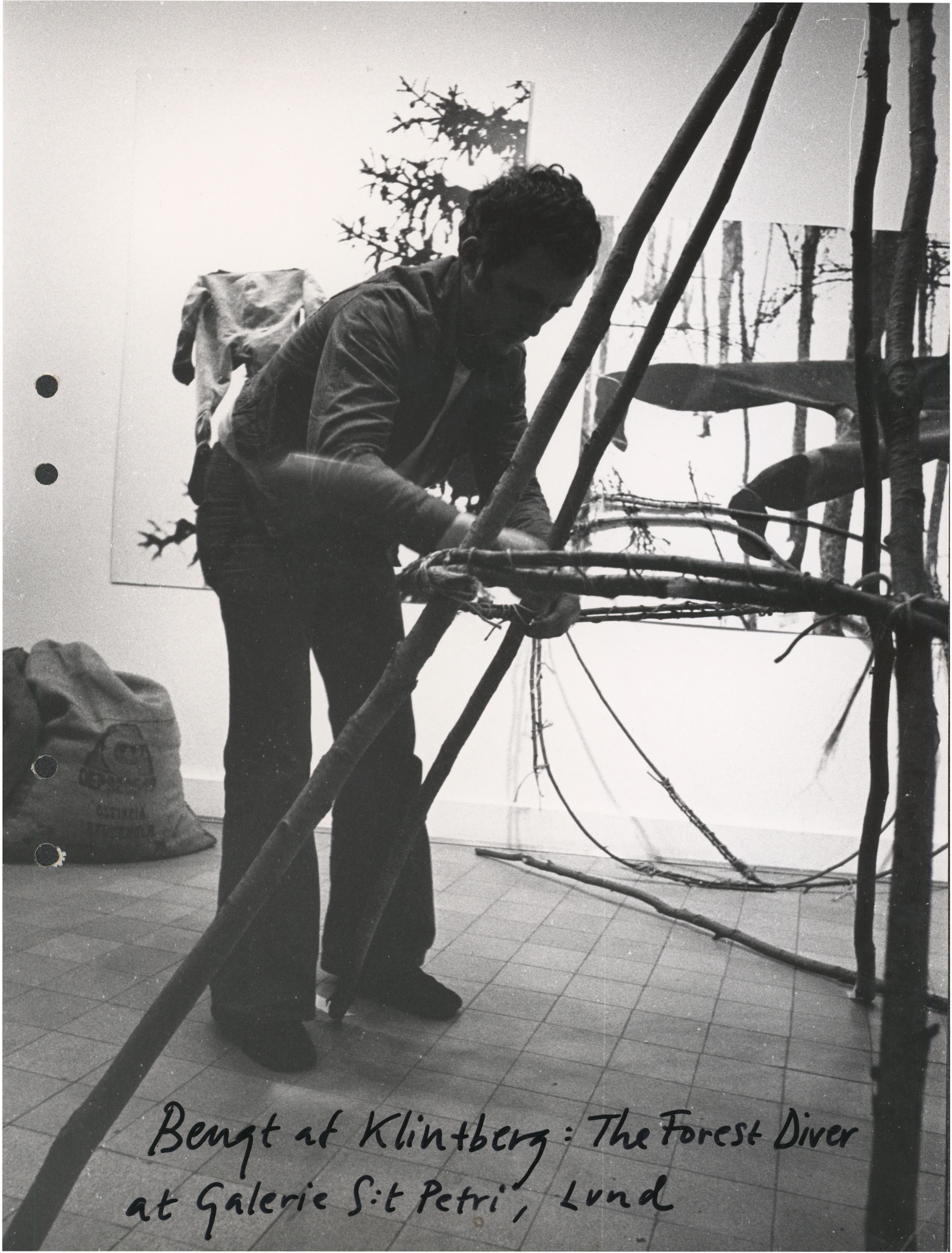
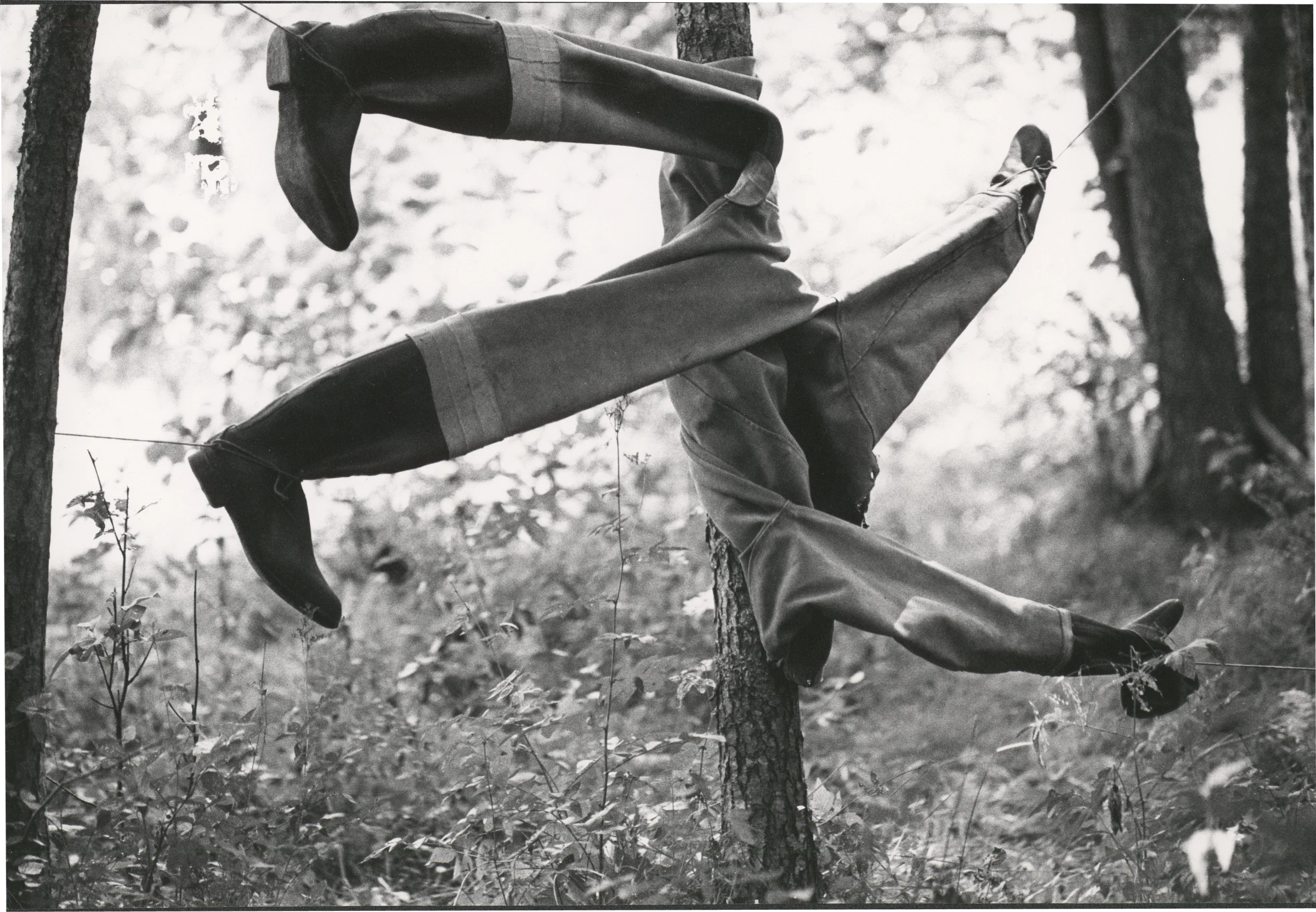
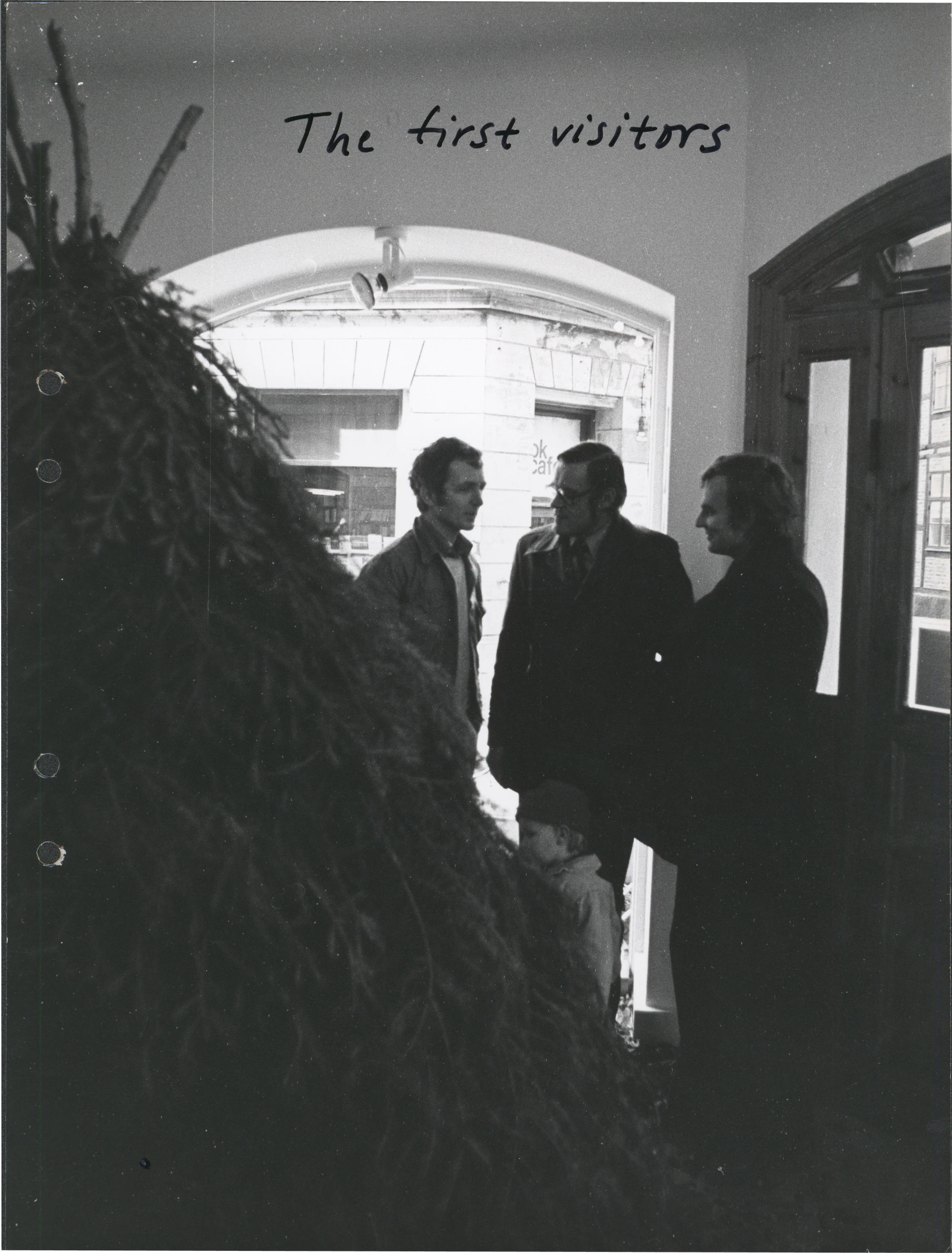
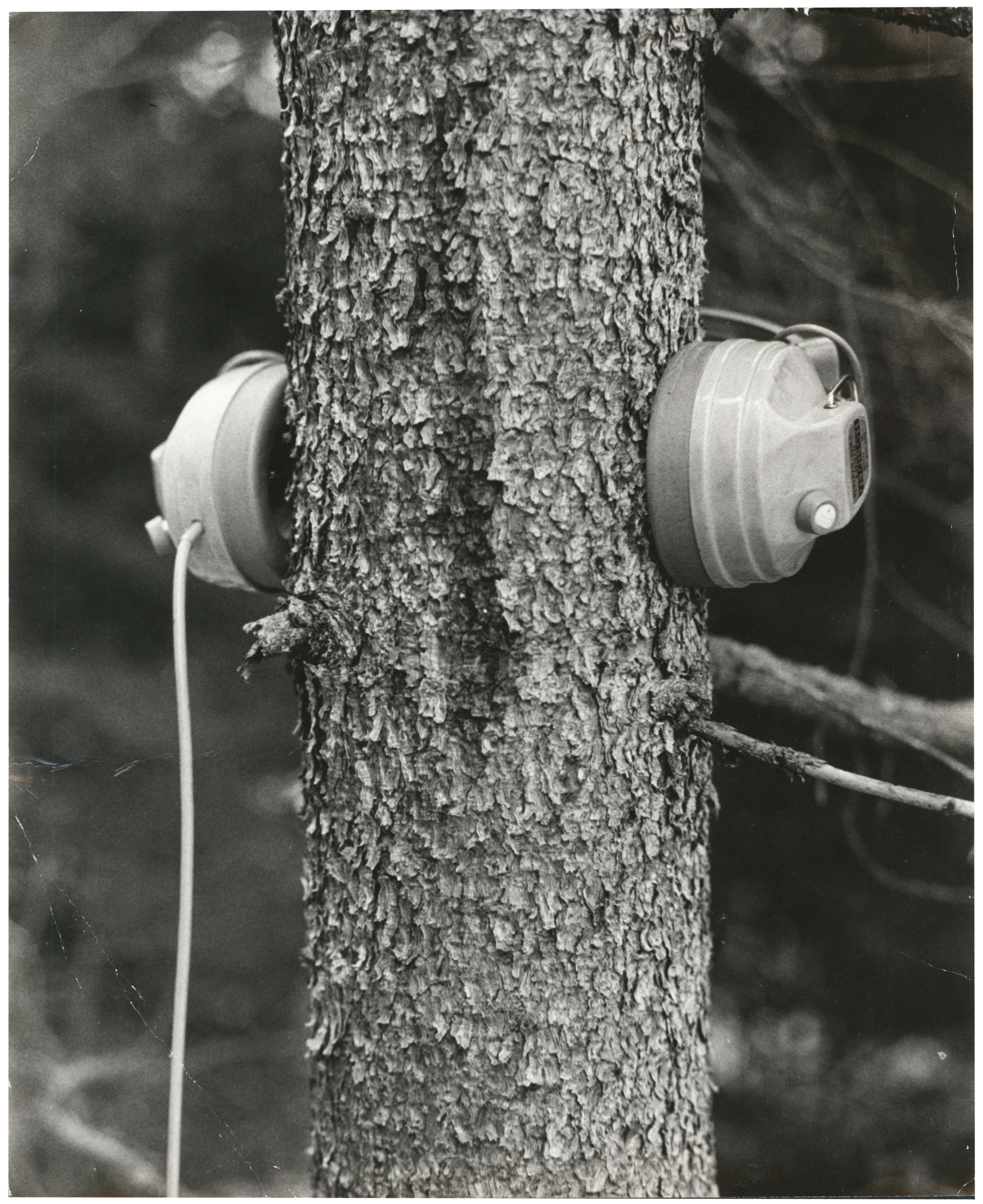
His exhibition at S:t Petri, titled “Skogsdykaren” (The Forest Diver) — earlier shown this autumn at Fylkingen in Stockholm — consists mainly of photographic documentation of a diving suit placed in various forest environments during different seasons.
---------------------------------------
The Forest Diver by Bengt af Klintberg Edition Sellem, Fack 7, 221 01 Lund 1, Sweden Autumn, 1974 3 dollars incl. postage
Bengt af Klintberg, whose pamphlet “The Forest Diver” now appears in the Edition Sellem, is a Swedish poet and artist, who also works as a folklore scholar. He is a lecturer at the Ethnological Institution at the University of Stockholm, and he has published several well-known books on Swedish folklore, such as “Svenska trollformler” (Swedish Magic Spells), “Svensk folkpoesi” (Swedish Folk Poetry), and “Svenska folksägner” (Swedish Folk Legends).
His poetry includes the books “Stigar” (Paths), “Ormkungens krona” (Crown of the Snake King), and “Stockholmsspelet” (The Stockholm Game). As an artist, he is influenced by the art theories of the Fluxus group, of which he became a member at the beginning of the sixties.
He has performed happenings and events in Stockholm and other Scandinavian cities. His exhibition “The Forest Diver” has been shown in Stockholm and Lund during the Autumn of 1974.