

CLICK TO VIEW PRESS RELEASE
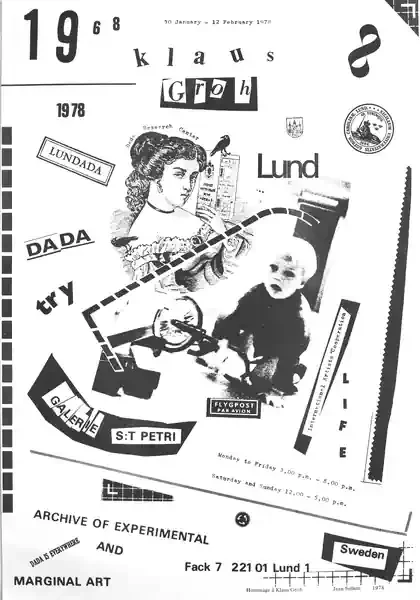
30.01 - 12.02.1978KLAUS GROH
Galerie S:t Petri in Lund presents from January 30 to February 12, 1978 KLAUS GROH — initiator of the Dada Research Center and International Artists’ Cooperation in West Germany. The exhibition spans a ten-year period, 1968–1978, and provides information about Klaus Groh’s diverse activities in the form of photographs, manifestos, books, writings, and more.
Klaus Groh’s philosophy is to encourage action at every possible opportunity. A positive attitude toward humanity’s capacity to think and act shapes his work — life becomes what you make it. He emphasizes: “To live means to constantly try again, not to give up or let oneself become passive. To live is art. The one who creates, lives. Try and try again! Every creative act is a document of one’s individuality.”
We live in a world that too often discourages innovation. Art arises frequently as a reaction to events in the social environment. Art can make people more conscious of themselves so that they can take positions and make decisions in a more nuanced way. This aim was already expressed by the Dadaists about sixty years ago. Klaus Groh starts from Dada as an attitude to life, not as something bound to its time. The classical Dadaists reacted to their environment with alternative expressions and standpoints. Likewise, the “neo-Dadaists.” The classical Dadaist tried to create in order to find himself; the neo-Dadaist, however, tries to create in order to show how one can find oneself. The process of communication thus becomes more important for the neo-Dadaists than the product. “Who I am is not as important — I become what I do,” says the American Dick Higgins.
The task of every artist and person is to follow the social and cultural traces of our time. To identify these, information and constant movement are necessary — a readiness to communicate on many nuanced levels brings knowledge. The Dadaist attitude to life cannot be confined to any single discipline — the poly-artist is necessary. The neo-Dadaists maintain: “Everything can be art!”
For international communication, the postal system and telegraph have come to play an essential role. It is easy to reach each other, exchange ideas, spread ideas by sending letters, telegrams, and phone calls. This form of art is not bound to commercial centers. For the neo-Dadaists, the audience is important.
