

CLICK TO VIEW PRESS RELEASE
CRESJOHAN CORNELISSEN, PETER MERTENS, JAN NEDERVEEN , ROB NYPELS09.05 - 22.05.1981
The exhibition took place from 9 to 22 May 1981, with a performance by Rob Nypels on 15 May, followed by a performance by Johan Cornelissen on 16 May.
Below:
1. Press release of the exhibition
2. Press release for Rob Nypels’ performance
3. Press release for Johan Cornelissen’s performance
1. Exhibition Press Release
Cres – a Dutch artists' group consisting of Johan Cornelissen, Peter Mertens, Jan Nederveen, and Rob Nypels, presents documents from their collaboration with the experimental magazine Cres, which they started in 1978. The group dissolved and the magazine ceased in 1980. During this period they developed a very close relationship, which also meant that they carried out performances together. The magazine work involved a conscious focus on the collective working process: decision-making, the selection of artists who were given the opportunity to create an issue of Cres. The group also worked with printing and layout of the magazine. To a large extent they paid for the publication themselves.
To explore more deeply the meaning of the collective working method, its positive and negative aspects, self-awareness, reciprocity between the group members in a specific situation, in a particular environment, has been a shared artistic goal for the four during this two-year period. The exploration of what arises through such intense close contact between different people could be expressed in many ways – for example in an experiment that three of them carried out in 1979. They lived and worked together for four weeks in a gallery and at the same time performed performances concerning relationships and communication between people – happening in a limited area during that time.
For some time now they have mainly worked individually. At Galerie S:t Petri two of them have arrived – Johan Cornelissen and Rob Nypels. On Friday 15 May and Saturday 16 May at 20:00 they will present their performances. The two have different personality temperaments – one more analytical, the other more emotional – although of course they are both/and. Objects, human beings, the inner and outer of communication, calm and unrest, closeness and distance are simultaneously present in the situation here and now.
With the help of sound, voices, photographs, body movements, they attempt to visualise how natural and culturally created phenomena exist side by side simultaneously – both inside and outside the human being.
The exhibition is open weekdays 15:00–20:00, Saturdays 13:00–17:00.
It runs from 9 to 22 May 1981.
2. Performance Press Release — Rob Nypels (15 May 1981)
ROB NYPELS from Holland sees himself as a permanent re-searcher of his surroundings or éspace ambiant. He arrived at Lund recently and knows nothing about either the town or its inhabitants. He is curious and wants to meet people here.
Therefore, on Friday May 15th at 8.00 p.m. he invites those living in and around Lund to come to Galerie S:t Petri, where he will present his project more in detail.
One could say already that his main interest is communication in a broad sense, the artist and the audience meeting for mutual give and take.
Rob Nypels endeavors to understand phenomena in their totality – the relationships between human beings, between objects, and between human beings and objects. He feels one should always be ready to develop one's consciousness at any moment.
Lund, Sweden
in May, 1981
3. Performance Press Release — Johan Cornelissen (16 May 1981)
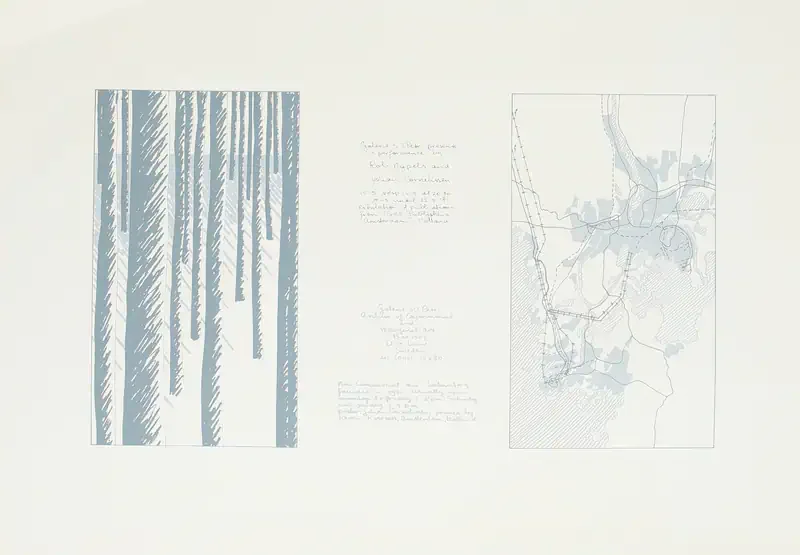
Maps of Sweden and of Lund are of major importance to the Dutch artist JOHAN CORNELISSEN in his performance to be held at Galerie S:t Petri on May 16th, 1981 at 8.00 p.m. With the help of these abstract representations of the country and the town he tries to capture their natural and cultural characteristics and transform these into artistic language.
In every object, human being and event there exist at any given time both naturally and culturally created phenomena which a person has to balance in such a way that the one aspect does not suppress the other. At the same time each new phase of development in an object, human being or event also involves the destruction of something else, thereby maintaining a balance. Accordingly, a tree appearing in a landscape contains the possibility of being cut down and thus transformed into another form. Johan Cornelissen visualizes this by placing two amplifiers on a tree, these transmitting from a tape-recorder the sound of a power-saw, thereby allowing a person standing next to the tree to experience the simultaneousness of the tree’s two possible states of being. He wants the perceiver to transcend the concrete material aspect, helping him or her to picture the hidden forms in what appears to be a clearly defined and closed entity.
However, Johan Cornelissen is also questioning whether, and why it seems to be, that every constructive development in anything also means the destruction of some element, and that life in a sense is also dead.
The map of Sweden indicates forest to be a special characteristic of the country. For this reason, Johan Cornelissen selected two relatively isolated spots near Lund to represent Sweden and Lund as well as the philosophy that new forms emanate from old perpetually. One person will be standing before a particular tree at the one spot listening to the sound of a power-saw on tape. A second person, placed at the other spot, which represents a tree cut down and transformed into a pole of an electric power line, will be listening to the sound of an alarm signal. A third individual will be located at Galerie S:t Petri, where drawings of the two other spots will be hanging and where the sounds played at both places will be heard.
Visitors to the gallery participate in the process of trying to go beyond the visually given signs and of imagining the circumstances at the other two places so as to capture the multidimensionality of the situation.
Marie Sjöberg, Lund, Sweden in May, 1981.
