

CLICK TO VIEW PRESS RELEASE
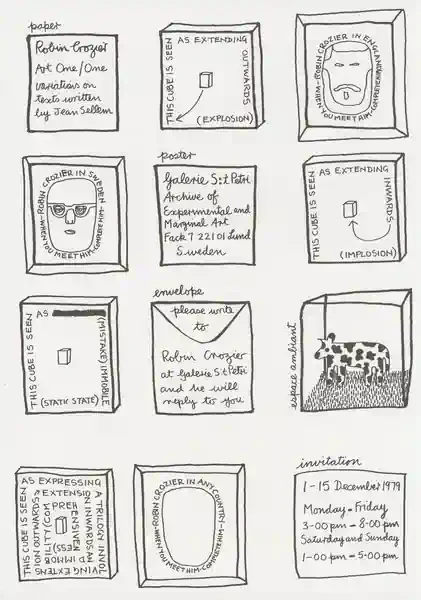
ROBIN CROZIERART ONE ONEVARIATIONS ON TEXTS WRITTEN BY JEAN SELLEM01-15.12-1979
Two and a half years ago Jean Sellem presented his art-philosophical ideas at an international art symposium in Warsaw. His philosophy is called Art One/One and aims, among other things, to make people see their surroundings and themselves as a whole, to become aware of their responsibility. Art One/One stands for a well-balanced use of the discoveries of modern science, while at the same time being aware that science provides us only with an image of reality, not the whole of reality. Man should be given the possibility to regain his faith in himself, to dream, to improvise, and to be independent.
Art One/One has since been further developed. Jean Sellem wrote the first part two years ago together with Dr. David Weston on, among other things, alienation. The third and fourth parts of the philosophy were completed in 1979.
The four sections of Art One/One form the basis for Robin Crozier’s exhibition at Galerie S:t Petri. He has read and studied the texts and visualized them. Above all, he has based his work on Art One/One III, which deals with reflections on art as thought and thinking as art.
To gain a deeper understanding of an artwork—or of an object in general—it is, according to Art One/One, important to be able to imagine it in its natural surroundings, its espace ambiant, and at the same time to reflect on how human living conditions would be in a world where the object in question would serve as an ethical and aesthetic model. To make his ideas clearer, Jean Sellem has used an abstract form — the cube — and with its help explains how we can perceive the surrounding world and ourselves.
Art One/One regards an arbitrary, drawn, motionless cube from four different points of view:
I) The cube’s form tends primarily toward an outgoing movement (explosion)
II) The cube’s form tends primarily toward an ingoing movement (implosion)
III) The cube’s form tends primarily toward stillness (statics)
IV) The cube’s form tends to express a trinity between the outgoing, ingoing, and static (unity)
The gallery’s remaining rooms are thus devoted to these four key concepts: explosion (room 2), implosion (room 3), statics (room 4), and unity (room 5).
The exhibition runs from December 1 to 15, 1979, and is open weekdays from 3–8 p.m., Saturdays and Sundays from 1–5 p.m.
