

CLICK TO VIEW PRESS RELEASE
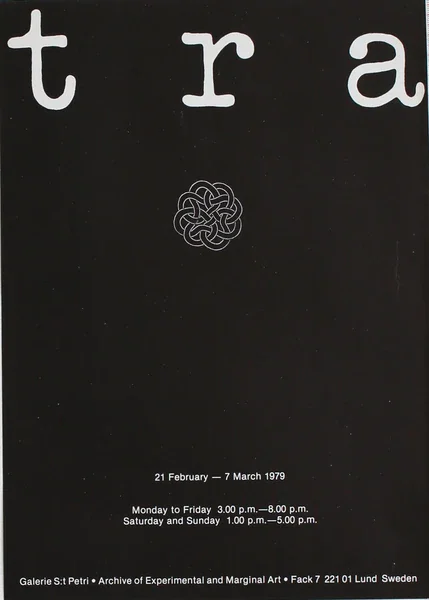
TRA21.02-07.03.1979
In today’s Italy, constant ideological debates are taking place. Political tensions run high. We can read about them in the newspapers and hear about them on radio and television. Naturally, Italian artists have also been drawn into these discussions regarding the permanence of the current social order compared with other systems that might be considered better.
A glimpse of this issue can be seen in the three current exhibitions at Galerie S:t Petri in Lund. Fernando De Filippi, Nicole Gravier, and the magazine TRA from Italy present their views on the artist’s role in a society such as the Italian one.
One of the main goals for artists, according to them, is to be able to feel part of a collective unit. To achieve this, one must understand the ideological conditions of the country and take a position either for or against them. The artist should avoid isolation, avoid placing themselves outside of reality and social interaction. Otherwise, there is a risk of being forced into acting within boundaries where art itself becomes purely ornamental.
In one issue of TRA, the theme “Art as Ideology” is discussed. It states, among other things, that humanity needs alternative models to those currently existing within a given system. There must always be the possibility of revising any system — whether in the East or the West.
For De Filippi, Gravier, and TRA, the current Italian social system is of such a nature that it must be questioned. Fernando De Filippi works with language in the form of slogans borrowed from texts related to art and politics. He places these various slogans everywhere — in subways, on squares, and in public spaces. He uses different languages simultaneously and sets them in contexts where their original meaning sometimes becomes its opposite.
Nicole Gravier is primarily concerned with mapping myths and clichés in art and television. She creates series of color images of phenomena from both fields to highlight their “sacredness.”
TRA, the magazine, focuses mainly on placing art within a social and societal perspective. Its emphasis on the collective often comes at the expense of the individual. For this reason, it also welcomes viewpoints from scientists in various social-scientific disciplines.
The exhibition runs from February 21 to March 7, 1979.
Opening hours: weekdays 3–8 p.m., Saturdays and Sundays 1–5 p.m.
