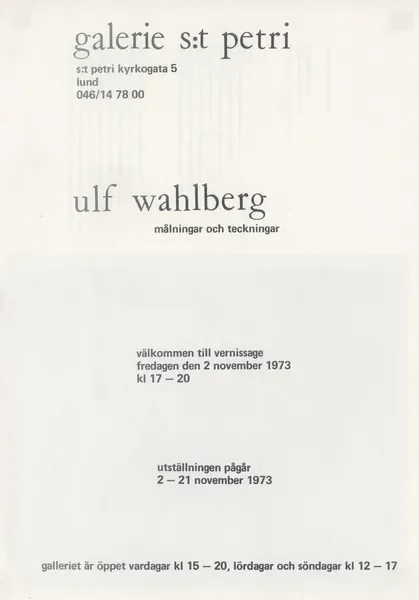
ULF WAHLBERGMÄLNINGAR OCH TECKNINGAR02 - 21.11.973
Galerie S:t Petri S:t Petri Kyrkogata 5 Lund 046/14 78 00
ULF WAHLBERG 2 – 21 November 1973
“The Car – The Human Being – Nature”
For the past eight years I have devoted myself almost exclusively to attempting to depict “the car, the human being, and nature” in my art. The car, as a symbol for all our technical thinking. The human being, representing society. Nature, representing our origins and our possibilities.
In some way, the human being has created his own likeness in the car. Nature is transformed by man into a car, which then in turn seeks to reunite itself with nature. The car lives its own life, in part quite similar to that of a human. When new, it is caressed with foaming shampoo and soft cloths, polished and admired with proud eyes. After its short service to humankind, it is perhaps removed to one of the huge car cemeteries, or abandoned in a forest clearing. There is something hopeless and beautiful about these cars, which are slowly swallowed up by nature. Grass and flowers penetrate the damaged parts, shrubbery grips the steering wheel.
Car graveyards are perhaps the most expressive monuments of our time. To wander among them is like experiencing a vanished culture, while being in the midst of it. The desolation and timeless atmosphere surrounding these cars makes us unaware that this is only a generation’s work. What humanity once, at the dawn of technology, acclaimed and felt proud of, now lies in great heaps as a burden to our conscience. The car, which has come to man as a plague, an insect, a fossil. A chrome bastard with heart and nervous system. An invention of man – man’s own creation – which long ago left him lost and irrational behind it.
[JEANSELLEM VIEWER] — ULF WAHLBERG MÄLNINGAR OCH TECKNINGAR 02 - 21.11.973 — Categories: press, docs, letters, visual — Keywords: Galerie S:t Petri, Jean Sellem, archive — Category: press — A Generational DocumentBy the sheer extent of the material and the size of the individual works, Ulf Wahlberg’s exhibition at the Royal Academy of Fine Arts becomes a generational document. He has summed up his sixties, which are also those of so many others. Both formally and in terms of content, the exhibition is filled with compressed, elapsed time. It is an archaeological investigation of a present that, with dizzying speed, has been transformed into something very remote. Wahlberg is 35; the pictures give the impression that he might just as well have been 350.Världen omkring mig [The World Around Me] is a motif that has accompanied Wahlberg for the past five years, and each time he has painted it, it has grown in scale. The painting now bearing that title measures two by ten metres. A profusion of forms, some identifiable and others not, fills its surface. Scorched earth cracks open towards dark interiors; a pearl floats weightlessly against a bright sky; through a crosshair one looks out into a dark space filled with confetti-like stars; elsewhere the Earth’s surface is seen at night from a great height, and so on.Racing CarsThe absence of a formal structure makes the picture difficult to read; it is read piece by piece, and this is evidently also how it was painted and intended to be viewed. Inserted resting points for the eye are scenes featuring fantastically equipped racing cars, the so-called dragsters. The motif recurs separately in several of the smaller paintings.If the large painting lacks a formal focal point, it has instead a thematic one in the simultaneously comic and pathetic group of figures whose central characters are the musician, the painter and the poet.Two further motifs dominate the exhibition: turbulent sea surfaces beneath hazy skies where time seems absent. This sea and its movements have looked the same for millions of years. The reminder of the past becomes all the more powerful in the beautiful paintings of car wrecks in desert landscapes. Here, however, time is equivalent to oblivion. Perhaps also to transience and death. The carefully worked surfaces and the dizzyingly beautiful light are as seductive as a siren song.Life as a ParoxysmThe whole may seem simple: against the unfathomable chaos of the “world around him”, Wahlberg sets the dragster’s brief, rapid race, in which man and machine appear to live in symbiosis. The similarity to an individual lifespan is striking. At the finish line, the timelessness and oblivion of sea and desert take over.In Anders Bergdahl’s Elva texter [Eleven Texts], a poetically well-crafted booklet accompanying the exhibition, there is a similar experience of life as a paroxysm, too violent and brief for one to gain any real grasp of the world. Bergdahl also describes:“A large room. In there one could grow old without difficulty, as people used to do, grow old as quickly as if one had put one’s fingers into an electrical socket and one’s entire life had been fired off at once.”The room could be that of the paintings, where the archaeology of our present is displayed.The paroxysmal and uncontrolled quality is contradicted by the very fact that these paintings have been made at all, that their creator so clearly enjoys his activity, devotes himself to it wholeheartedly and gives it his time. In this context one can place the peculiar procession of the musician, the poet and the painter who appear from time to time in the pictures.CemeteryAnachronistically dressed like jesters and outsiders, they belong no more to the chaos than they do among the racing cars and car wrecks. Independent, curious and stubborn, they wander about absorbed in their strange feats. Their physiognomies, caricatured in the manner of Bruegel, contrast with the photographic form Wahlberg otherwise employs in his painting.What belongs to the style of the 1960s in this painting — the imitation of commercial colour photography — has its limitations exposed by the three comedians. Style is determined by generational affiliation and circumstance. More enduring is the desire to bring order to chaos and fill empty expanses with meaning, however futile that may seem. Wahlberg can make one feel as though one were standing in a cemetery where an entire civilisation lies buried and the only monuments worthy of it are the decaying car wrecks in the silent desert.Through that silence, the jesters’ bells ring hopefully; from the chaos a song rises and the emptiness becomes populated. Art is absence, lack and emptiness. An art that merely shows us what we already possess can only produce boredom. It is with that boredom, it seems to me, that Wahlberg struggles.The small company seems to wage an unequal battle against the desolation and disorder surrounding them. To emphasise that, despite everything, he is one of them, Wahlberg has made a double portrait of himself with the Mona Lisa. Few things, like her portrait, have come to symbolise what is absent and gives rise to longing.Olle Granath“Bil i landskap” [Car in a Landscape]. Painting by Ulf Wahlberg at the Royal Academy of Fine Arts. — — — Category: press — It Is About the Car, Man and Nature…“During the past eight years, I have devoted myself almost exclusively in my art to trying to depict ‘the car, man, nature’. The car as a symbol of our entire technological way of thinking. Man as a representative of society. Nature as a representation of our origins and our possibilities.”So says the artist Ulf Wahlberg, who is exhibiting at Galerie S:t Petri.“In some way, man has created his own image in the car. Nature is transformed by man into the car, which, once abandoned, then tries to reunite with nature.”The car lives a life of its own, in some respects quite similar to that of a human being. When it is new, it is caressed with foaming shampoo and soft cloths, polished and admired with proud eyes.After its brief service to man, it may be transported to one of the enormous car cemeteries or left abandoned in a forest clearing.There is something helpless and beautiful about these cars as they are slowly swallowed up by nature. Grass and flowers penetrate the damaged parts, and bindweed takes hold of the steering wheel.From 2 to 21 November 1973, Ulf Wahlberg of Stockholm is showing paintings and drawings at Galerie S:t Petri.This is his first solo exhibition in Lund. He has previously held several exhibitions in Stockholm and Gothenburg and has also participated in major group exhibitions, including in the United States, Japan (Swedish Art 72), Finland, Denmark and France (Salon Comparaisons 72). — — — Category: press — Dead NatureThere is a particular type of picture that we call still life. The Swedish term stilleben comes from German and literally means “motionless life”; in English these images are likewise called “still life”. French, however, uses a different expression: nature morte, meaning “dead nature”. The distinction may seem insignificant, but it is not: it reflects a real difference in the way the depicted subject is regarded. Still lifes / natures mortes are pictures of arranged objects — flowers, fruit, household utensils, game, foodstuffs, and so on — objects that can be owned and can enrich human existence.Ulf Wahlberg mostly paints cars and car wrecks, arranging them in composed settings. Yet these car pictures are not really still lifes but rather natures mortes: they depict dead nature. In Wahlberg’s pictorial world, the car has become a kind of nature while at the same time remaining a living being, with an identity and personality, that lives and dies. It is therefore characteristic that he depicts dragsters, specially built racing cars with individual names and identities — cars as distinctive individuals.Wahlberg’s cars are often in a state of decay. They lie piled on top of one another in car cemeteries like bodies in an open mass grave, or stand alone, abandoned in the landscape. In a strange way, these solitary wrecks seem to be merging with nature, sinking into it, disappearing or becoming absorbed by it. One wonders whether future archaeologists will excavate these technological fossils of our vanished culture.The transience of the automobile and the immortality of nature expressed in Wahlberg’s pictures give them a strongly fateful character. There is a constant process of petrification and erosion in Wahlberg’s world; even in his straightforward images of nature, one senses that some kind of ending or destruction is near. The trees in the paintings look as though they will never turn green again; the painted seas carry no ships; somehow, no possibilities or ways out are offered. Everything Wahlberg paints takes on the character of arrangements of objects or staged nature, but what he paints is not motionless life — it is dead nature.Wahlberg himself writes:“Car cemeteries are perhaps the most expressive monuments of our time. Walking through a car cemetery is like experiencing a vanished culture while still being in the midst of it. The desolation and timeless atmosphere surrounding these cars make us forget that this is merely the work of a single generation. What humankind celebrated and took pride in at the dawn of technology now lies in great heaps, a burden on our own time.”In the same way, Wahlberg’s own works can be experienced as monuments to our time. Looking at these drawings and paintings can feel like looking at images related to an era or historical situation that has already passed, while at the same time being aware that we ourselves are still living within that situation. Through this way of working, Wahlberg emerges as a kind of modern, contemporary history painter.Hans JohanssonUlf Wahlberg, 124 B/COMP, oil and tempera, 1970. — — — Category: press — GALERIE S:T PETRI, S:t Petri kyrkogata 5, open Monday–Friday 3–8 p.m., Saturday and Sunday 12–5 p.m.It is actually easier to understand what Ulf Wahlberg is trying to achieve with his paintings, drawings and graphic works when they are shown, as here, in two very small rooms. In large white galleries, they can sometimes acquire the same unequivocal, elegant beauty as the space in which they hang. On the small walls of S:t Petri, that same beauty appears painful, double-layered and ambiguous. This is, of course, also essentially Wahlberg’s attitude towards the history and nature he paints.Ulf Wahlberg paints cars, sometimes as iconic objects, emblematic and awe-inspiring in their extreme coldness and sublimity; but he also paints cars that are decaying and seem to be trying to rid themselves of their own history and become nature again. He says, among other things:“There is something helpless and beautiful about these cars as they are slowly swallowed up by nature. Grass and flowers penetrate the damaged parts; bindweed takes hold of the steering wheel. Car cemeteries are perhaps the most expressive monuments of our time. To walk around a car cemetery is like experiencing a vanished culture while still being in the midst of it. The desolation and timeless atmosphere surrounding these cars…”Here, I think Wahlberg has grasped something important. He has found something that concerns him deeply and which, at the same time, he can approach from a distance, critically. In this small, fine exhibition, these two aspects are evident in most of the works. The images have a monumental character; they are filled with pathos in their great stillness. — — — Category: press — Cars — Is That Art?One may like or dislike the car in our modern society; it is there, it concerns us all, and should therefore naturally be a subject for artists as well. Yet it was only with Pop Art in the 1960s that the car became common as an independent motif. Ulf Wahlberg, who is currently exhibiting simultaneously in Lund (Galerie S:t Petri) and Helsingborg (Galleri 1 + 1), is one of Sweden’s pioneers in using the car as an artistic subject.This is how Ulf Wahlberg describes his intentions for the Lund exhibition:“During the past eight years, I have devoted myself almost exclusively in my art to trying to depict the car, man, and nature. The car as a symbol of our entire technological way of thinking. […] In a sense, man has created his own image in the car.”Wahlberg believes that the car lives a life of its own that resembles human life. As long as it is new, shiny, attractive and works well, it is caressed and admired; but after a short period of service it is taken to the car cemetery or abandoned in a forest clearing to rust away.Wahlberg is not a car-hater, however. On the contrary, he is fascinated by the car both as a gleaming, perfect speed machine and as a rusty, melancholy wreck abandoned in nature. In his paintings he portrays both states in a manner that is at once poetic and sharply realistic.His admiration is not uncritical. He is aware that the car poses a danger to people and society. He can therefore write that the car has come:“to man like a plague, an insect, a fossil. A chrome-plated bastard with a heart and nervous system.”Through his ambivalent attitude towards the car, Ulf Wahlberg has succeeded in turning it into an exciting subject for artistic depiction. His works possess considerable painterly qualities. — — — Category: press — LundGalerie S:t Petri, S:t Petri Kyrkogata 5, 17 h–20 h.Ulf Wahlberg. — — — Category: press — Ulf Wahlberg at S:t PetriOn Friday, Ulf Wahlberg’s exhibition opens at Galerie S:t Petri in Lund. His paintings and drawings all deal with the car, man and nature.Wahlberg is represented, among others, in the collections of Moderna Museet, Nationalmuseum, Göteborgs konstmuseum, and the French State collections. — — — Category: docs — — — Category: docs — Dear Ulf,I am writing to remind you of the exhibition period I have reserved for you at Galerie S:t Petri, namely 2–21 October 1973. As you may remember, the cost to you for these three weeks will be 120 Swedish kronor × 3 = 360 kronor for the gallery. In addition, there will be the cost of any printed matter you have produced. As you know, the gallery takes no commission.When you have your poster or opening invitation printed, I would just like you to bear in mind that the gallery always prints all text in lower-case letters (Helvetica semibold is the professional name for the typeface).I am enclosing an opening invitation with this letter so that you can see for yourself.The text for your printed matter is being sent on a separate sheet.A plan of the gallery is also enclosed with this letter, so that you can more easily plan the placement of your works.I would be grateful if, before 22 October, you could send me all the printed matter that is to be mailed out and provide me, for the press, with 15 photographs, biographical information and a text explaining the philosophy behind your paintings. The entire exhibition should be in Lund before 29 October.I am very pleased to be having an exhibition of your work.Best regards, — — — Category: docs — — — Category: docs — From 2 to 21 November 1973, Ulf Wahlberg from Stockholm is showing paintings and drawings at Galerie S:t Petri.They all deal with the car, man and nature, as explained in the text written for the exhibition.This is his first solo exhibition in Lund. He has previously held several in Stockholm and Gothenburg and has also participated in major group exhibitions, including in America, Japan (Swedish Art 72), Finland, Denmark and France (Salon Comparaisons 72).In 1965 he was awarded the Jenny Lind Travel Scholarship, and in 1970 and 1971 he received the major State working grant.Works by Ulf Wahlberg are represented, among others, in Moderna Museet and Nationalmuseum in Stockholm, Göteborgs Konstmuseum, and the French State Collections. — — — Category: docs — — — Category: docs — The overturned car wreck can be seen as an individual. Someone who could no longer endure the roaring pace of technology and instead sought refuge in the silent desert, where time is no longer measured in seconds and tenths of a second, but where stillness prevails.On the shore, about to slide out into the sea, lie heaps of car bodies, these strange shells that might have belonged to some gigantic insects from a prehistoric age.As a painter, I seek to depict the reality that surrounds me. And the car is very much present in my reality. — — — Category: docs — — — Category: docs — — — Category: letters — — — Category: letters — Hello!I am now sending the photographs, etc.There has been a delay at the printer’s. I hope this will not cause you too much inconvenience.I will bring the paintings, etc., on 27 October (possibly the 28th), in the afternoon.Stockholm, 22/10Ulf — — — Category: letters — Lund, 3 December 1973Dear Ulf,Enclosed are the press clippings I spoke to you about on the telephone on Sunday.As soon as we have the opportunity to drive to Stockholm, you will get your works back.Today I am also sending you 400 kronor(320 kronor for one graphic work sold, 80 kronor for catalogues sold).Kind regards,Marie – Jean — — — Category: letters — — — Category: letters — — — Category: letters — — — Category: letters — Lund, 20 February 1973Dear Ulf,Last summer we discussed an exhibition for you at Galerie S:t Petri in Lund. I am still very interested in the proposed idea for the autumn of 1973.Could you let me know as soon as possible whether you are able and willing to do it and, if so, when?As you may remember, it costs 120 kronor per week to exhibit, i.e. 360 kronor for a period of three weeks, which is the period we normally use.The gallery takes no commission on works sold.As the gallery is well known in southern Sweden, there is no need to send out opening invitations, but there should be a poster, which you can design according to your own wishes.I would be grateful for a prompt reply. — — — Category: visual — — — Category: visual — — — Category: visual — — — Category: visual — — — Category: visual — — — Category: visual — — — Category: visual