

CLICK TO VIEW PRESS RELEASE
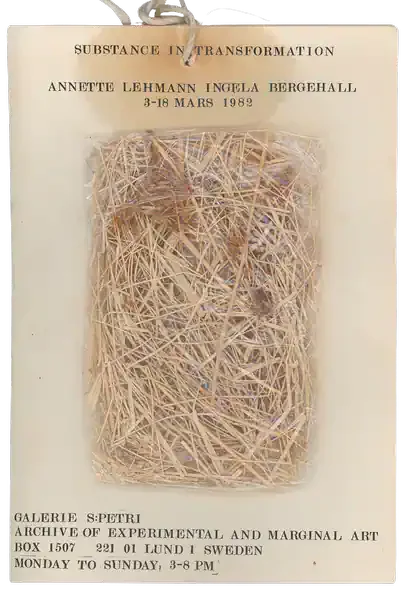
ANNETTE LEHMANN AND INGELA BERGEHALLSUBSTANCE IN TRANSFORMATION03.03 - 18.03.1982
With the First Tool, Man Was Created
Exhibitions
By Henrik S. Holck
Annette Lehmann & Ingela Bergehall: “Substance in Transformation.” Galerie S:t Petri, “Archive of Experimental and Marginal Art,” Kyrkogata 5 — box 1507, 221 01 Lund, Sweden. Monday–Sunday 3–8. Exhibition open until Thursday.
Here follows the last review of one of Scandinavia’s most essential galleries, S:t Petri in Lund. At the end of March, the artist Jean Sellem turns the key, and the North becomes artistically a bit poorer.
“Substance in Transformation” is a duo project that has been fully realized. It is an exhibition in which the artists lead us through their own messages, of which one stands out with the greatest potential.
Nature, origin, magic, tribe, cult, etc., name the syllables of communication in the exhibition’s upper layer — that layer that, through spontaneous action, also contains remnants of Denmark’s three best-known bands, Ballet Mécanique, No Knox, and Gods’ Benefits.
The mythological universe of symbolic scales (and objects) can be viewed from another angle through its materials. Everything is included: straw, bark, sand, plastic, leather, pigment, wax, cardboard, paper, salt, water, flour.
Several coincidences among these materials indicate a connection to age-old women’s traditions — woman as part of the practical situationist basic substance in the pattern of existence.
In addition to her separate material works, Annette Lehmann and Ingela Bergehall’s exhibition, according to the description, deals with art and life. With the first tool, man was created: With this phrase, one moves further and further into the exhibition’s labyrinth, where things dissolve, and mystification arises.
I do not want to waste time on a detailed account of individual elements in Substance in Transformation; instead, I concentrated on what took place in all four rooms.
Here, a photographic series documents a process based on a black square canvas surface, which “becomes” active in the space. Metallic glints make it half-visible and move out over most of the floor. A consistent process has supplied the space with structures. Here (for example) we find a “historical” model for the exhibition: The Void. The dark surface and the non-linear spatial relationship underline that a gap has been created. The void, built up of cells (structures), suddenly becomes materialized.
The way in which “Substance in Transformation” is built and expressed is thoroughly governed and fully conscious. But also, at some points along the edge of the heightened, neat (the “delicious effect” between dark, light, and strong colors) there is something naïve that brings forth a certain freshness.
Based on what I saw, I would like to characterize A.L. & I.B.’s session as a “promising debut,” which, in short, means: completely fine, continued.
Information, 17.III.82
