

CLICK TO VIEW PRESS RELEASE
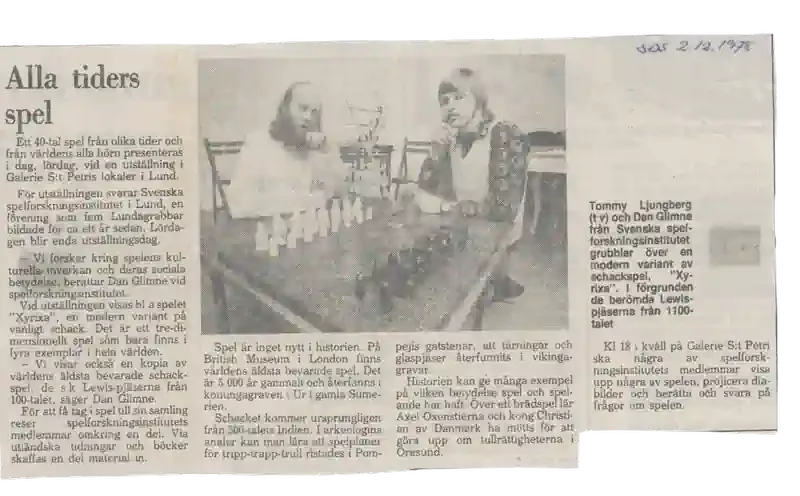
Alla tiders spel (All-Time Games )Saturday 02.12.1978 at 6 p.m.
ABOUT GAMES…..
Games are an often-overlooked part of humanity’s cultural heritage.
Just as people have enjoyed a symphony or a poem for centuries, so too have generation after generation been captivated by the patterns and inherent beauty of a game.
Chess originated in its original form in 5th-century India, while Go has been played unchanged for 4,000 years, and Mancala was already ancient when the pyramids were built.
In archaeological records we find many examples of games: game boards for tic-tac-toe carved into the streets of Pompeii, stones, dice, and glass pieces in Viking graves.
When long-ago buried kings and princes were interred with their most precious possessions, games were often included — Tutankhamun’s precious game board for playing senet is in the Egyptian Museum in Cairo, and in the British Museum in London there is a glass cabinet containing the world’s oldest preserved game, from the royal tomb at Ur in ancient Sumer.
Its age is estimated at 5,000 years.
History also offers many examples, often amusing, of how important games and gaming have been.
Richard the Lionheart forbade his Crusaders to play board games in order to keep their minds on more Christian matters; and over the same kind of games, Axel Oxenstierna and King Christian of Denmark once met to “settle accounts” during their negotiations in Öresund.
Caesar is remembered in history for his famous dice-throw — alea iacta est, “the die is cast” — when he and his troops crossed the Rubicon to march on Rome.
The emperors who followed him were not immune to gaming: Nero gambled away insane sums, Caligula was notorious for cheating, and Claudius even wrote a book about games.
Playing cards came to Europe in the 13th century, probably brought back by the last returning Crusaders, and were soon banned in many places by both the Church and secular authorities.
Today, games are a widespread phenomenon in both East and West — sometimes surrounded by drama: think of the casinos in Las Vegas or the latest world championship match in chess.
World championships are also held in such diverse games as Monopoly and backgammon.
As a modest contribution, a few members of the Swedish Game Research Institute in Lund will show parts of their collection, project some slides, and in their most charming manner, tell stories and answer questions — all for those interested — on Saturday, December 2 at 6 p.m., at Galerie S:t Petri in Lund.
--------------------------------
Text of the newspaper article reproduced here, translated into English.
Tommy Ljungberg (left) and Dan Glimne from the Swedish Game Research Institute ponder over a modern variant of chess, "Xyrixa." In the foreground are the famous Lewis pieces from the 12th century.
All-Time Games Around 40 games from different eras and corners of the world are being showcased today, Saturday, at an exhibition in the Galerie S:t Petri in Lund. The exhibition is organized by the Swedish Game Research Institute in Lund, an association formed about a year ago by five guys from Lund. Saturday will be the only day of the exhibition. — We research the cultural impact of games and their social significance, explains Dan Glimne from the game research institute. Among the exhibits is the game "Xyrixa," a modern variant of traditional chess. It is a three-dimensional game that exists in only four copies worldwide. — We are also displaying a copy of the world's oldest preserved chess set, the so-called Lewis pieces from the 12th century, says Dan Glimne. To acquire games for their collection, members of the game research institute travel quite a bit. Some materials are obtained through foreign newspapers and books. Games are not new in history. The British Museum in London houses the world's oldest preserved game. It is 5,000 years old and was found in the royal tomb in Ur in ancient Sumer. Chess originally comes from India in the 6th century. Archaeological records show that game boards for tic-tac-toe were carved into the cobblestones of Pompeii, and dice and glass pieces have been found in Viking graves. History can provide many examples of the significance that games and gaming have had. It is said that Axel Oxenstierna and King Christian of Denmark met over a board game to negotiate toll rights in the Öresund.
At 6 PM tonight at Galerie S:t Petri, some members of the game research institute will showcase several of the games, project slides, and share stories while answering questions about the games.
