

PRESS RELEASE
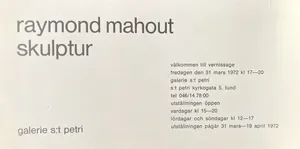
RAYMOND MAHOUT
SKULPTUR
31.03-19.04.1972
RAYMOND MAHOUTSKULPTUR31.03-19.04.1972
galerie s:t petri
s:t petri kyrkogata 5
lund
RAYMOND MAHOUT – sculptor (1930 France)
31 March – 19 April 1972
"What I particularly wish to banish from art is the artistic, the artist and the artistic manner, which attach more importance to a diamond than to a matchbox, and give more weight to a rose than to a smoked herring."
(Letter of 7 November 1915 from Apollinaire to J. Catelain, teacher in Lisieux)
[JEANSELLEM VIEWER] — 31.03-19.04.1972 RAYMOND MAHOUT — Categories: press, docs, letters, visual — Keywords: Galerie S:t Petri, Jean Sellem, archive — Category: press — <p>Unidentified newspaper clipping (source unknown), 1972</p> — French-born sculptor exhibits at S:t PetriLUND. The April exhibitor at Gallery S:t Petri in Lund is Raymond Mahout, 42. Mahout, who is a sculptor, was born in northern France but is now based in Malmö. He has previously participated in various exhibitions, including the Paris Biennale and Liljevalchs in Stockholm. Of the sculptures he is exhibiting in Lund, he says in part:“I have imagined large spacecraft constructed from the most ordinary household objects — everything enhanced by the colors of carnival — for the exploration of the most hidden regions of our inner space. The vast infinities where we can arrange the eternal celebration open to all.”Mahout’s exhibition can be seen at Gallery S:t Petri from March 31 to April 19. The exhibition is open on weekdays from 3–8 p.m., and on Saturdays and Sundays from 12–5 p.m. — — — Category: press — <p>Unidentified newspaper clipping (source unknown), 1972</p> — Exhibition openingsLundGalerie S:t Petri, Good Friday, 5–8 p.m. Raymond Mahout, sculpture.Makes sculptures from household objectsThe French-born artist Raymond Mahout, based in Malmö, is exhibiting at Galerie S:t Petri in Lund from March 31 to April 19. He has previously taken part in, among others, the Biennale in Menton, the Salon International de l’Art in Paris, and at Liljevalchs in Stockholm. In Lund he presents around fifteen sculptures and reliefs. They are constructed from household utensils.“I have imagined large spacecraft — built from the most ordinary household objects, everything enhanced by the colors of carnival — for the exploration of the most hidden regions of our inner space…” — — — Category: press — <p>Le Monde, 18 May 1972.</p> — Intervention of law enforcement at the opening of Exposition 72Exposition 72 was inaugurated yesterday morning under calm conditions by Mr. Jacques Duhamel, Minister of Cultural Affairs. But the opening did not take place in the afternoon due to violent incidents that set the demonstrators of the FAP (Front des artistes plasticiens) against the police forces.From the early afternoon, indeed, the entrance to the Grand Palais, on the side of the Champs-Élysées, was surrounded by police forces, armed in anticipation of the demonstration announced by the protesting artists.Shortly before four o’clock, about forty demonstrators climbed onto the forecourt with banners reading: “Pompidou Exhibition 72: artists at the service of power!”; “The ideological struggle in the artistic field is the continuation of the struggle of the proletariat in the domain of ideas!”; “The individualist attitude of artists is reactionary!”The artists of the FAP declared their intention to block the entrance hall. Suddenly, the police, who had been positioned for a long time, charged with batons the demonstrators blocking some twenty artists inside the building. The demonstrators, who had not invaded the exhibition hall, were arrested, handcuffed and placed under arrest. They are accused, it seems, of having struck the police.In the confusion, the demonstrators struck Mr. Chatelain, Director of the Museums of France, who defended himself by striking back. He was hit with a baton on the head. Bleeding, he had to leave the premises.Meanwhile, on the side of the Champs-Élysées, the police cordon prevented visitors from entering. They were arrested and questioned. The artists and demonstrators tore down the “Exhibition 72” posters.At the same time, the police entered the Grand Palais and carried out a violent charge, pushing back the demonstrators who were blocking the main entrance. Several people were beaten, some arrested. A young woman was knocked to the ground by the explosion of a tear gas grenade.At the entrance to the exhibition, most of the protesting artists decided to leave voluntarily to avoid further intervention by the police.The group of fifty tore down the exhibition posters. Others were arrested in the absence of their authors or transported outside, where photographers captured them in the act.Around 7 p.m., police forces withdrew, announcing that the opening was over. The protesters then left the premises without further incident.No damage, apparently, was found except for a hole made in an expansion joint sculpted in the plastic material of César.On Wednesday afternoon at 2 p.m., the artists presented their apologies for these incidents, which all the more regrettable as the Grand Palais had asked for police intervention.That Wednesday morning, the Grand Palais did not open its doors.“ARTISTS ARE MEN LIKE OTHERS,” writes Mr. BourgeadeFollowing the publication of Mr. Jacques Duhamel’s article, Minister of Cultural Affairs, on Exposition 72 at the Grand Palais, contested by certain artists of the modern art world, we received from Mr. Pierre Bourgeade, novelist and playwright, the following text:Mr. Bourgeade’s argument is simple: artists do not know what they want. The State does not act due to lack of invisible coherence. The State proposes something — that or something else. What should be done? Nothing at all. Certainly not agitation.This attitude may seem convincing; it is, on the contrary, extremely dangerous, because it tends to reduce the relationship between artists and the State to the sole problem of exhibitions and, more generally, as Mr. Jacques Duhamel does, to reduce cultural problems to those falling under the Ministry of Cultural Affairs.Artists are not only painters, sculptors, or designers of posters and paintings. Artists are men who live like others, with the same problems as others, and who therefore are concerned with power, with the place of politics in life and in society.To ask artists to be silent, to ask them to content themselves with what is given to them, is to confine them to a moral ghetto or, to use a common expression, to an aesthetic ghetto.The incidents of Exposition 72 are not based on aesthetic motives. They are not based on the fact that the organizers of the exhibition preferred one doctrine to another, to the detriment of artistic freedom.The Exhibition Committee condemns the use of forceFor its part, the organizing committee of the exhibition (Mrs. Françoise Bary, Messrs. Jean Clair, Daniel Buren, Maurice Fréchuret, Serge Lemoine, Alfred Pacquement) issued the following statement:“On the occasion of the inauguration of Exposition 72, a peaceful demonstration took place in the Grand Palais. It was violently repressed by an intervention of the police.The organizing committee condemns, with unanimity and the greatest firmness, this intervention, which contradicts the formal guarantees that had been given. It refuses to assume responsibility for events for which it is not responsible and affirms that such incidents and such a deployment of police forces must not be repeated. — — — Category: docs — <p>Le Monde, 16 May 1972.</p> — ON A CONTESTED EXHIBITIONBy Jacques DuhamelExposition 72, whose ambition is to present an assessment of artistic creation in France over the past decade, brings together the contributions of some seventy artists out of the three hundred initially considered. On the eve of its inauguration, scheduled for Tuesday, May 16, the artists who protested against its official endorsement, as well as those who refused to take part, held, under the patronage of the Front des artistes plasticiens (FAP), the General Assembly of the Visual Arts, in order to enable artists to “take their affairs into their own hands.”An exhibition opens at the Grand Palais covering twelve years of art in France. It has already been, more than any other exhibition, subject to contestation throughout its existence. This fact in itself is significant. Who would once have imagined such a mobilization of so much anger against an exhibition? Formerly, for many, art stood apart from life, a luxury. Today, for troubled individuals, art is a necessity: it is the very heart of life. Thus contemporary art is contested in its very existence. For me, this is already a sign that the exhibition had to be attempted. To oppose is to take a stand. And that is healthy. Insignificance does not give rise to the violence of criticism. The harshness of criticism alone is a sign — a good sign — for its object.It is criticized in its origins, because the President of the Republic initiated the principle. And why not? Is the State doing nothing? It is accused of unacceptable shortcomings. Does the State, at its highest levels, propose something? “Not this, and not you,” it is told. What should it do? Nothing and everything — simultaneously!In this case, it has not done nothing; it has proposed something. And that requires administrators and financiers. The necessary means — nothing less than the means required for a major exhibition.A statement of support from intellectuals, which began circulating on Friday, has gathered some thirty signatures, including those of J.-P. Sartre, Michel Foucault, Maurice Blanchot, Gilles Deleuze, J.-L. Godard, P. Bourgeade and Mrs. Marguerite Duras. It expresses solidarity with the Front des artistes plasticiens, which has issued a call for a demonstration on Tuesday at 4 p.m. at the Grand Palais.Mr. Jacques Duhamel, Minister of Cultural Affairs, here explains the reasons behind the choices that guided this gathering of contemporary works.Limits of partiality?We have been partial, I acknowledge it. We chose one man to conceive and organize the exhibition. That man chose a group to support him. We could have chosen another man; we would also have chosen him from the small number of connoisseurs of contemporary art. Our choice was partial. Another choice would have been so as well. This was — and remains — inevitable. There lies the field of our partiality. There are its limits. I challenge anyone to reduce them.(Read the continuation on page 10, first column.) — (Continuation from the first page)ON AN EXHIBITIONBy Jacques DuhamelBut I am certain that in some countries this field would have extended much further, reaching as far as a freedom dangerous to doctrine. Here, the content of the exhibition bears the imprint of those who created it. My choice is undoubtedly different. Different from that of a third age that might understand, that at this stage would be both responsible and competent. Here are the means of your action: suggest, solicit, react. Once again, so much the better. It takes nothing away and can only enrich it, as a spectacle. But who, seriously, would claim, within the kaleidoscope of contemporary art, to find the unique color, the true one, the sole reflection of creation? This multiplicity, this entire group, must be accepted or rejected as a whole, like a single work. Each person may find a color of reference or preference, complain that their own has not been adopted. What matters, for the democratic State, is that once a man has been chosen, he is granted complete freedom of conception and realization. We know what happened. This is what, in the name of no one — absolutely no one — is contested. Apparent partiality is inherent in the logic of the State.This, of course, disturbs certain people, as it does in the case of the Opera, for example, or the T.N.P., or the Théâtre National de Chaillot, or in the various fields of art: political pressure is excluded, and once the individuals responsible for creating a work have been chosen, they are given the means placed at their disposal.One of the accents of a policyContested, contestable, the exhibition will thus be enriching. After it, nothing will ever be quite the same as before. Whether the public rejects it or reacts to it, well or badly, in any case this will be not only useful to them, but beneficial.If I have perhaps overestimated the full meaning of the word “political” in its broadest sense — the highest fidelity to oneself, creative generosity, so adventurous in our time — rather than a compromise tending toward a certain feeble narcissism, then this exhibition is worthwhile in itself. It is worth far more as one of the accents of a policy. These are some elements of a policy. This is not a song of victory; the greater the effort to satisfy the most pressing necessities, the more clearly new needs appear. What matters is the questioning of problems. The honesty of recognizing that one cannot resolve them, nor even attempt to resolve them.This is what renders me indifferent to the outburst of certain criticisms. It is the guarantee that the problem has been approached seriously. No definitive solution is proposed for the contemporary art world, which is multiple. The crisis of civilization we are experiencing entails a crisis of what is most sensitive to our anxiety.The duty of the StateIt is thus the privileged site of utopias, in the noble and broad, realistic and effective sense of the word — the most contradictory ones. Must the State choose between them? It then slightly reduces its means of dissemination so as not to immobilize them. Should it favor the neutrality of a Kafkaesque administration? An approach disconnected from present and future action? No. Should it encourage internal critique? Take a position, as is the case? — — — Category: letters — <p>Letter from Jean Sellem to Raymond Mahout, 20 October 1973</p> — galerie s:t petri – st petri kyrkogata 5 – fack 7 – 221 01 lund 1 – sweden – tel. 046-14 78 00jean sellemLund, 20 October 1973.My dear Raymond,About a few weeks ago I sent youthree money orders:one in the name of Marie,one in the name of Marie’s mother,one in my own name —Could you let me know whether you havereceived this money, as I do not understandthe meaning of [illegible, 8 words] —Everything is going well at the gallery…I look forward to hearing from youand to meeting you.Jean(signature — — — Category: letters — <p>Letter from Raymond Mahout to Jean Sellem, 12 February 1974</p> — Nice, 12 February 1974My dear Jean,Thank you for your short card. You tell melittle about your current activities and you no longersend me invitations very often; you are French, old, and,as one of them once said, who hadhis gaze turned toward the blue line of the Vosges,“with a short memory.” This is only a[illegible] — do not take it too badly.— Have you also managed, as you had long wished,to give a clear directiontoward the new figuration? Or are you stillconstrained by “local cultural terrorism”that obliged you to a cautious eclecticism? I understandyour positions better since I left the confinedatmosphere of Sweden, and how is your idea of a journal progressing?I am now convincedthat it was the best way to make oneself heard.Unfortunately, I am working with my student organization,which leaves me little free timeto do anything other than try to stayup to date, and I regret this greatly; but in the nearfuture I will resume my activities withrenewed vigor, for this period of silence issalutary for me and allows me to wipe the slateclean of my former aesthetic considerations.I am sending you an issue of CHORUS,which you undoubtedly know. Please get in touchwith Pierre Tilman on my behalf. He can… — Certainly, to help you broaden your international audience.Or else write to:Thierry HomÉditions Galiléerue Linné, Paris 5thIf Thierry has not already contacted you,do so yourself, as he is currently openinga new gallery at the same address and hehas contacts with the new international figuration.Nice is always the same; I have often metBen at his Galerie Saint-Pancrace, buthe is so much in demand on all sides…As for my offer for lithographs,silkscreens, etc., I renew it to you [illegible]; do not hesitate if you havea free period in the coming months or if you know someonewho might be willing to organize such an exhibition—please let me know.I can offer selling prices well below thosecharged by traditional galleries,with internationally renowned figures,and prices even lower than those charged [illegible, 2 words] bylocal artists, with guarantees.I am not becoming a vile merchant.I am attempting to escape my conditionas a salaried worker without hope, without hope.Regards, old friend; I look forward to hearing from you soon.Raymond — — — Category: letters — <p>Letter from Jean Sellem to Raymond Mahout, 20 January 1974</p> — galerie s:t petri – st petri kyrkogata 5 – fack 7 – 221 01 lund 1 – sweden – tel. 046-14 78 00jean sellemDOUBLE20 January 1974Dear Raymond,These few lines by return of post: I am very gratefulfor your offer. I am very familiar with the works of Kermarrec,of Veličković, of Télémaque, of Erró — unfortunatelyit is impossible for me to exhibit them — the gallery’s programis tightly scheduled. If I have a friend who can take on the exhibition, I willimmediately pass on a [illegible: word ?].Very warmly,(signature) Jean Sellem — — — Category: letters — <p>Letter from Jean Sellem to Raymond Mahout, 17 January 1973</p> — Lund, 17 January 1973. My dear Raymond, following our telephone conversation the other day, I am sending you this brief dissertation. The irony of artists’ coquetry, their virulence, has the merit of bringing into the light of evidence what until now we sensed only in the obscure clarity of suspicion. What does the impossibility for them, today, of distinguishing repression from repression in the psychoanalytic sense mean? The history of artists is the history of progress in the refinements of repression, up to its apotheosis. For my part, intellectual unity is that of the synthetic act, which can be sub — — — Category: letters — <p>Postcard from Raymond Mahout to Jean Sellem, undated (postmark 1973)</p> — Self-published postcard by Raymond Mahout , 1973 — Self-published postcard by Raymond Mahout bearing the following caption:RAYMOND MAHOUTOld house in Nicefrom Place Saint-FrançoisAll rights reserved the Artist.1972 Printed in Sweden — — — Category: letters — <p>Postcard from Raymond Mahout to Jean Sellem, (postmark 15.06.1972)</p> — Self-published postcard by Raymond Mahout , 1972 — Self-published postcard by Raymond Mahout bearing the following caption:RAYMOND MAHOUTOld house in Nicefrom Place Saint-FrançoisAll rights reserved the Artist.1972 Printed in Sweden — — — Category: letters — <p>Postcard from Raymond Mahout to Jean Sellem, undated (postmark 1973)</p> — Self-published postcard by Raymond Mahout , 1972 — Self-published postcard by Raymond Mahout bearing the following caption:RAYMOND MAHOUTOld house in Nicefrom Place Saint-FrançoisAll rights reserved the Artist.1972 Printed in SwedenText by R. Mahout:Here, evidence succumbs to fact. Antonyms that only serve to confirm the immense confusion that lingers in false problems. Artists and their works are spoken of with the incompetence of philistines, left sclerosed by prejudices, by a system of fixed values, which are those of their masters: the bourgeois. It is easy to observe that your critical attempt concerning the condition of the artist remains limited to the individual aspect and not to understanding the totality of artistic experience within the totality of social experience. Your attempt demonstrates a non-creative intellectual distress, in order to console itself for an imaginative impotence; a behavior that is that of so many Western bourgeois creators, and above all [illegible traditional ? ] ones. Raymond — — — Category: letters — <p>Letter from Jean Sellem to Raymond Mahout. 25 February 1974</p> — — — Category: letters — <p>Postcard from Raymond Mahout to Jean Sellem and Marie Soeberg, Kassel, 1972</p> — — — Category: letters — <p>Letter from Jean Sellem to Raymond Mahout, 23 January 1973</p> — — — Category: letters — <p>Letter from Raymond Mahout to Jean Sellem, Nice, 12 January 1974</p> — — — Category: letters — <p>Letter from Raymond Mahout to Jean Sellem, October 1973</p> — — — Category: letters — <p>Letter from Raymond Mahout to Jean Sellem, Nice, 31 July 1972</p> — — — Category: letters — <p>Letter from Raymond Mahout to Jean Sellem, Nice, 25 March 1974</p> — — — Category: letters — <p>Letter from Raymond Mahout to Jean Sellem, Nice, 15 September (year not specified)</p> — — — Category: letters — Letter from Raymond Mahout to Jean Sellem, Nice, 21 February 1974 — — — Category: visual — <p>Black and white photographic reproduction of a work by Raymond Mahout</p>


