galerie s:t petri s:t petri kyrkogata 5 lund – sverige 046/14 78 00
PER KIRKEBY November–December 1973
"A museum involves not only that which its work or objects directly portray and the conditions immediately associated with their existence or creation, but also an entire historical background. Thus, a museum makes a statement about something and not simply about what is immediately displayed.
There is nevertheless much in recent thinking about museums which is ahistorical, attempting for so-called pedagogical reasons to divorce itself from history. Considered more deeply, the pedagogics here are highly reactionary and constitute an unsound mode of thought, however good their intentions. To contemplate without reference to history is like using a spade without a shaft. Terrible things have occurred in recent years, it seems to me, under the name of modernizing museums.
The same is happening in the world of art in general, i.e. in the promotion of major international art tendencies. The real creators here are those arranging for exhibitions and it is actually their creations which are being shown. Artists whose work are chosen for the degree to which these fit into the overall picture sought by the arranger serve simply as elements. The result is one of small diverse units without historical background, so that real meaning or statement is lacking.
Fluxus represented the most significant development since the War. It involved simplicity and a way of saying simple things. Much of that which has come since, as in conceptual art for example, possesses quite the opposite of simplicity, having little or no meaning and being executed in an empty and pompous style. If methods and materials are reduced to pure demonstrations, they are without interest. Fluxus always involved and was something definite, which a museum in its true sense is as well."
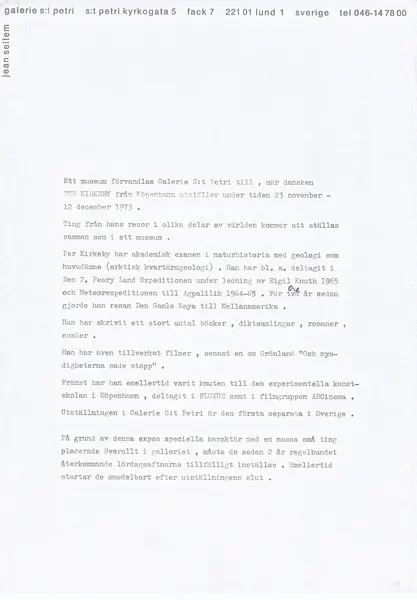
[JEANSELLEM VIEWER] — PER KIRKEBY November–December 1973 — Categories: press, docs, letters, visual — Keywords: Galerie S:t Petri, Jean Sellem, archive — Category: press — Each His Own MuseumPer Kirkeby, the Danish writer, artist and geologist who for some time now — and for a few more days — has transformed Galerie S:t Petri in Lund into a kind of personal museum filled with objects he has collected during research journeys and studies, is an original and thoughtful man.“In fact, every museum is also a testimony to those who have directed and dominated the institution over the years,” he began when I had a brief conversation with him. “What is in the museum, and what is not there, bears witness to the interests and reservations of its directors and assistants. We should not believe that a museum objectively reflects the artistic life of a place. So many factors determine the acquisition of art for a museum. In fact, every home is a museum, bearing witness to the people who live there.”Up to this point Kirkeby’s reasoning is not difficult to follow, and he continues to express himself clearly.“This exhibition is intended to express what I have arrived at. It contains things that have come to mean something to me and which, for various reasons, have remained with me during my journeys and wanderings through existence. Look at these simple drawings. I made them on one of the simplest means of communication of all: the blackboard or slate, where the eraser can quickly intervene, erase and revise. As a geologist, I am interested in all the traces that life leaves behind, both in the present and in ages long since vanished. One of my principal tasks as a researcher has been to investigate early Eskimo migration in northern Greenland, but I have also taken a great interest in the fascinating Maya culture of Central America.”Historical AnchoringKirkeby reacts strongly against contemporary attempts to sever the ties with our historical past.“Thought without history is like a spade without a handle,”he writes in his programme statement, where one also finds the following thought-provoking remarks on what is happening in “the great tendentious art world”:“The real creators are the exhibition organisers; it is their images that are shown. The artists, whose works are selected according to how they fit into the particular image, are used merely as elements.”FluxusPer Kirkeby regards himself as a member of Fluxus, the group working against phenomena of this kind. What Fluxus primarily aims to do is to say simple things in a simple and comprehensible language.The target is clear. It is directed against the attempts of certain modern art movements to conceal the emptiness of their message behind grand gestures and obscuring clouds of incense.Karl-Erik Eliasson — — — Category: press — Artist Exhibits Small Objects from His TravelsToday, Friday, Galerie S:t Petri will be transformed into a museum — though only for a short time, until 12 December. The reason is Per Kirkeby from Copenhagen, who from today is exhibiting objects from his travels in different parts of the world.Per Kirkeby holds a degree in natural history, with geology as his main subject. Among other things, he took part in the Peary Land expedition, led by Eigil Knuth in 1965, and in the meteorite expedition to Agpalilik in 1964–65. Two years ago, he travelled to Central America, where he studied Maya culture.He has written numerous books, poetry collections, novels and essays. He has also made films, most recently one about Greenland: Och myndigheterna sa stopp [And the Authorities Said Stop].He has, however, been primarily associated with the Experimental Art School in Copenhagen, participated in Fluxus, and was also involved with the film group ABCinema.The exhibition at Galerie S:t Petri is his first solo exhibition in Sweden.Because of the special character of the exhibition, with numerous small objects placed throughout the gallery, the regular Saturday evening events must be temporarily suspended. They will resume after the exhibition ends. — — — Category: press — Galerie S:t Petri in Lund Is Transformed into a MuseumLUND: Galerie S:t Petri is being transformed into a museum as the Danish artist Per Kirkeby from Copenhagen exhibits there from 23 November to 12 December. Objects from his travels in different parts of the world are assembled as in a museum.Per Kirkeby holds a degree in natural history, with geology as his main subject. He took part in the Peary Land expedition in 1965 and the meteorite expedition to Agpalilik in 1964–65. Two years ago, he made the journey Den Gamle Maya [The Old Maya] to Central America.He has written a large number of books, poetry collections and novels. He has also made films, most recently one about Greenland.He has, however, been primarily associated with the Experimental Art School in Copenhagen.The exhibition at Galerie S:t Petri is his first solo exhibition in Sweden. Because of the exhibition, the regular Saturday evening events held over the past two years must temporarily be suspended. — — — Category: press — <p><em style="color: rgb(17, 17, 17);">SDS 22.11.1973</em></p> — Geologist Exhibits at GalleryGalerie S:t Petri in Lund is being transformed into a museum when the Danish artist Per Kirkeby, from Copenhagen, begins exhibiting there on Friday. Objects from his travels in different parts of the world are assembled as in a museum.Per Kirkeby holds an academic degree in natural history, with geology as his main subject. He has written a number of books — poetry collections, novels and essays — and has made films, most recently one about Greenland: Och myndigheterna satte stopp [And the Authorities Put a Stop to It].He has, however, been primarily associated with the Experimental Art School in Copenhagen, has participated in Fluxus, and has also been involved with the film group ABCinema.Because of the exhibition’s special character, the gallery must temporarily suspend its Saturday evening events, which have been held regularly for the past two years. — — — Category: press — <p>12.12.1973</p> — The Indians as a MirrorA travel book about a Danish expedition to the ruins of the vanished Maya civilisationBy Thomas Bredsdorff“What are we supposed to do with all that old Indian junk?”, a chairman of the finance committee once said about the National Museum and such things. One could dismiss him with a cultured smile: of course it is good to know something about everything, including the Indians. Who did he think he was?Later, things became somewhat more complicated. Young anthropologists and ethnographers began asking themselves whether their science was really as innocent as it appeared. Of course it was good to know something about the Indians; that was not what gave them cold feet. But might it not be that, in their scientific eagerness to reconstruct the Indians’ past, they were failing the Indians who were still alive? While chloroformed Indian costumes and artefacts piled up in museums, oil and banana companies pushed into the rainforests and exterminated the living population. Ethnographers had turned their backs. Some of them now began to understand their political responsibility. This was, of course, something quite different from what the famous finance committee chairman had once had in mind.More recently still, in the very latest years, the question of the Indians and our relationship to their culture has become even more complicated. Indians have become “in”, especially in the United States, but here as well. There are obvious reasons for this, especially in the USA: Indians provide such a convenient “missing link” between the clear political activism of the 1960s and the budding mysticism of the 1970s. The Indians are the minority capitalism has exploited most brutally, and at the same time they are wonderfully spiritual people, full of profound wisdom and mystical history. They are well suited to making the sixties and seventies hang together. For God knows which time, the Indians can once again be used by white people. As on several previous occasions, this is done with the best of intentions.In the three-man book Mayalandet, published today, there are traces of both of these latest stages in the white relationship to the Indians. There is some harsh information about Texaco’s and United Fruit’s conduct in the Central American rainforest, and there is an ecstatic hovering over translated fragments of Maya texts. The book also carries the scent of rainforest and a sense of what total alienness feels like. The latter is what succeeds best.In 1971 three Danes travelled through southern Mexico, Guatemala and Honduras in search of the Maya. Ib Michael wrote and translated Maya texts, Teit Jørgensen took photographs, and Per Kirkeby wrote and drew. The photographs are the least exciting part of the result; Kirkeby’s texts are the most exciting.Ib Michael’s text makes up the greater part of the book and also its most problematic pages. He is a student of the Indians and clearly knows a great deal. At the same time, he shares his travelling companions’ experience of distance. This places him in a dilemma.At one moment he fires blanks at “Western pseudo-science”; at the next he freely draws on it, complete with philological footnotes and the whole apparatus. Sometimes he wants to convey knowledge, sometimes observations, but the latter drown in an overuse of words that makes his description of Maya traces strangely difficult to grasp.The most vivid section is his brief account of a solitary hitchhiking journey home through the USA. And the strongest moment in his longer texts is the first visit to an isolated Lacandon village. Here the book’s recurring theme — the experience of distance — works particularly well because living Indians are present. Yet for precisely that reason they also disappear almost entirely from the rest of the book.Per Kirkeby’s texts are short. He does not pretend to know anything particularly special about the Maya. On the other hand, he knows something about seeing, drawing and style. I do not think his reflections on “the image-forming capacity of the Romantic ruin” tell us anything about the Maya. Nor do I think they are meant to. Instead, they say something about a view of European art history, and they provide the most consistent alternative to the scientific approach to Indian ruins.About the Maya we know that they had hieroglyphs and a calendar. Why their civilisation arose and why it collapsed, we know as little now as we did before. Mayalandet is a book about how the Maya look according to the place and time from which one sees them, as the preface puts it. It portrays the vanished Maya, to use Ib Michael’s astronomical image, as the black holes of space, which cannot be observed except through the effects of the forces emanating from them.It is a wildly sprawling book that the three Danish travellers have produced. But there are enough flashes in it to make it worth a thorough reading.Teit Jørgensen, Per Kirkeby, Ib Michael: MAYALANDET. Rhodos, 318 pp., 48.50 kroner. — — — Category: press — Photography, Spray Can, Speed MarkerA little girl on her way out of her dress — at first sight there seems to be nothing particularly startling about this lithograph, produced at Bjørn Rosengreen’s workshop by one of the artists belonging to the avant-garde, Per Kirkeby. It is one of four lithographs in a portfolio entitled Englebarnet [The Angel Child], recently issued by Kirkeby and Rosengreen.The portfolio of four works is nevertheless remarkable, not only for artistic reasons, but also because the artist has deliberately made use of the possibilities offered by new techniques and has just as deliberately disregarded the traditional rules governing the proper execution of original lithographs.Spray can, speed marker, camera, offset printing. These are the means Kirkeby has used. The work reproduced here was chosen as an illustration because it appears to be the least controversial; nevertheless, its lines were drawn with a speed marker on plastic film, rather than on a lithographic stone with lithographic crayon, while the coloured background was sprayed onto the film with a spray can.The film was then used like photographic film, producing an image on the plate from which the print was subsequently made. It was printed in four colours and therefore required four plates: black, red, yellow and silver. Where yellow and silver meet, they produce a fifth, almost greenish colour.Two of the four works were printed in this way. The other two were based on small amateur photographs. The photographs were greatly enlarged, printed against a silver background, and then overlaid with a yellow, drawn plate. Englebarnet depicts Per Kirkeby’s young daughter, Rebecca.When the artist asked the professional lithographer whether these methods could still be described as original lithography, Rosengreen replied yes, arguing that the plates were printed onto paper by means of a rubber roller, which today must be regarded as original lithography. Rosengreen would, however, prefer the term “print” to describe this artistic form of expression.Despite the break with traditional original lithography, the prints in the portfolio are numbered and signed by hand by the artist.Virtus Schade — — — Category: press — <p><em style="color: rgb(17, 17, 17);">1.12.1973</em></p> — GALERIE S:T PETRI, S:t Petri kyrkogata, open Monday to Friday 3–8 p.m., Saturday and Sunday 12–5 p.m.Per Kirkeby is showing objects brought back from travels in different parts of the world. They are small, very small objects, tents, clothes, etc., mainly from Greenland and Mexico, assembled to form a Per Kirkeby museum.“A museum does not include only what its works or objects tell in themselves and the circumstances directly associated with their creation, but also a complete historical background. A museum tells something about something, but above all it describes itself. Much of present-day thinking about museums is ahistorical: for pedagogical reasons, attempts are made to distance oneself from history.”Per Kirkeby wants to discuss museums and the way they are organised, an important discussion. At present, the gallery is crowded with objects and unfortunately leaves no room for the gallery’s regular Saturday evening events. But perhaps after the exhibition, which gives a rather confused and temporary impression, museums themselves might become the subject of a discussion? — — — Category: docs — Lund, 16 September 1973Dear Per,I have reserved three weeks for you at Galerie S:t Petri, from 23 November to 12 December 1973. The cost to you for the entire period will be 360 Swedish kronor. This amount also includes insurance.In addition, you will pay for any printed matter you wish to produce — poster, opening invitation, etc. — as well as postage. You may decide for yourself how you wish to design the poster or opening invitations.As regards typography, the gallery always uses lower-case letters in semibold Helvetica, as the typeface is called professionally.I am enclosing an opening invitation with this letter so that you can get an idea of its appearance. A plan of the gallery is also enclosed. This will make it easier for you to prepare the proper placement of your works. On a separate sheet you will also find the text you should use for the printing.Could you send me, by 12 November at the latest, all printed matter, 15 photographs for the press, biographical information, and a text explaining the philosophical idea behind your works?The entire exhibition should be in Lund before 19 November.I look forward to your exhibition.Best regards, — — — Category: letters — Copenhagen, 22 August 1974Dear Jean,Here are the four pages.It has taken me a great deal of work to have all the images prepared in such a short time. Two of the pages are somewhat larger than A4 and must therefore be reduced as indicated.Some of the images were only lent to me, so it is very important that I get everything back after use.By the way, could you send me the black-and-white negatives from the exhibition at S:t Petri?With warm regards,Per — — — Category: letters — Dear Marie and Jean,I am sorry that it has taken so long with the negatives — but, as you may know, I have moved away from home and have had many problems; and at the moment I seem to spend my time wasting time, all the time. But here they are.At present I do not have a catalogue from the Norwegian exhibition, but I will of course make sure that you receive one. I am enclosing another book I have made. Perhaps it may please you.Perhaps we shall see each other —With warm regards,Per — — — Category: letters — — — Category: letters — Dear friends,Enclosed are the photographs and a preliminary programme statement, which you may use as you wish.Best wishes for now,Per — — — Category: letters — Sonja Henie and Niels Onstad Foundations Høvikodden, NorwayFor our documentation archive on modern art, we would be grateful if you could send us the catalogue, etc., for Per Kirkeby’s exhibition at your gallery.If copies of reviews, etc., can also be obtained, we would be particularly grateful.Kind regards,Per HovdenakkMuseum curator — A museum is not only what the individual objects tell in themselves and through their references to their place of origin; it is also the history of the collection. A museum tells us something about something, and one also learns something about oneself.There is much in modern thinking about museums that is ahistorical, attempting, for so-called pedagogical reasons, to present itself without history. There is a form of pedagogy which, fundamentally, is highly reactionary, because it is a bad way of thinking, regardless of how good the intentions and opinions behind it may be. To think without history is like having a spade without a handle. I think terrible things are happening with the museum modernisations taking place in these years.The same thing happens in the art world, in the great international, trend-setting art world. The real creators are the exhibition organisers: it is their image that is exhibited. Artists are used as elements in this image; those parts of an artist’s work that fit the image are selected. They become, so to speak, fragments without history; as statements, they become meaningless and irrelevant.Fluxus contained the most valuable movements of the post-war period. It was about simplicity and the ability to say simple things.Much of what followed, the Conceptual Art movement, is very often the opposite of simplicity: namely nothing, carried out in a pompous and empty manner. If the method and the material are reduced to mere demonstrations, they are of no interest. Fluxus was always about something and was always something. Like a museum. — — — Category: visual — — — Category: visual — — — Category: visual — Copenhagen, 25 August 1975Dear Vargen,Thank you for your letter about the Varg exhibition. I am a little surprised, as this is the first I have heard of it.I understand the part concerning the binder. There are only two questions:Is it possible to protect against theft of the things placed in the binder?This is not really a question: I would like you to send an original binder.What I do not understand is what is mentioned at the end of the letter:the photomontage. How much? How large? How?Kind regards,Per KirkebyPer KirkebyVesterbrogade 116 D1620 Copenhagen V.Denmark — — — Category: visual — — — Category: visual