OPEN EVENT ARCHIVE
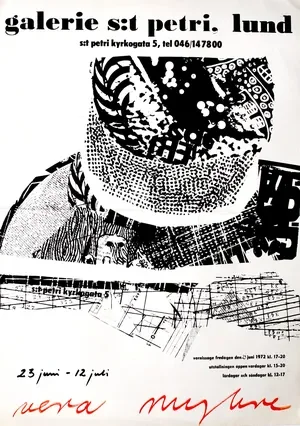
[JEANSELLEM VIEWER] — 23.06- 12.07.1972 VERA MYHRE — Categories: press, docs, visual — Keywords: Galerie S:t Petri, Jean Sellem, archive — Category: press — Sydsvenska Dagbladet, 24 June 1972 (handwritten annotation: “SDS 24.6.72”) — Midsummer Day 24.6.72 The Midsummer dance continues in the city park, dance games for children from 3:00 to 4:30 p.m., dancing on the dance floor from 7:00 to 11:00 p.m. Open-air church service in Berga Park, Bjärred at 11 a.m. (in case of bad weather in the park pavilion). Exhibitions: Archive for Decorative Art: John Wipp – ten years of sketches for public walls, textiles by Ulla Grytt and the tobacco exhibition “Tjärleken” from 12:00 to 4:00 p.m. Galleri Lundensis, AF: exhibition by the Vipeholm children “Speak with visual language” after 7:00 p.m. Galleri S:t Petri: Vera Myhre from 12:00 to 5:00 p.m. Lund Art Hall: closed. Kulturen’s Östarp Hall: “This is how Scanian food was prepared” from 12:00 to 6:00 p.m. Indian sitar evening: evening ragas with Lincoln Geiger at Galleri S:t Petri at 6:00 p.m. — — — Category: press — Sydsvenska Dagbladet, 7 July 1972 (handwritten annotation: “SDS 7.7.72”), by Hans Johansson — In the wake of modernism At the summer exhibition of Galleri Loftet five printmakers and draughtsmen come together: Anders Bergh, Anders Carlsson, Rune Grönjord, Olle Länsberg and Bror Struwe, all except one with their home base in Gothenburg. It is an exhibition that I perceive in a general and vague way as good. Upon closer reflection, however, I find it difficult to determine why the images are good or what they might be good for. The positive impression seems to be based on internal artistic qualities; the images are expressions of craftsmanship, artistry, a sense for graphic qualities or some other undefined characteristics that are conventionally regarded as positive. Can these undefined qualities of the images still truly carry the viewer? That the individual artists work in completely different ways and in entirely separate visual worlds does not prevent them from ending up on the same common ground. This is largely due to the fact that they have, in what appears to be an uncritical manner, adopted various established visual languages that they have not managed to fill with personal and articulated content; their visual language appears almost stereotyped or schematic. Even more general and vague than that of the five exhibitors at Loftet is the visual language of Vera Myhre. She works with collages in which the parts are arranged so as to vaguely suggest different figures in the images, figures that are present but which, at least for me, remain completely mute and passive as expressions. I believe this muteness is due to the fact that it has become increasingly impossible to give life to a general modernist visual language. I find it difficult to imagine that images of this type can continue to have a life. The traditional modernist visual language has been worn down and corrupted on several levels. It is always the case that if one wants to express something, one must find an adequate form for one’s message; it is not sufficient merely to present a modernist and more or less abstract formal language and then pretend that these vaguenesses have a specific content. I know nothing, strictly speaking, about Myhre’s intentions, but her images are of such a vague character that one could probably assign them almost any content. Among Leif Svensson’s drawings there is one entitled “Modules”, which shows a series of fragments of reality drawn into something resembling small boxes or building blocks with the help of which he has then constructed his images. With these building blocks, which function as pictorial elements, he manages to grasp and articulate a complex image of reality that, although it contains certain universal values, is grounded in something personal and self-experienced. The question of the real and the unreal reappears, for example, in a form that Svensson, like other younger artists, borrows in part from Magritte, yet nevertheless gives a personal stamp. Most personal, and at the same time most typical, however, are the images in which he attempts to express the relationship between human beings and nature, drawings that can be seen as contributions to the environmental debate but which do not stop at superficial propaganda, instead articulating a relationship. Therein lies the realism of the images – if one wants to express something about reality, it is not enough to depict a series of objects or people; one must attempt to reach the conditions, the relations between the things or people that appear in the images.Hans Johansson — — — Category: press — Sydsvenska Dagbladet, summer 1972 (handwritten annotation: “SDS 1972”). Image caption: Avisläsare (“Newspaper Reader”), 1972. Collage by Vera Myhre, exhibited at Galleri S:t Petri in Lund. — Collages, lithographs at Galleri S:t Petri “It is the material that I am fond of; it is what creates the image. In this exhibition I present collages composed of letters and images taken from magazines, national railway timetables and fashion photographs. The perception of these prosaic elements and the inspiration drawn from the motifs are the same. The experience arises in everyday life and seeks its content in common materials. The form is itself the thought. It originates from the frame, whatever expressiveness the image may contain.” This is how the Danish printmaker Vera Myhre describes her art. With seven large collages and seven lithographs, she concludes the spring season at Galleri S:t Petri. Vera Myhre was already noted at her debut in 1947. At the Royal Academy of Fine Arts in Copenhagen, both Professor Vilhelm Lundström and Professor Aksel Jörgensen were of great importance to her. She has worked as a painter, but from the beginning it has primarily been the problems of graphic art that have occupied her. The possibilities of woodcut techniques for working with elementary graphic effects nourished her imagination. She fundamentally regards herself as a lithographer. In recent years, however, she has worked with collage, which has attracted great attention, although it originally arose solely as a supporting product to help her envision the finished lithograph. In a contemporary formal language, Vera Myhre has attempted to interpret her experiences of everyday life as it unfolds where people move about, in railway waiting rooms, at pedestrian crossings, on a bench reading a newspaper, etc. Numerous exhibitions have marked her career over the years, including at the Riverside Museum in New York, Cottingham Gardens in London, the Wolfgang Gurlitt Museum in Linz, the Musée d’Art Moderne in Paris, as well as many venues throughout Scandinavia. The exhibition runs from 23 June to 12 July. — — — Category: press — — — Category: docs — Exhibition card, Sønderjyllands Kunstmuseum, Kongevejen, 6270 Tønder, 23 June–23 July 1972. Printed leaflet presenting Vera Myhre’s lithography exhibition, accompanied by a biographical note and a detailed list of exhibitions, public collections, institutional support, and international exhibition venues. — Sønderjylland Art Museum, Kongevejen 6270 Tønder 1972. 23 June – 23 July lithographs printed on a hand press. Own printing, exhibitions and representation. Copperplate Collection, New Carlsberg Foundation, Danish Arts Foundation, Cultural Fund of the Municipality of Copenhagen, Diocesan Museums of Funen and Maribo, Museum of Modern Art, Angola, VRA. Palazzo del Valentino, Turin. Nikolaj, three solo exhibitions, Galerie Gammel Strand, City of Stockholm, Kunstnerforbundet and Kunstnernes Hus Oslo, Ministry of Social Affairs, Labour and Education and Ministry for Cultural Affairs. Member of Kammeraterne. Exhibits every October in Copenhagen, art museums in Svendborg, Aarhus, Lolland-Falster, Sorø, Riverside Drive Museum New York, 9th International Black and White Exhibition in Lugano, Collingham Gardens London, International Print Exhibition Ljubljana, Nordic Graphic Union Helsinki, Stockholm, Åbo Art Museum, Wolfgang Gurlitt Museum Linz, Boston Pottery Barn, Hässelby Castle, church, City Museum Copenhagen, Gammel Strand, Nancy City Hall. — — — Category: visual — Reproduction card, published by Galleri S:t Petri, Lund (Sweden), 1972. Black-and-white reproduction of the artwork “Avislæsere” by Vera Myhre. — Reproduction card, front side, published by Galleri S:t Petri, Lund (Sweden), 1972. Black-and-white reproduction of the artwork “Avislæsere” (collage, 1972) by Vera Myhre. Card printed by Skånska Dagbladet, Malmö, with copyright notice © 1972, all rights reserved to the artist. — Reproduction card, back side, published by Galleri S:t Petri, Lund (Sweden), 1972. Black-and-white reproduction of the artwork “Avislæsere” (collage, 1972) by Vera Myhre. Card printed by Skånska Dagbladet, Malmö, with copyright notice © 1972, all rights reserved to the artist. — — — Category: visual — Black and white reproduction, of the artwork “Avislæsere” by Vera Myhre, 1972 — Black and white reproduction, reverse bearing a handwritten annotation indicating the technique, title, and dimensions of the artwork “Avislæsere” (collage, 101 × 140 cm, 1972) by Vera Myhre, along with a printed stamp showing the artist’s name and address in Copenhagen. — — — Category: visual — Black and white reproduction of a lithograph by Vera Myhre, 36 × 48 cm, title illegible, 1971